Two Nobel Prize winners. The smartest traders on Earth. How did they almost crash Wall Street?
This is When Genius Failed by Roger Lowenstein, the gripping story of Long-Term Capital Management, a hedge fund run by math geniuses that nearly brought down the whole financial system in 1998. It is the greatest cautionary tale on Wall Street.
Bet the Spread Closes
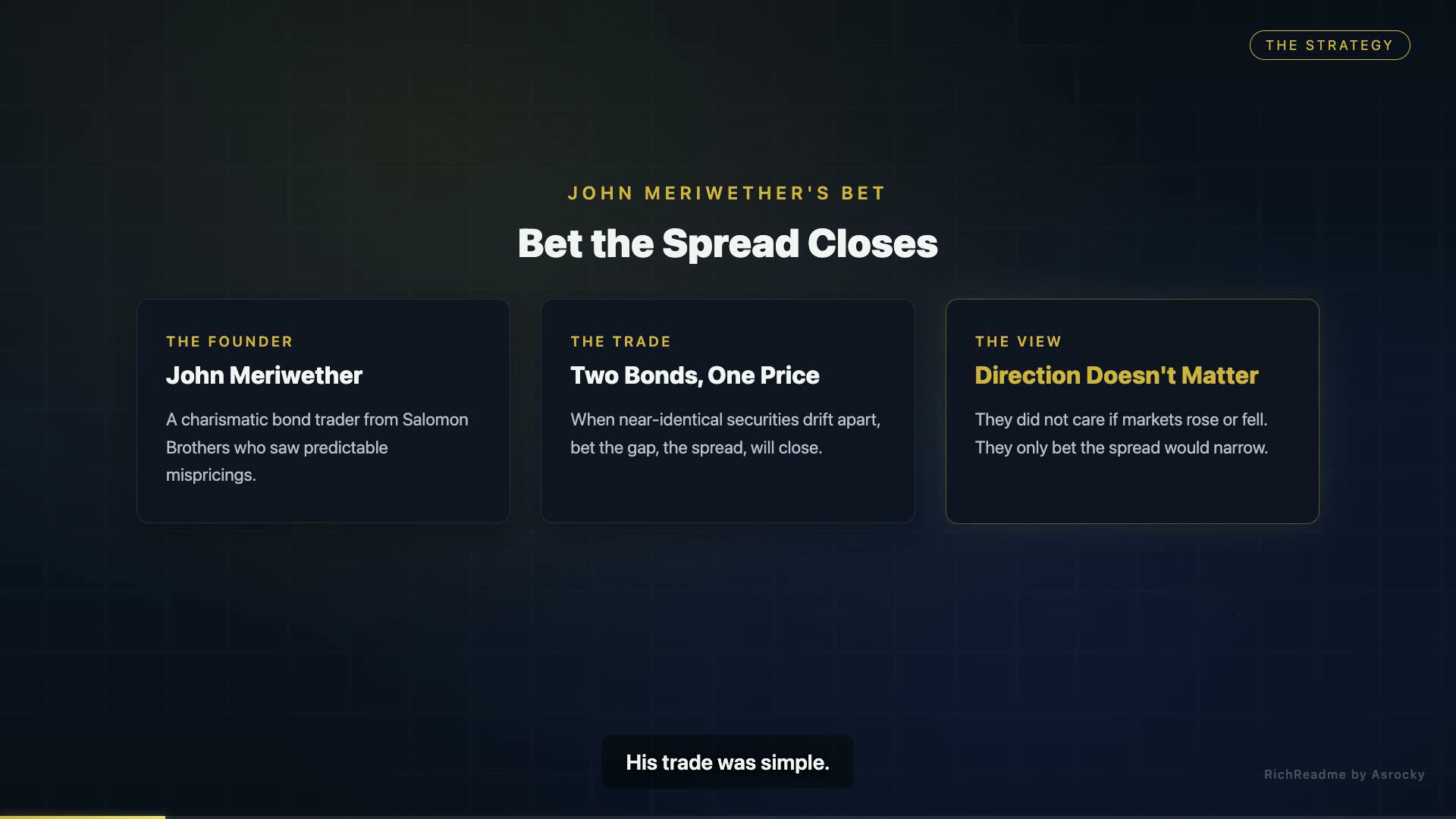
The fund was the brainchild of John Meriwether, a charismatic bond trader from Salomon Brothers. He believed markets misprice related bonds in predictable ways. His trade was simple.
When two nearly identical securities should trade at the same price, he bet the gap, called the spread, would close. He did not care if prices rose or fell. He only bet that the spread would narrow.
The Smartest Team on Earth
To run it, he recruited the sharpest minds in finance. He hired a team of PhDs and, most famously, two economists who had won a Nobel Prize, Myron Scholes and Robert Merton. These men had invented the math used to price options.
To Wall Street, this looked unstoppable. Never had this much brainpower been handed this much money.
40% a Year, Barely a Loss

For years, it worked like magic. Long-Term earned more than forty percent a year after fees, year after year, with barely a down month. It seemed to print money with no risk.
Investors begged to get in, and the banks threw billions at them on generous terms. The geniuses looked invincible.
$100B in Assets, $4B of Their Own
But there was a catch almost no one saw. The fund borrowed enormous sums. By 1996, it controlled over a hundred billion dollars in assets, but its own capital was only about four billion.
That is leverage of roughly thirty to one. On top of that, it held more than a trillion dollars of side bets, called derivatives, tied to every big bank on Wall Street.
The Fatal Flaw
Their model assumed markets behaved like dice. It treated past price swings as a reliable map of future risk, the way an actuary calculates life insurance. It assumed prices moved in calm, normal patterns.
The fatal flaw was that it almost entirely ignored the rare, catastrophic events that the math said could almost never happen. They were so confident in the model that they kept borrowing more to size up the bets.
The Model Bet on the Wrong Tail
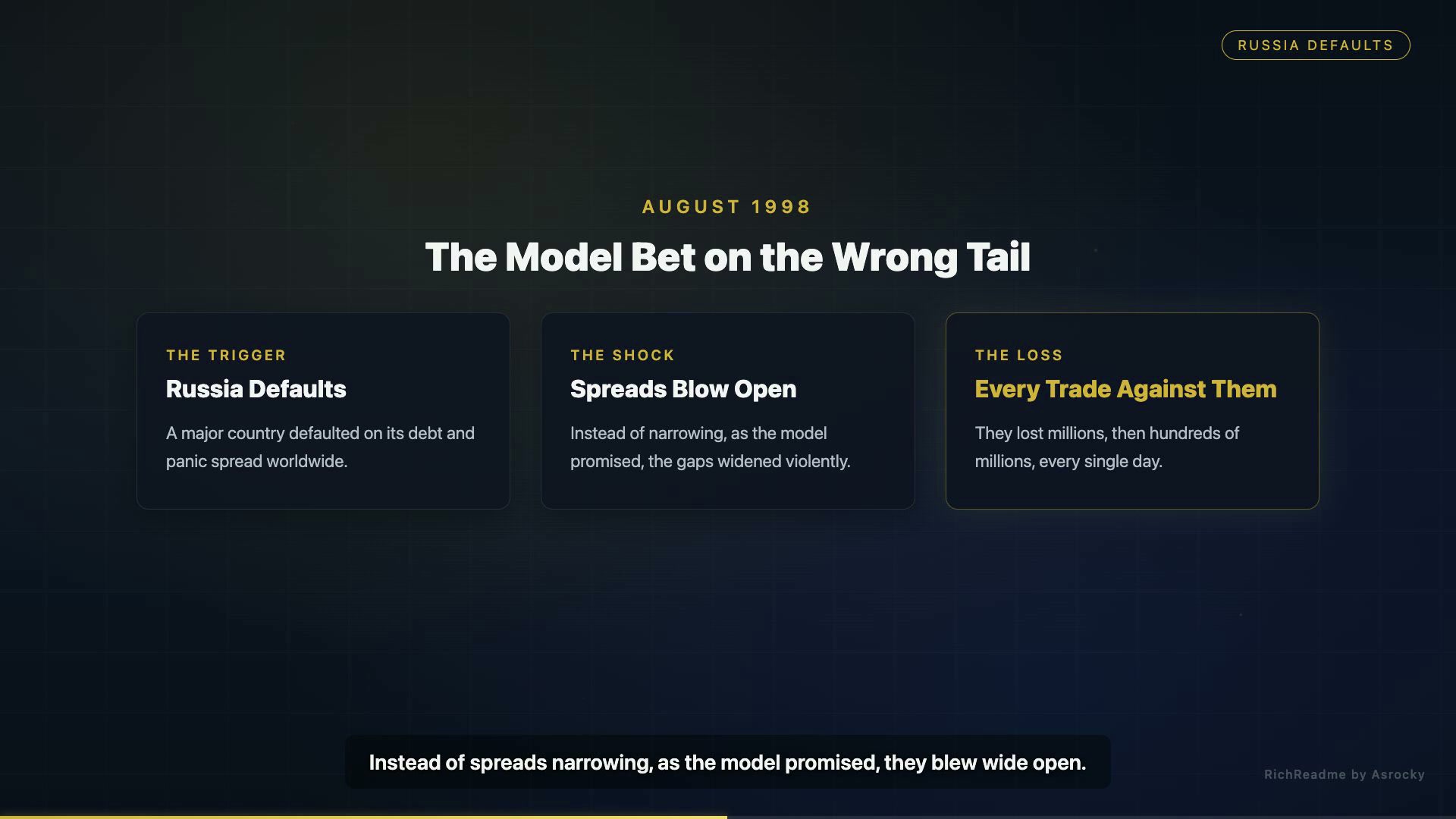
The breaking point came in August 1998. Russia, a major country, defaulted on its debt. Panic spread across global markets.
Instead of spreads narrowing, as the model promised, they blew wide open. Every trade Long-Term had on moved against it at once. The geniuses were losing millions, then hundreds of millions, every single day.
The Death Spiral

The worst part was the leverage. Small losses on a borrowed fortune are not small. As spreads widened, the fund's thin slice of its hundred-billion-dollar portfolio evaporated.
They had bet that normal would return. But in a crisis, normal can stay gone far longer than you can stay solvent. The market can remain irrational longer than you can remain solvent.
Buffett and Soros Walk Away

They begged for help everywhere. They called Warren Buffett. They called George Soros. They called every big bank they knew.
One by one, everyone turned them down. By September, the fund had days left. The Federal Reserve stepped in, not to spend taxpayer money, but to summon the heads of every major Wall Street bank into a room and order them to rescue Long-Term together.
Why the Fed Cared
The reason was frightening. Long-Term owed the banks so much, and was tangled in so many derivative contracts, that if it failed, every bank would suddenly hold one side of trades with no one on the other side. A chaotic fire sale could have crashed the whole financial system. That is why the Fed cared about one obscure fund no one had heard of.
The Banks Paid $4 Billion
The rescue happened at the eleventh hour. The banks put up about four billion dollars to buy the fund and unwind its positions in an orderly way. Long-Term's investors lost nearly everything. The geniuses who had seemed untouchable had blown up one of the most admired funds in history.
Even Geniuses Can't Model the Tail
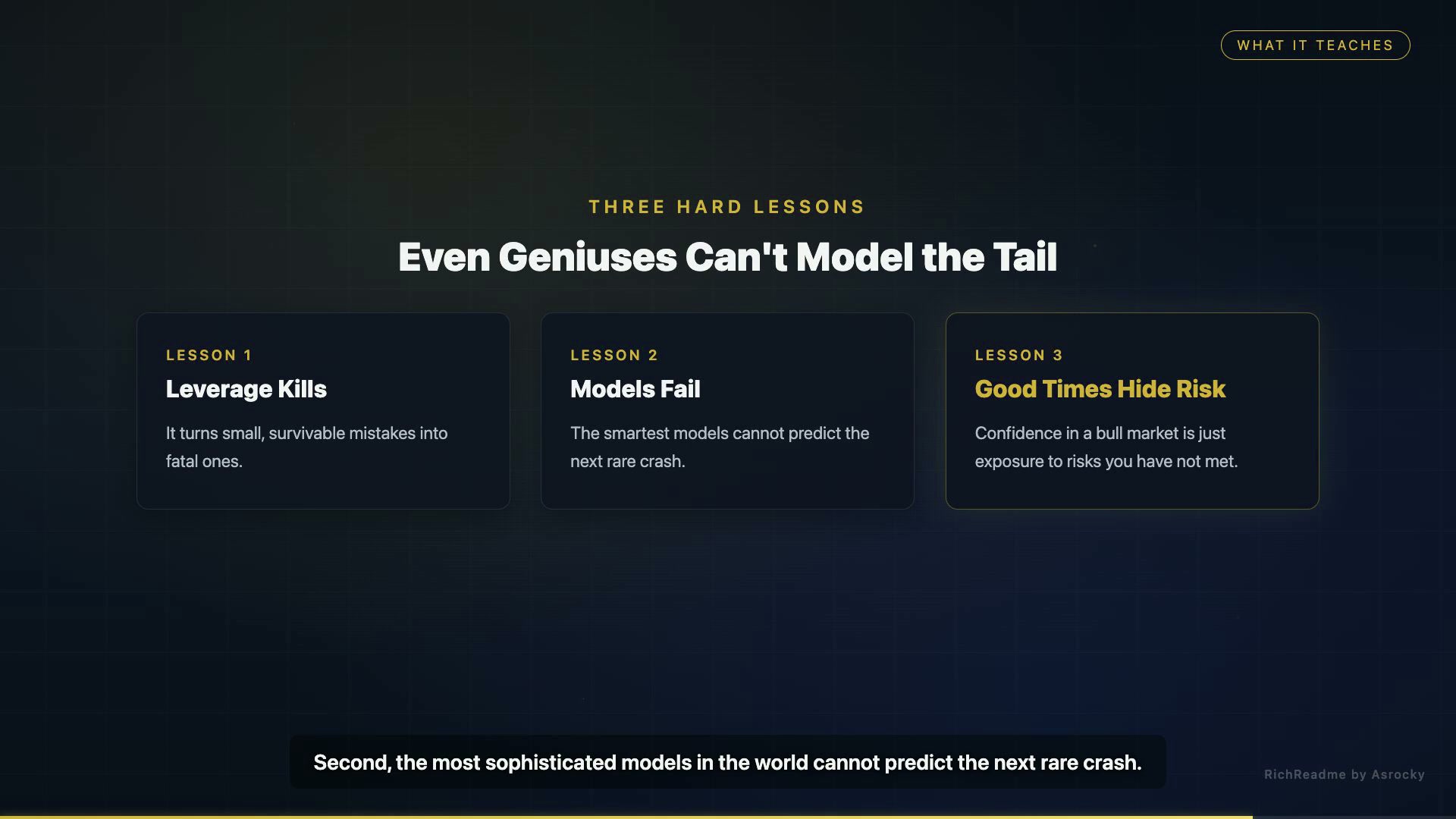
The lessons are the point of the book. First, leverage turns small mistakes into fatal ones. Second, the most sophisticated models in the world cannot predict the next rare crash.
And third, confidence earned in good times is often just exposure to risks you have not met yet. Smarter people can be wrong in far more expensive ways.
Don't Outsmart Yourself Into Ruin

You can apply this to your own money. Never borrow so much that a normal downturn wipes you out. Diversify so one shock does not hit all your bets at once.
And be deeply suspicious of anyone, however credentialed, who claims to have risk figured out. The tail risk that has not happened yet can still ruin you.