More money should make you work better, right? Wrong. Big bonuses can wreck your performance. Here's the proof.
This is The Upside of Irrationality by Dan Ariely, the behavioral economist who runs bizarre experiments to reveal how we really make choices. The surprise is that our irrational tendencies often work in our favor, once we understand them.
Huge Bonuses Backfire on Thinking

Start with the thing every company gets wrong, incentives. The standard idea is simple. Pay people more, they work harder and better. Ariely tested this with careful experiments. On simple mechanical tasks, the bonus did help.
But on anything requiring focus, creativity, or clear thinking, a very large bonus made people choke and perform worse. The tests were run in India, where the top prize equaled months of a person's household income. The higher the stakes, the steeper the drop on the thinking tasks. Think about that.
Choking Under Pressure

The bigger the prize, the more the pressure, and the worse the thinking. Psychologists call it the inverted U. A little motivation lifts you up, but too much reward tightens you, and your brain clamps down. This is why huge executive bonuses may be quietly destroying the very judgment they are meant to buy.
Two Rooms, Same Job, Different Fate
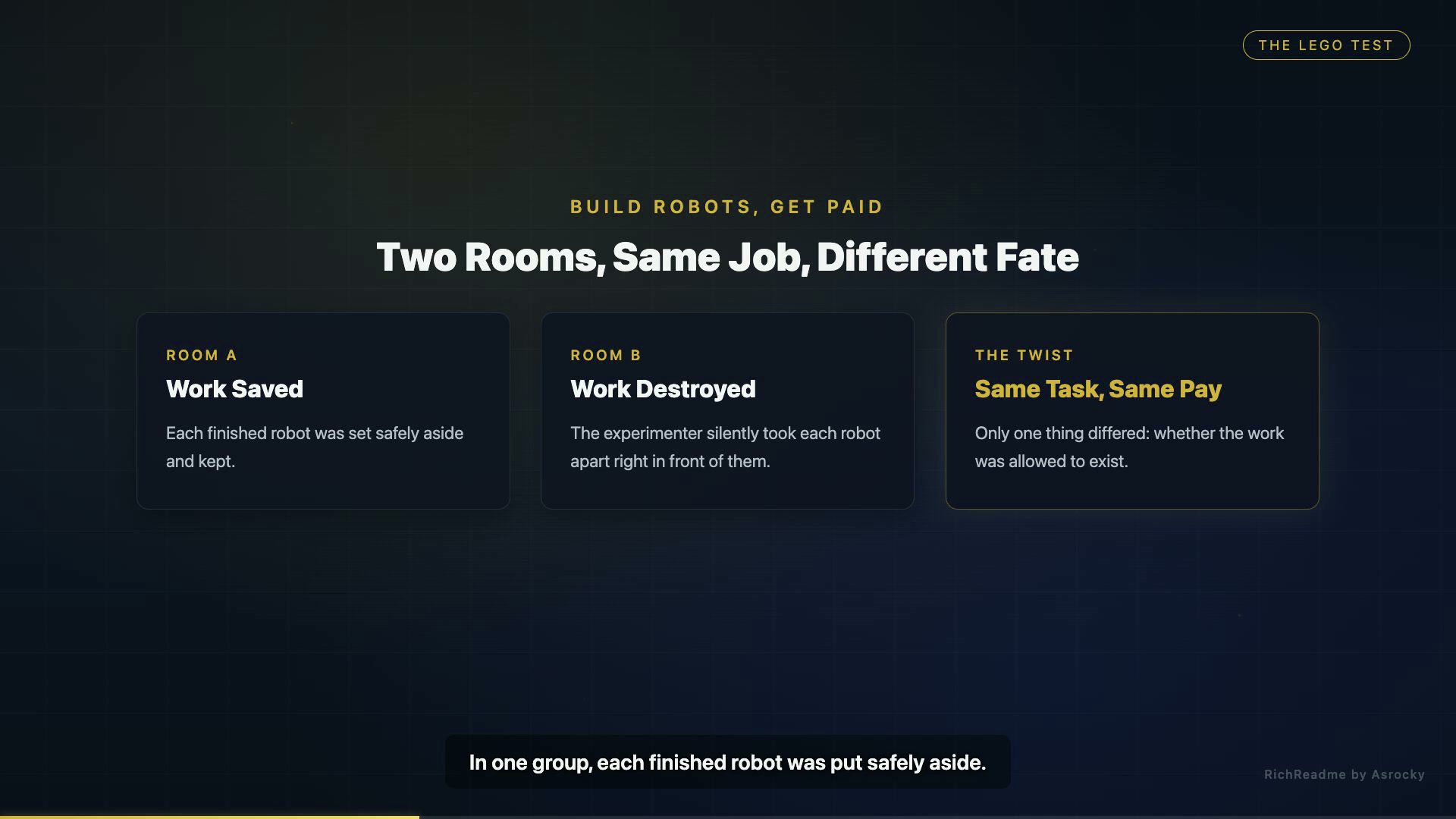
Then there is the meaning of work. Ariely had students build Lego robots for money. In one group, each finished robot was put safely aside.
In the other, the experimenter silently took it apart in front of them as soon as they finished. Same task, same pay, a totally different feeling.
Purpose Turns Passion Into Paycheck
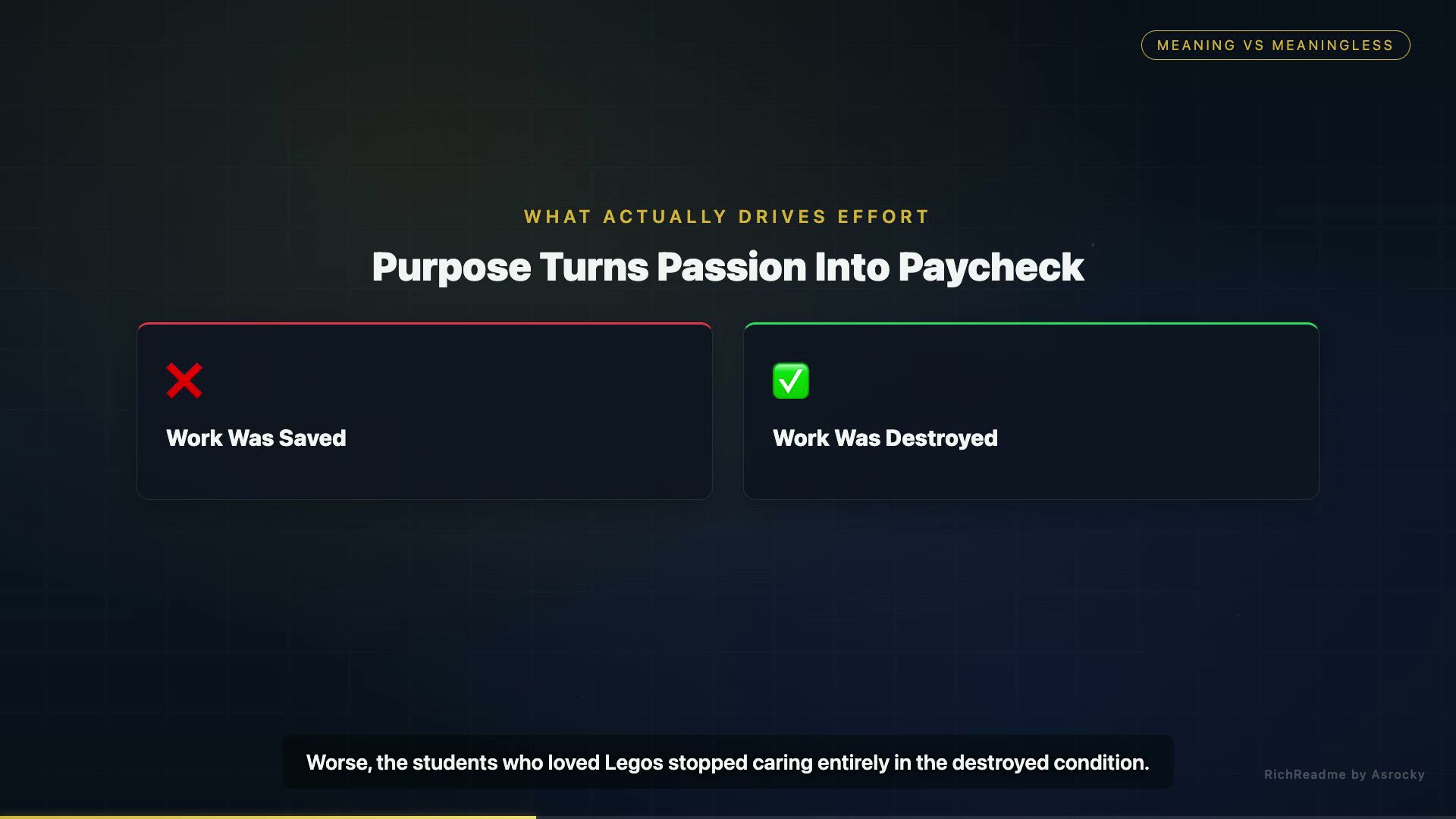
The results were striking. The people whose work was saved kept building, finishing over ten robots each. The people whose work was destroyed in front of them gave up early, building only about seven. Worse, the students who loved Legos stopped caring entirely in the destroyed condition.
When a job felt pointless, the joy drained out fast, and they only kept going for the money. Meaningless work does not just lower morale. It turns passionate people into mercenaries.
Bad Jobs

This explains a lot of bad jobs. When bosses treat work as disposable, when they delete your slides the moment you make them, they should not be shocked when you only care about the paycheck. The fix is not a bigger bonus. It is showing people that their work matters, that it is seen, used, and allowed to exist.
You Value What You Build Yourself

We also overvalue almost anything we had a hand in making. Ariely calls it the IKEA effect. Put people in a room to fold a simple origami crane, then ask them what it is worth.
They price their own creation nearly as high as a master's. The same chair you built yourself feels worth more, even if it is crooked and wobbly. Labor, it turns out, creates love.
You Overvalue What You Own

The flip side is the endowment effect. The moment something is yours, you suddenly value it more. Ariely, who lost the use of his arm in a terrible accident, describes clinging to that damaged arm far longer than doctors advised.
We overvalue what we own, just because it is ours, and giving it up feels like a painful loss. Here is the upside.
Purpose Is a Reward Itself

We are not purely greedy machines. People, and even animals, will often work for free when the task feels meaningful, just for the satisfaction of it. In one early experiment, rats preferred pressing a lever to earn food instead of taking it for nothing.
Economists call it contrafreeloading, and it drives a stake through the old idea that pay is the only reason anyone shows up. Purpose is a reward all on its own.
Pride Beats Fat Bonuses

This changes how you should lead. If you manage people, stop throwing money at problems first. Make their work visible, let them finish things, and give them ownership of the result. A little pride and recognition often beats a fat bonus, especially for work that requires thinking and creativity.
Invest Effort, Gain Care

It also changes how you should design your own life. If you want to care about something, invest effort in building it yourself. The wobbly bookshelf you assemble will mean more than the perfect one delivered to your door. The start-up you launch, the meal you cook, the garden you plant, you will value them because you made them.
Watch the Traps
And be careful with the traps. Huge stakes can freeze your best thinking, so do not make your most important choices under massive pressure or desperation. Notice when you overvalue something just because it is yours, and ask whether you would pick it again if you were starting from scratch.
The Bottom Line

The big lesson is that we are predictably irrational, and that is not a flaw to fix. It is a map. Once you see how people actually behave, you can design better work, better products, and better choices for yourself.