Your brain is not a calculator. It is a storyteller guessing. Two friends proved it, and upended economics.
This is The Undoing Project by Michael Lewis, the story of a friendship that rewired how we understand the human mind. Lewis tells the tale of Daniel Kahneman and Amos Tversky, two Israeli psychologists whose unlikely collaboration overturned a century of economic theory. Their idea was simple, and it changed everything.
We Are Not Rational Calculators
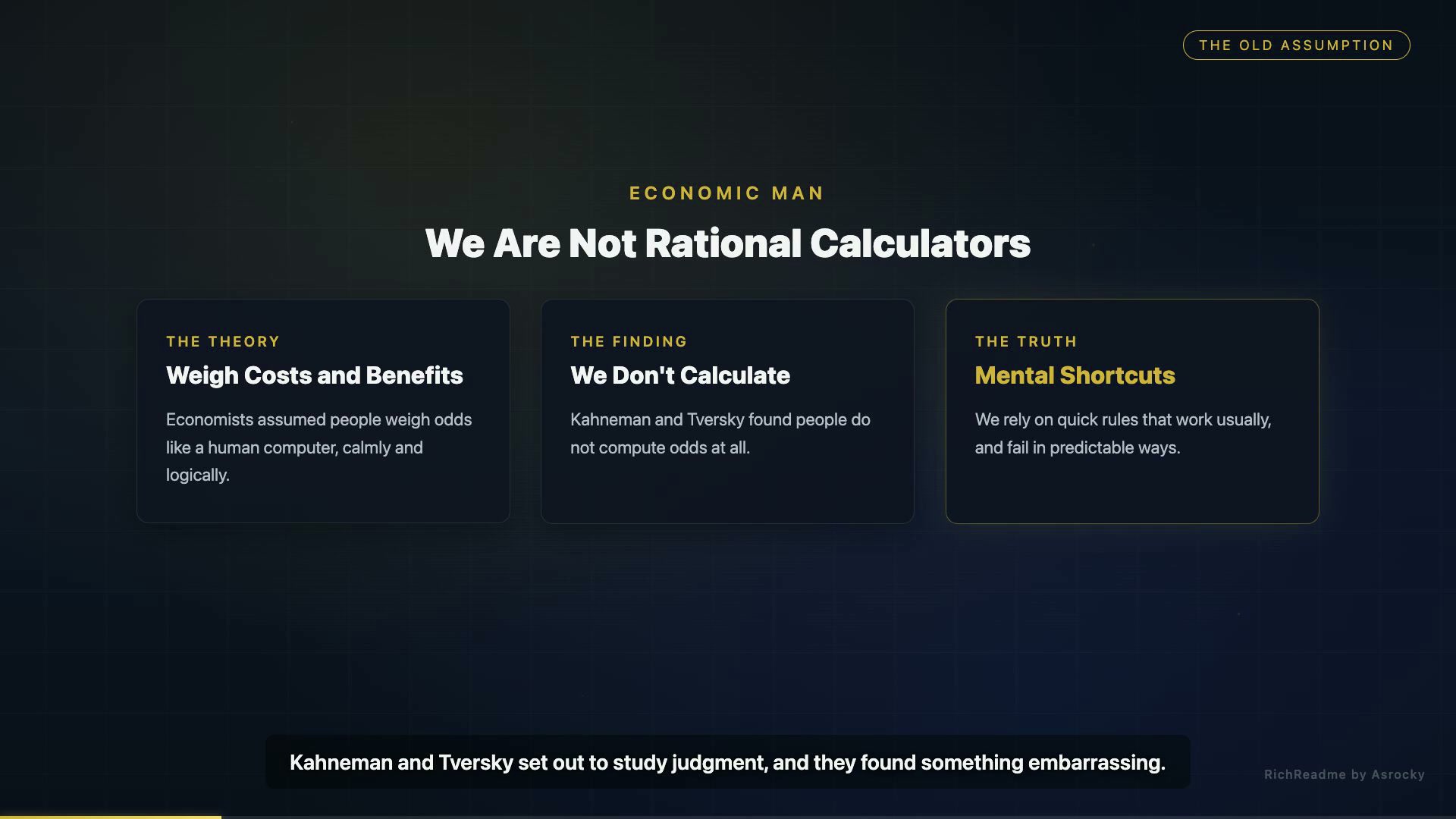
For decades, economists assumed we were rational calculators. Given money and odds, the theory went, people weigh costs and benefits like a human computer. Kahneman and Tversky set out to study judgment, and they found something embarrassing.
People do not calculate odds at all. They lean on mental shortcuts that work well most of the time, and fail in predictable ways the rest. The catch is that we have no idea when we are doing it.
We Judge by Similarity
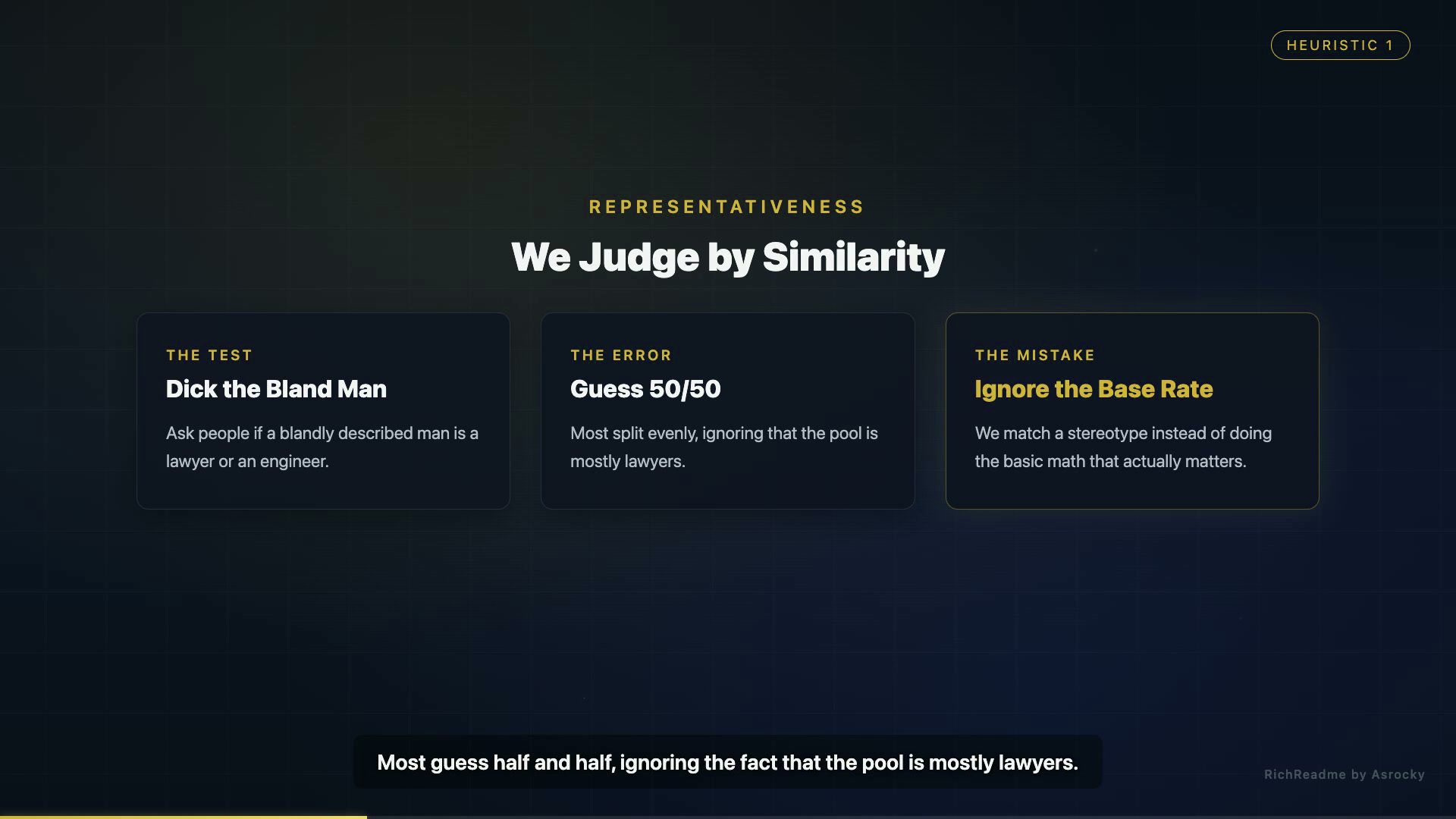
The first shortcut they named representativeness. We judge odds by similarity. Show people a blandly described man named Dick, and ask whether he is a lawyer or an engineer.
Most guess half and half, ignoring the fact that the pool is mostly lawyers. We match the story to a stereotype instead of doing the basic math. The shortcut is useful, but it quietly ignores the base rates that actually matter.
We Judge by What Comes to Mind
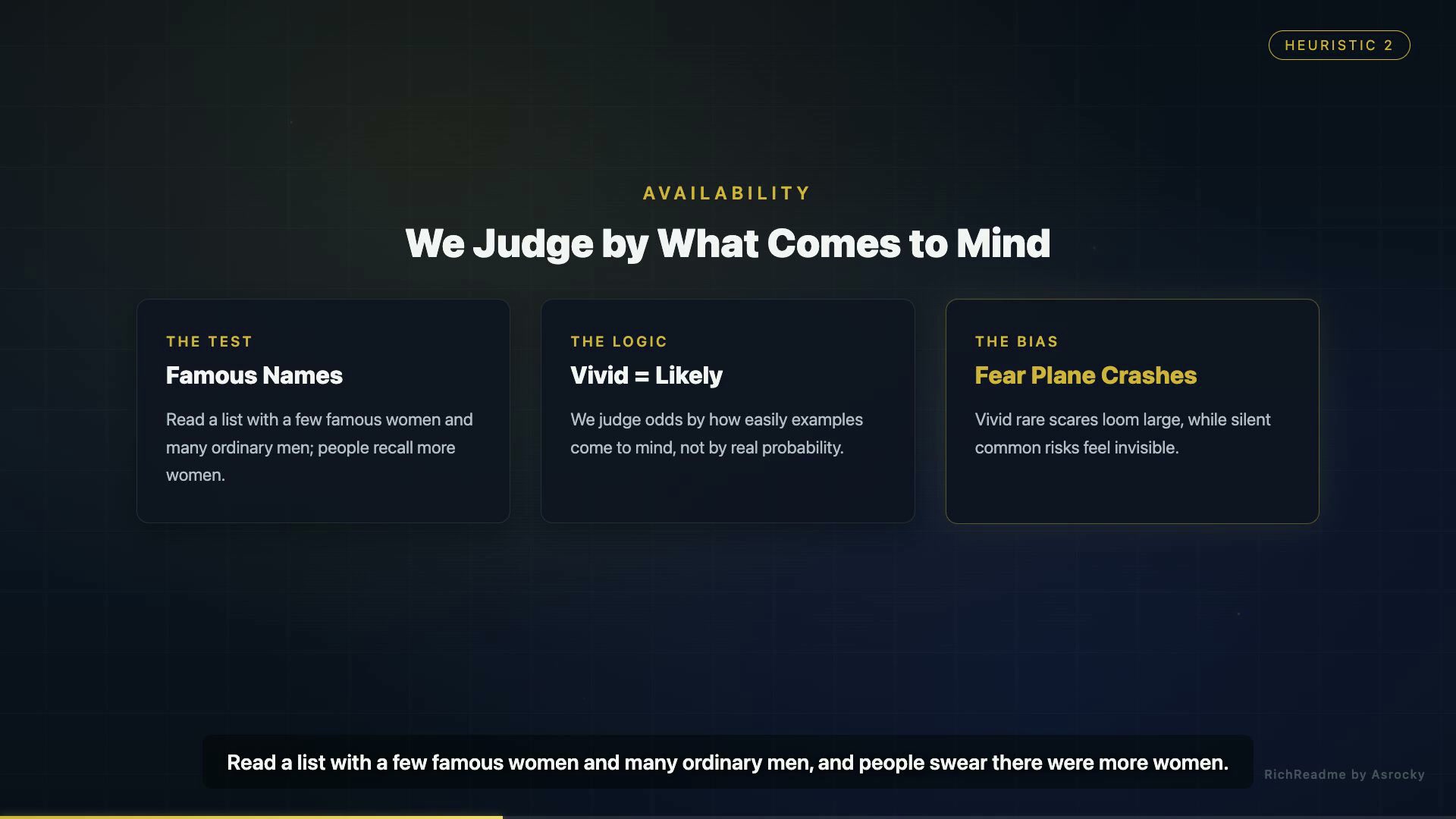
The second shortcut is availability. We judge how likely something is by how easily examples come to mind. Read a list with a few famous women and many ordinary men, and people swear there were more women.
We measure risk by what we can picture, not by what is actually probable. Plane crashes are vivid, so we fear them, while silent, common risks feel almost invisible.
Heuristic 3
The third is anchoring. Spin a rigged wheel that stops on a random number, then ask what share of the United Nations is African. People exposed to the high number guess far higher, even though the number came straight from a wheel.
Irrelevant figures planted in our heads drag our estimates toward them. We do not start from zero and reason up. We anchor to whatever number is nearest.
Prospect Theory
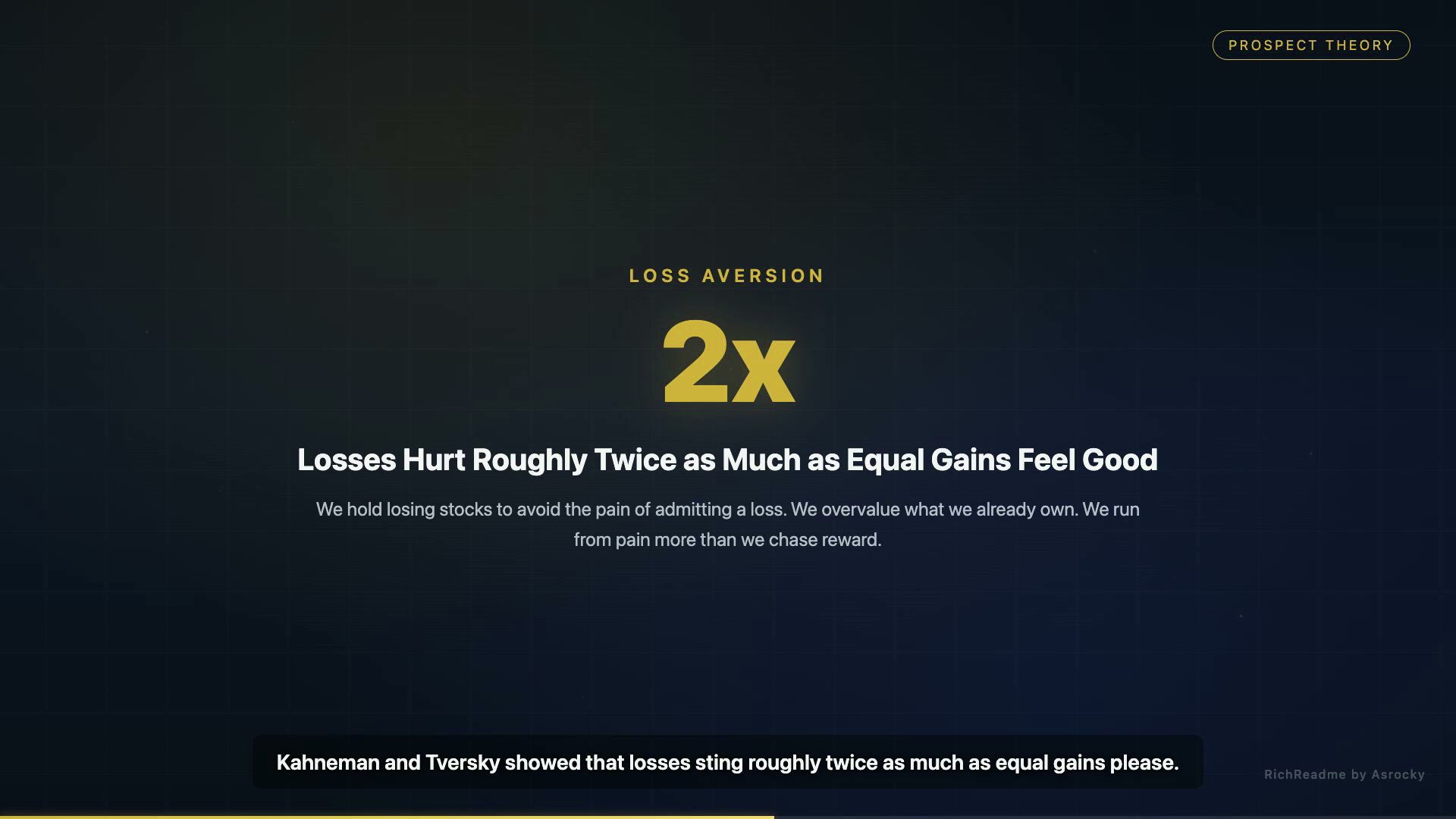
Their biggest discovery was how we feel about losses. Standard economics said a dollar lost hurts about as much as a dollar gained feels good. Kahneman and Tversky showed that losses sting roughly twice as much as equal gains please. That single fact explains so much.
People hold losing stocks too long to avoid the pain of admitting a loss. People overvalue whatever they already own. We are not balancing rewards. We are running from pain.
Framing
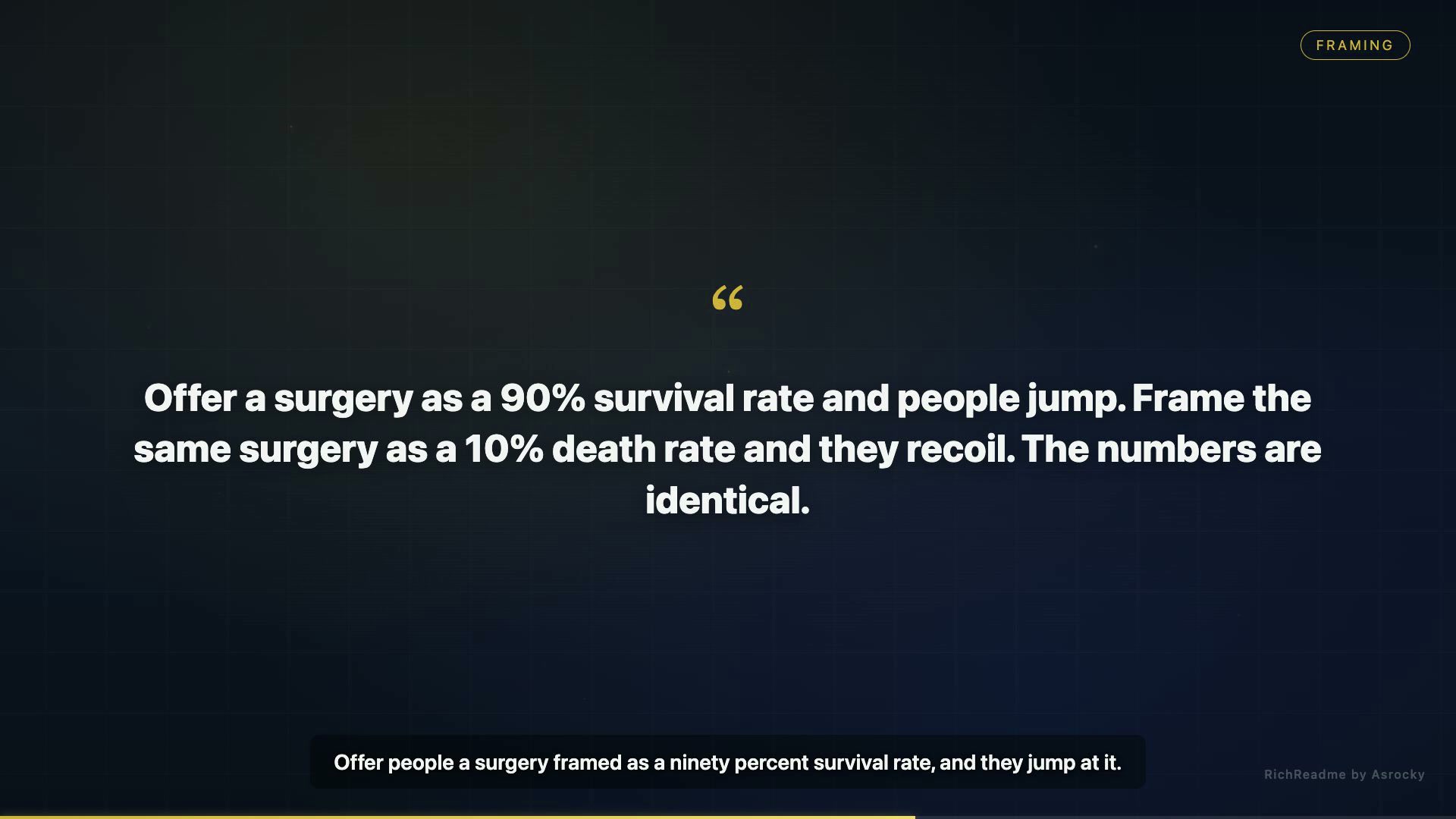
Even stranger, we do not choose between things. We choose between descriptions of things. Offer people a surgery framed as a ninety percent survival rate, and they jump at it.
Frame the exact same surgery as a ten percent death rate, and they recoil. The numbers are identical. The story wrapped around them is not, and we react to the story, not the math.
They Shared One Mind
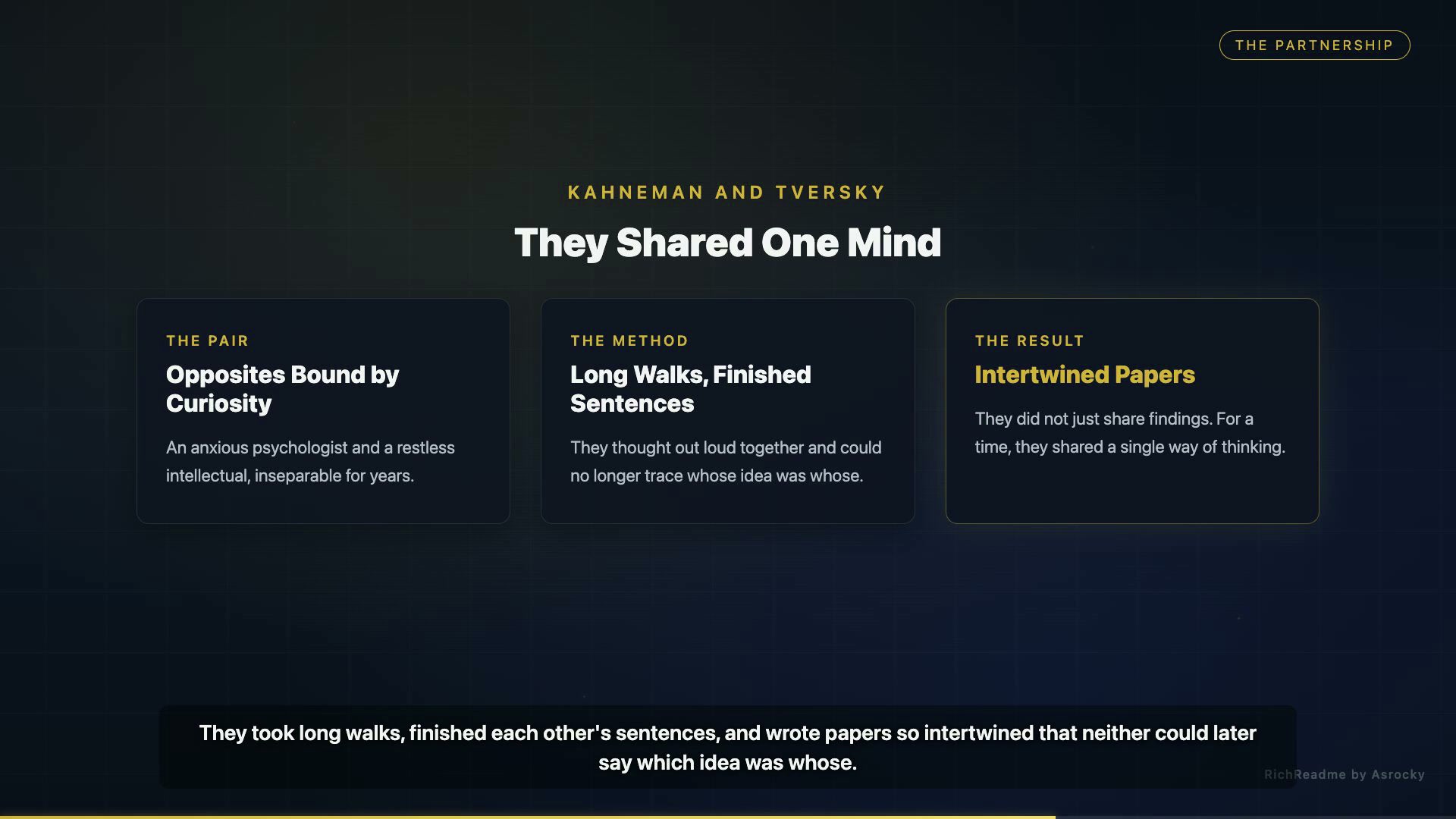
All of this came out of one extraordinary friendship. Kahneman and Tversky were opposites, anxious and restless, bound together by sheer curiosity. They took long walks, finished each other's sentences, and wrote papers so intertwined that neither could later say which idea was whose.
They argued constantly, in the middle of courtyards and cafeterias, oblivious to anyone watching. They did not just share findings. For years, they shared a mind.
The Legacy
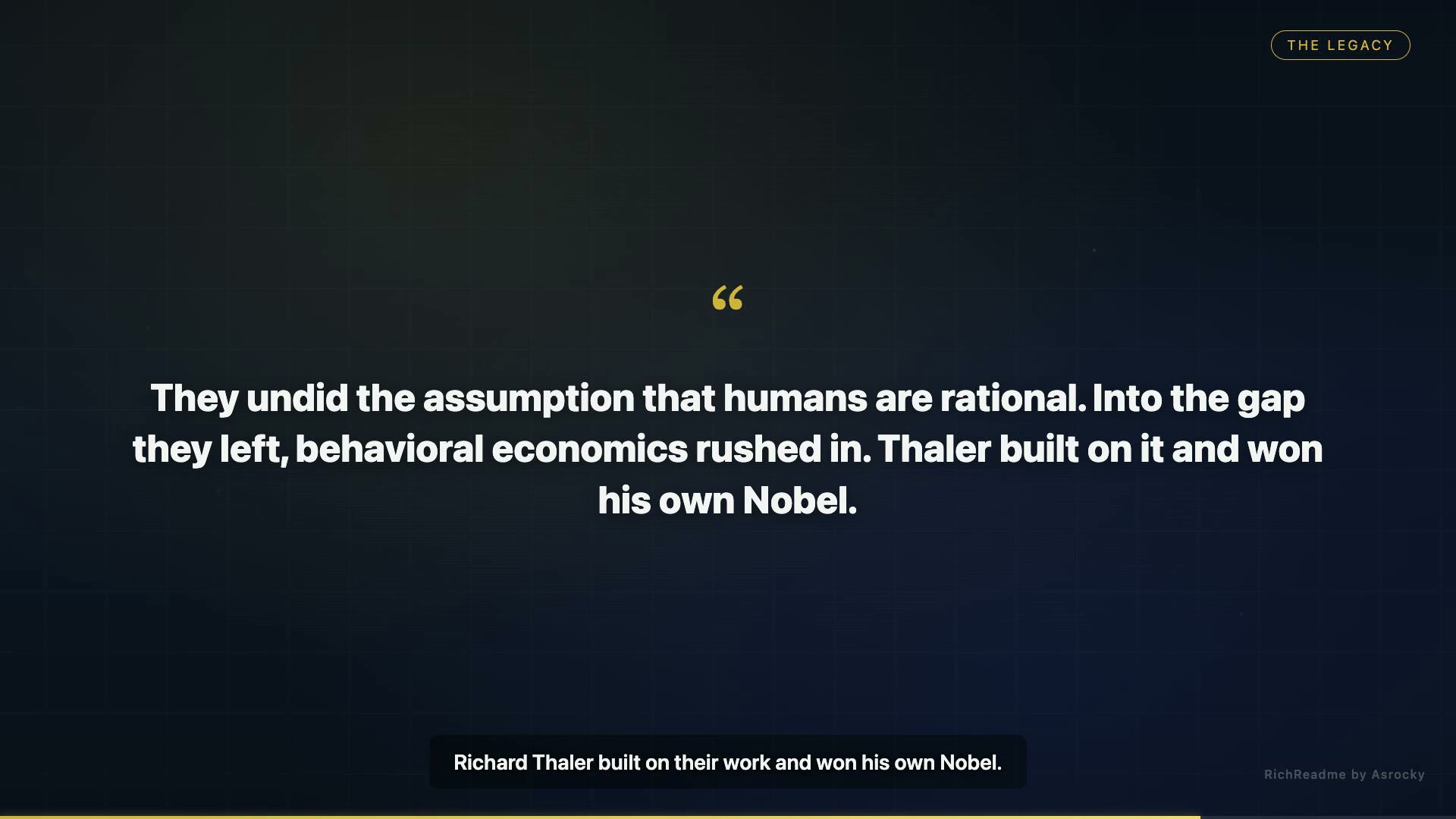
They undid a founding assumption of economics, that humans are rational. Into the hole they left, a whole field called behavioral economics rushed in. Richard Thaler built on their work and won his own Nobel.
Tversky died of cancer in nineteen ninety six. The Nobel prize went to Kahneman in two thousand and two, and he accepted it as a prize for both of them.
Slow the Gut Down
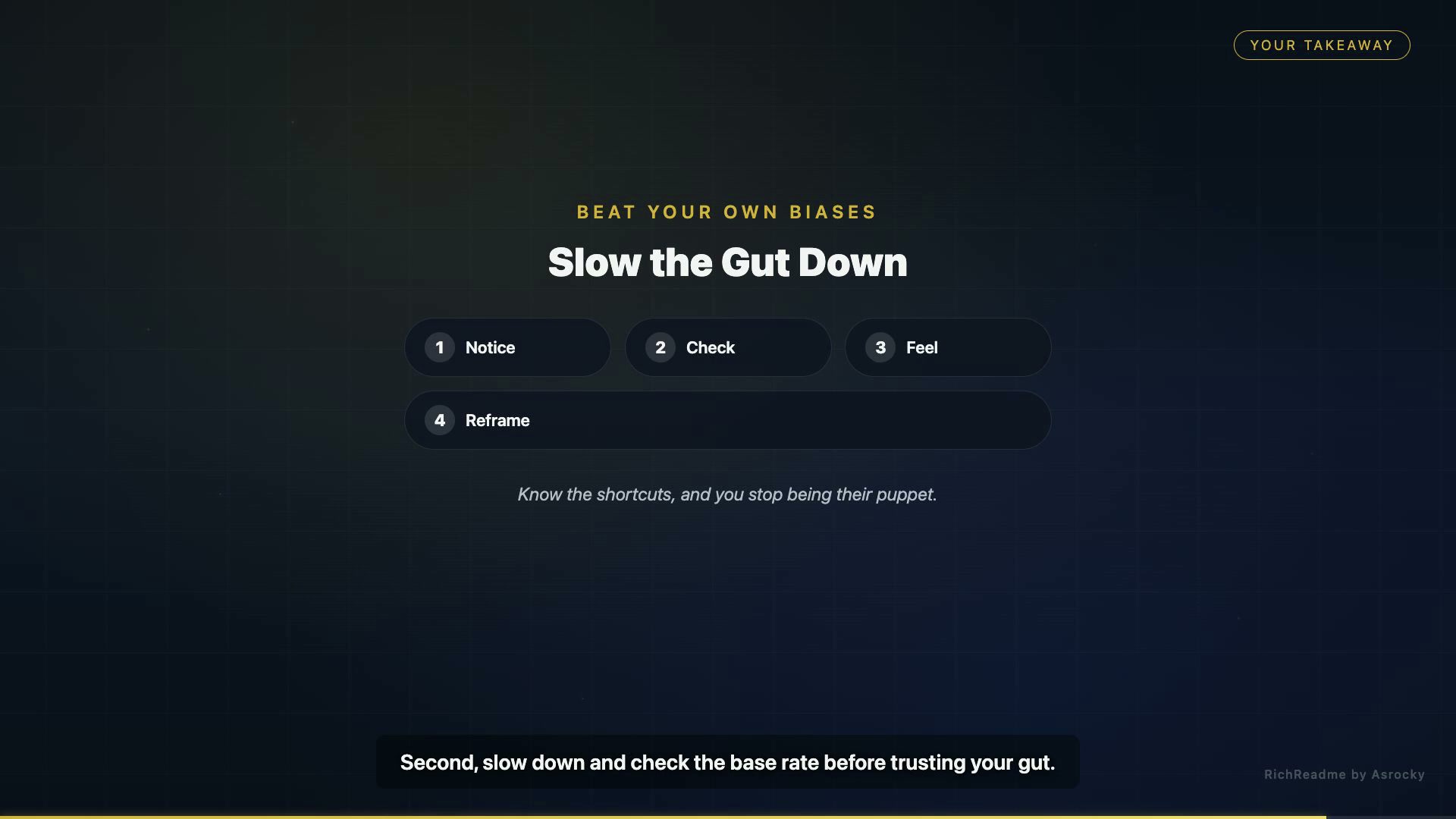
So what should you actually do with this? First, notice when a judgment feels obvious. That feeling is a shortcut, not proof.
Second, slow down and check the base rate before trusting your gut. Third, ask whether you are avoiding a loss more than chasing a gain. And fourth, reframe big decisions, because the description you pick will quietly steer your choice.