Great real estate investors are not lucky guessers. They took luck out of the game, by following proven models.
This is The Millionaire Real Estate Investor, by Gary Keller, Dave Jenks, and Jay Papasan. The authors interviewed more than a hundred investors who had built a million or more, and looked for what they shared. The answer was not secret deals or special timing. It was a particular way of thinking, and a handful of models that ordinary people can copy.
Champions Remove the Luck

The opening idea is that champions take the luck out of the game. Most people imagine that successful investors simply guess well and happen to be in the right place. The investors in this book see it differently.
They believe that consistent results come from preparation and proven models, not from hoping fortune smiles on them. When you rely on luck, every deal is a gamble. When you rely on a model that has worked repeatedly, the same deal becomes a repeatable process, and that shift in belief is where everything begins.
Learn to Think a Million

Before any of the tactics, the book insists that you learn to think a million. Most people are held back not by a lack of money, but by a set of beliefs that quietly cap what they attempt. They assume investing is only for the wealthy, that big results require big risk, or that their job will simply take care of them later.
The millionaire investors rejected those beliefs early. They decided that financial wealth was possible, took responsibility for it, and then let their actions follow the belief. The thinking has to change before the bank balance can.
Dismantling the Myths

The authors give these limiting beliefs a playful name, mythunderstandings, and they dismantle them one by one. Some people believe they do not need to invest because a salary will protect them, which leaves them fragile the moment that job changes. Others believe all investing is reckless, confusing calculated risk with blind gambling.
Still others think you need perfect timing or a fortune to begin. Each myth, once examined, turns out to be an excuse dressed as wisdom, and letting go of them is what frees a beginner to start.
Criteria, Know It in Advance

Once the mindset is clear, the book narrows the work to three areas of focus, and the first is criteria. Criteria means knowing exactly what you are looking for before you ever look, the type of property, the location, the condition, the minimum return you require. Most amateurs fall in love with whatever looks nice and then try to justify it. Investors with clear criteria can sort through hundreds of properties quickly and unemotionally, saying no to almost everything and yes only to the rare deal that fits their model.
Terms Make the Deal

The second area is terms, how you actually buy it. A property that looks mediocre at one price and one financing structure can become excellent under better terms. Terms include the purchase price, the down payment, the interest rate, the repayment schedule, and who carries what risk.
Two investors can buy the very same house and end with wildly different results, purely because one negotiated terms that worked while the other accepted whatever was offered. The deal is often in the structure, not just the building.
Network, the Hidden Force

The third area is network, who helps you. Even a solo investor is surrounded by a team, agents, lenders, contractors, property managers, accountants, lawyers, and other investors further down the path. The authors found that millionaire investors did not try to know everything themselves.
They deliberately built relationships with people who had already solved the problems they were facing. A strong network does not just make the work easier. It brings the deals, the advice, and the honest warnings that no amount of solo studying can replace.
The Four Stages of Growth

The journey itself moves through four stages of growth. It begins with thinking a million, changing the beliefs and building the knowledge. Next comes buying a million, acquiring the assets that meet your criteria. Then owning a million, as the equity and the net worth quietly build over time.
The final stage is receiving a million, when the holdings throw off enough passive income to fund your life. Notice the order. Cash flow and freedom come last, as the reward for patiently working through the earlier stages rather than skipping them.
Wait for the Fat Pitch

A recurring discipline is waiting for the fat pitch. In baseball, a disciplined hitter does not swing at every ball. They wait for the one pitch that lands perfectly in their zone. Real estate works the same way.
Many beginners feel pressure to buy something, anything, and end up swinging at weak deals out of impatience. The experienced investor is comfortable saying no dozens of times, holding their cash, and acting decisively only when a property matches their criteria and terms. Discipline in waiting is itself a competitive edge.
Trust the Fundamentals
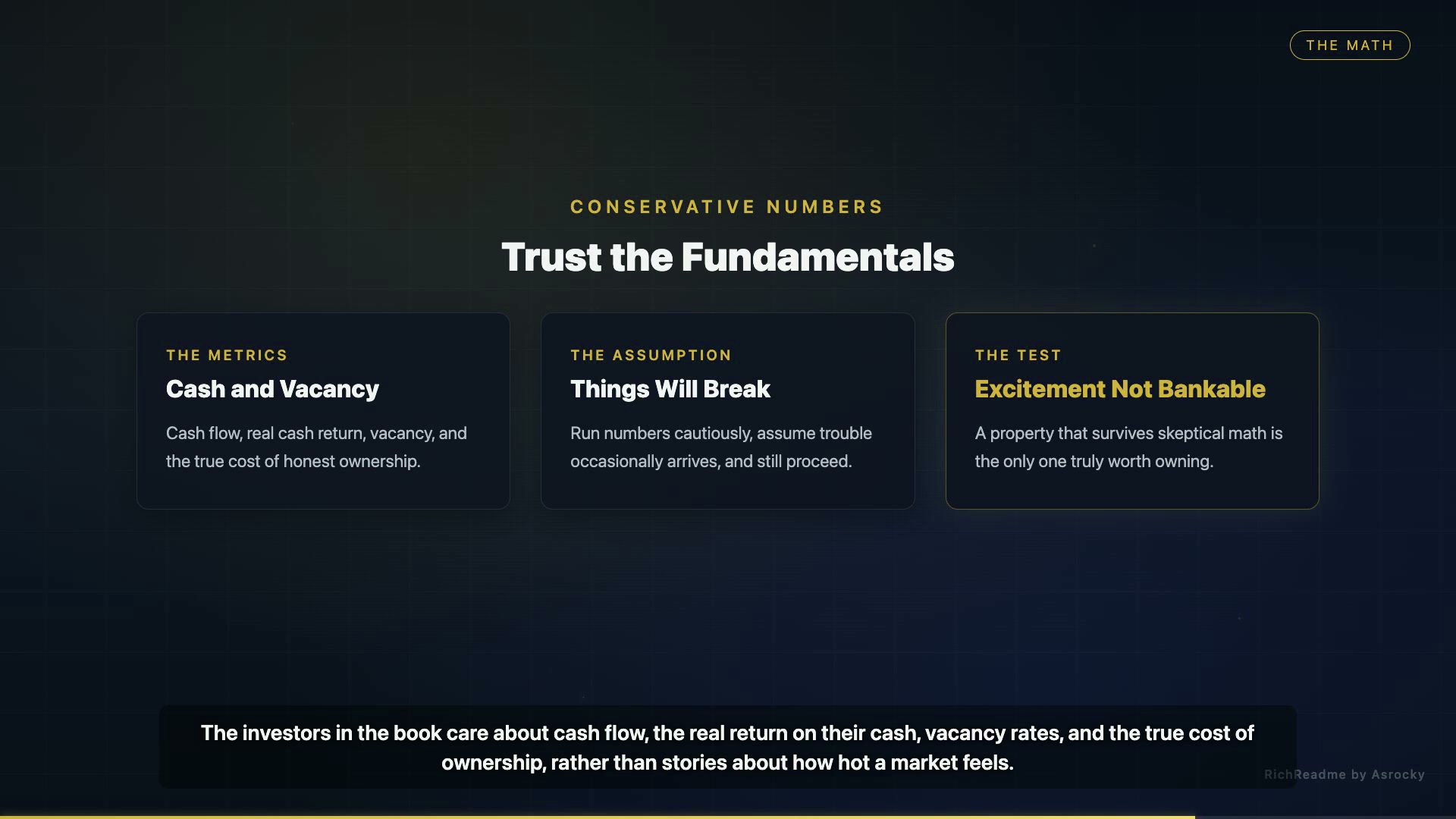
That patience is backed by a focus on fundamentals and honest numbers. The investors in the book care about cash flow, the real return on their cash, vacancy rates, and the true cost of ownership, rather than stories about how hot a market feels. They run the numbers conservatively, assume things will occasionally go wrong, and only proceed when the deal still works under those cautious assumptions.
Excitement cannot be deposited in a bank account. A property that survives skeptical math is the one worth owning.
Receive, Then You Are Free

The end goal is worth keeping in view, because the final stage, receiving a million, is really about freedom. Financial independence is not a magical number of properties. It is the point where your passive income quietly exceeds your living costs, and the choice to work becomes genuinely yours.
Everything before that, the beliefs, the criteria, the team, the patient waiting, is built to reach that single condition. The millionaire investors were not chasing houses. They were chasing the freedom that a portfolio of well chosen houses eventually delivers.