Who's the greatest investor of all time? It's not Buffett or Soros. It's a math professor who made a hundred billion.
This is The Man Who Solved the Market by Gregory Zuckerman, the untold story of Jim Simons and his ultra-secret hedge fund, Renaissance Technologies. While the rest of Wall Street bet on gut feel and earnings calls, Simons used pure math to build the greatest money machine in history.
A Math Professor Who Coded for the Government

Simons was no finance guy. He earned his PhD at twenty-three, broke Soviet codes for the government, and ran the math department at Stony Brook. He only stumbled into trading in his forties after a friend showed him a cheap computer.
At first he traded on intuition like everyone else, and the ups and downs left him sick to his stomach. He once grew so stressed that people close to him feared for his health. It was the opposite of the calm, rational image people have of quants today.
The Humbling Years

His early years were a disaster. He lost money year after year, fought with his partners, and got so discouraged a colleague worried he might quit entirely. The lesson he finally accepted was brutal.
Human judgment was the problem. Markets were too noisy, too fast, and too full of tricks for any person to outguess by feeling.
He Hired Scientists, Not Bankers
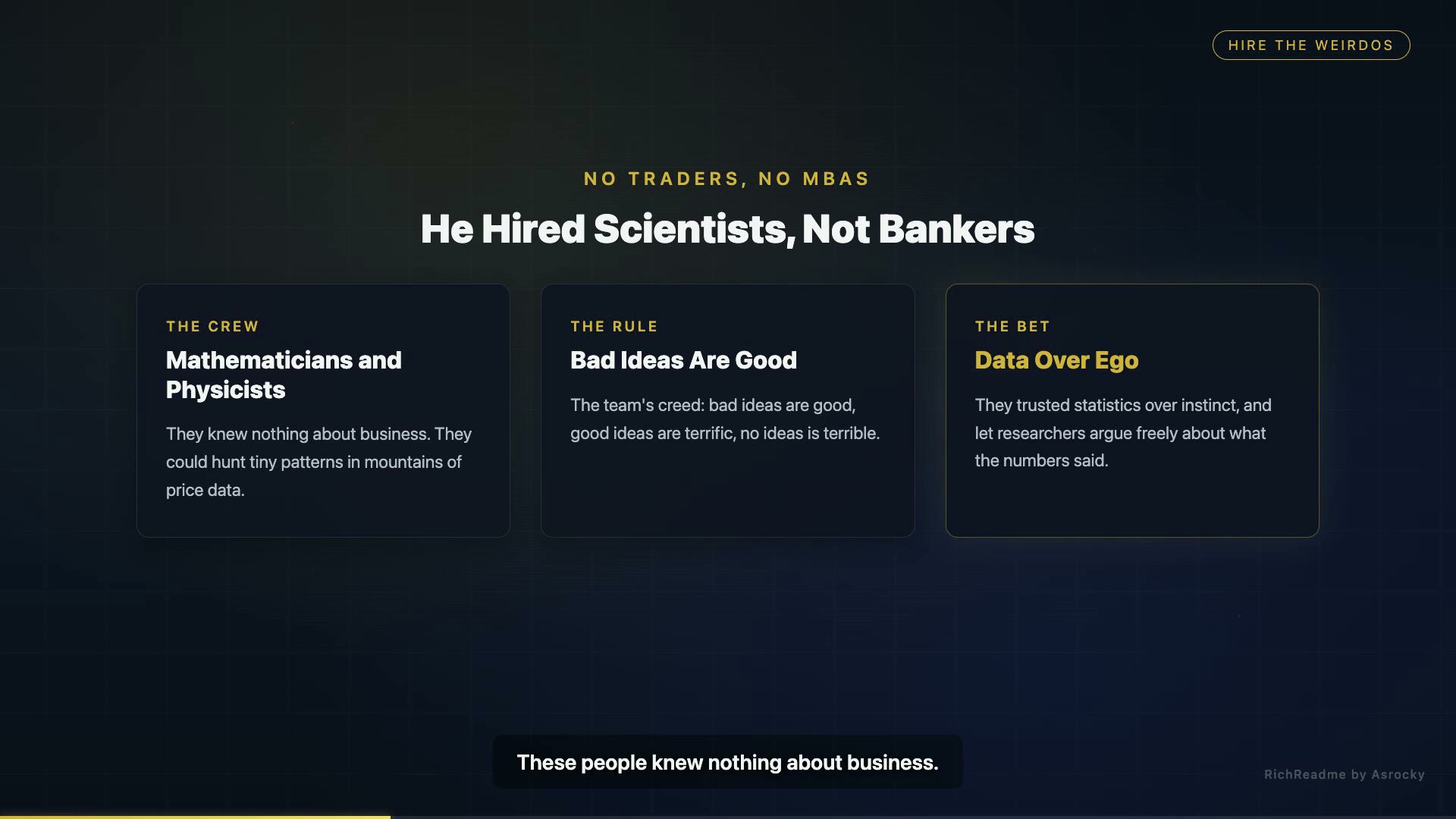
So he flipped the whole approach. He hired mathematicians, physicists, and computer scientists instead of traders or MBAs. These people knew nothing about business. What they could do was spot tiny statistical patterns in mountains of price data.
The creed of his team was simple. Bad ideas were good. No ideas was terrible.
You Don't Need to Win Every Bet

The breakthrough came from treating trading like a casino. A casino does not need to win every hand. It only needs a small edge on a huge number of bets, and the law of averages does the rest. Simons's team traded on signals that predicted the market by a hair, holding positions for about a day and a half.
Most of their bets were tiny edges, not grand insights. On a bare majority of trades, they made money almost every day. The magic came from doing that over and over, millions of times, until the small edges piled up into a fortune.
66% a Year, Before Fees

The numbers are almost unbelievable. Starting in 1988, his Medallion Fund racked up average annual returns of sixty-six percent before fees. Even after his famous cut, investors still earned around thirty-nine percent a year.
Over the decades, Medallion generated more than a hundred billion dollars in trading profits. No one on Wall Street comes close.
He Chose Performance Over Growth
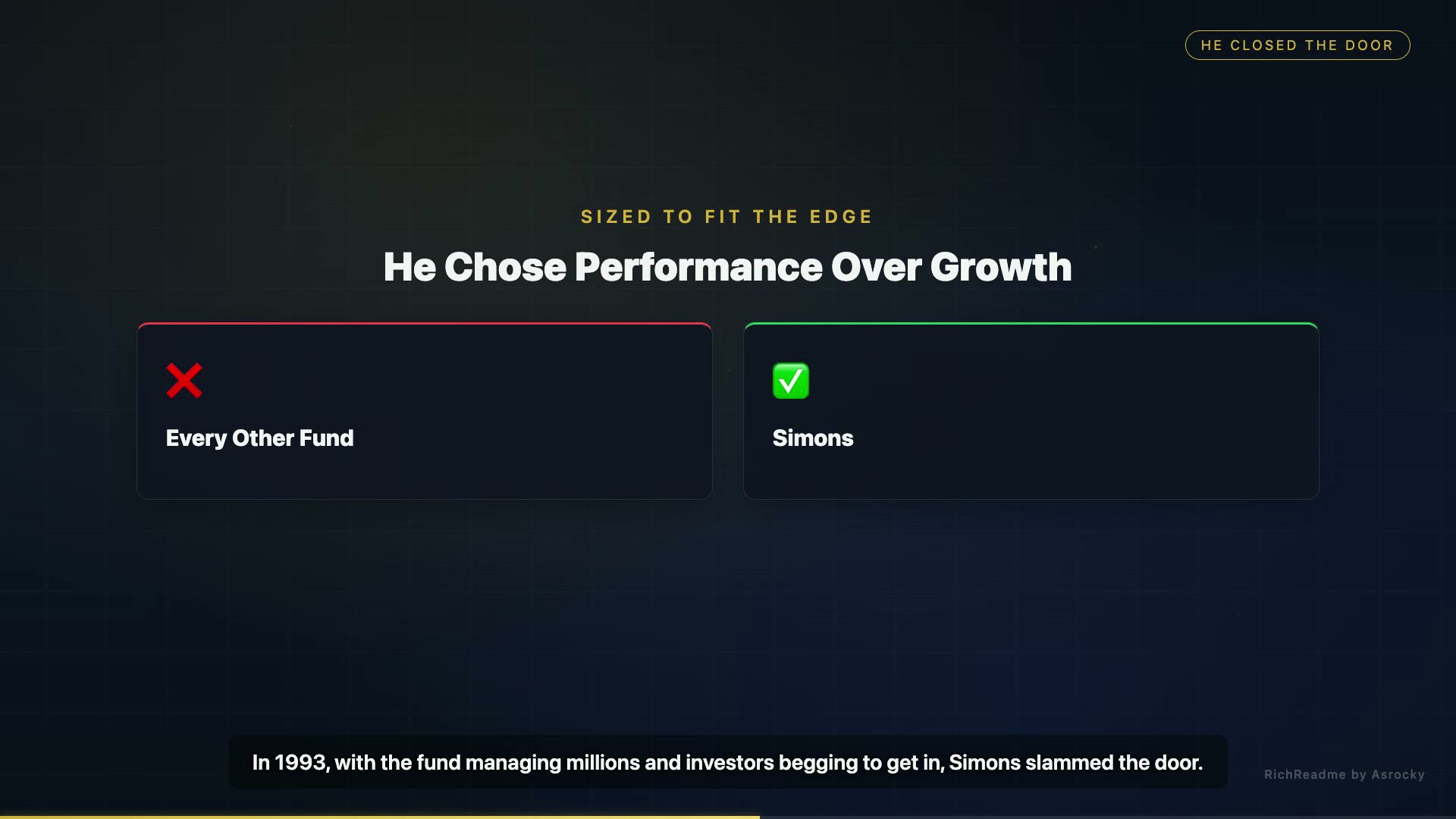
But the real magic is what he did next. In 1993, with the fund managing millions and investors begging to get in, Simons slammed the door. He refused new money, worried that getting too big would ruin the tiny signals he traded. While every other fund on earth chased growth, he chose performance over size.
Don't Ask Why

He also understood that no one really knows why the market moves. The model did not care about interest rates, recessions, or the news. It just hunted for repeatable patterns that worked in the past and bet on them before they vanished.
The team never asked why a signal worked. They only asked if it kept working.
IBM Scientists, Wall Street Beginners
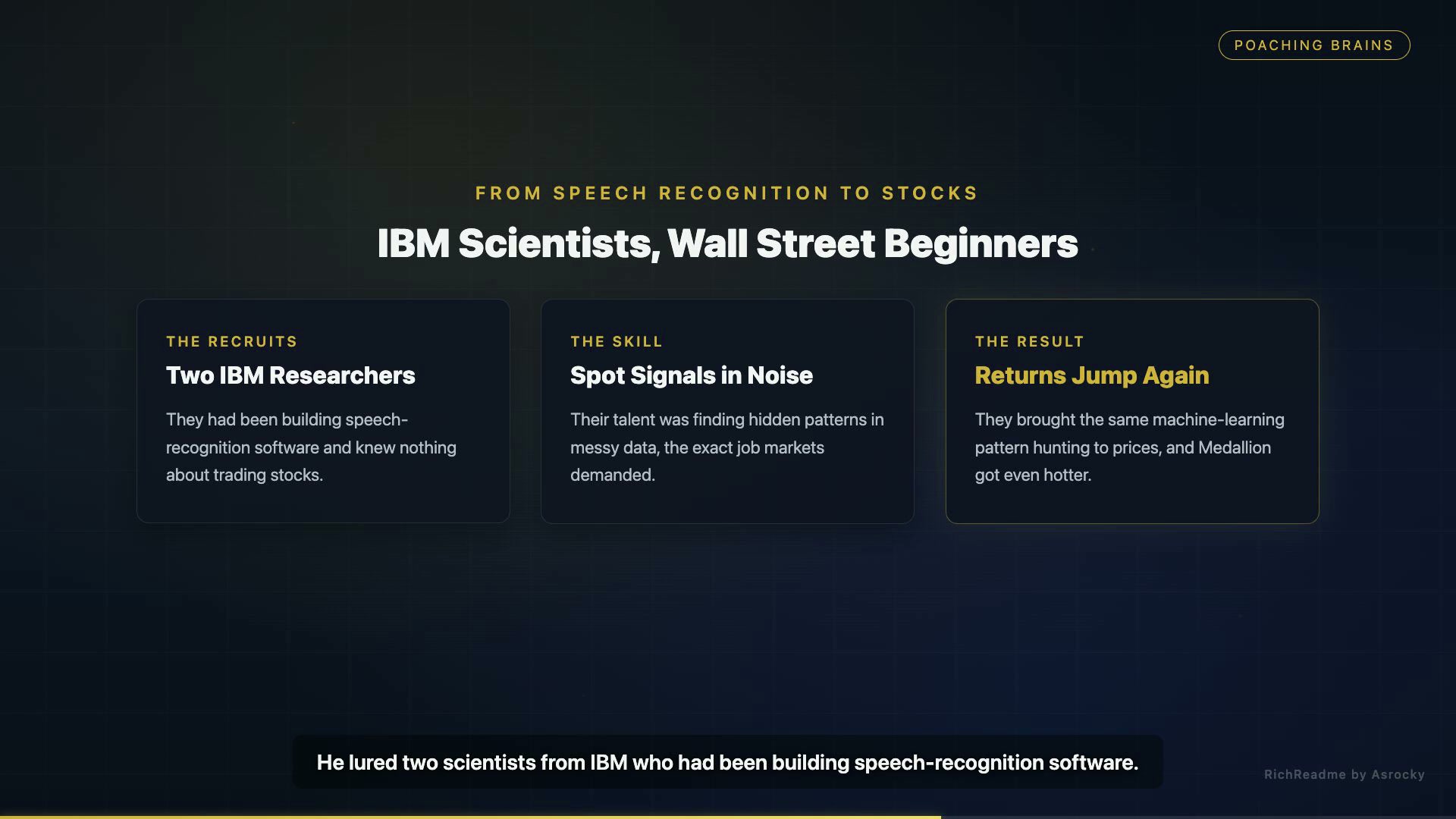
Some of his best hires came from outside finance entirely. He lured two scientists from IBM who had been building speech-recognition software. They knew nothing about stocks, but they were masters at finding hidden signals in messy data. They brought the same pattern-hunting machine learning to markets, and the returns jumped again.
A Lottery No One Else Knew Existed

The secrecy became legendary. Renaissance hid in a quiet town on Long Island, said almost nothing publicly, and shielded its models like state secrets. Rivals spent decades trying to copy them and failed.
The average employee ended up sitting on nearly fifty million dollars of the firm's own funds. It was like winning a lottery no one else knew existed.
The Uncomfortable Truth

The book's bigger question is unsettling. If mathematicians and machines beat Wall Street's brightest judgment year after year, what does that say about us? Maybe markets are not stories we understand.
They are random noise with faint patterns, and the winners are not the people who know the most about business. They are the ones who spot tiny edges and bet on them fast.
Twelve Years of Losing

Simons's real genius was never a single formula. It was culture. He built a place where math obsessives could argue freely, where bad ideas were welcomed and nothing was sacred.
He trusted data over ego, and he was willing to spend twelve long years losing before the edge finally showed up. He also let his researchers keep part of the upside, which is why so many of them became billionaires themselves.
Process Beats Prediction

You can borrow his lesson on a smaller scale. The point is not that you need a supercomputer. It is to stop trusting your gut on big bets, look for repeatable evidence instead of one-off stories, and bet small on many chances rather than everything on one call. In a noisy world, process beats prediction.