The best-run companies in the world did everything the textbooks recommend. They still lost their entire industry.
This is The Innovator's Dilemma, by Clayton Christensen. He studied the disk drive industry for decades and tracked every leading firm as it rose and fell. What he found was unsettling. The companies that failed were not stupid, lazy, or slow.
They were excellently managed. They listened to their customers, invested heavily in better products, and pursued the highest margins. And that is precisely why they died.
The Best-Managed Companies Failed
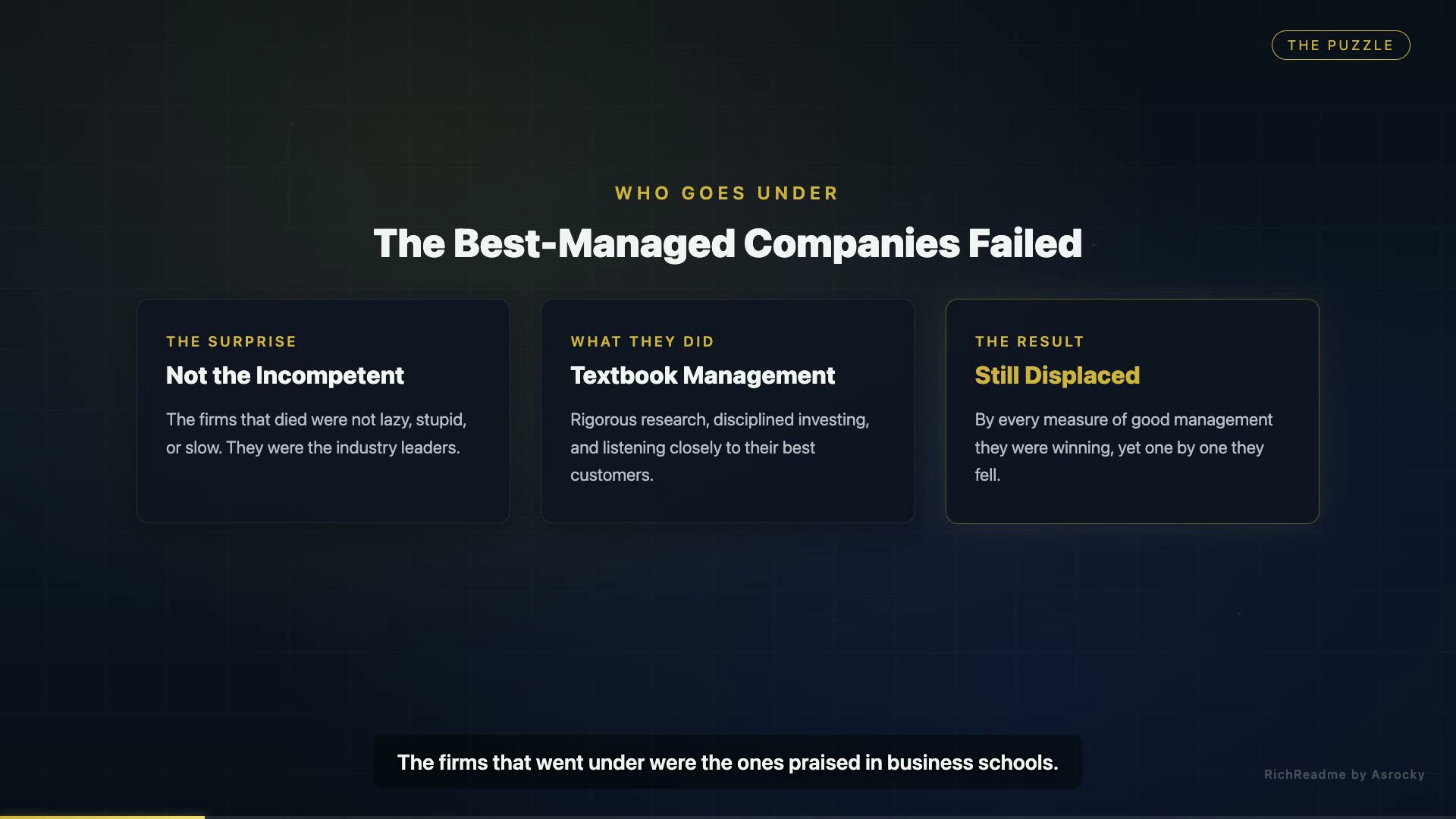
The puzzle is who actually failed. It was not the incompetent companies. Christensen looked at the leaders year after year and saw the same pattern. The firms that went under were the ones praised in business schools.
They did rigorous market research, made disciplined investment decisions, and stayed close to their best customers. By every measure of good management, they were winning. Yet one by one, they were displaced.
Sustaining vs Disruptive Tech
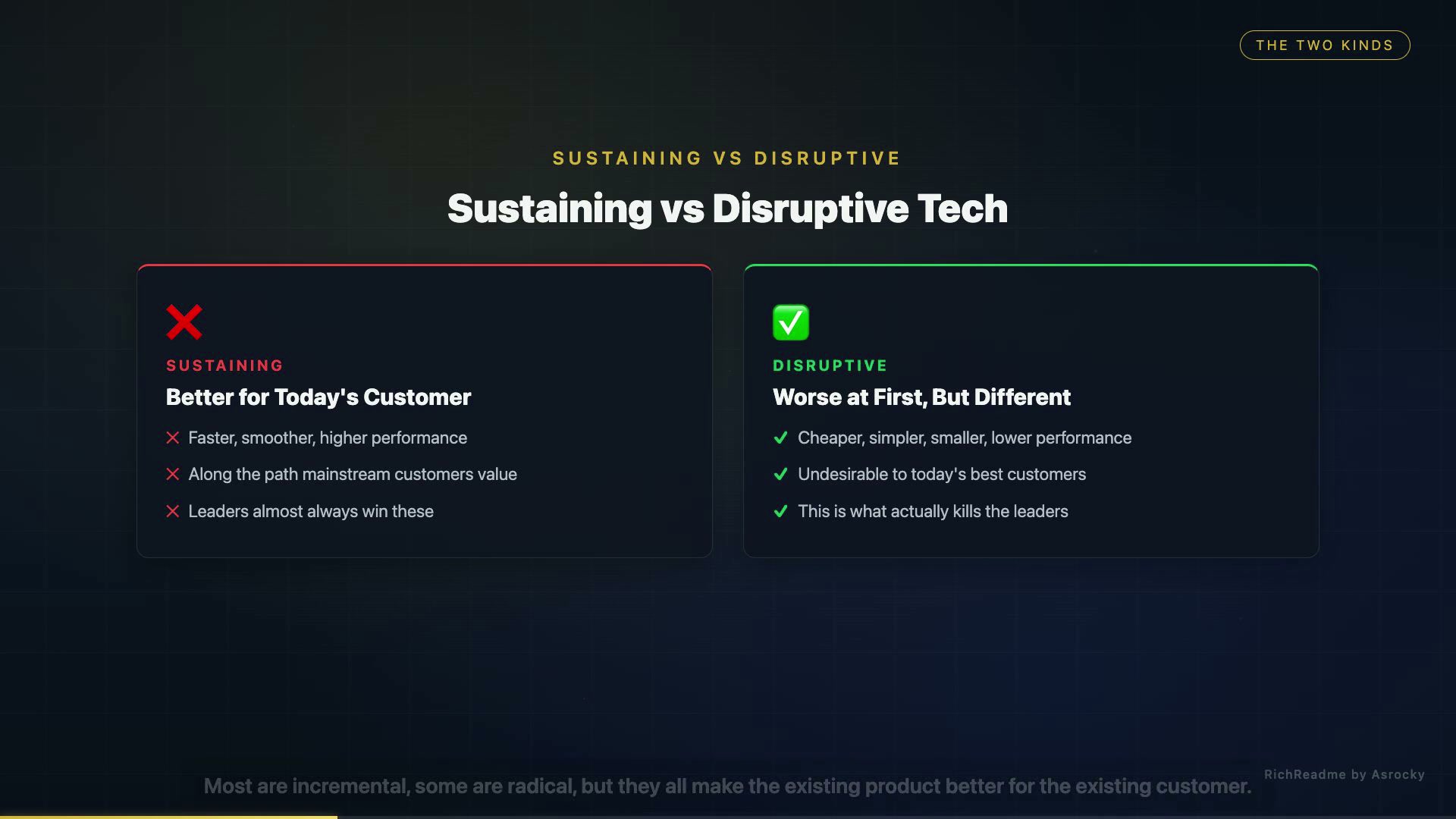
Christensen splits all new technology into two kinds. The first he calls sustaining technology. These are improvements along the path customers already value. A faster processor, a longer lasting battery, a smoother ride.
Most are incremental, some are radical, but they all make the existing product better for the existing customer. And here is the surprise. In his data, even the hardest, riskiest sustaining technologies almost never killed the industry leaders. The good companies handled them just fine.
Each Generation Ignores the Next
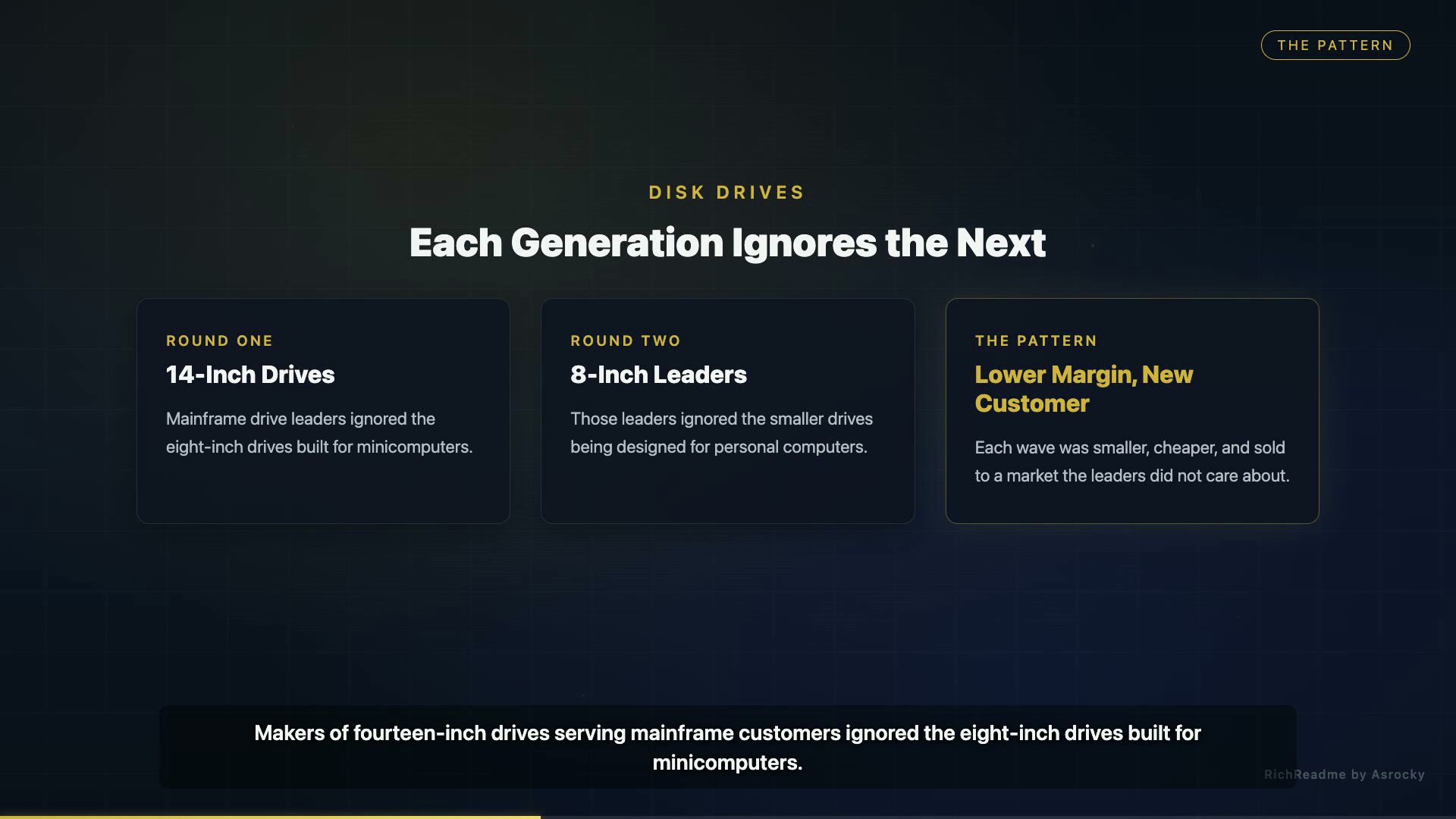
The second kind is disruptive technology. It is the opposite. In the near term, a disruptive technology performs worse than the established product. It is cheaper, simpler, smaller, and less impressive for the main customer. It does not look like a threat. The big customers of the leading firms do not want it at first. In disk drives, this happened over and over.
Makers of fourteen-inch drives serving mainframe customers ignored the eight-inch drives built for minicomputers. Then those eight-inch leaders ignored the smaller drives being designed for personal computers. Each new generation was lower capacity and lower margin, sold to a customer the leaders did not care about. Transistors were disruptive to vacuum tubes. Personal computers were disruptive to mainframes. Discount retail was disruptive to department stores. The leaders saw these things, and they correctly decided not to invest.
Good Enough Beats Better
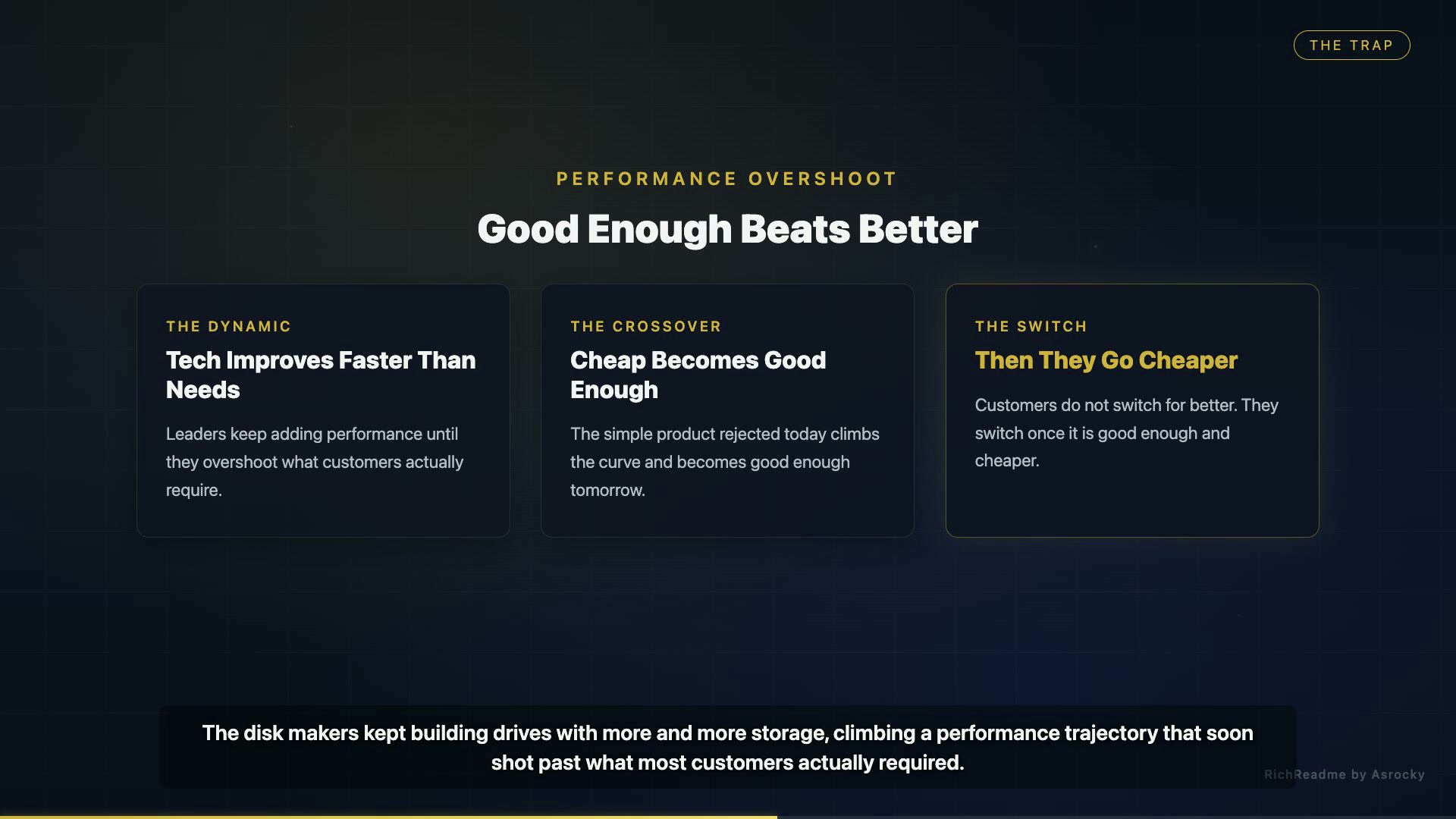
So why does that decision destroy them? Because technology keeps improving faster than customer needs do. Christensen calls this the overshooting of performance. The disk makers kept building drives with more and more storage, climbing a performance trajectory that soon shot past what most customers actually required.
The small, simple, cheaper drive that the main market rejected today climbs that same improvement curve and becomes good enough for that same market tomorrow. By then, the newcomer has a lean cost structure and a loyal foothold, and the leader cannot compete on price. The customer did not switch because the new product was better at first. They switched once it was good enough, and cheaper.
The Rational No
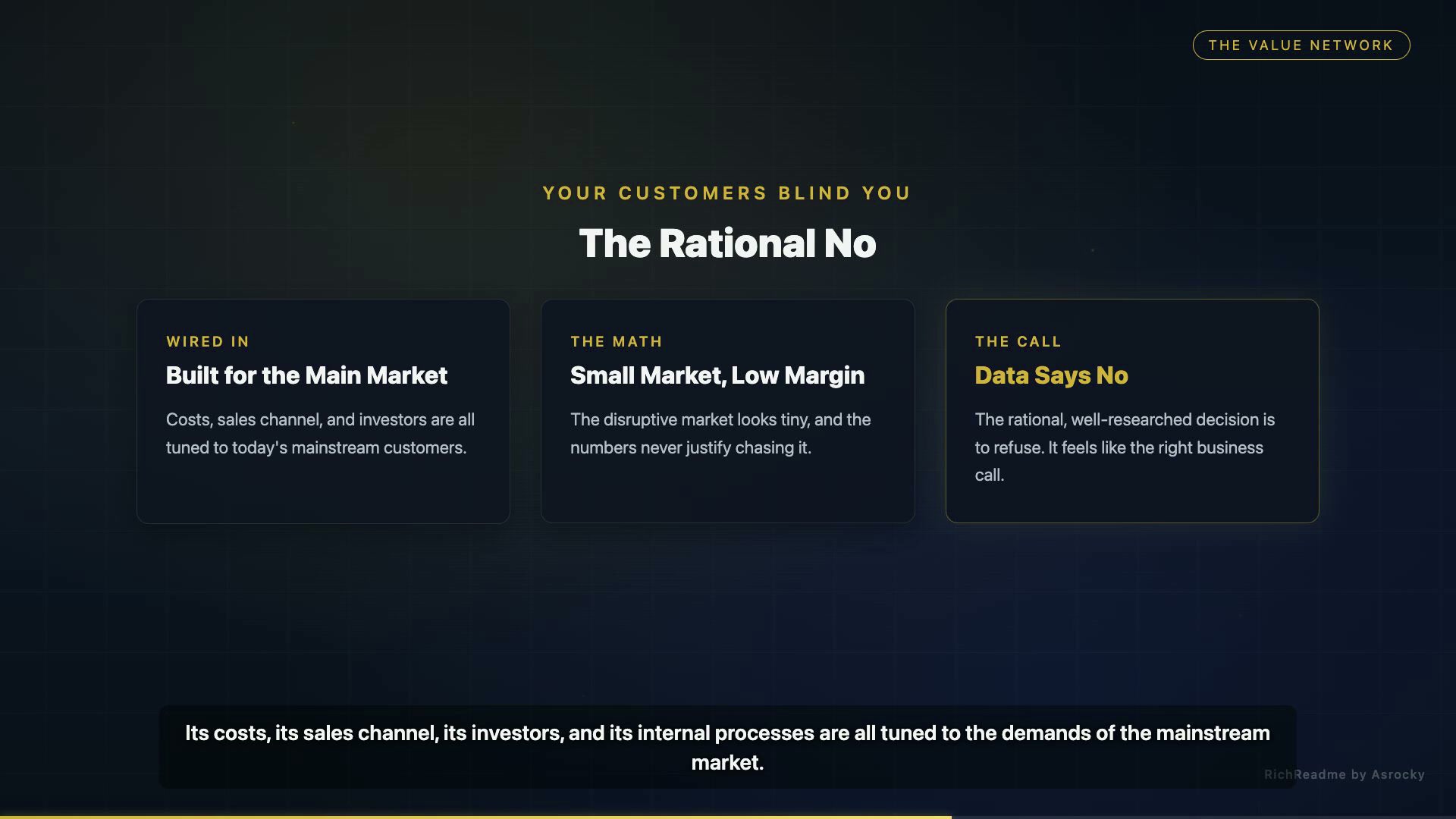
The deeper trap is the value network. A company is wired to serve its best customers. Its costs, its sales channel, its investors, and its internal processes are all tuned to the demands of the mainstream market. A disruptive product starts in a small market that looks tiny to the leader.
The numbers never justify chasing it. When a manager proposes a smaller, cheaper product for an unknown customer, the rational, data driven answer is no. It feels like the right business call.
The Dilemma
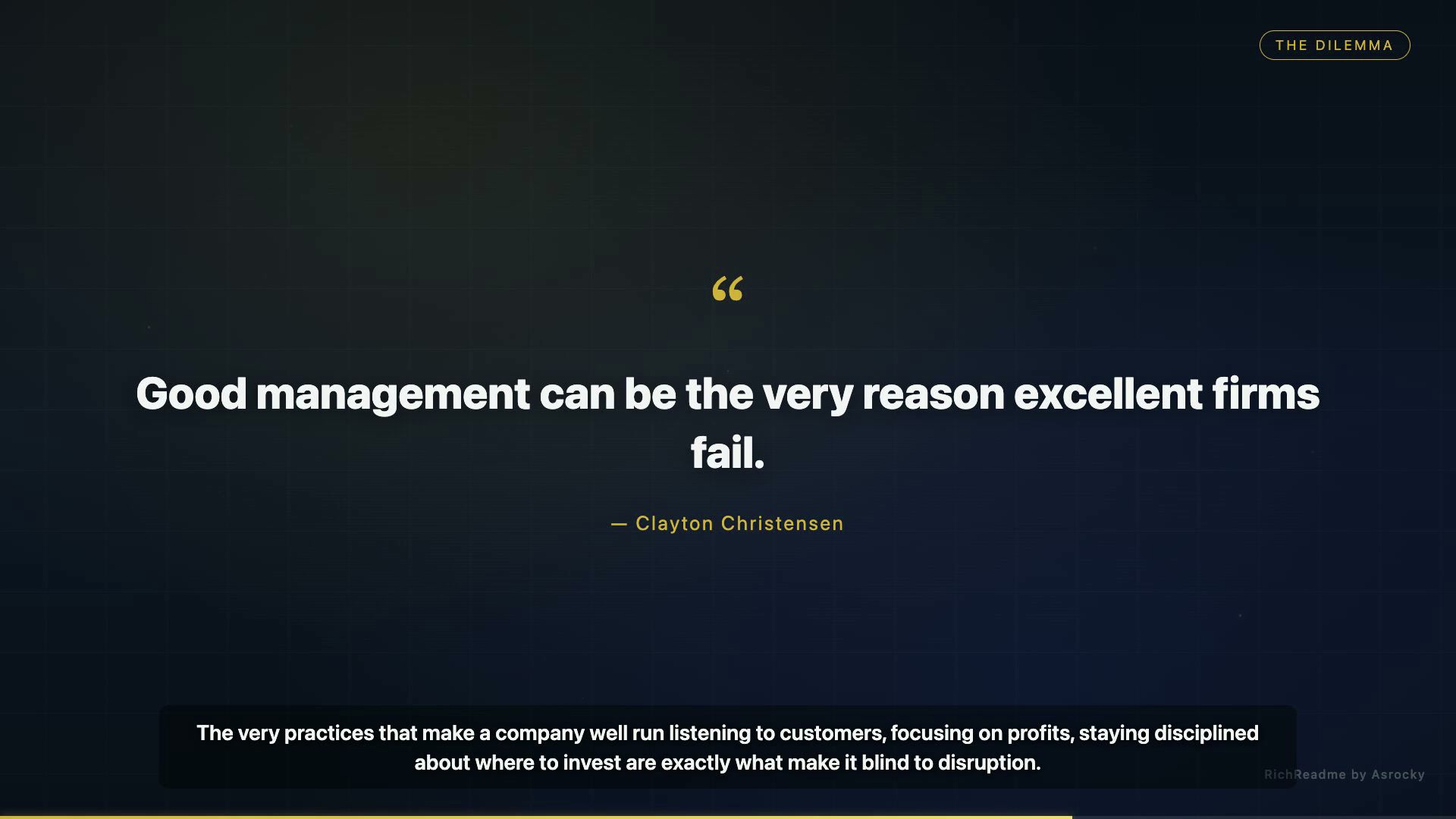
That is the dilemma. The very practices that make a company well run listening to customers, focusing on profits, staying disciplined about where to invest are exactly what make it blind to disruption. You can do everything right and still lose, because the things that feel right are aimed at the market that is already slipping away.
Rational for the Market That's Slipping
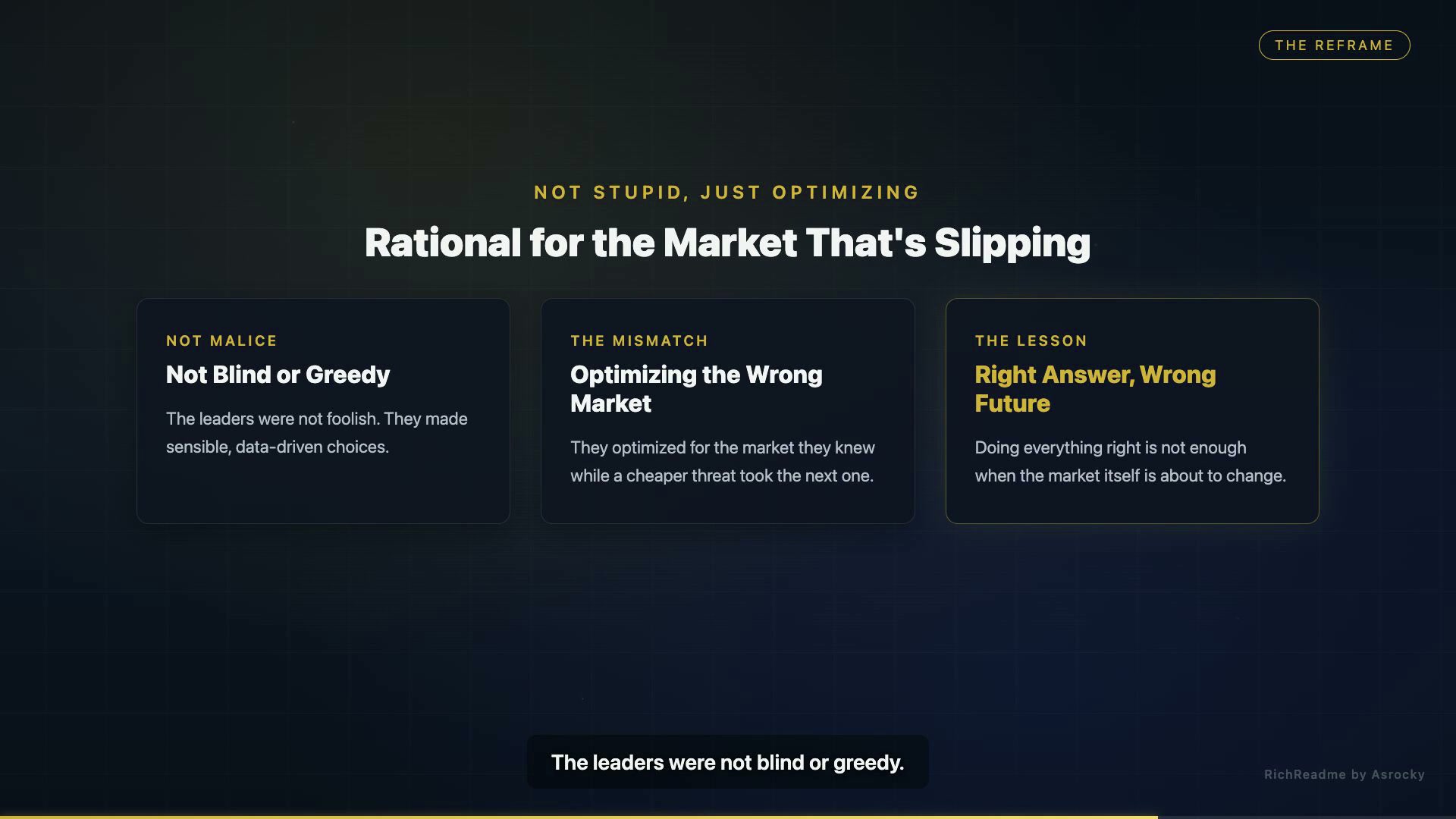
Christensen is not bashing management. He is proving that doing everything right is not enough. The leaders were not blind or greedy. They were rationally optimizing for the market they knew, while a cheaper, simpler threat quietly got good enough to take the next one.
Build a Separate Unit
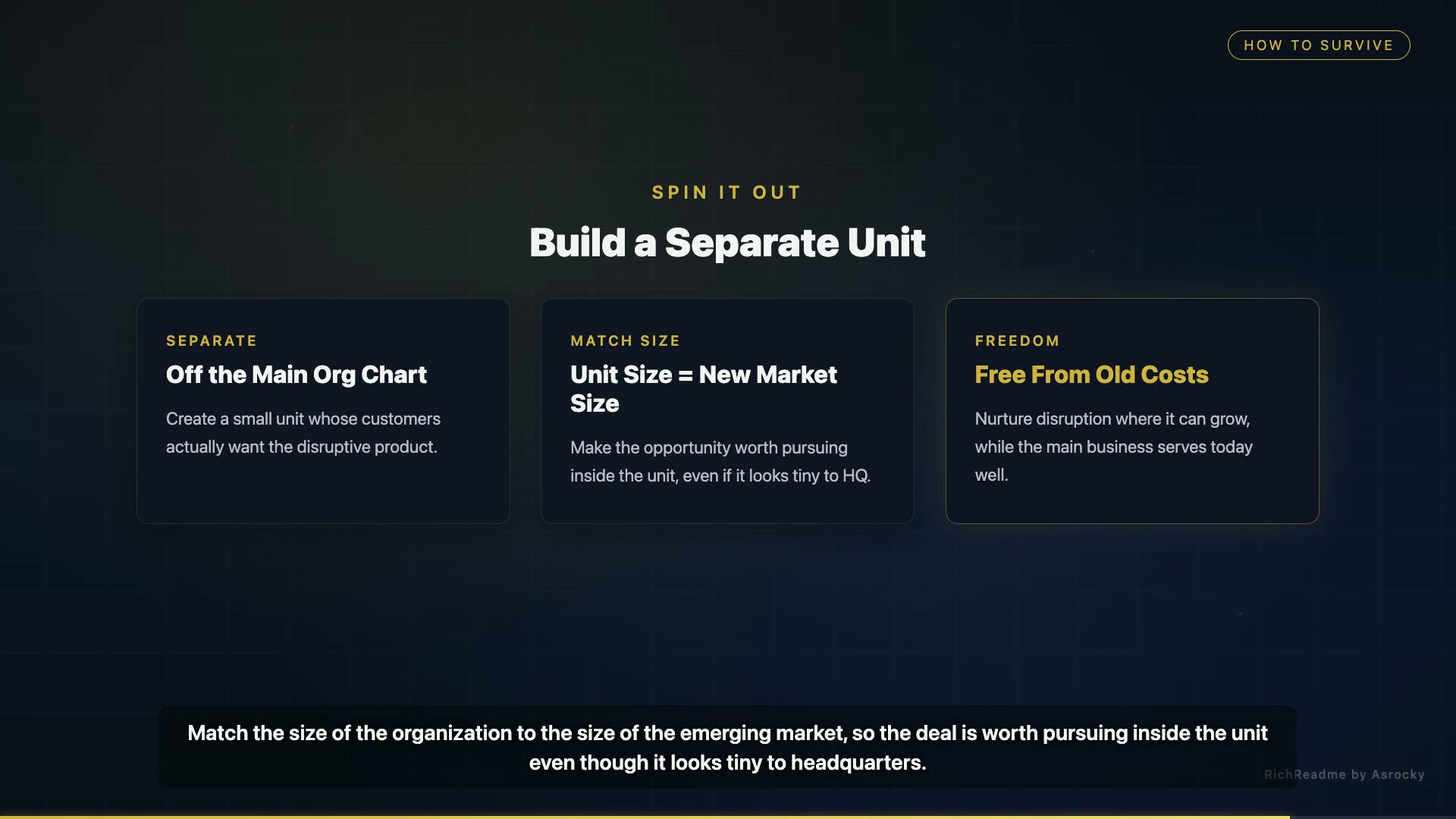
So what works? Christensen says you cannot fix this inside the main organization. You have to create a separate, small unit whose customers actually want the disruptive product, and whose business model can profit at the low prices that disruption brings. Match the size of the organization to the size of the emerging market, so the deal is worth pursuing inside the unit even though it looks tiny to headquarters.
Let it find a market that does not yet exist. Give it freedom from the main company's cost structure and its best customers. The main company should keep serving today's market well, while the separate unit hunts tomorrow's. The leader survives not by ignoring disruption, but by nurturing it somewhere it can grow.