Refugees with five thousand dollars ended up owning half of America's motels. They ignored the rule that high returns require high risk.
This is The Dhandho Investor, by Mohnish Pabrai. Dhandho is a Gujarati word that loosely means creating wealth while taking virtually no risk. Pabrai spent decades studying how Indian motel owners, Richard Branson, Warren Buffett, and Charlie Munger compounded fortunes, and he boiled their common approach down to one sentence, heads, I win, tails, I don't lose much.
Heads I Win, Tails I Don't Lose Much
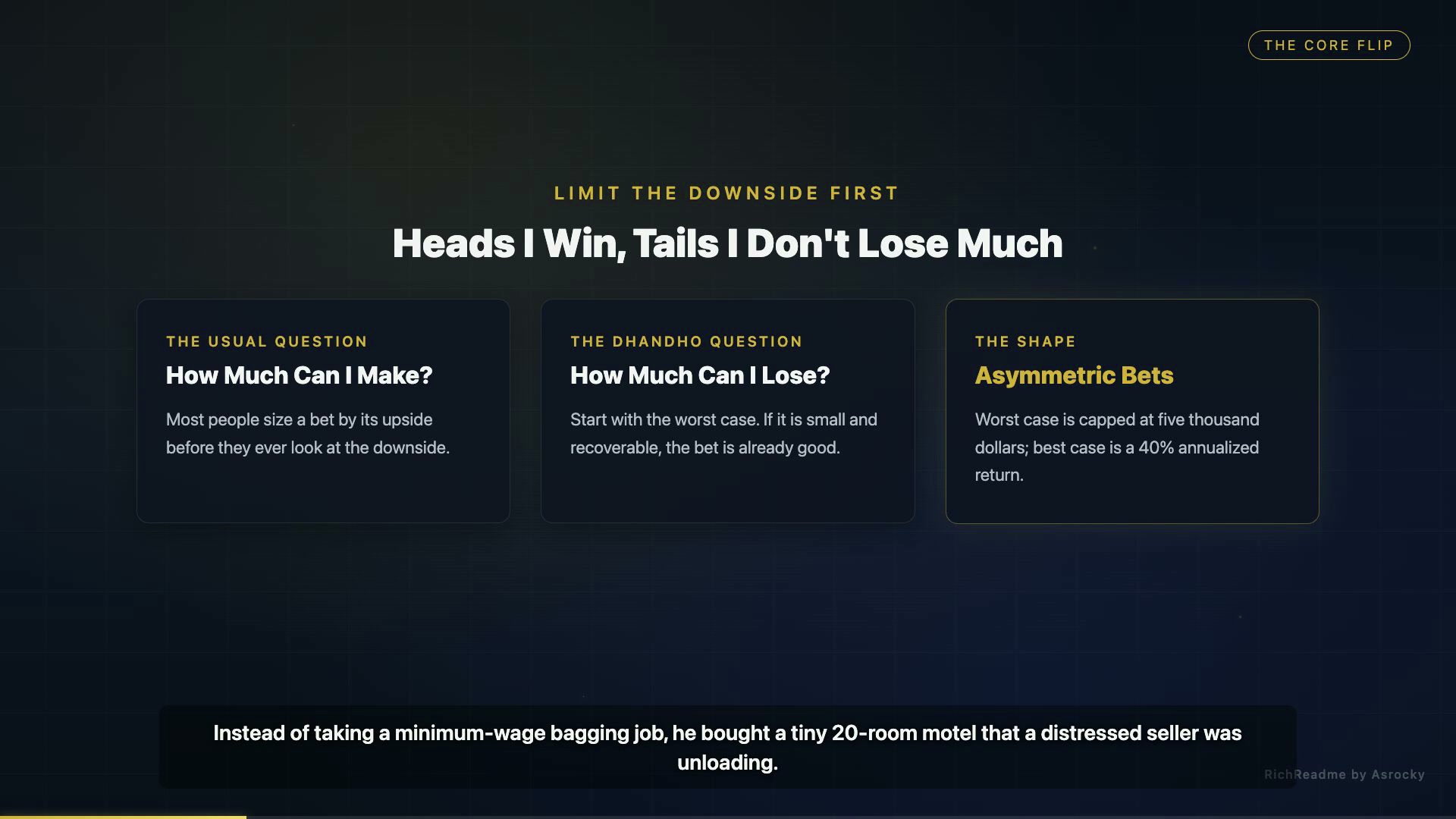
The core flip is that most people start by asking how much they can make. Dhandha starts by asking how much they can lose. Pabrai tells the story of Papa Patel, a refugee arriving in 1973 with a few thousand dollars, broken English, and no network. Instead of taking a minimum-wage bagging job, he bought a tiny 20-room motel that a distressed seller was unloading.
His family lived in two rooms, fired the hired help, and ran the front desk themselves. The downside was capped at the five thousand dollars he put in. The upside was a forty percent annualized return over ten years. Even in his worst realistic case, the bank foreclosed and he lost the five thousand, he could bag groceries for two years, save another nest egg, and try again.
Lose Small, Win Big, Repeat
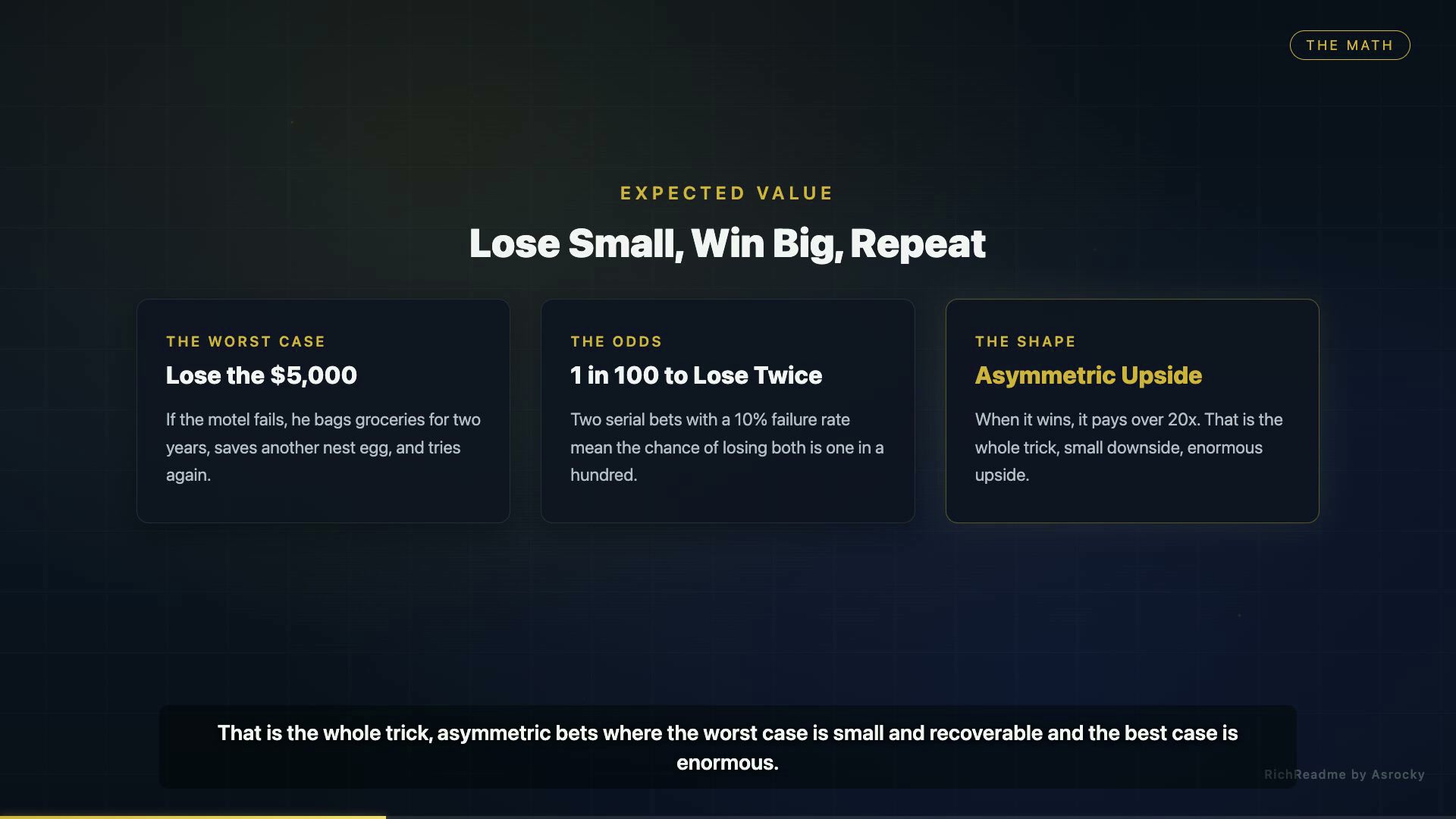
The odds of losing twice in a row were one in a hundred. That is the whole trick, asymmetric bets where the worst case is small and recoverable and the best case is enormous.
Buy What Already Works
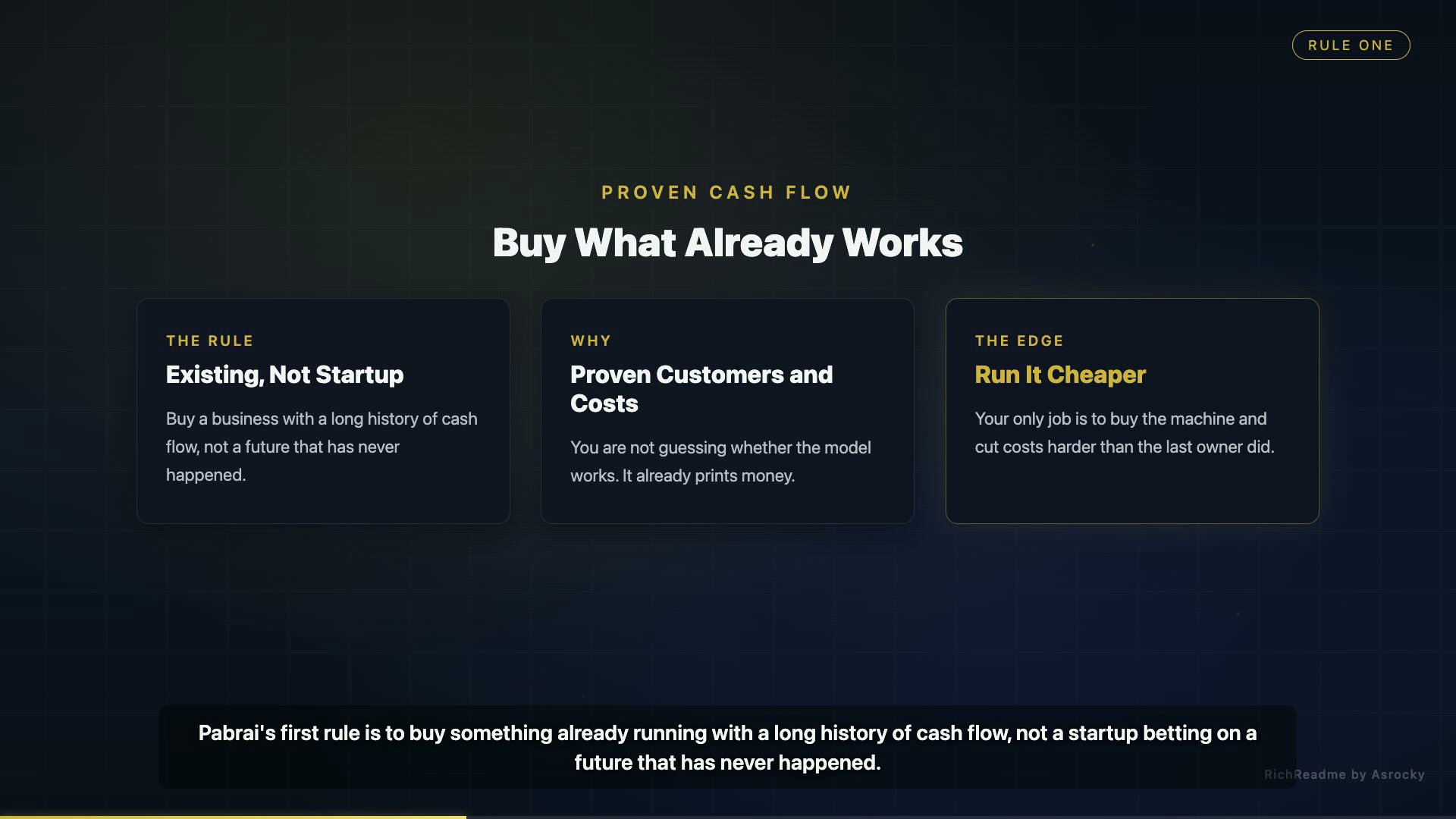
That trade only makes sense because he bought an existing business. Pabrai's first rule is to buy something already running with a long history of cash flow, not a startup betting on a future that has never happened. Existing businesses have proven customers, proven costs, and proven demand.
You are not guessing whether the model works. You are buying a machine that already prints money and figuring out whether you can run it better and cheaper than the current owner.
Simple, Slow-Change Businesses
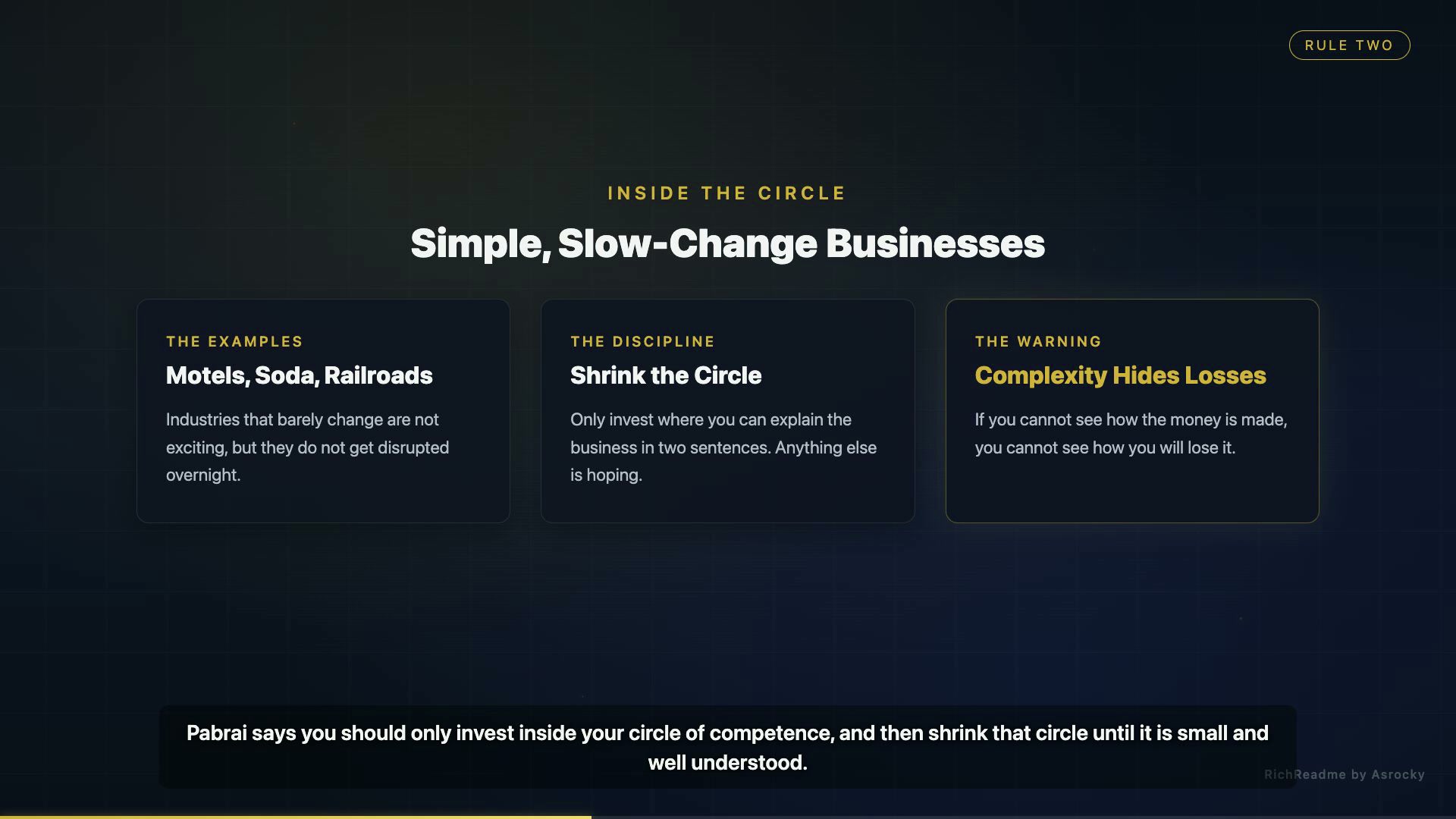
The second rule is to stick to simple businesses in industries that barely change. Motels, discount retail, railroads, and soda do not get disrupted by new technology every two years. Pabrai says you should only invest inside your circle of competence, and then shrink that circle until it is small and well understood.
If you cannot explain how the business makes money in two sentences, you are not investing, you are hoping. Complexity is where losses hide.
Distress Is Where the Price Is
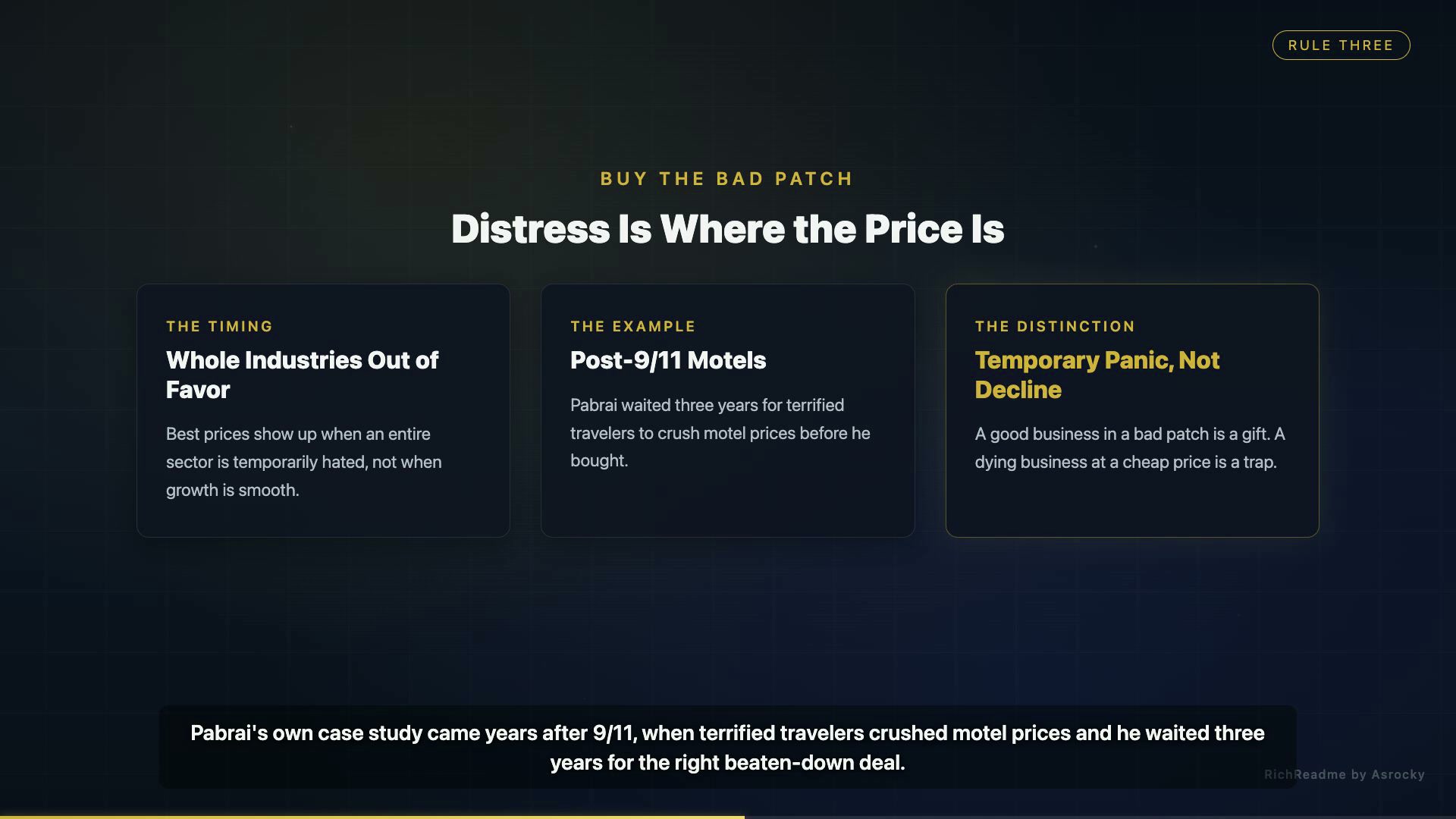
Third, go looking for distress. The best prices show up when a whole industry is temporarily out of favor, not when the company is quietly growing. Pabrai's own case study came years after 9/11, when terrified travelers crushed motel prices and he waited three years for the right beaten-down deal.
Buffett made a legendary bet on American Express during the 1963 salad-oil scandal, when one scandal temporarily tanked a pristine consumer brand and the market panicked. A good business going through a bad patch is a gift. You want the temporary panic, not the permanent decline, and you have to sit on cash while you wait for it.
Only Buy a Business That Can't Be Copied
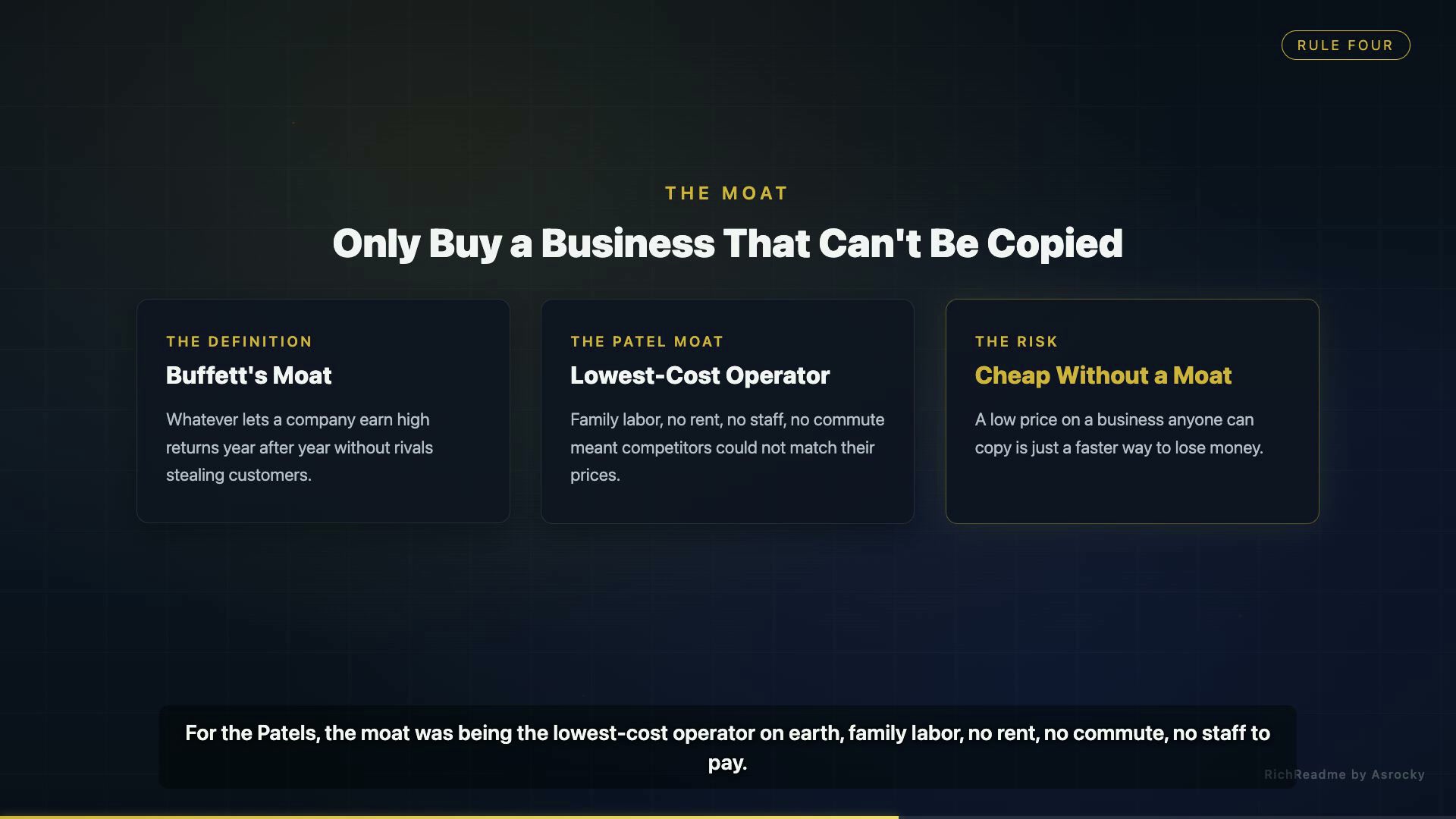
Fourth, only buy businesses with a durable competitive advantage, what Buffett calls the moat. For the Patels, the moat was being the lowest-cost operator on earth, family labor, no rent, no commute, no staff to pay. Competitors could not match their prices and survive.
A moat is whatever lets a company earn high returns year after year without rivals stealing its customers. Without it, a cheap price is just a trap.
Margin of Safety
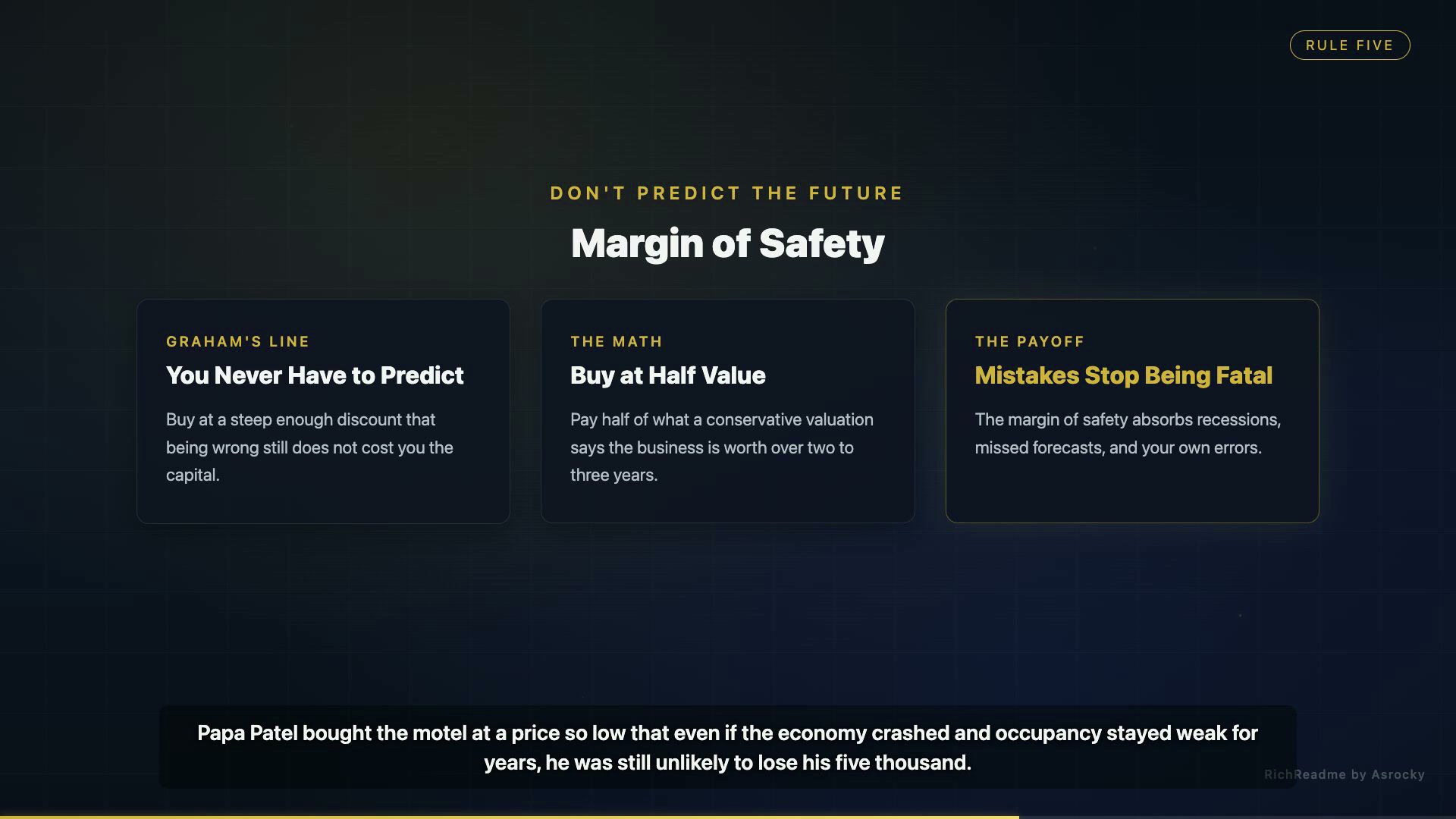
Fifth, demand a huge margin of safety. Pabrai quotes Ben Graham, the margin of safety exists so you never have to accurately predict the future. Papa Patel bought the motel at a price so low that even if the economy crashed and occupancy stayed weak for years, he was still unlikely to lose his five thousand. Buy at half of what a conservative valuation says the business is worth, and your mistakes stop being fatal.
Bet Heavy When Odds Are Overwhelming
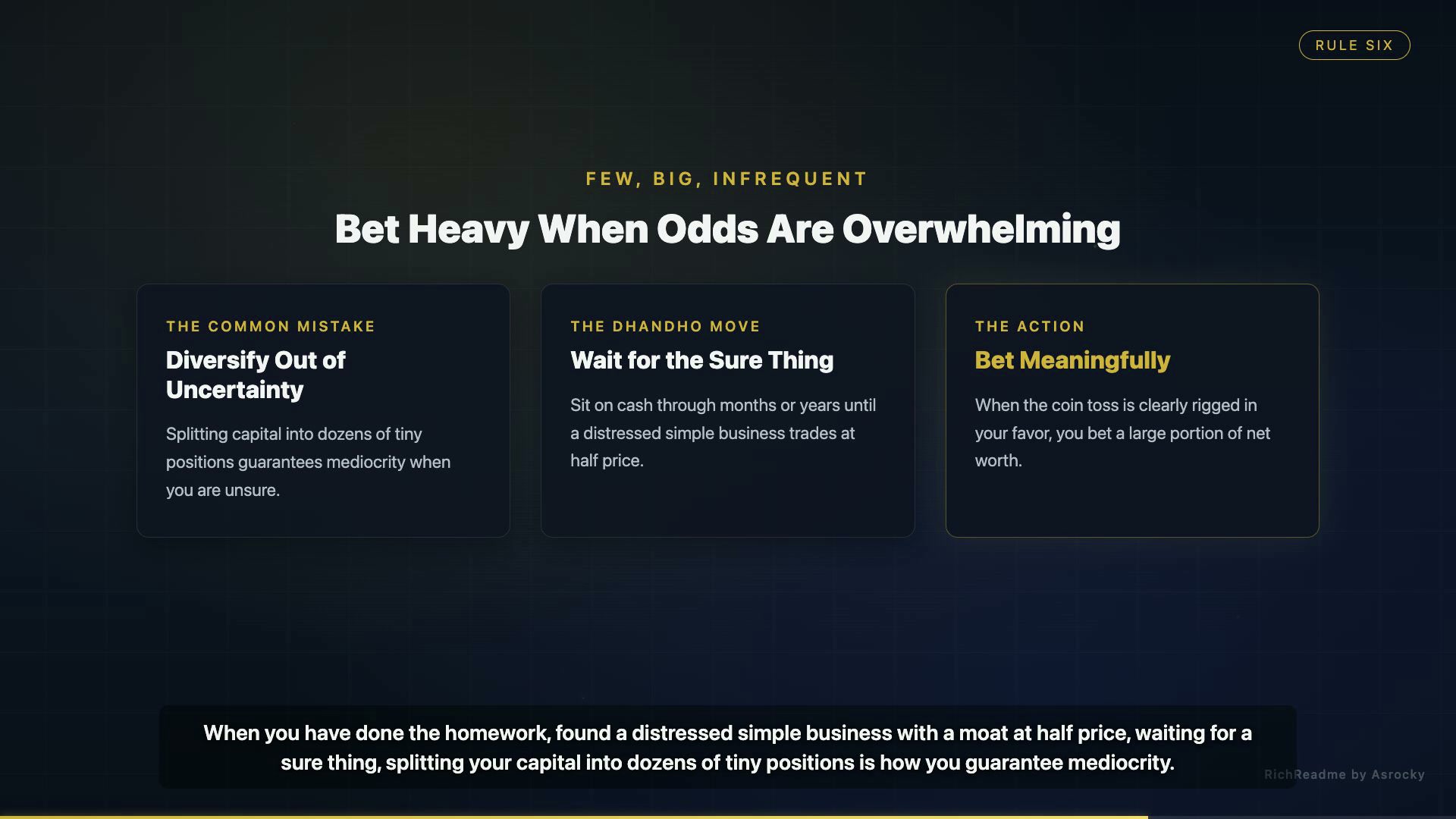
Sixth, and most counterintuitive, bet big when the odds are overwhelmingly on your side. Pabrai calls this few bets, big bets, infrequent bets. Most people diversify because they are unsure.
When you have done the homework, found a distressed simple business with a moat at half price, waiting for a sure thing, splitting your capital into dozens of tiny positions is how you guarantee mediocrity. You wait patiently, and when the coin toss is clearly rigged in your favor, you bet meaningfully.
Copy, Don't Innovate
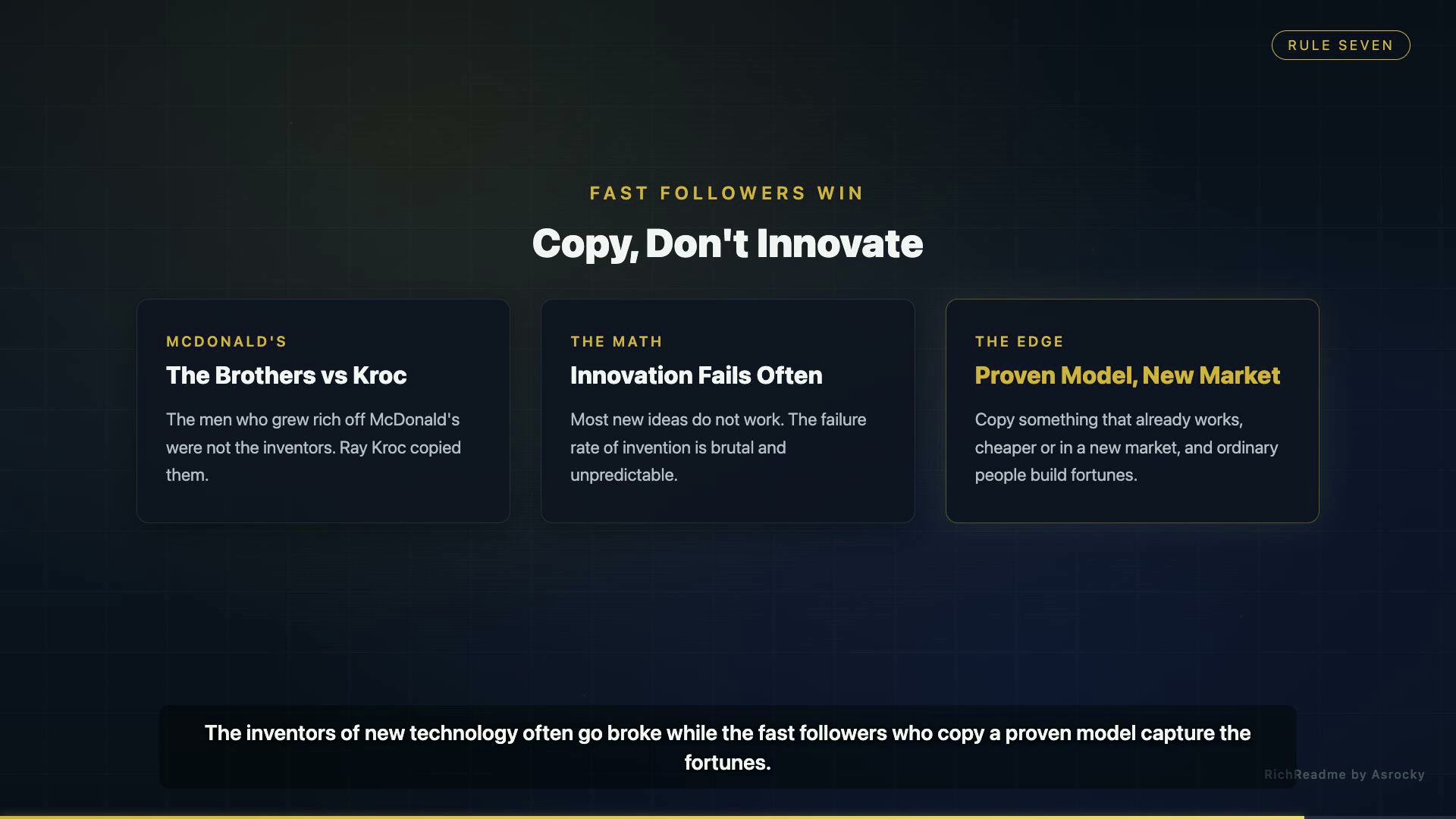
Finally, be a copycat, not an innovator. Pabrai points out that the men who got rich off McDonald's were not the brothers who invented the burger stand. Ray Kroc copied them. The inventors of new technology often go broke while the fast followers who copy a proven model capture the fortunes.
Even Microsoft was not the first into personal computing. Innovation carries huge failure rates, because most new ideas do not work. Copying something that already works, in a slightly new market or a slightly cheaper way, is how ordinary people build extraordinary wealth without betting their life savings on an unproven idea.