Retiring in your twenties isn't about winning the lottery. It's about a three-stage ladder almost anyone can climb.
This is Set for Life, by Scott Trench, written for the regular wage earner, not the trust-fund kid. His argument is that the normal plan, save ten percent for forty years and hope it lasts, traps you in a cubicle through your best years. Instead, he lays out a faster path: cut hard first, attack your biggest expense, then let assets do the rest. The goal is enough passive income to cover your spending, not a number on a retirement statement.
Build Your Year of Runway

The first rung is the hardest, and it is not glamorous. Trench says your first target is not a stock pick or a side hustle. It is twenty-five thousand dollars in accessible cash, built while living on roughly two thousand dollars a month.
This is the stage where you save half your take-home pay or more, and it feels like a grind. But that cash is not just money. It is a year of runway, and runway is what turns you from trapped into free.
Skip The Latte Talk

Trench is blunt about frugality. He does not care if you skip a latte or pick the cheaper salad. Those moves only make you slightly less ridiculous than average.
Real progress means not buying the car at all, biking to work, taking on no consumer debt, and feeling genuinely weirded out by a guy financing a giant pickup. You cut the big life expenses, housing, transportation, and consumer debt, not the small joys. A frugal life, he insists, is a better and freer life, not a deprived one.
Three Steps Before You Invest

Within that first stage, he gives you three milestones in order. First, build a one to two thousand dollar emergency fund, just enough to cover flat tires and speeding tickets without sliding back onto a credit card. Second, attack every high-interest bad debt, anything above roughly seven or ten percent, as the emergency it is.
Third, once that is cleared, pile up the full year of cash. Home equity, retirement accounts, and your car do not count. It has to be money you can touch.
Live For Free In A Duplex

Once you have that runway, the second rung opens up, and the biggest lever is housing. Trench calls it house hacking. You buy a small duplex or multi-unit building, live in one unit, and rent out the other.
The rent from your tenants covers the mortgage, so your housing cost collapses toward zero, and you build equity the whole time. He runs the numbers and shows the plain homeowner slowly bleeds wealth, while the house hacker's net worth accelerates because the cash he would have spent on rent goes straight into investments.
Don't Buy The Dream House

He also warns against the opposite move, stretching to buy the nicest house you can qualify for. That locks you into a mortgage, a neighborhood, and a job you cannot leave. Trench wants you to buy the boring affordable place that gives you three outs: live in it, rent it out, or sell it later. The whole point is to keep your options open, because early freedom dies the day you become a prisoner of your own mortgage.
Chase A Scalable Career

The other lever in stage two is income, but not the way most people think. Trench says do not chase the highest base salary next year. Chase a scalable career, one where commissions, equity, or ownership can multiply your earnings over three to five years.
A year of runway is what lets you take that pay cut for a shot at upside, or walk out of a toxic boss. The frugal lifestyle is the thing that buys you the courage to aim higher instead of just surviving.
Freedom Is A Formula

Then comes stage three, when the math finally takes over. Trench writes the freedom equation out plainly: your assets times their return must exceed your lifestyle spending. This is why frugality matters so much.
At a safe withdrawal rate around five percent, every extra hundred dollars a month you spend means you need roughly twenty-four thousand dollars more in assets just to support it. Trim your spending, and your freedom date moves years earlier without earning another dollar.
Don't Pick Stocks

He is also disciplined about what counts as an investor. Do not pick individual stocks, he says, because a broad index fund already returns about ten percent a year over the long run, and your effort stock-picking does not beat that. Put your energy where you actually have control, like fixing up and managing a rental you live next door to. And he warns against false assets: a paid-off house or a locked retirement account feels like wealth, but it does not pay your bills while you are still young.
Watch Four Numbers
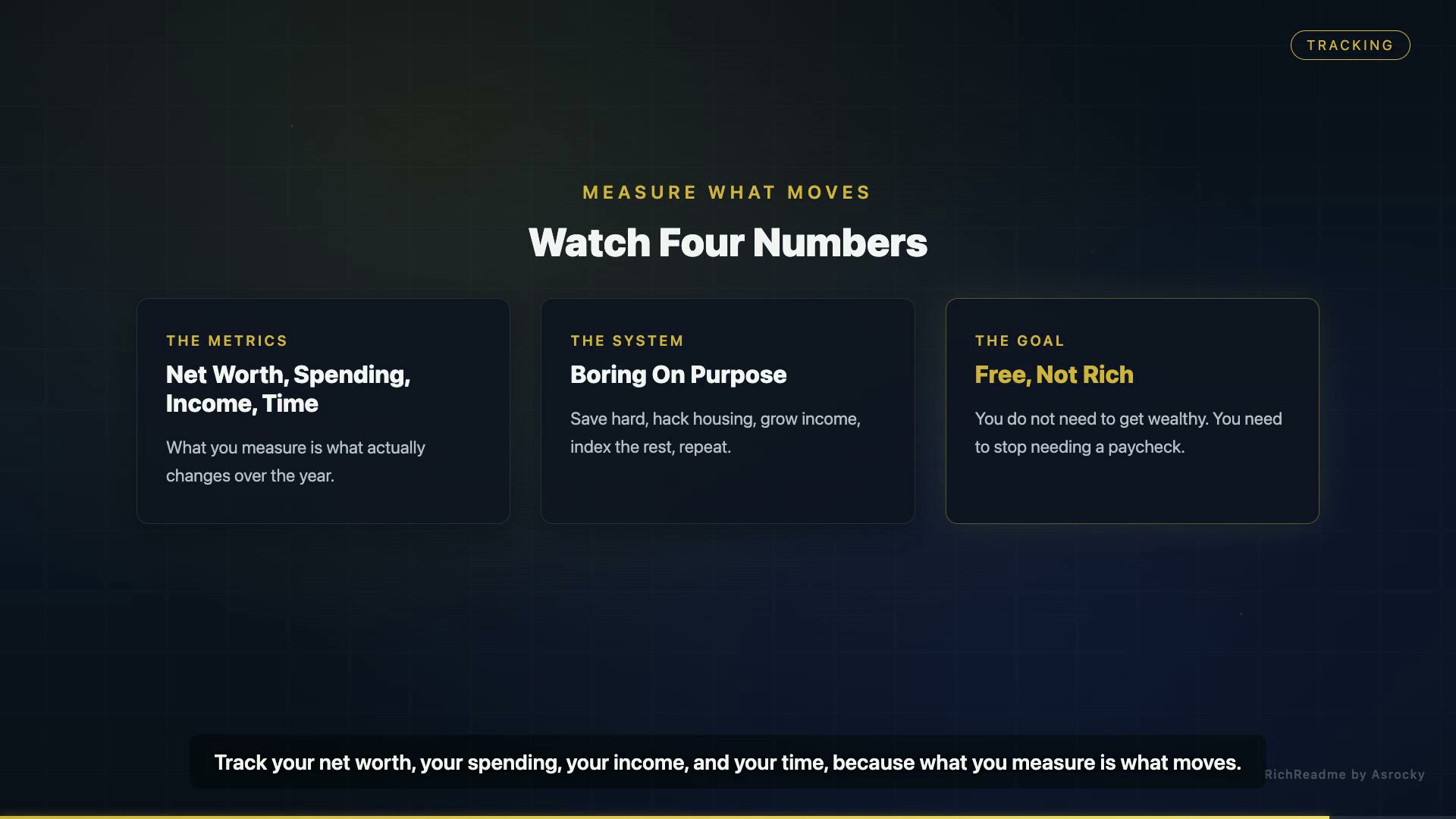
The book ends as it starts, with your daily metrics. Track your net worth, your spending, your income, and your time, because what you measure is what moves. The whole system is boring on purpose.
Save hard, hack your housing, grow a scalable income, index the rest, and watch the numbers. You do not need to get rich. You need to get free.