You do not need a trust fund, a gimmick, or luck to retire a millionaire. You need math, patience, and a few very boring decisions.
This is Quit Like a Millionaire by Kristy Shen and Bryce Leung. She grew up poor, the daughter of Chinese immigrants, worked as an engineer, and by her early thirties she and Bryce had saved enough to quit their jobs and live off their investments, anywhere in the world.
You Are Not the Problem

Her first message is a relief: you are not the problem. The system was designed to keep you trading your time for money. The rent eats your raises, the market scares you out, and the retirement advice you heard assumes you want to work until sixty-five. The fix is not to hustle harder, it is to change the math.
The Savings Rate

Here is the math that matters. It is not your income that decides when you can retire, it is your savings rate. If you save ten percent of your income, retirement takes about fifty-one years. Save fifty percent, and it takes about seventeen years.
Save seventy percent, and it takes under nine years. Every dollar you keep is a slice of your time bought back. The authors were able to save about seventy percent of their income, and the numbers did the rest.
Three Funds, That's It

They invested that money the simplest possible way: a three fund portfolio. One fund for the entire US stock market, one for the international market, and one for bonds. No picking stocks, no timing the market, no hot tips.
Just broad, cheap, index funds, held for years. Boring is the point. Boring survives crashes and keeps compounding.
Buying vs. Renting + Investing
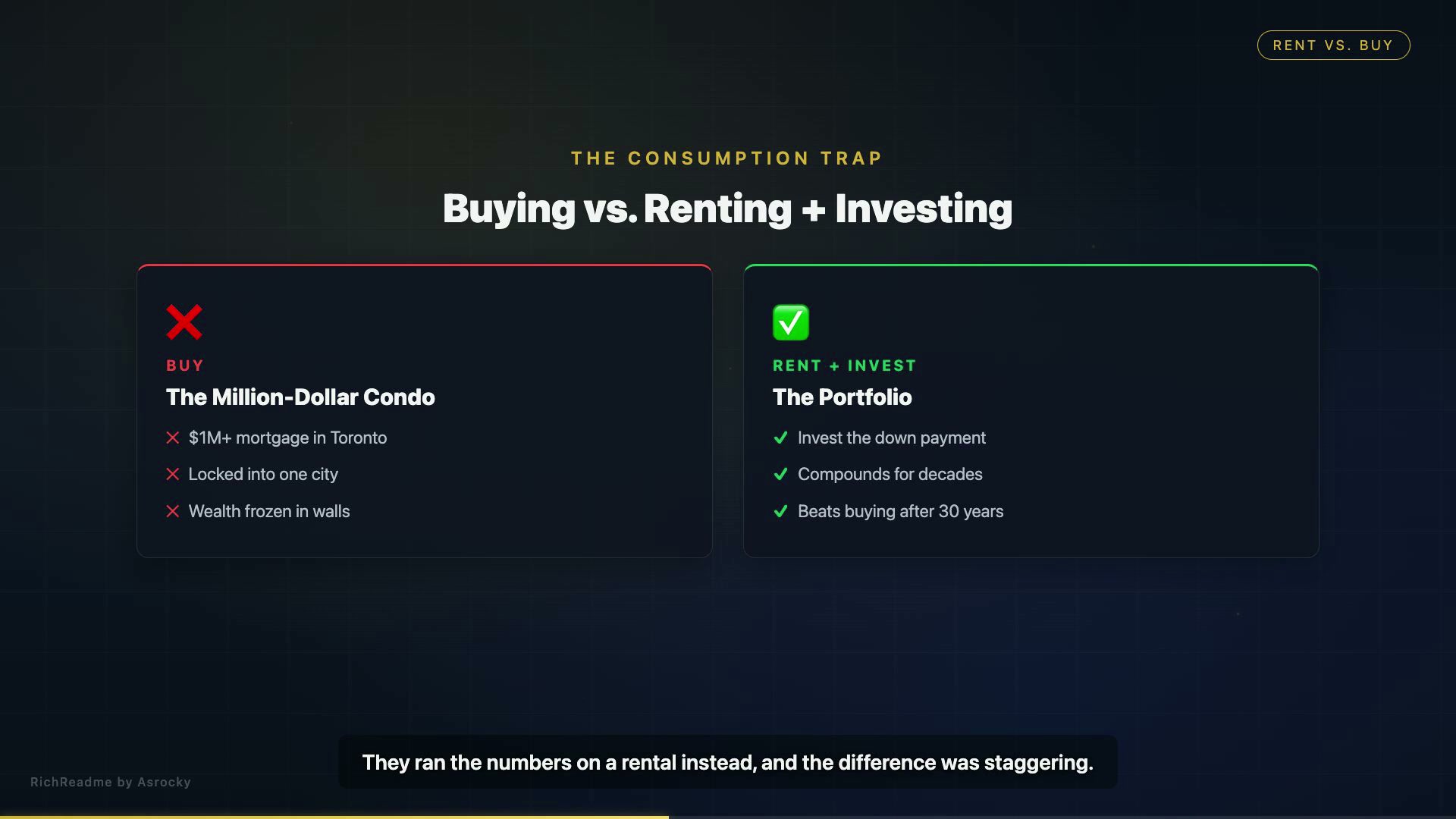
Then came the decision that shocked their families. They refused to buy a home in Toronto, where a decent condo cost more than a million dollars. They ran the numbers on a rental instead, and the difference was staggering.
Renting the same place and investing the down payment beat buying after thirty years. For many young people, a home is not an asset, it is a consumption trap disguised as an investment.
Geographic Arbitrage

And once your portfolio is big enough, you get to use the ultimate trick: geographic arbitrage. A million dollars in New York is a comfortable life. The same million in a lower cost city, or a lower cost country, is a wealthy life. Your money is worth whatever you can buy with it, so the smart move is to live where your money goes further.
The Safe Withdrawal Rate
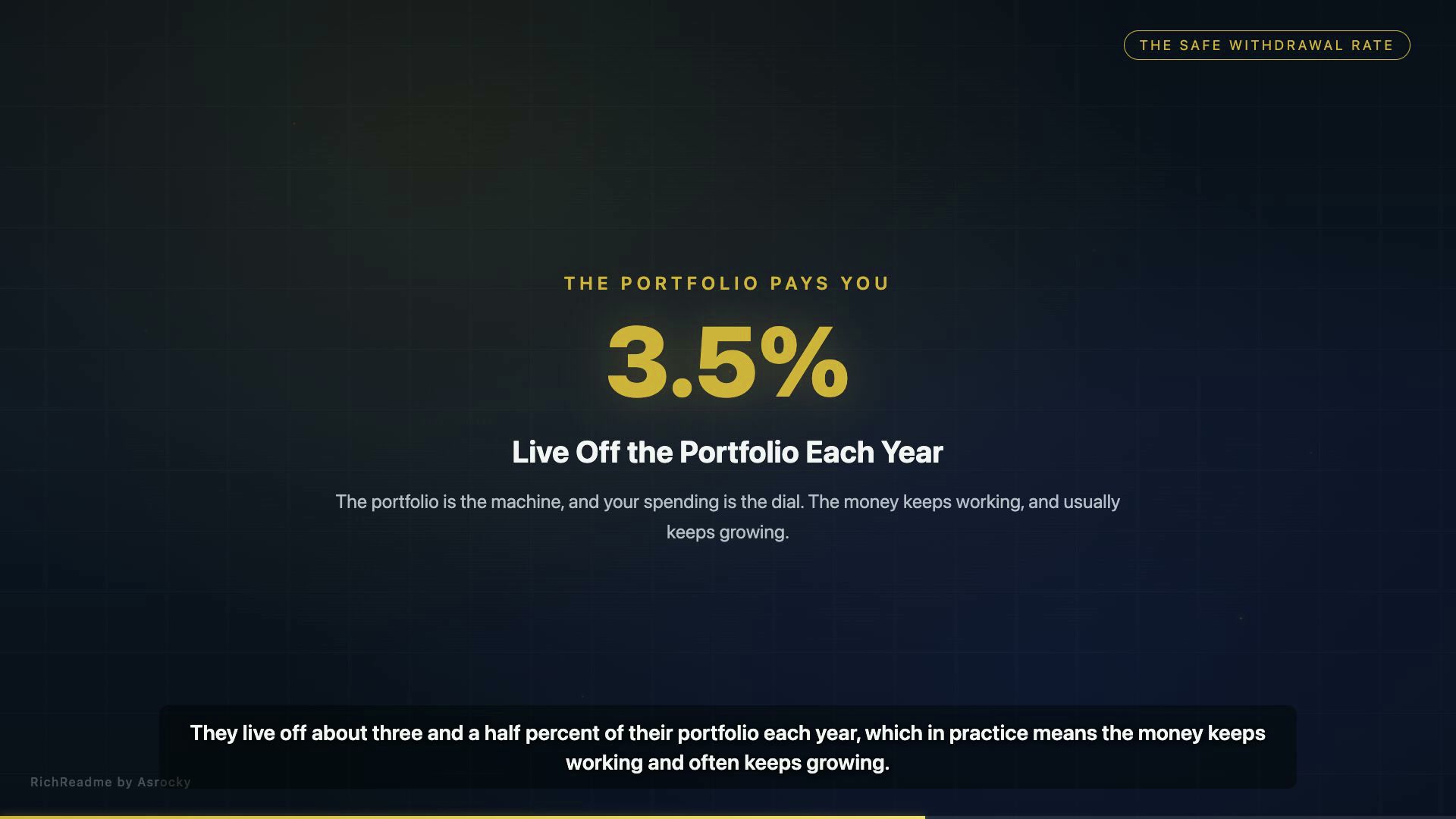
The withdrawal side is simple too. They live off about three and a half percent of their portfolio each year, which in practice means the money keeps working and often keeps growing. The portfolio is the machine, and your spending is the dial.
What Kills the Plan

None of this requires being a genius. It requires avoiding the traps: the expensive rent that grows faster than your salary, the lifestyle that inflates every time you get a raise, and the fear that keeps your money in cash, losing to inflation. Every one of these is a choice you can unmake.
Four Moves

So the plan is short enough to fit in a wallet. Save aggressively, as close to seventy percent as you can. Invest in three boring index funds.
Rent, and invest the difference. Then move your life to where your money is worth more. Do that for a decade or two, and the portfolio retires you.
The Point

The point was never to stop working. It was to stop working for someone else's timeline.