A plastic surgeon discovered that changing faces did not change lives.
This is Psycho-Cybernetics, by Maxwell Maltz. He was a cosmetic surgeon in the nineteen sixties who watched patients leave his operating room with new noses and chins, yet still carry the same old image of themselves as ugly, inadequate, or unlovable. The surgery fixed their faces.
It did not fix their self-image. That observation became the seed of a book that has sold over thirty-five million copies and shaped nearly every self-help method that came after it.
Your Self-Image Runs Everything

Maltz's core idea is simple. Every person carries a mental blueprint of who they are. He called it the self-image. It is built from your past experiences, your failures, your triumphs, and the way people treated you growing up. Once a belief about yourself gets lodged in that blueprint, you stop questioning it. You simply act it out.
Your actions, your feelings, even your abilities, all line up with the picture you hold of yourself. If you see yourself as a failure, you will find a way to fail, even when opportunity lands on your lap. If you see yourself as someone who belongs, you will find a way to belong. Maltz watched straight-A students suddenly become failing students, and shy people turn outgoing, the moment their self-image shifted. The outer behavior was never the real problem. It was always a symptom of the inner picture.
Your Brain Is a Guidance System

The reason this happens is that your brain works like a guided missile. Maltz called it a servo-mechanism. It is a goal-seeking system built into your nervous system.
Give it a target, and it will steer you toward it, correcting course along the way, the same way a heat-seeking missile adjusts to hit its mark. The problem is that most people feed their guidance system the wrong target. They run mental movies of failure, embarrassment, and rejection, and then wonder why life keeps steering them there.
Imagination Is Training

This is where imagination becomes your most powerful tool. Maltz found that the nervous system cannot tell the difference between a vividly imagined experience and a real one. If you rehearse a scene in your mind with enough detail and emotion, your brain treats it as data.
It stores the memory. It adjusts your self-image. It makes the behavior automatic.
They Practice in Their Heads

Golf great Ben Hogan did not just practice on the course. Before every shot, he played a perfect mental movie, feeling the club strike the ball, seeing the flight, then stepped up and let his body execute. Concert pianist Artur Schnabel practiced surprisingly little at the keyboard. When asked why, he said he practiced in his head.
Run Your Mental Movie
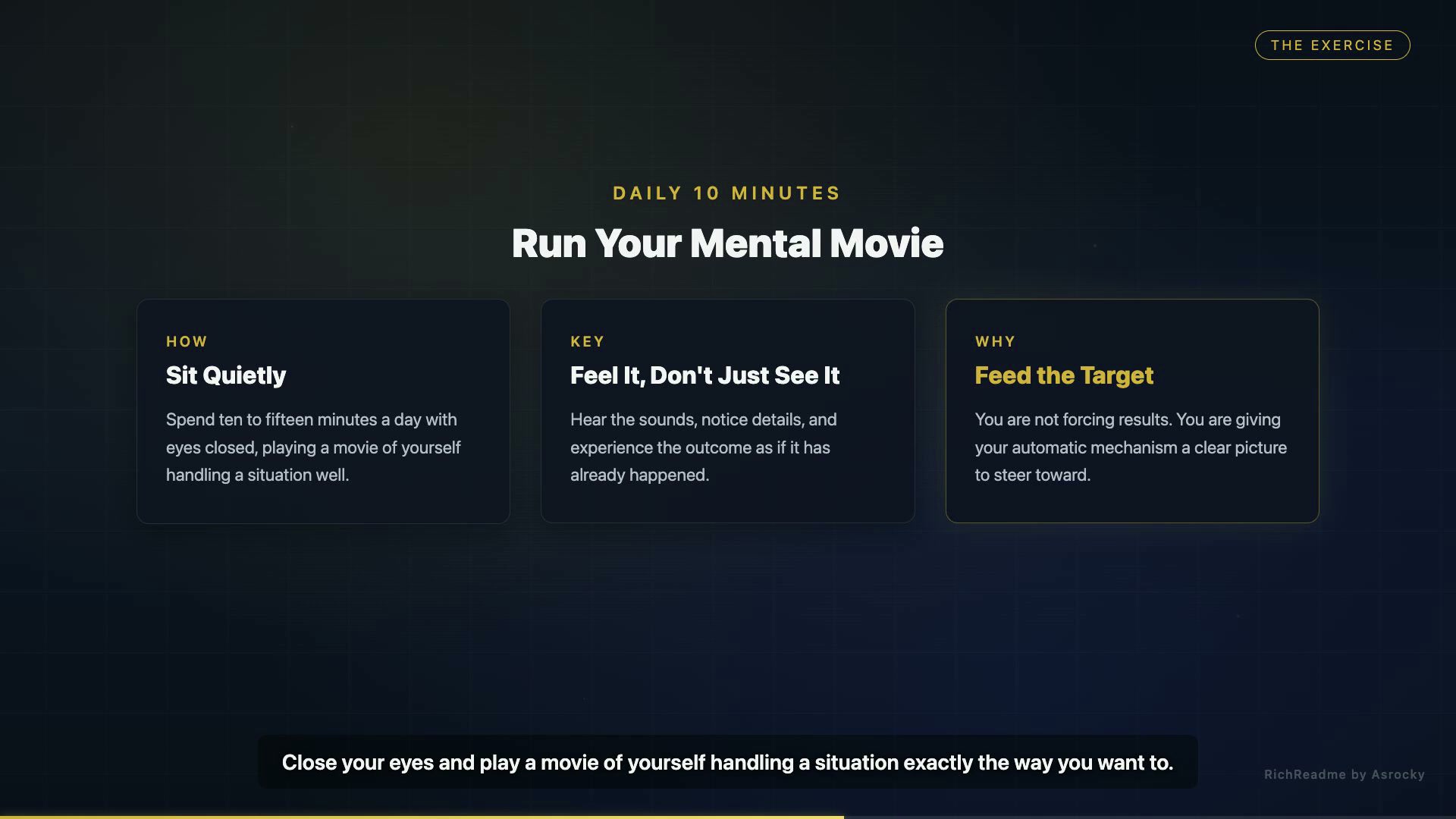
The practical exercise is what Maltz called the mental theater. Every day, sit quietly for ten or fifteen minutes. Close your eyes and play a movie of yourself handling a situation exactly the way you want to. Do not just see it. Feel it. Hear the sounds.
Notice the details. Let yourself experience the outcome as if it has already happened. There is no need to strain or force it. You are feeding the target to your automatic mechanism. It will find the means to get you there.
Stop Forcing It
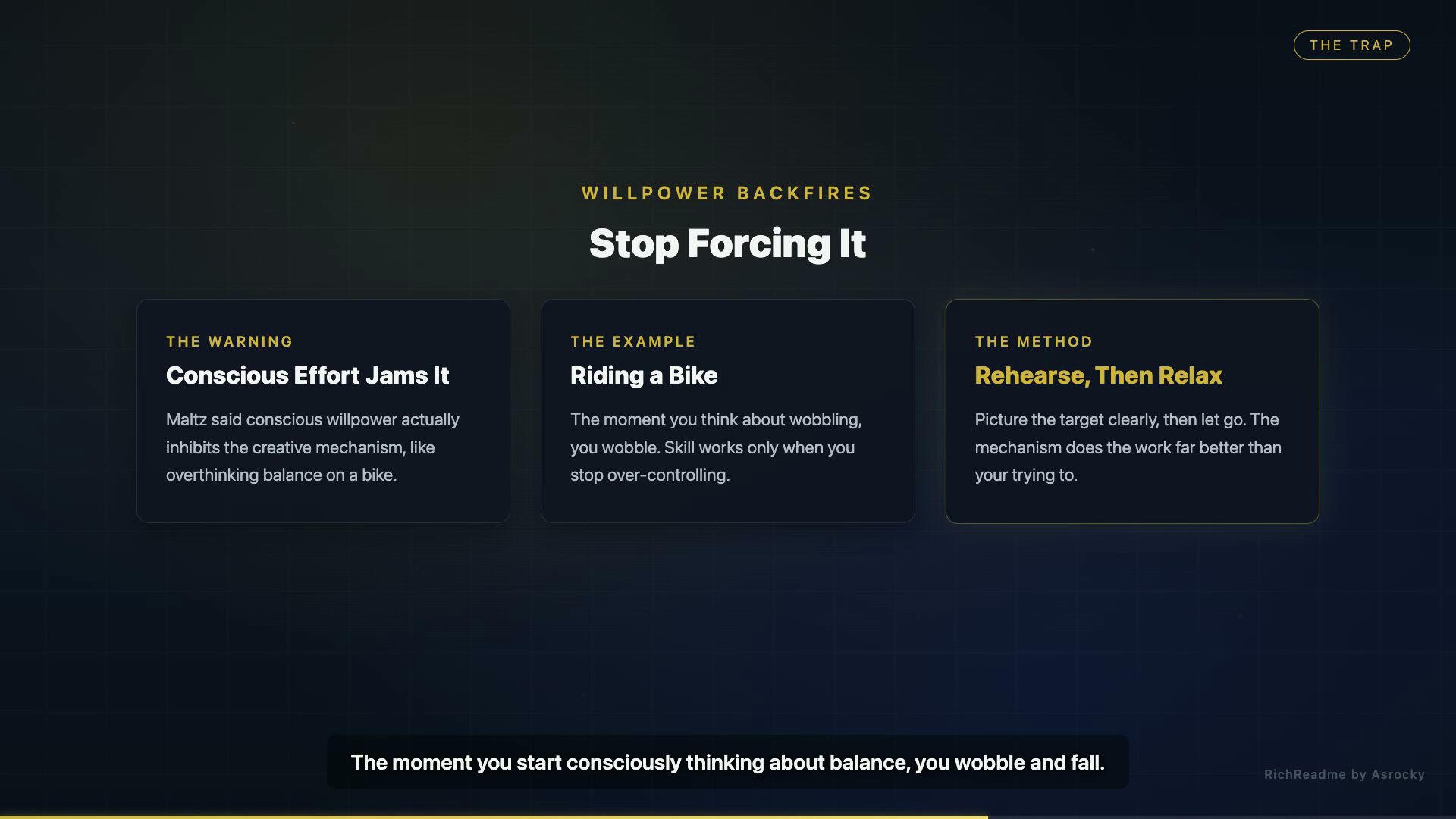
The trap most people fall into is trying to force results with willpower. Maltz warned that conscious effort actually jams the creative mechanism. Think of learning to ride a bike. The moment you start consciously thinking about balance, you wobble and fall.
Skill becomes automatic only when you stop over-controlling. The same is true for confidence, public speaking, or social ease. You rehearse the target mentally, then you relax and let the mechanism do the work.
Question the Old Blueprint

You also have to dehypnotize yourself. Most of the limitations you accept are not facts. They are beliefs you picked up as a child, from a teacher, a parent, or a single humiliating moment.
Maltz says you can challenge them the same way you would challenge anyone else's claim. Ask yourself, is this actually true, or did I just decide it once and never revisit it? Rational thinking, applied to your own self-image, can rewrite the blueprint.
The Winning Feeling
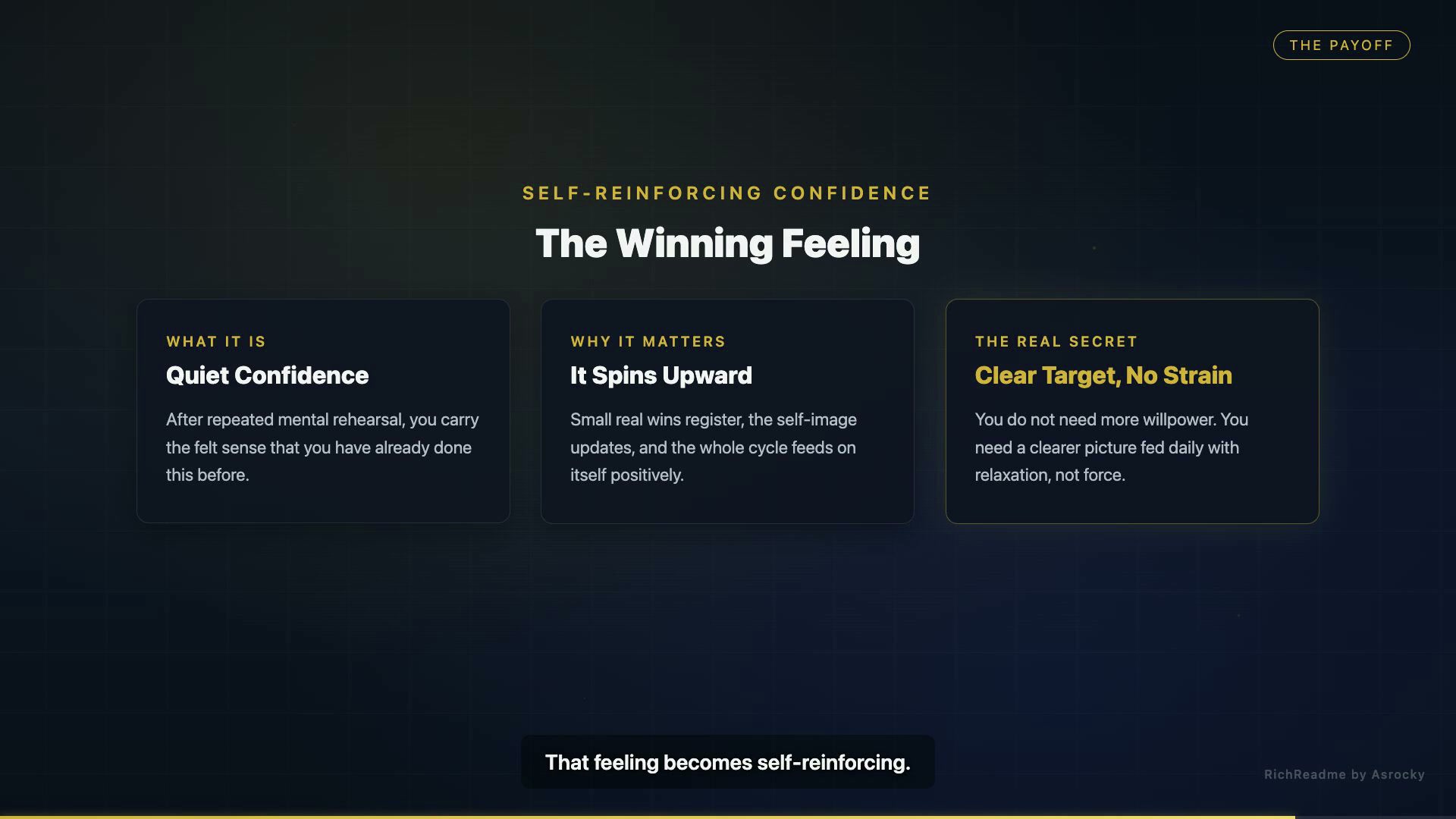
The payoff is what Maltz called the winning feeling. When you have repeatedly rehearsed success in your mind, you start carrying a quiet confidence into real situations. It is not arrogance. It is the felt sense that you have already done this before, because in your mind, you have. That feeling becomes self-reinforcing.
Small wins register, the self-image updates, and the whole cycle spins upward instead of downward. Maltz argued this is the real secret behind championship performance, from golf to public speaking. You do not need more willpower. You need a clearer target picture, fed daily, with relaxation instead of strain.