Are humans rational? We are not coldly logical. We make the same predictable mistakes every single day.
This is Predictably Irrational by Dan Ariely, a behavioral economist who uses wild experiments to show why we make the same dumb choices over and over.
Irrationality Started in a Burns Ward

Ariely knows about irrationality from personal experience. As a young man he suffered third-degree burns over much of his body. Years in hospitals and burns wards gave him a front-row seat to how people think and suffer.
He started asking why patients, doctors, and even himself made decisions that clearly hurt them. That question became his life's work.
A Useless Option Changed Everything
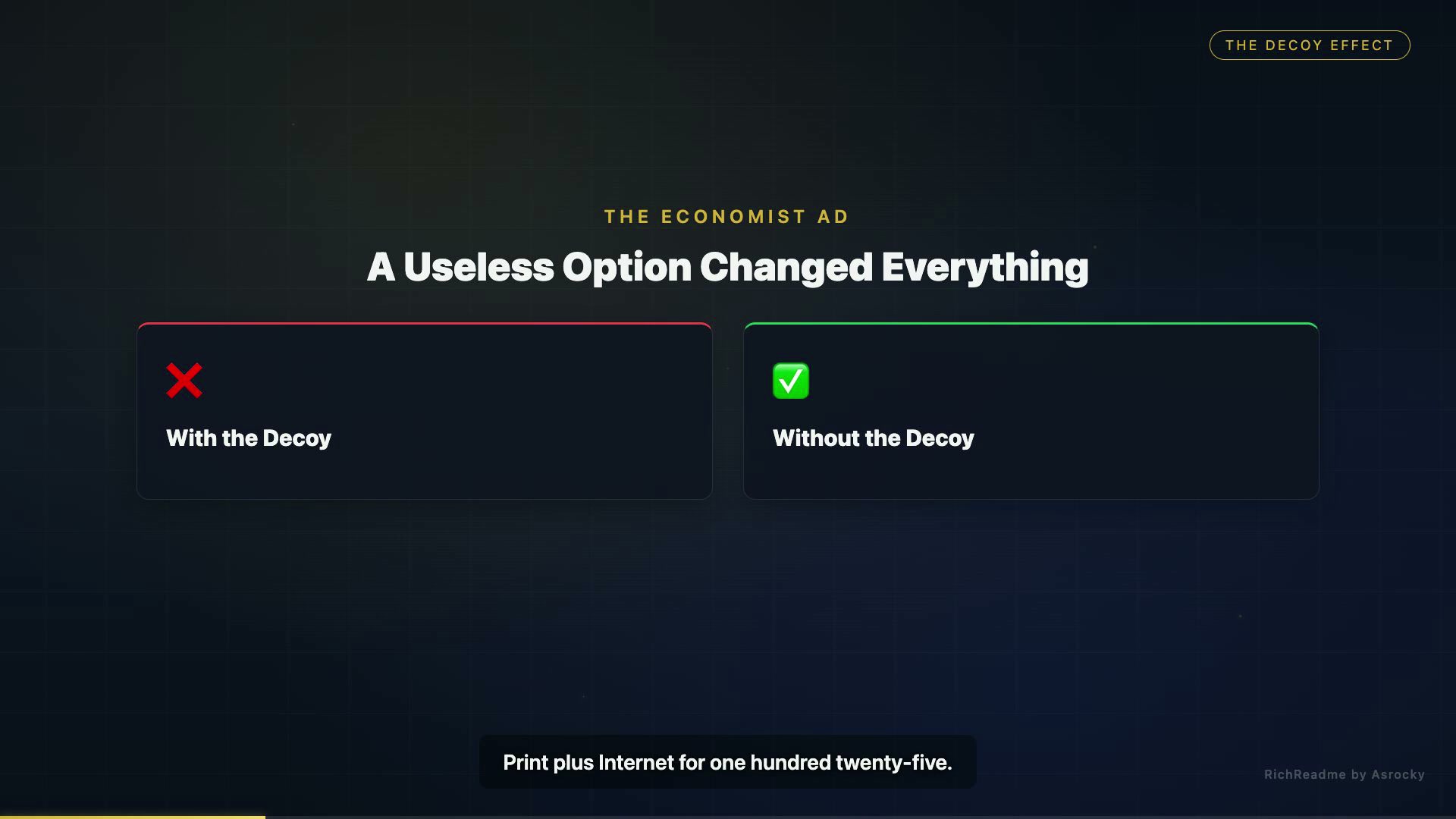
His most famous experiment started with a magazine ad. The Economist offered three deals. Internet only for fifty-nine dollars. Print only for one hundred twenty-five. Print plus Internet for one hundred twenty-five. Who would buy print alone?
Nobody. But that useless option was the decoy. When he showed the ad to a hundred students, eighty-four picked the bundle. Pull out the decoy, and sixty-eight switched to the cheaper deal. We don't choose options. We choose between options.
Free Kills Our Reason
Then there is the power of free. Ariely sold Lindt truffles for fifteen cents and Hershey's Kisses for one cent. Most people picked the truffle, a sensible bargain. He dropped both prices by one cent. Now the truffle was fourteen cents and the Kiss was free.
Logically nothing changed. But sixty-nine percent grabbed the cheap Kiss, abandoning the far better truffle. Free does not just lower price. It short-circuits our reason.
Social Norms vs Market Norms
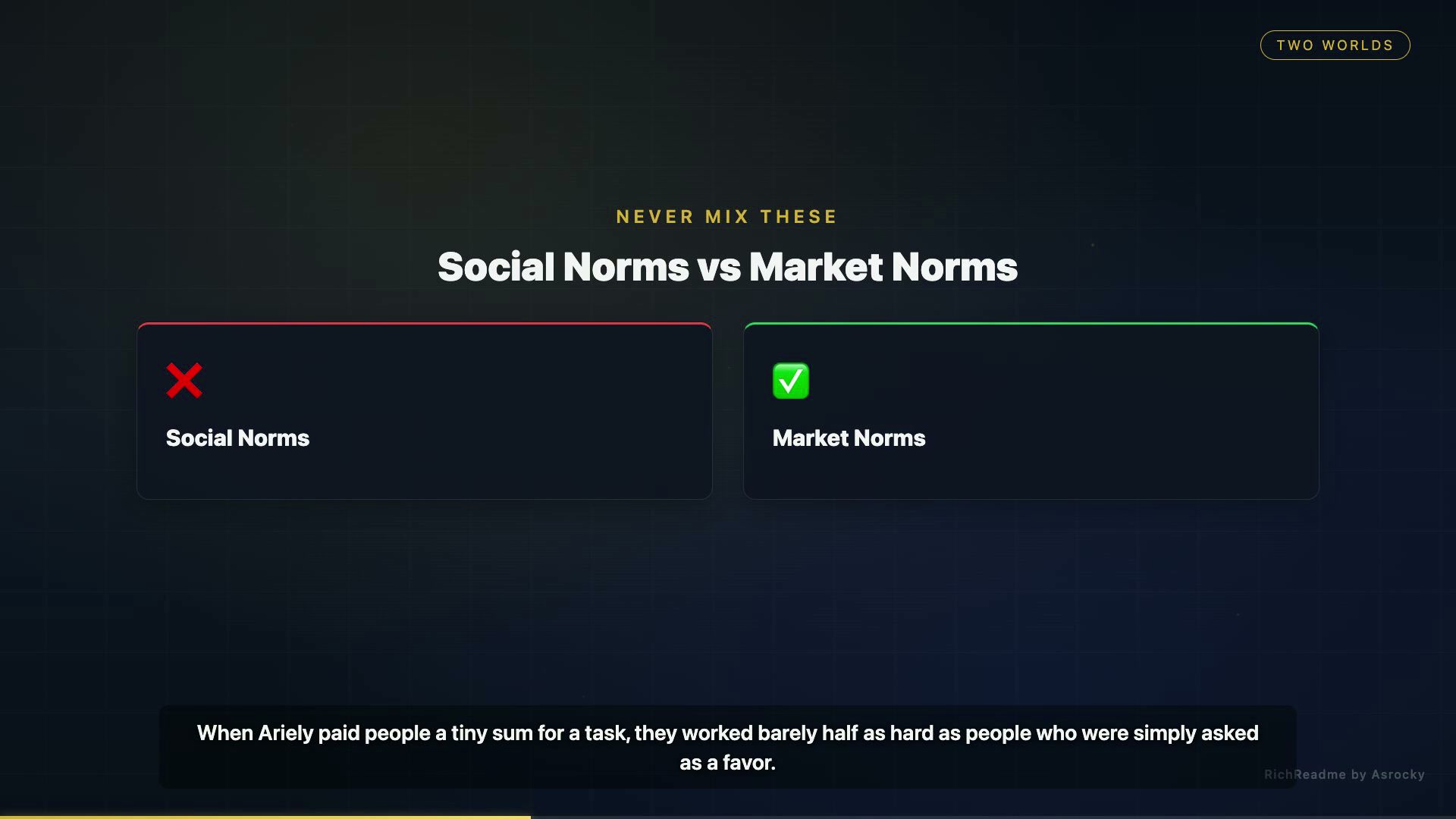
We also live in two worlds we never mix. Social norms are warm. Could you help me move this couch? Market norms are cold.
You get what you pay for. When Ariely paid people a tiny sum for a task, they worked barely half as hard as people who were simply asked as a favor. Mention money, and the kindness evaporates. Mix the two, and you get neither.
The Hot-Cold Gap

When we are calm, we have no idea how we will act when emotional. Ariely asked college students about their decisions in a calm state, then again while sexually aroused. The aroused versions of the same men admitted they were far more likely to take stupid sexual risks.
Our calm selves believe we will behave. Our heated selves make the actual choices.
Placebo

The mind also heals the body on belief alone. In one study, heart patients got either real surgery or a fake operation where the surgeon just cut the skin and sewed it up. Both groups reported the same pain relief for three months.
An expensive pill works better than a cheap one, not because of chemistry, but because we expect it to. Price is part of the treatment.
We Overvalue What Is Ours

Once we own something, we suddenly value it more. Sign up for the cable gold package, and downgrading feels like a loss. Ariely calls this the endowment effect. We overvalue what is ours simply because it is ours.
The market assumes we know what things are worth. Usually we do not. We just decide, then justify.
The Pain of Paying
Credit cards work because they turn paying into a vague future event. Handing over cash hurts, so we avoid spending. Swiping plastic softens that pain, which is exactly why restaurants and stores push cards.
The less visible the cost, the more we spend. We are not budgeting. We are escaping the feeling of loss.
Force Deadlines on Yourself
Procrastination is the same bug in adult form. Ariely tested students who could set their own deadlines. The ones who forced themselves to spread work across the semester scored best.
Left alone, we all promise to start early. Then we do not. We need external structure because our willpower is not built for long horizons.
Clinging to Everything Costs You
We also waste energy trying to keep every option alive. In Ariely's game, players who frantically tried to keep doors from closing earned about fifteen percent less than players who picked one door and stayed. In life and careers, clinging to every possibility costs you more than committing.
The Big Idea

The old economics assumed we are rational and the market will fix our mistakes. Ariely proves we are predictably irrational. Our errors are not random.
They repeat, and they can be designed around. Good companies already design for them, which is why checkout counters sit right next to the candy.
The Traps Stop Working Once You See Them
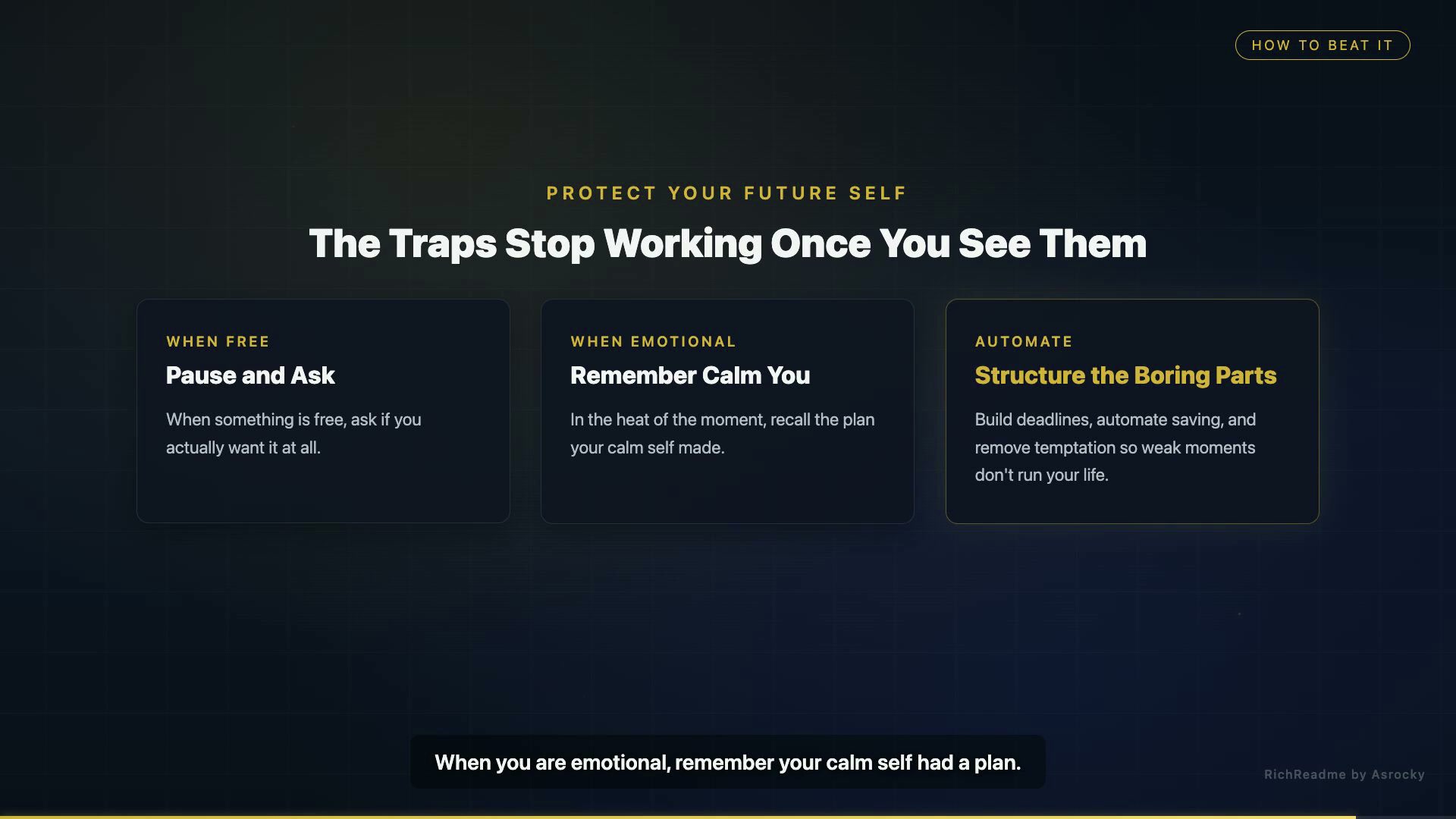
The practical lesson is to stop trusting your gut in the moment. When something is free, pause and ask if you actually want it. When you are emotional, remember your calm self had a plan.
Build deadlines before you need them. Automate the boring decisions so your weak moments do not run your life. Once you see the traps, they stop working on you, and you start choosing for yourself instead.