Why are the best hockey players almost all born in January? It is not talent. It is a birthday cut-off.
This is Outliers by Malcolm Gladwell, published in 2008. Gladwell set out to find why some people rise to extraordinary success. What he discovered is uncomfortable.
Greatness is rarely just about the person. It is about the hidden advantages, timing, and culture that surround them.
The January Advantage

The book opens with a shocking pattern. Look at the best young hockey teams, and a stunning share of the players were born in January, February, or March. The cut-off date for age groups is January first. Kids born early in the year are almost a full year older than their teammates. At that age, a year means enormous physical maturity.
They get picked for better teams, get better coaching, and practice more. The advantage compounds. By adulthood, they look like geniuses. They were just early birthdays.
Luck Gets Resources

Gladwell calls this the Matthew Effect. Advantage snowballs. The lucky get resources, which create more luck. This shows up everywhere. Top software founders were disproportionately born in a narrow window in the mid nineteen fifties.
If you were too old when personal computers arrived, you had a career already. Too young, and you lacked the access. Bill Gates was born in nineteen fifty five. Timing gave him a once-in-a-generation machine at exactly the right age.
Focused Practice

Then comes the famous rule. Gladwell looked at the Beatles and at Bill Gates. To reach the very top, he found, you need about ten thousand hours of focused practice. The Beatles played over a thousand nights in Hamburg, sometimes eight sets a day, before anyone had heard of them.
Gates had rare, early access to a computer at a time when almost no one did, and he snuck out at night to code. Ten thousand hours is real, but notice what it takes. It takes access. Most people never get the chance to put in those hours.
IQ Is Not the Whole Story
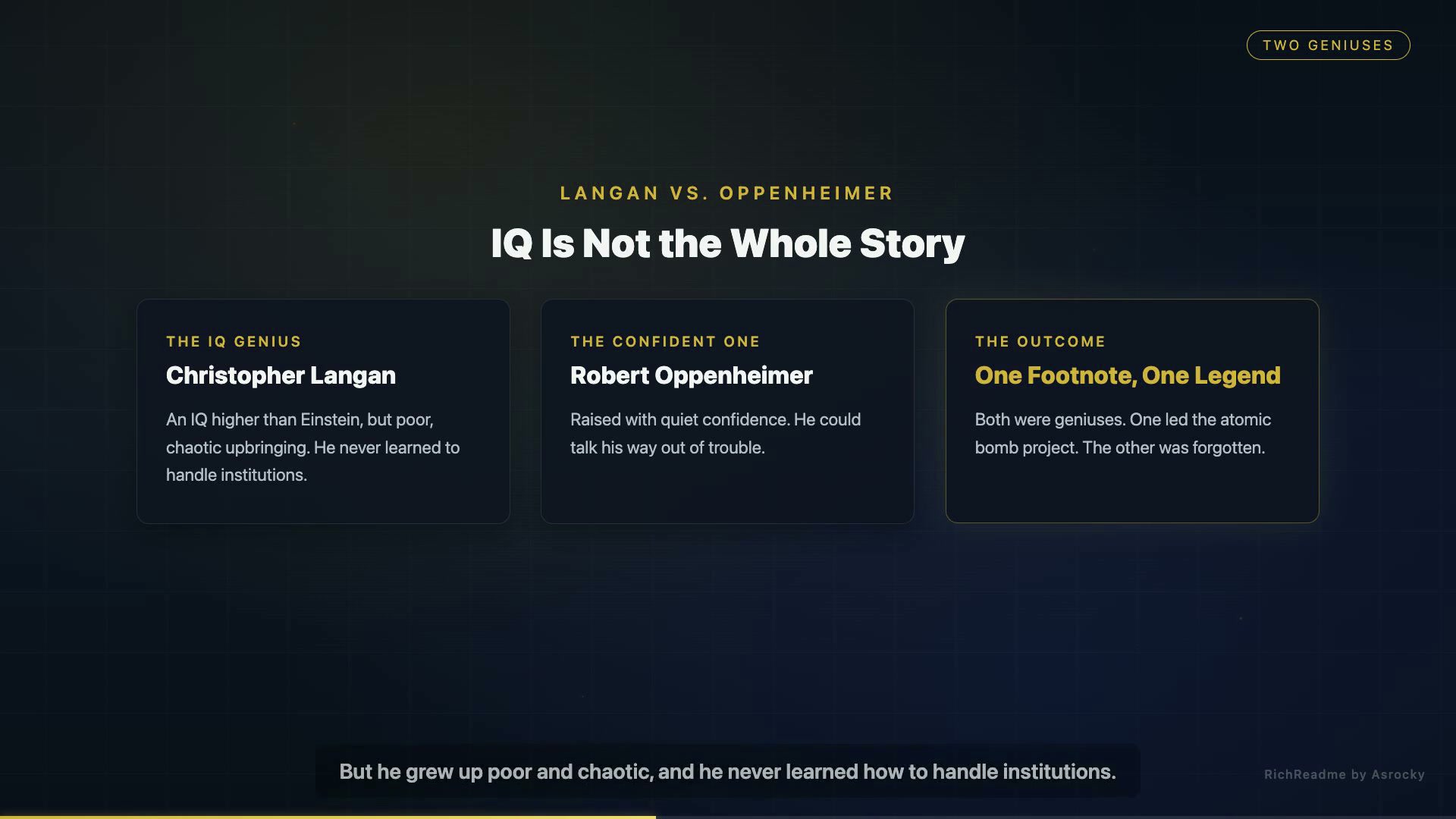
The deeper Gladwell digs, the more he sees that success is handed to people by their culture and their upbringing. He contrasts two brilliant men. Christopher Langan had an astronomical IQ, higher than Einstein. But he grew up poor and chaotic, and he never learned how to handle institutions.
Robert Oppenheimer, by contrast, was raised with the quiet confidence to talk his way out of trouble. Both were geniuses. One became a footnote. The other led the atomic bomb project.
The Skill That Decides

The difference was not raw brainpower. It was what Gladwell calls practical intelligence, the ability to convince, to ask for favors, to make the world accommodate you. This is not taught in school.
It is handed down by parents who treat children as equals, who negotiate and advocate for them. Richer parents do this more. That invisible skill travels across generations and decides more than IQ ever could.
Deference Kills

Culture shows up in the hardest places. Gladwell studied why some airplane crashes happened. The worst, he found, traced back to national styles of authority. Co-pilots in some cultures were too polite to challenge the captain directly.
They hinted. The captain missed it. Hundreds died because of a buried habit of deference, not because of bad planes.
Grit Is Inherited

Work ethic has roots too. People from rice-farming regions, where farming demanded relentless, careful labor, tend to value effort differently. A rice paddy is a hard, year-round task, nothing like the rhythms of Western wheat farming.
The math lesson is that grit is not a moral character it is inherited from a way of life. When immigrant students from those backgrounds arrive, they outperform peers who seem to have every advantage.
Remove the Drain

Gladwell also looked at a girl named Marita, from a poor neighborhood, who won a place at a school called KIPP. That school treated the day like a rice paddy. Longer hours, summer school, no long vacation that erases what was learned. Poor children lost ground every summer while richer ones did not.
KIPP simply removed that drain. Within a few years, kids from the projects were doing math at grade level. The culture changed. The results followed.
Design Your Advantages

The point of the book is not that you are a victim of your birth. It is the opposite. Once you see the hidden forces, you can design them. You can choose environments that compound your effort.
You can move toward the field that is exploding right now, not the one that peaked before you arrived. You can give your children the confidence to ask. You can understand that success is a combination of talent, work, and the luck of your moment. And when you see an outlier, remember to look at the hidden advantages that carried them.