Who makes more money than the biggest banks? Not traders, not bankers. A handful of secretive funds print a billion dollars a year.
This is More Money Than God by Sebastian Mallaby, the inside history of how hedge funds went from a nineteen forty-nine experiment to the most lucrative club on Wall Street.
He Invented the Hedged Fund in 1949

The story starts with a man nobody expected. Alfred Winslow Jones was a journalist and sociologist, not a banker. In nineteen forty-nine he launched what he called a hedged fund.
He bought cheap stocks and shorted expensive ones at the same time, so the market's ups and downs barely mattered. What was left was pure stock-picking skill.
The Fee That Built an Industry

Jones also built the pay model that still runs the industry. Instead of charging a flat fee, he took twenty percent of the profits. He told people he copied Phoenician merchants, who kept a fifth of every successful voyage.
It worked. By nineteen sixty-eight, ten thousand dollars invested with him was worth about four hundred eighty thousand.
The Swashbucklers

The next wave was louder. Michael Steinhardt ran a desk that bought big blocks of stock and leaned on information. In the brutal bear market of nineteen seventy-three and seventy-four, when ordinary managers were losing their shirts, his fund made twelve percent and then twenty-eight percent.
People hated him for it. Shorting American stocks was treated as almost treason.
Prices Change Reality

Then came George Soros, a Hungarian who survived the Nazi occupation by hiding under a false identity. He ran the Quantum Fund and built a philosophy he called reflexivity. His idea was that prices do not just reflect reality.
They change reality, which changes prices back in a feedback loop. In nineteen ninety-two he famously bet against the pound and forced the Bank of England to back down.
He Saw 1929 in the Charts
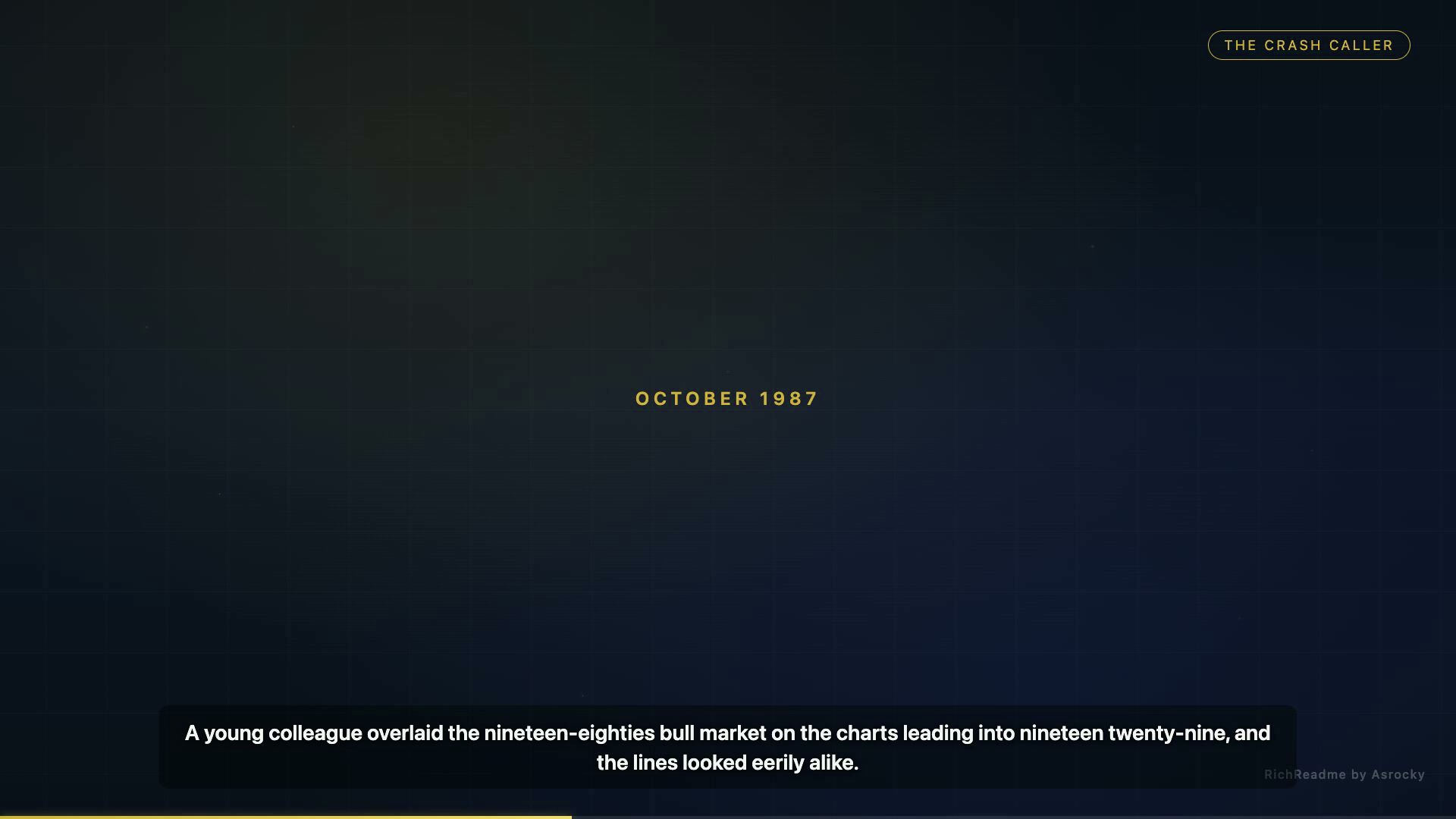
Paul Tudor Jones is famous for calling the nineteen eighty-seven crash. A young colleague overlaid the nineteen-eighties bull market on the charts leading into nineteen twenty-nine, and the lines looked eerily alike. When the Dow fell twenty-three percent in a single day, Jones was positioned to profit. Later he founded Robin Hood to fight poverty in New York.
Medallion's Machine

The strangest success belongs to Jim Simons. He was a mathematician and code-breaker, not a stock picker. He started Renaissance Technologies and launched the Medallion Fund in nineteen eighty-eight.
Early on it crashed almost twenty-five percent, so he shut it down, studied the data, and rebuilt it around tiny short-term patterns. Between nineteen eighty-nine and two thousand six, Medallion returned about thirty-nine percent a year on average.
The Warning

For every winner there is a spectacular blowup. Long-Term Capital Management was run by Nobel Prize winners who thought their math had tamed risk. In nineteen ninety-eight it collapsed so suddenly that the Federal Reserve had to organize a rescue to stop Lehman and other banks from going down with it.
The lesson was not that genius beats the market forever. It is that borrowed money can make even brilliant people fragile.
The Defense

Mallaby makes a surprising defense of these funds. Short selling gets treated as unpatriotic, but short sellers pop bubbles. When a stock is absurdly overpriced, someone has to bet against it.
The managers doing that work provide a soft landing, not a crash. They are the contrarians who keep markets honest.
Professors Joined the Rush

Academics used to say markets were efficient and you could not beat them. Then the nineteen eighty-seven crash proved otherwise. Once professors admitted markets were irrational, they rushed to work for hedge funds.
Endowments piled in too, chasing the uncorrelated returns they call alpha. Between two thousand three and two thousand six, the top hundred funds doubled to a trillion dollars.
The Top Three Earned Over $1B Each

The payoff became absurd. In two thousand six, the top three hedge fund managers each reportedly earned more than a billion dollars in a single year. J.P. Morgan, the most powerful banker of his era, had amassed his entire fortune over a lifetime. These men earned it in twelve months.
Banks Got Trillions. Hedge Funds Got Nothing.

Then two thousand eight hit. Banks collapsed, short selling was banned, investors pulled their money, and hedge funds bled. But here is the twist.
Unlike Citigroup, Goldman, or AIG, hedge funds received no taxpayer bailout. When Long-Term Capital died, the Fed organized a burial but spent no public money. Most of the industry is too small to threaten the system.
They Did Not Fit the Mold

The real takeaway is not that you should quit your job and short stocks. It is that the people who win are often outsiders. Jones was a journalist. Simons was a mathematician.
Soros was a refugee. They did not fit the stodgy Wall Street mold, and that is exactly why they saw things the insiders missed. The market rewards people who refuse to play by the old rules.