Is the stock market fair? You're not imagining it's rigged. Here's the microsecond tax nobody sees.
This is Flash Boys by Michael Lewis, the reporter who exposed Wall Street's inner workings, and the story of how a handful of quiet traders found a hidden machine stealing pennies from every investor.
The Only Goldman Charged After the Crash Was the One Who Left
It starts with a strange arrest. A Russian programmer at Goldman Sachs named Sergey walked out the door, and the FBI cuffed him on a runway. His crime?
Taking the firm's trading code. The government said that code, in the wrong hands, could manipulate markets. The only Goldman employee charged after the crash was the one who left.
They Spent $300M to Shave a Blink
Here is what that code was actually worth. A company called Spread Networks spent three hundred million dollars burying a fiber cable from Chicago to New Jersey. Why? To shave a few milliseconds off the round trip.
The fastest line did it in thirteen milliseconds. That is a tenth of a blink. Whoever owned it owned a license to print money.
Brad's Problem

Enter Brad Katsuyama, a trader at the Royal Bank of Canada. He sent an order to buy five million shares. Before his order even finished reaching the exchanges, the price moved.
It was as if the market could read his mind. Every time he tried to trade big, someone raced in front of him and pushed the price up. He lost a small fortune and could not explain why.
How the Skim Actually Works
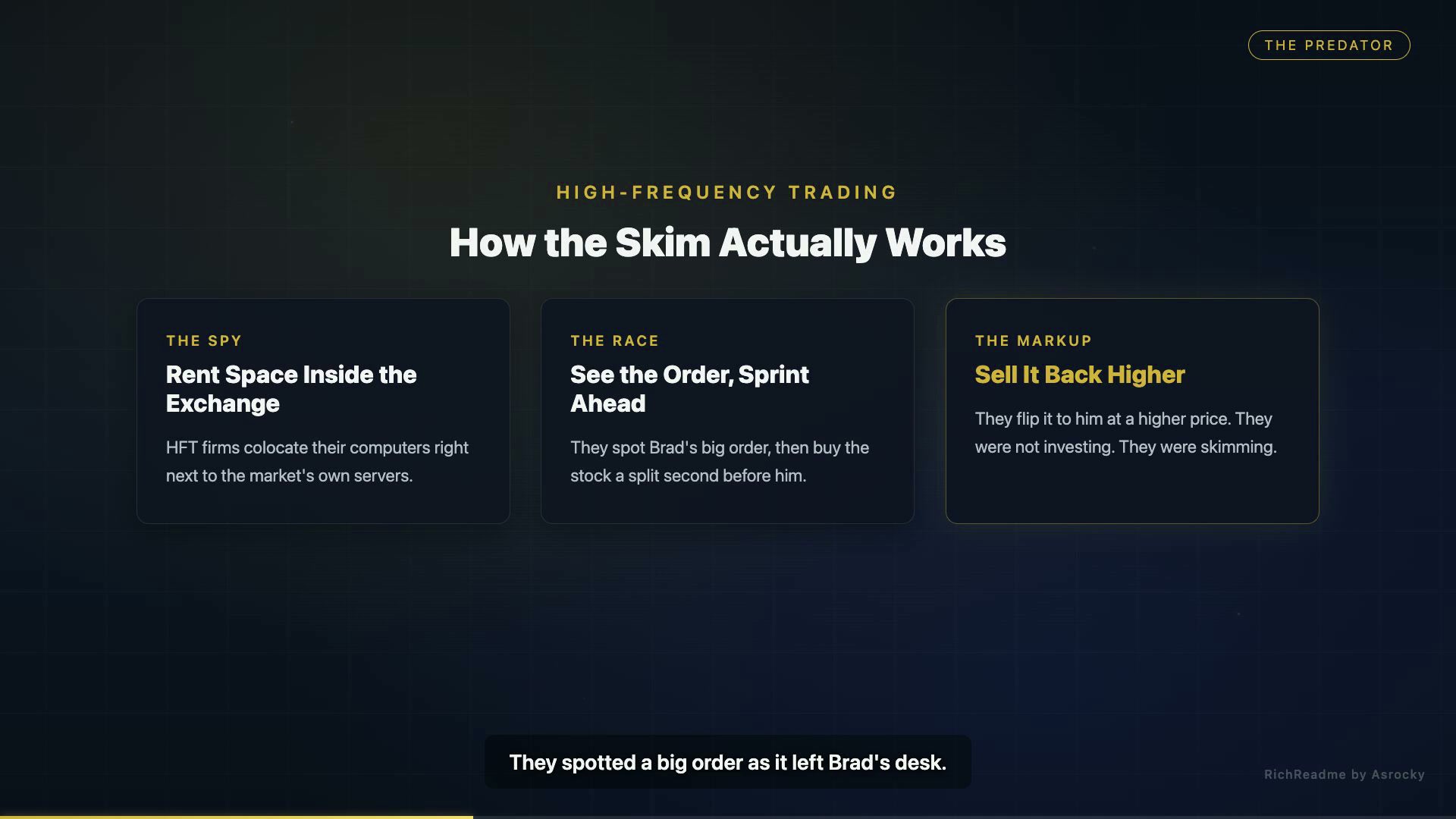
He dug until he found the predator. High-frequency traders rented space right inside the exchanges. They spotted a big order as it left Brad's desk.
Then, in a few thousandths of a second, they raced ahead, bought the stock first, and sold it back to him at a higher price. They were not investing. They were skimming.
It Cost the Market $160 Million a Day
They measured the skim. When Brad blocked the front-running on a ten-million-share trade, he saved twenty-nine thousand dollars. That sounds tiny.
But applied to the whole market, that hidden tax came to over a hundred and sixty million dollars a day. It was so small per trade that no ordinary investor could ever see it.
Banks Built Secret Exchanges, Then Sold Access
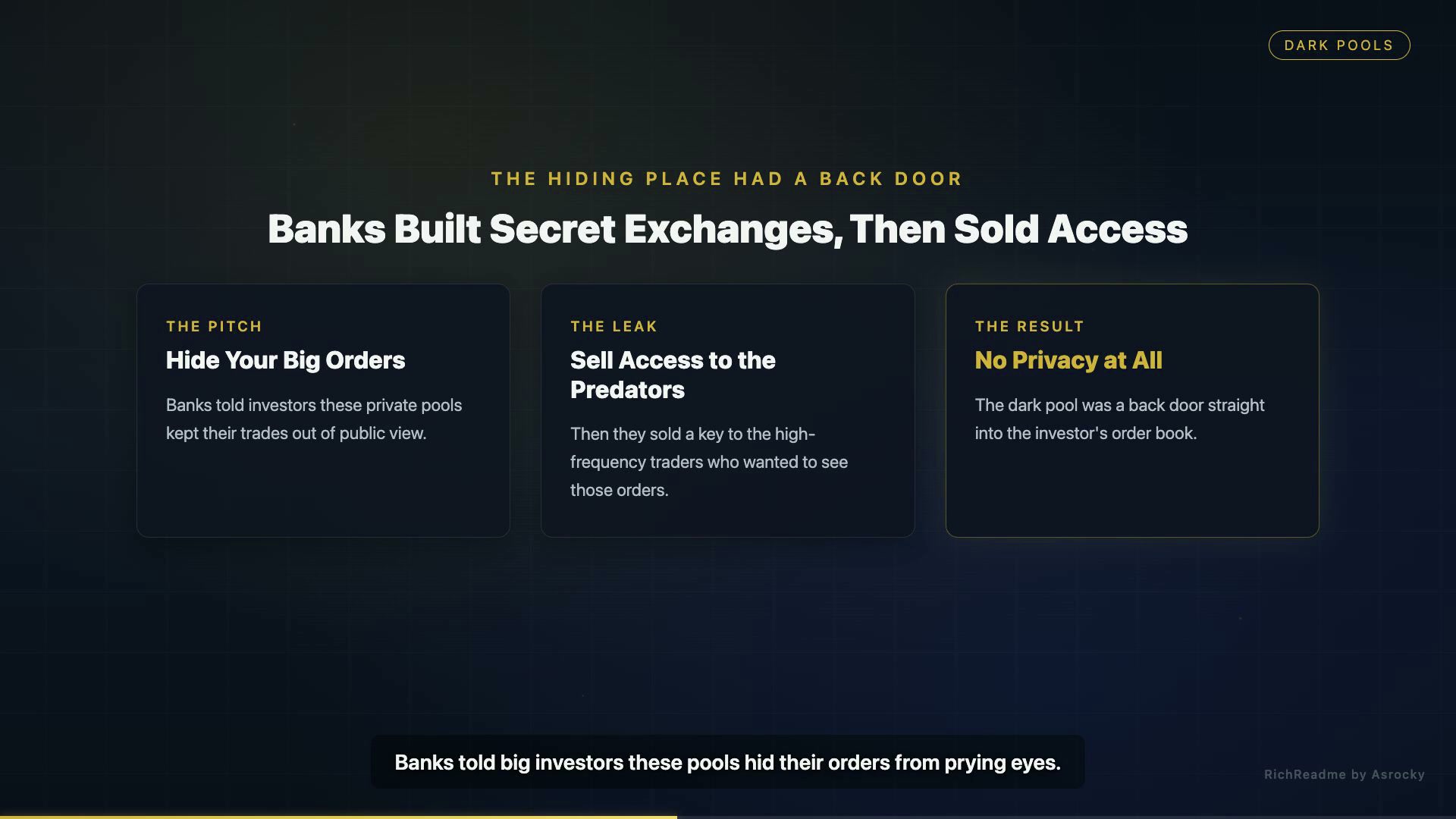
Then came the secret exchanges. Wall Street banks built private markets called dark pools where trades happened out of public view. Banks told big investors these pools hid their orders from prying eyes.
But the banks then sold access inside the pools to the high-frequency traders. The hiding place had a back door, and the predators had a key.
They Paid Hundreds of Millions to Watch You Trade
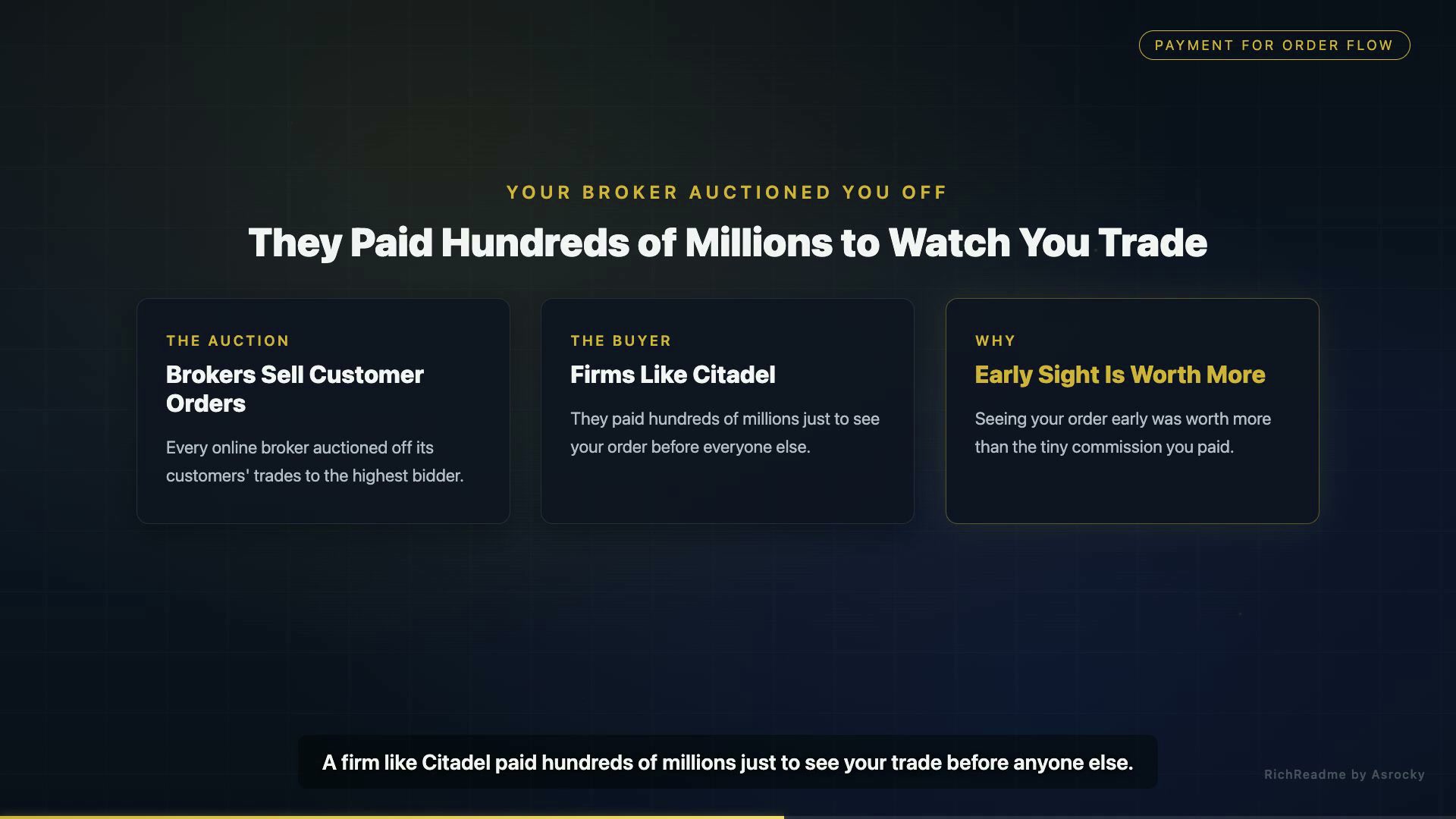
Worse, your broker was selling you out too. Every online broker auctioned off its customers' orders to the highest bidder. A firm like Citadel paid hundreds of millions just to see your trade before anyone else.
Why would they pay so much to watch you buy and sell? Because seeing your order early was worth more than you paid in commissions.
Everyone Raced to Go Faster. He Slowed Down.
Brad's team built the counterweapon. It was called Thor. Everyone on Wall Street was racing to go faster. Brad did the opposite.
He built in tiny delays so his orders reached every exchange at exactly the same instant. No predator could see one exchange and race the others. The screen lit up green. They had beaten the machine.
The Rig

That is when Brad understood the whole system was rigged. The numbers on your business-news screen were an illusion. Exchanges sold speed. Brokers sold order flow.
Dark pools sold access. Everyone took a cut, and the cut came straight out of the pocket of the ordinary investor. The market was not a level playing field. It was a toll road.
IEX: A Speed Bump for Everyone
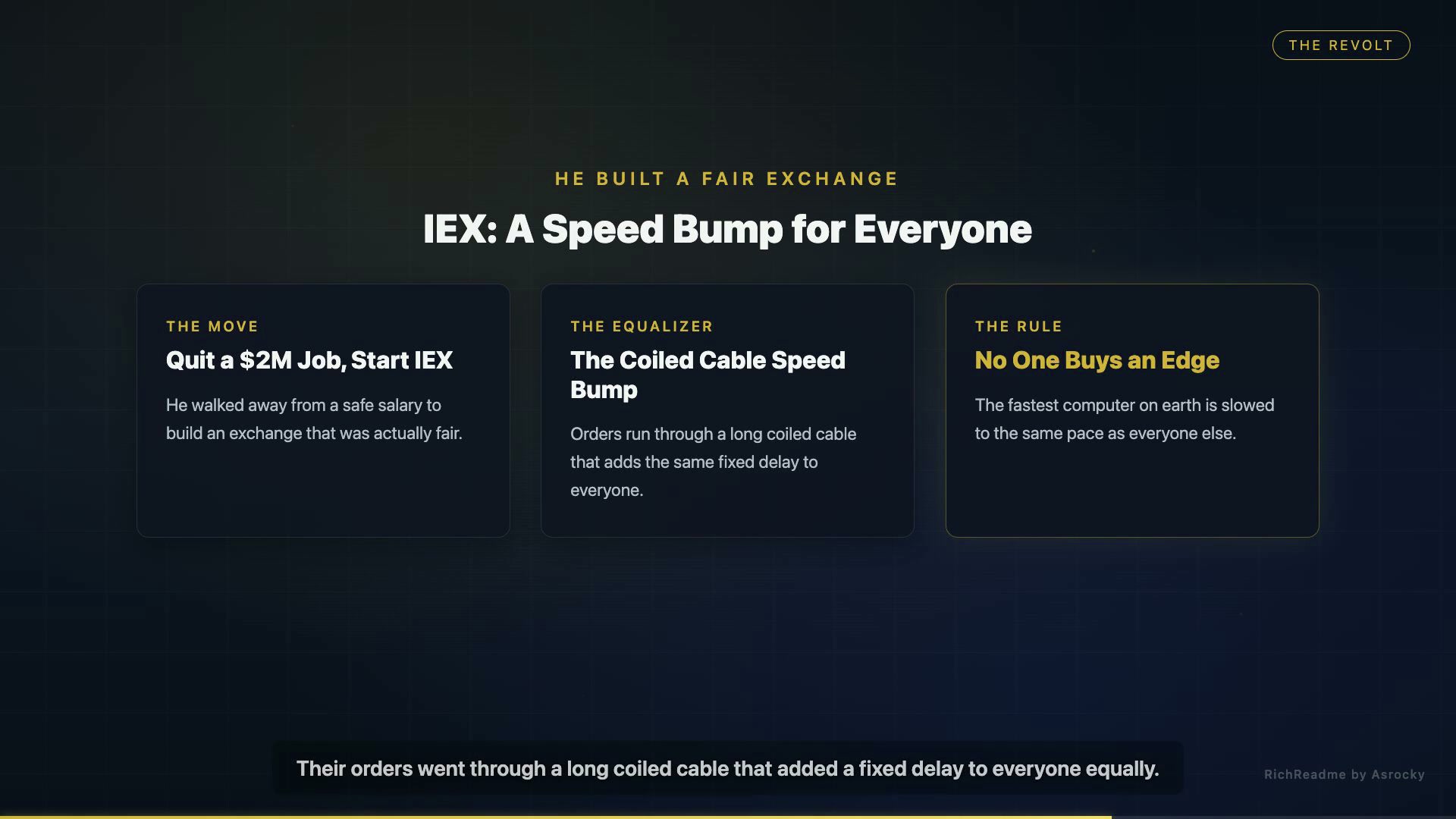
So Brad did the unthinkable. He quit his two-million-dollar job and started an exchange that was fair. It was called IEX. They built a speed bump.
Their orders went through a long coiled cable that added a fixed delay to everyone equally. No one could buy an edge. The fastest computer on earth was slowed to the same pace as everyone else.
The Exodus

The biggest money managers ran to them. Giants holding hundreds of billions moved their business to IEX. The Wall Street banks fought back hard.
They had a sweet racket going. But Brad and his team had built the one thing no rigged market can survive, a trustworthy place to trade.
Fastest Does Not Mean Helpful

The takeaway is not that you should day trade. It is that the system is not on your side by default. The people moving fastest are not trying to help you.
They are skimming a fraction of a penny off millions of trades. When you cannot see a tax, that is usually when you are paying the most.
Beat the Machine by Not Playing Its Game
So what do you actually do? Buy index funds. Think long term.
Do not try to out-trade machines that operate in microseconds. Let the people who built fair markets handle the plumbing. Your edge is patience, not speed.