Loved by early users. Praised by the press. Then sales suddenly die. Why do most breakthrough startups stall right after launch?
This is Crossing the Chasm by Geoffrey Moore, first published in nineteen ninety-one. It is the bible of how disruptive products move from a cult following into the mainstream market.
Customers Arrive in Waves

Moore starts with a simple model called the technology adoption lifecycle. Customers arrive in waves, from left to right. First come the innovators, enthusiasts who love to tinker. Then the early adopters, visionaries who see a revolution.
Then the early majority, practical pragmatists. Then the late majority, cautious skeptics. And finally the laggards, who buy only when there is no other choice.
The Chasm

Normally, each wave flows into the next. Customers move through the lifecycle like people stepping from one block to the next. But Moore found a gap, a crack in the sidewalk, hidden between the early adopters and the early majority.
That gap is the chasm. It is the single most dangerous moment in the life of any breakthrough product.
Dreamers vs. Pragmatists
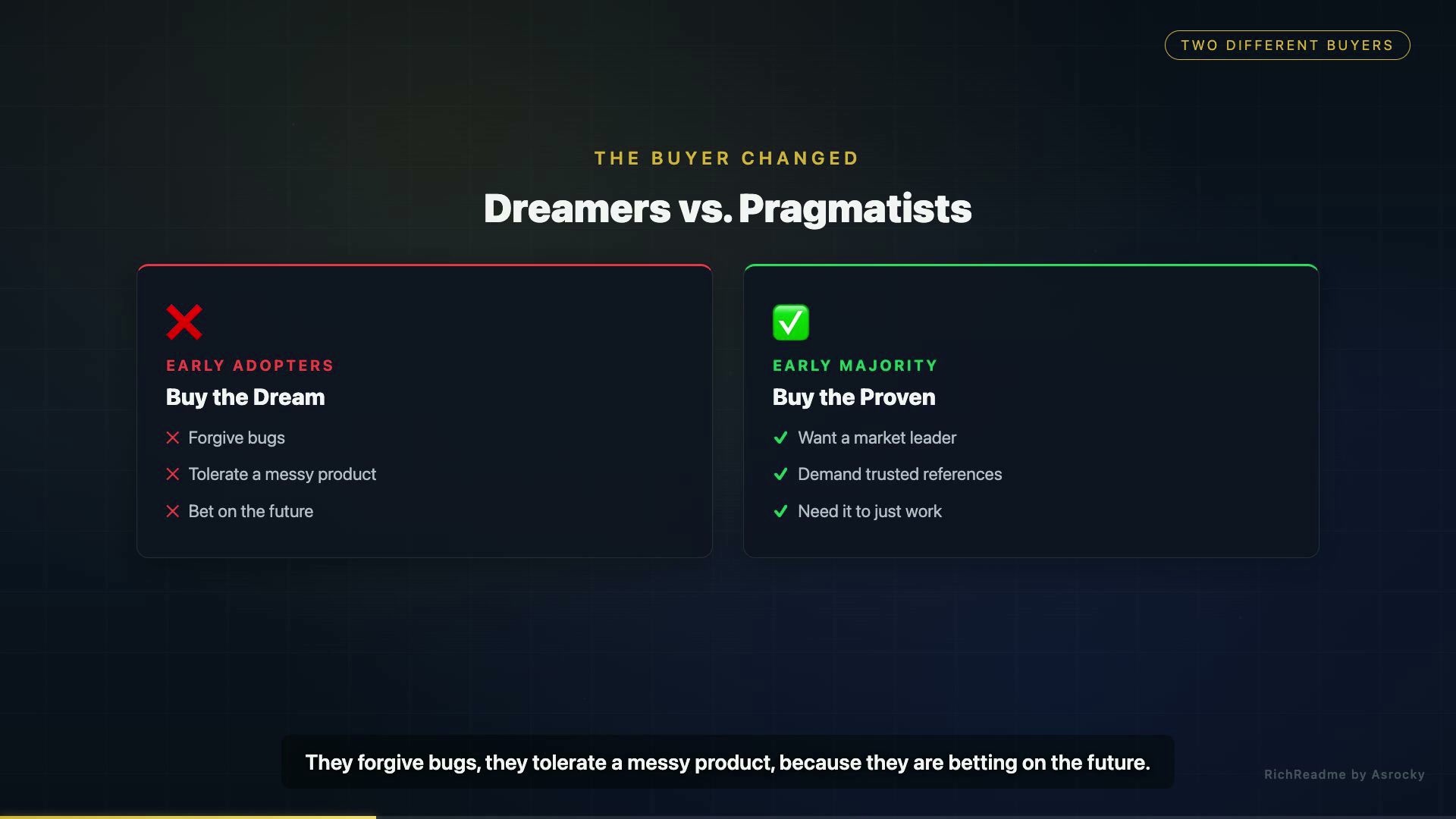
The reason is simple. Early adopters and the early majority are not the same kind of buyer. Visionaries buy the dream.
They forgive bugs, they tolerate a messy product, because they are betting on the future. The early majority, the pragmatists, do not care about your vision. They want a proven solution from a market leader, with references they trust, that just works.
They Sell to the Future, Not the Present

A company can sell beautifully to the dreamers and then hit a wall when the pragmatists will not touch it. The product is the same. What changed is the buyer.
This is why so many startups raise money, win awards, get glowing press, and then quietly die. They fall into the chasm. They are great at selling to the future but cannot sell to the present.
Too Few Visionaries to Build On

This is not just theory. Think of any product that wowed a small crowd and then vanished. They had loyal fans, great demos, and press coverage, but no way to win over the practical buyer.
The early market is small by design. There are simply not enough visionaries to build a large company on. To grow, you must cross the chasm, and most companies never do.
Pick One Beachhead, Not the Whole Coast

Moore compares crossing the chasm to D-Day in the second world war. You do not attack the whole coastline at once. You pick one narrow beachhead, a single niche market, and pour every resource into taking it completely. You become the undisputed leader of that one small market before you ever think about expanding.
Where You Are Clearly the Best Answer

Targeting the beachhead means choosing carefully. Do not spread your product across many customers at once. Find the segment where your product is so clearly the best answer that pragmatists will buy it despite the risk.
Then dominate it. Win the references, the case studies, and the loyalty that pragmatists demand.
Find the Wedge

Choose the beachhead wrong and you lose everything. Pick a market that is too small and you get a safe corner with no growth. Pick one that is too big and you spread yourself thin, letting competitors pick you off. The art is finding the wedge, the narrow entry point where your advantage is sharpest.
Pragmatists Buy the Full Solution

Next you assemble the invasion force. That means a whole product, not just your core technology. Pragmatists need the full solution, the installation, the training, the integration, the service, and the support that make the promise actually work in their world. If any piece is missing, they will wait for someone else to finish it.
Be the Safe Upgrade, Not the Future

You also have to define the battle on your terms. In the early market, visionaries bought the future. In the mainstream, pragmatists compare you to the incumbent. You must position yourself as the better, faster, safer alternative to the old way of doing things, with a clear reason to switch that a busy manager can repeat in one sentence.
Make the Safe Choice Obvious

Then you launch the invasion. You go to market through the channels pragmatists actually trust, not the ones that felt exciting early on. You price for value, you sell through established partners, and you use the beachhead references as your proof.
The goal is no longer to impress enthusiasts. It is to make the safe choice obvious.
Mainstream Takes Off

The payoff is enormous. Once you cross the chasm, the early majority starts to buy in waves. Word of mouth finally works in your favor.
Pragmatists trust other pragmatists, and a leadership position in one niche becomes the bridge to the next adjacent market. This is how a startup becomes a real company.
Growth Without a Foothold = Falling

The lessons apply far beyond technology. Any new idea, from a new app to a new habit, faces the same gap between the excited few and the cautious many. The mistake is trying to scale before you have a proven beachhead. Growth before a real foothold is just a faster way to fall into the chasm.