Wall Street pros spent thirteen years trying to beat this man. He won by buying stocks he spotted at the mall.
This is Beating the Street, by Peter Lynch, who ran the Fidelity Magellan Fund from 1977 to 1990 and turned one thousand dollars into twenty-eight thousand. His core argument is that the individual investor has a real edge, and it comes from the everyday world you already live in, not from brokerage reports or television pundits.
Behind Every Ticker Is a Company

The first thing to remember is that a stock is not a lottery ticket. Behind every ticker symbol is a real company with sales, earnings, employees, products, and a story unfolding quarter by quarter. Most people treat stocks as abstract pieces of paper to trade, which is why they buy on tips and sell on fear. Lynch says once you start seeing the business behind the price, the casino noise fades.
Your Everyday Edge

His most famous rule is invest in what you know. Lynch bought Dunkin' Donuts, Taco Bell, and the Gap because he saw them winning in real life long before the analysts did. A mall employee sees which stores are packed month after month. A nurse sees which hospital supplies keep winning bids.
A car mechanic sees which brands keep coming back with problems and which keep running for two hundred thousand miles. Your job, your shopping, your hobbies are not distractions from investing. They are your research pipeline, and they beat most brokerage reports because you are seeing the numbers firsthand.
Know What You Own

Lynch sorts every stock into one of six buckets, and each bucket has a different job. Slow growers plod along with the economy and pay fat dividends. Stalwarts like Coca-Cola grow steadily at ten or twelve percent. Fast growers expand earnings twenty percent a year and are where the ten-baggers come from.
Cyclicals rise and fall with autos, chemicals, and steel. Turnarounds are battered companies recovering from disaster. Asset plays sit on hidden real estate, cash, or patents the market has ignored.
P/E vs Growth Rate
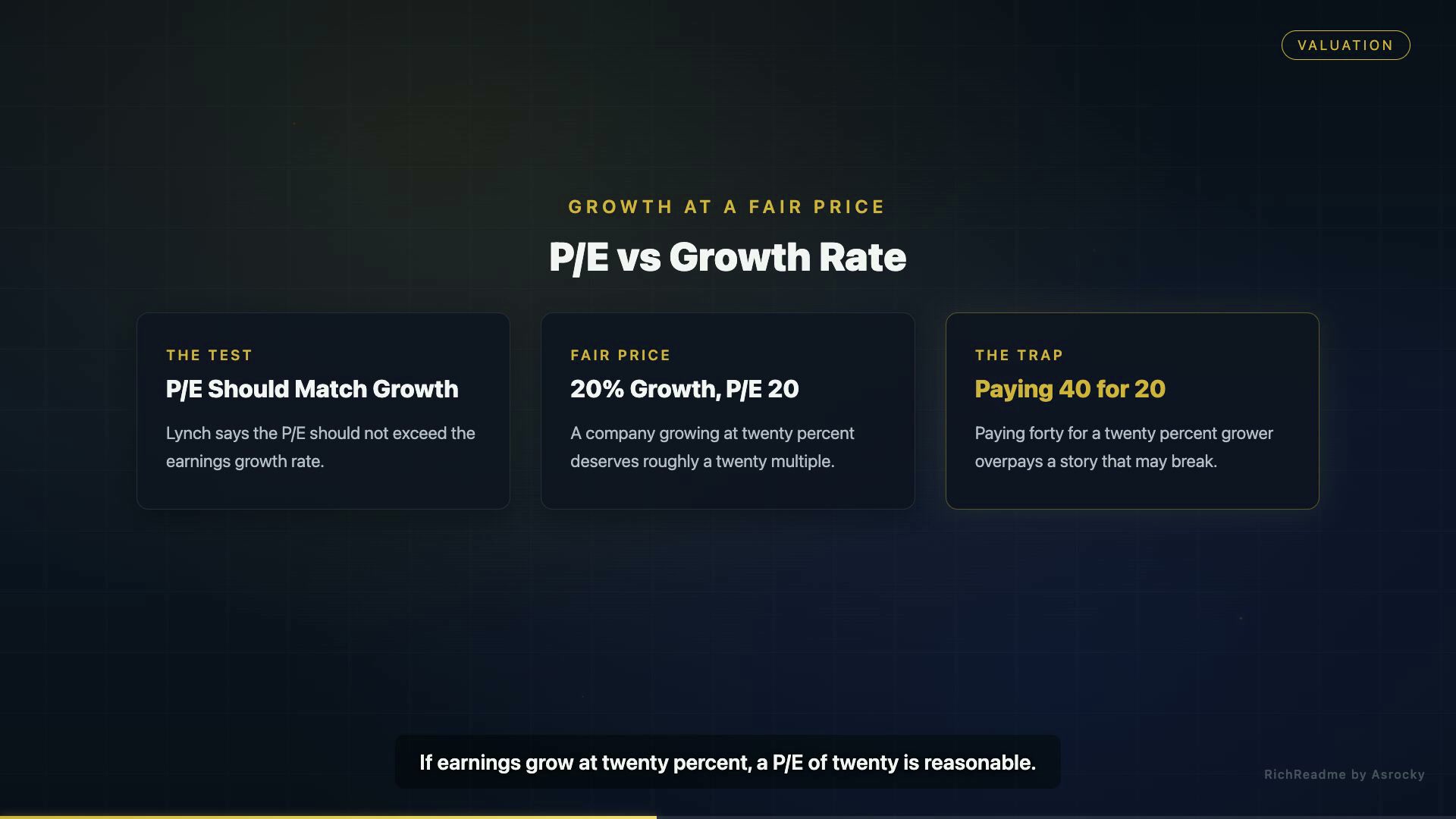
Once you know the bucket, the P/E ratio stops being scary. Lynch's simple rule is that the P/E ratio should not exceed the company's long-term earnings growth rate. If earnings grow at twenty percent, a P/E of twenty is reasonable.
If the same company trades at forty, you are overpaying for a story that may not last. Buy growth at a fair price, not perfection at any price.
Tune Out the Forecasts
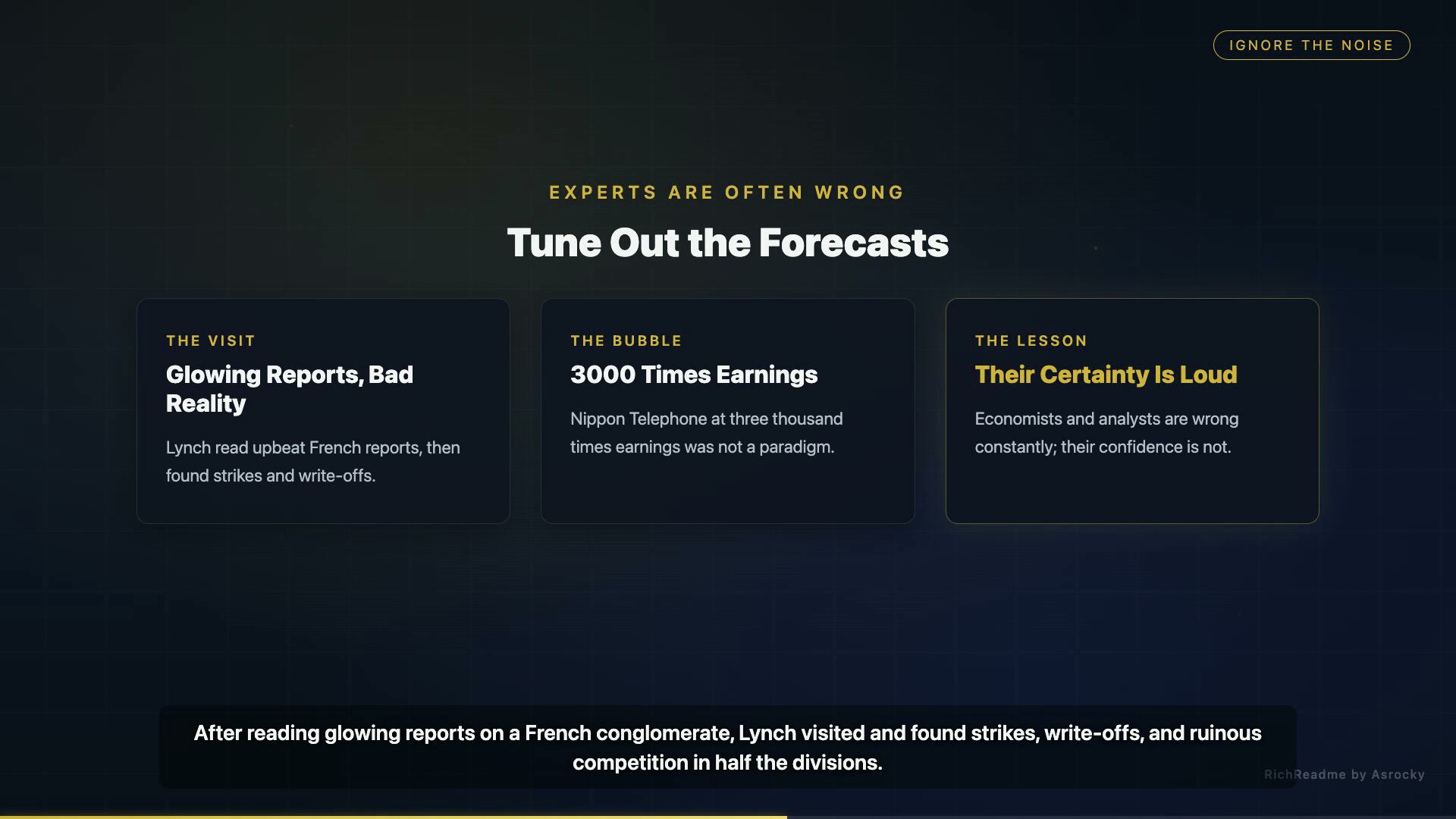
He also warns against listening to the experts. After reading glowing reports on a French conglomerate, Lynch visited and found strikes, write-offs, and ruinous competition in half the divisions. The Japanese market, where Nippon Telephone traded at three thousand times earnings, was not a new paradigm.
It was a bubble. Economists, strategists, and analysts are wrong constantly, and their certainty is far louder than it is accurate.
Five Questions That Matter

The edge comes from doing your own legwork. Lynch flew to Macon, Georgia to eat at Cracker Barrel. He sat through crash courses on insurance at Aetna and Travelers. He walked bank branches and noticed that solid banks were selling at half the market P/E while investors chased flashy companies with no earnings. You do not need a Goldman Sachs model. You need to ask a few blunt questions.
Are sales growing? Are margins holding? Is the balance sheet strong? Is the debt manageable? Is the industry expanding? If you cannot answer those in two sentences, you do not own the stock, the stock owns you.
Own the Narrative
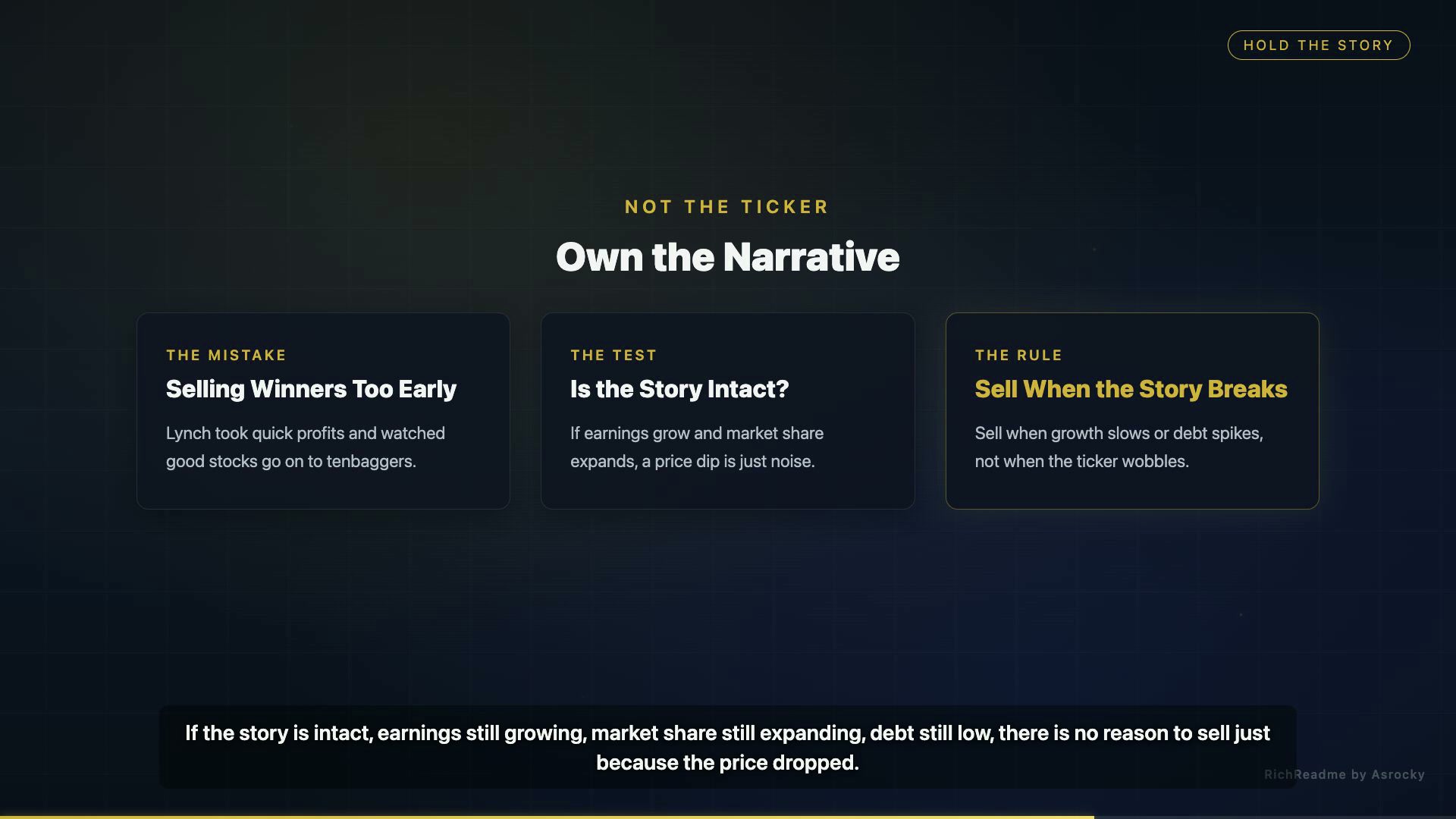
When you buy, you are buying a slice of a company's story. If the story is intact, earnings still growing, market share still expanding, debt still low, there is no reason to sell just because the price dropped. Lynch sold good businesses far too early in his career because he took quick profits, then watched them double, triple, and tenbagger. Hold the story, not the ticker.
Revisit Your Thesis
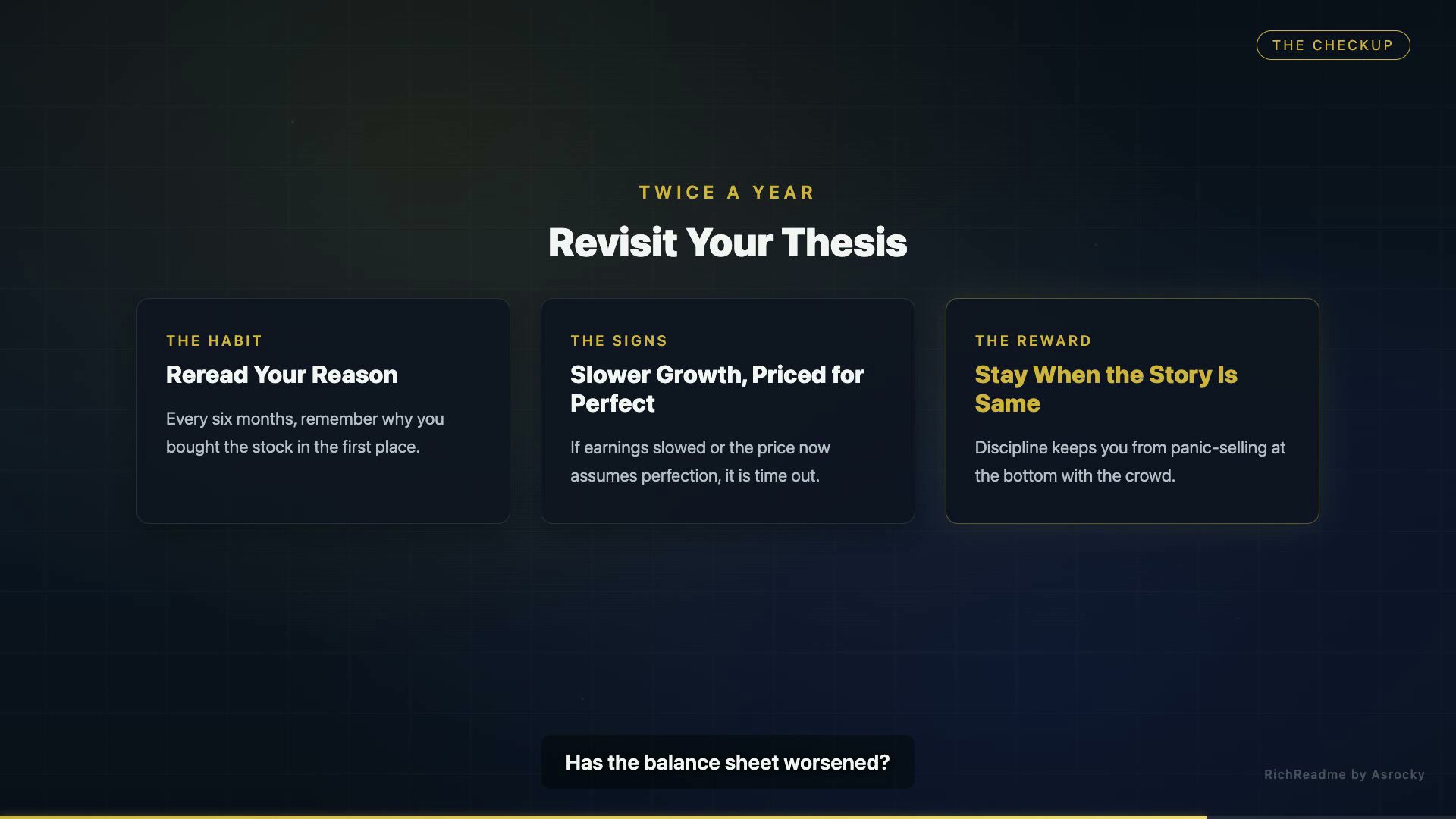
That is why he recommends a six-month checkup on every position. Twice a year, reread the reason you bought. Has growth slowed? Has the balance sheet worsened?
Has the stock been bid up to a price that assumes perfection? If the story is the same, the volatility is just noise. If the story has changed, sell before the crowd notices.
You Need Stomach, Not Just Smarts

Finally, Lynch says success in stocks requires faith as much as analysis. You can be brilliant on balance sheets and still sell at the bottom if you believe the headlines. The market will drop by thirty percent several times in your investing life.
Good companies keep earning through those crashes, but weak hands sell at the worst possible moment. If you cannot stomach a downturn, you do not belong in stocks.