Employees pay taxes first, then spend what is left. Owners spend first, then pay tax on what remains. Same income, totally different wealth.
This is The Book on Advanced Tax Strategies by Amanda Han and Matthew MacFarland, two practicing CPAs who specialize in real estate investors. Most people treat taxes as a fixed number they can only complain about. The authors argue the exact opposite: the tax code is a written set of incentives, and if you structure your life the way the government rewards, you can legally keep a lot more of what you earn.
Written for Owners, Not Workers
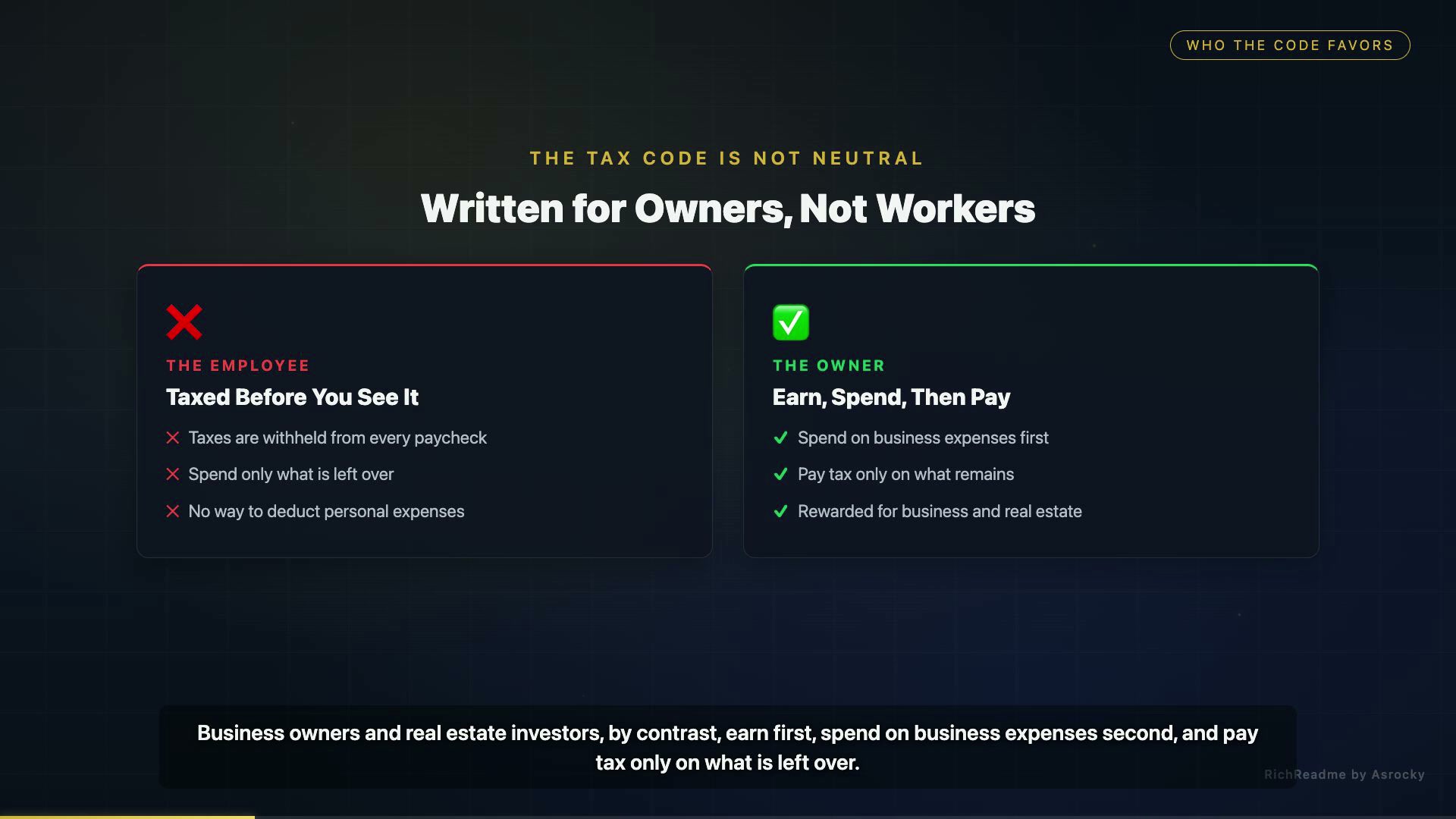
The first big shift is who the system is built for. Employees have taxes withheld before they ever see the money. Business owners and real estate investors, by contrast, earn first, spend on business expenses second, and pay tax only on what is left over.
The tax code is not neutral. It actively rewards owning a business and holding real estate, and it quietly penalizes being a pure wage earner.
Pick the Structure the Rules Give You
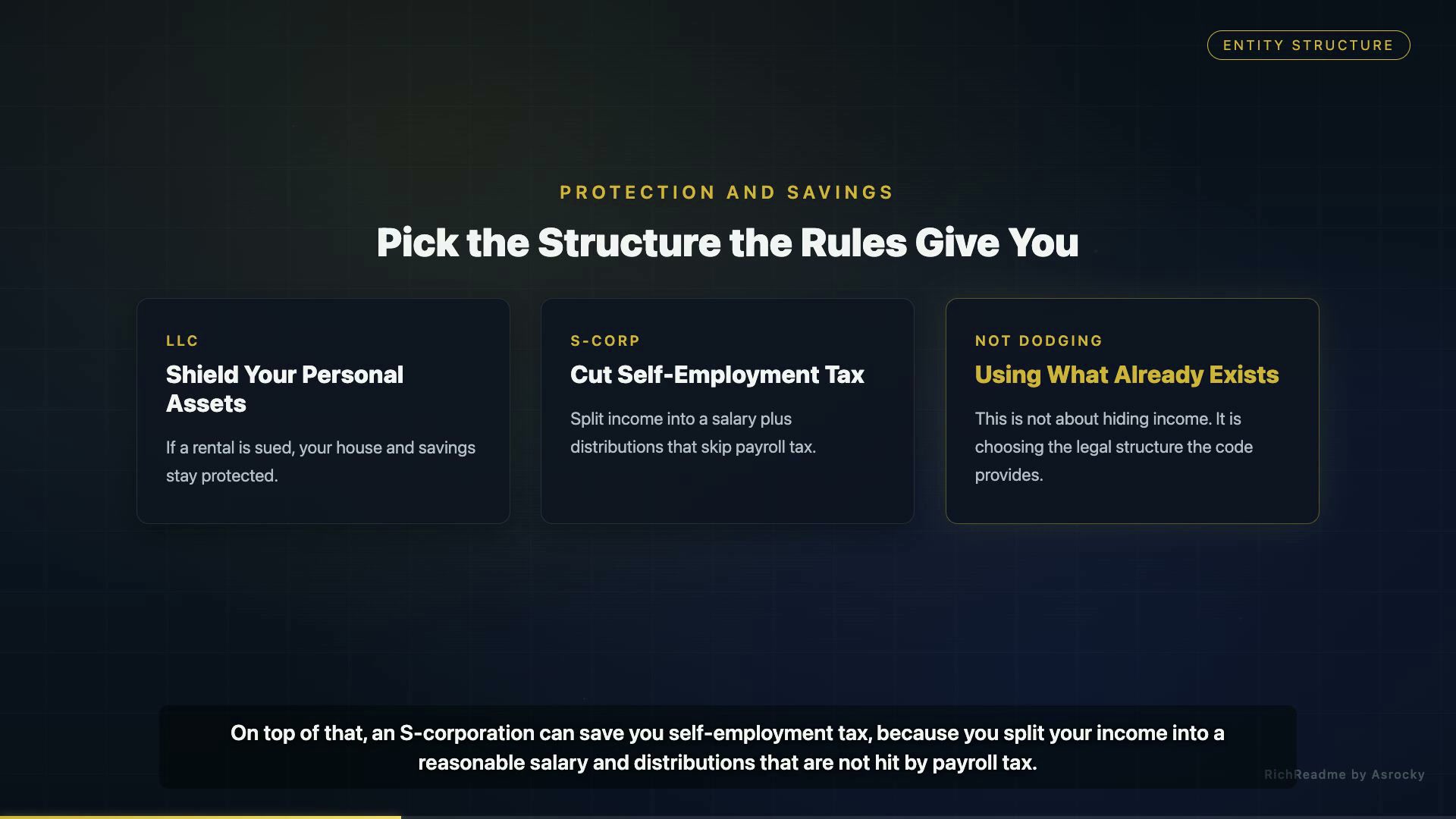
That starts with choosing the right entities. An LLC is mainly for protection, so if someone sues a rental property, they cannot reach your house or savings. On top of that, an S-corporation can save you self-employment tax, because you split your income into a reasonable salary and distributions that are not hit by payroll tax.
The authors stress this is not about dodging anything. It is about picking the legal structure the rules already give you.
Write Off the Everyday Costs

Then there are the deductions most people leave on the table. If you run a real estate business, your home office, your vehicle, your computer, and even travel can be written off, as long as the primary purpose is business. A trip to inspect a property can be combined with a vacation, and the flight and hotel are partly deductible.
Meals, education, and coaching that improve your skills all count. The key is good records and a legitimate business purpose, not a shoebox full of receipts.
Depreciation
Real estate has its own tax superpower called depreciation. The government lets you deduct the building's wear and tear over time, even when the property is actually going up in value. This creates paper losses that can offset your other income, so you collect rent while showing a loss on paper. Push it further with cost segregation, where you reclassify parts of the building to depreciate even faster in the early years.
Turn Paper Losses Into Real Savings

There is also a way around the rule that blocks passive losses. If you qualify as a real estate professional, meaning you spend more than half your working time in real estate, those paper losses can fully offset your ordinary income, dollar for dollar. Short-term rentals, like Airbnb-style properties, can qualify for another loophole that lets you deduct the losses without that full-time status. These are the strategies the authors built their practice on.
Don't Hand Over the Gain

When it comes time to sell, you do not have to hand over a giant tax bill. A 1031 exchange lets you sell one property and roll all the gains into a new one, deferring the tax indefinitely. And if you simply hold until death, your heirs get a step-up in basis, wiping out decades of appreciation entirely. The code rewards the patient holder and punishes the quick flipper.
Retirement Accounts

You can even shelter new money with self-directed retirement accounts. Instead of a boring mutual fund, a self-directed IRA or Roth can hold real estate and private deals, letting that investment grow tax-free or tax-deferred inside the account. Combining the right entity, the right deductions, and the right account is how investors stack several legal breaks at once.
Think Like an Owner

So where do you begin? First, track every business-related dollar, because a deduction never taken is money thrown away. Second, get a CPA who actually works with real estate investors, not just one who files W-2s. Third, stop thinking like an employee and start structuring your income the way the tax code rewards.
Small legal moves, repeated over years, beat any single investment return. The difference between paying a little tax and paying a lot is not genius. It is just doing the homework the code already hands you.