Howard Marks
Selling Out
PDF Translations
Japanese
Korean
Simplified Chinese
Traditional Chinese
Memos from Howard Marks
Jan 13, 2022
PDF (English)
PDF (Translations)
Listen to Memo
Archived Memos
Subscribe
Selling Out
As I’m now in my fourth decade of memo writing, I’m sometimes tempted to conclude I should quit, because I’ve covered all the relevant topics. Then a new idea for a memo pops up, delivering a pleasant surprise. My January
2021 memo
Something of Value
which chronicled the time I spent in 2020 living and discussing investing with my son Andrew, recounted a semi-real conversation in which we briefly discussed whether and when to sell appreciated assets. It occurred to me that even though selling
is an inescapable part of the investment process, I’ve never devoted an entire memo to it.
The Basic Idea
Everyone is familiar with the old saw that’s supposed to capture investing’s basic proposition: “buy low, sell high.”
It’s a hackneyed caricature of the way most people view investing. But few
things that are important can be distilled into just four words; thus, “buy low, sell high” is nothing but a starting point for discussion of a very complex process.
Will Rogers, an American film star and humorist of the 1920s and ’30s, provided what he may have thought was a more comprehensive roadmap for success in the pursuit of wealth:
Don’t gamble; take all your savings and buy some good stock and hold it till it goes up, then sell it. If it don’t go up, don’t buy it.
The illogicality of his advice makes clear how simplistic this adage – like many others – really is. However, regardless of the details, people may unquestioningly accept that they should sell appreciated investments. But how helpful
is that basic concept?
Origins
Much of what I’ll write here got its start in a 2015 memo called
Liquidity
. The hot topic in the investment world at that moment was the concern about a perceived decline in the liquidity provided by the market (when I say “the market,” I’m talking specifically
about the U.S. stock market, but the statement has broad applicability). This was commonly attributed to a combination of (a) the licking investment banks had taken in the Global Financial Crisis of 2008-09 and (b) the Volcker Rule, which prohibited
risky activities such as proprietary trading on the part of systemically important financial institutions. The latter constrained banks’ ability to “position” securities, or buy them, when clients wanted to sell.
Maybe liquidity in 2015 was less than it had previously been, and maybe it wasn’t. However, looking beyond the events of the day, I closed that memo by stating my conviction that (a) most investors trade too much, to their own detriment, and
(b) the best solution for illiquidity is to build portfolios for the long term that don’t rely on liquidity for success. Long-term investors have an advantage over those with short timeframes (and I think the latter describes the majority
of market participants these days). Patient investors are able to ignore short-term performance, hold for the long run, and avoid excessive trading costs, while everyone else worries about what’s going to happen in the next month or quarter
and therefore trades excessively. In addition, long-term investors can take advantage if illiquid assets become available for purchase at bargain prices.
Like so many things in investing, however, just holding is easier said than done. Too many people equate activity with adding value. Here’s how I summed up this idea in
Liquidity
, inspired by something Andrew had said:
When you find an investment with the potential to compound over a long period, one of the hardest things is to be patient and maintain your position as long as doing so is warranted based on the prospective return and risk. Investors can easily
be moved to sell by news, emotion, the fact that they’ve made a lot of money to date, or the excitement of a new, seemingly more promising idea.
When you look at the chart for something that’s gone up and to the right for 20 years, think about all the times a holder would have had to convince himself not to sell.
Everyone wishes they’d bought Amazon at $5 on the first day of 1998, since it’s now up 660x at $3,304.
But who would have continued to hold when the stock hit $85 in 1999 – up 17x in less than two years?
Who among those who held on would have been able to avoid panicking in 2001, as the price fell 93%, to $6?
And who wouldn’t have sold by late 2015 when it hit $600 – up 100x from the 2001 low? Yet anyone who sold at $600 captured only the first 18% of the overall rise from that low.
This reminds me of the time I once visited Malibu with a friend and mentioned that the Rindge family is said to have bought the entire area – all 13,330 acres – in 1892 for $300,000, or $22.50 per acre. (It’s clearly worth
many billions today.) My friend said, “I’d like to have bought all of Malibu for $300,000.” My response was simple: “you would have sold it when it got to $600,000.”
The more I’ve thought about it since writing
Liquidity
, the more convinced I’ve become that there are two main reasons why people sell investments: because they’re up and because they’re down.
You
may say that sounds nutty, but what’s really nutty is many investors’ behavior.
Selling Because It’s Up
“Profit-taking” is the intelligent-sounding term in our business for selling things that have appreciated. To understand why people engage in it, you need insight into human behavior, because a lot of investors’ selling is
motivated by psychology.
In short, a good deal of selling takes place because people like the fact that their assets show gains, and they’re afraid the profits will go away.
Most people invest a lot of time and effort trying to avoid unpleasant
feelings like regret and embarrassment. What could cause an investor more self-recrimination than watching a big gain evaporate? And what about the professional investor who reports a big winner to clients one quarter and then has
to explain why the holding is at or below cost the next? It’s only human to want to realize profits to avoid these outcomes.
If you sell an appreciated asset, that puts the gain “in the books,” and it can never be reversed. Thus, some people consider selling winners extremely desirable – they love realized gains. In fact, at a meeting of a
non-profit’s investment committee, a member suggested that they should be leery of increasing endowment spending in response to gains because those gains were unrealized. I was quick to point out that it’s usually a mistake to
view realized gains as less transient than unrealized ones (assuming there’s no reason to doubt the veracity of the unrealized carrying values). Yes, the former have been made concrete. However, sales proceeds are generally reinvested,
meaning the profits – and the principal – are put back at risk. One might argue that appreciated securities are more vulnerable to declines than new investments in assets currently deemed to be attractively priced, but that’s
far from a certainty.
I’m not saying investors shouldn’t sell appreciated assets and realize profits.
But it certainly doesn’t make sense to sell things just because they’re up.
Selling Because It’s Down
As wrong as it is to sell appreciated assets solely to crystalize gains, it’s even worse to sell them just because they’re down.
Nevertheless, I’m sure many people do it.
While the rule is “buy low, sell high,” clearly many people become more motivated to sell assets the more they decline.
In fact, just as continued buying of appreciated assets can eventually turn a bull market into a bubble, widespread selling of things that are down has the potential to turn market declines into crashes. Bubbles and crashes do occur, proving that investors contribute to excesses in both directions.
In a movie that plays in my head, the typical investor buys something at $100. If it goes to $120, he says, “I think I’m onto something – I should add,” and if it reaches $150, he says, “Now I’m highly confident
– I’m going to double up.” On the other hand, if it falls to $90, he says, “I’m going to think about increasing my position to reduce my average cost,” but at $75, he concludes he should reconfirm his
thesis before averaging down further. At $50, he says, “I’d better wait for the dust to settle before buying more.” And at $20 he says, “It feels like it’s going to zero; get me out!”
Just like those who are afraid of surrendering gains, many investors worry about letting losses compound.
They might fear their clients will say (or they’ll say to themselves), “What kind of a lame-brain continues
to hold a security after it’s gone from $100 to $50?
Everyone knows
a decline like that can foreshadow further declines. And look – it happened.”
Do investors really make behavioral errors such as those I’ve described? There’s plenty of anecdotal evidence. For example, studies have shown that the average mutual fund investor performs worse than the average mutual
fund. How can that be? If she merely held her positions, or if her errors were unsystematic, the average fund investor would, by definition, fare the same as the average fund. For the studies’ findings to occur, investors
have to on balance reduce the amount of capital they have in funds that subsequently do better and increase their allocation to funds that go on to do worse. Let me put that another way: on average, mutual fund investors tend to sell
the funds with the worst recent performance (missing out on their potential recoveries) in order to chase the funds that have done the best (and thus likely participate in their return to earth).
We know that “retail investors” tend to be trend-followers, as described above, and their long-term performance often suffers as a result. What about the pros? Here the evidence is even clearer: the powerful shift in recent
decades toward indexing and other forms of passive investing has taken place for the simple reason that active investment decisions are so often wrong. Of course, many forms of error contribute to this reality. Whatever the reason,
however, we have to conclude that, on average, active professional investors held more of the things that did less well and less of the things that outperformed, and/or that they bought too much at elevated prices and sold too much at depressed
prices. Passive investing hasn’t grown to cover the majority of U.S. equity mutual fund capital because passive results have been so good; I think it’s because active management has been so bad.
Back when I worked at First National City Bank 50 years ago, prospective clients used to ask, “What kind of return do you think you can make in an equity portfolio?” The standard answer was 12%. Why? “Well,”
we said (so simplistically), “the stock market returns about 10% a year. A little effort should enable us to improve on that by at least 20%.” Of course, as time has shown, there’s no truth in that. “A
little effort” didn’t add anything. In fact, in most cases, active investing detracted: most equity funds failed to keep up with the indices, especially after fees.
What about the ultimate proof? The essential ingredient in Oaktree’s investments in distressed debt – bargain purchases – has emanated from the great opportunities sellers gave us. Negativity reaches a crescendo during
economic and market crises, causing many investors to become depressed or fearful and sell in panic. Results like those we target in distressed debt can only be achieved when holders sell to us at irrationally low prices.
Superior investing consists largely of taking advantage of mistakes made by others. Clearly, selling things because they’re down is a mistake that can give the buyers great opportunities.
When Should Investors Sell?
If you shouldn’t sell things because they’re up, and you shouldn’t sell because they’re down, is it ever right to sell? As I previously mentioned, I described the discussions that took place while Andrew and his
family lived with Nancy and me in 2020 in
Something of Value
. That experience truly was of great value – an unexpected silver lining to the pandemic. That memo evoked the strongest reaction from readers of any
of my memos to date. This response was probably attributable to (a) the content, which mostly related to value investing; (b) the personal insights provided, and especially my confession regarding my need to grow with the times;
or (c) the recreated conversation that I included as an appendix. The last of these went like this, in part:
Howard: Hey, I see XYZ is up xx% this year and selling at a p/e ratio of xx. Are you tempted to take some profits?
Andrew: Dad, I’ve told you I’m not a seller. Why would I sell?
H: Well, you might sell some here because (a) you’re up so much; (b) you want to put some of the gain “in the books” to make sure you don’t give it all back; and (c) at that valuation, it might be overvalued and precarious.
And, of course, (d) no one ever went broke taking a profit.
A: Yeah, but on the other hand, (a) I’m a long-term investor, and I don’t think of shares as pieces of paper to trade, but as part ownership in a business; (b) the company still has enormous potential; and (c) I can live with a
short-term downward fluctuation, the threat of which is part of what creates opportunities in stocks to begin with. Ultimately, it’s only the long term that matters. (There’s a lot of “a-b-c” in our
house. I wonder where Andrew got that.)
H: But if it’s potentially overvalued in the short term, shouldn’t you trim your holding and pocket some of the gain? Then if it goes down, (a) you’ve limited your regret and (b) you can buy in lower.
A: If I owned a stake in a private company with enormous potential, strong momentum and great management, I would never sell part of it just because someone offered me a full price. Great compounders are extremely hard to find, so it’s
usually a mistake to let them go. Also, I think it’s much more straightforward to predict the long-term outcome for a company than short-term price movements, and it doesn’t make sense to trade off a decision in an area
of high conviction for one about which you’re limited to low conviction. . . .
H: Isn’t there any point where you’d begin to sell?
A: In theory there is, but it largely depends on (a) whether the fundamentals are playing out as I hope and (b) how this opportunity compares to the others that are available, taking into account my high level of comfort with this one.
Aphorisms like “no one ever went broke taking a profit” may be relevant to people who invest part-time for themselves, but they should have no place in professional investing.
There certainly are good reasons for selling, but they have nothing to do with the fear of making mistakes, experiencing regret and looking bad.
Rather, these reasons should be based on the outlook for the investment – not the psyche of the investor – and they have to be identified through hardheaded financial analysis, rigor and discipline.
Stanford University professor Sidney Cottle was the editor of the later versions of Benjamin Graham and David L. Dodd’s
Security Analysis
, “the bible of value investing,” including the edition I read at Wharton 56
years ago. For that reason, I knew the book as “Graham, Dodd and Cottle.” Sid was a consultant to the investment department at First National City Bank in the 1970s, and
I’ve never forgotten his description of investing: “the discipline of relative selection.”
In
other words, most of the portfolio decisions investors make are relative choices.
It’s patently clear that relative considerations should play an enormous part in any decision to sell existing holdings.
If your investment thesis seems less valid than it did previously and/or the probability that it will prove accurate has declined, selling some or all of the holding is probably appropriate.
Likewise, if another investment comes along that appears to have more promise – to offer a superior risk-adjusted prospective return – it’s reasonable to reduce or eliminate existing holdings to make room for it.
Selling an asset is a decision that must not be considered in isolation. Cottle’s concept of “relative selection” highlights the fact that every sale results in proceeds. What will you do with them? Do you
have something in mind that you think might produce a superior return? What might you miss by switching to the new investment? And what will you give up if you continue to hold the asset in your portfolio rather than making
the change? Or perhaps you don’t plan to reinvest the proceeds. In that case, what’s the likelihood that holding the proceeds in cash will make you better off than you would have been if you had held onto the thing
you sold?
Questions like these relate to the concept of “opportunity cost,” one of the most important ideas in financial decision-making.
Switching gears, what about the idea of selling because you think a temporary dip lies ahead that will affect one of your holdings or the whole market? There are real problems with this approach:
Why sell something you think has a positive long-term future to prepare for a dip you expect to be temporary?
Doing so introduces one more way to be wrong (of which there are so many), since the decline might not occur.
Charlie Munger, vice chairman of Berkshire Hathaway, points out that selling for market-timing purposes actually gives an investor two ways to be wrong: the decline may or may not occur, and if it does, you’ll have to figure
out when the time is right to go back in.
Or maybe it’s three ways, because once you sell, you also have to decide what to do with the proceeds while you wait until the dip occurs and the time comes to get back in.
People who avoid declines by selling too often may revel in their brilliance and fail to reinstate their positions at the resulting lows. Thus, even sellers who were right can fail to accomplish anything of lasting value.
Lastly, what if you’re wrong and there is no dip? In that case, you’ll miss out on the ensuing gains and either never get back in or do so at higher prices.
So it’s generally not a good idea to sell for purposes of market timing.
There are very few occasions to do so profitably and very few people who possess the skill needed to take advantage of these opportunities.
Before I close on this subject, it’s important to note that decisions to sell aren’t always within an investment manager’s control. Clients can withdraw capital from accounts and funds, necessitating sales, and the
limited lifespan of closed-end funds can require managers to liquidate holdings even though they’re not ripe for selling. The choice of
what
to sell
under these conditions can still be based on a manager’s
expectations regarding future returns, but deciding
not
to sell
isn’t among the manager’s choices.
How Much Is Too Much to Hold?
Certainly there are times when it’s right to sell one asset in favor of another based on the idea of relative selection. But we mustn’t do this in a mechanical manner. If we did, at the logical extreme, we would put
all of our capital into the one investment we consider the best.
Virtually all investors – even the best – diversify their portfolios. We may have a sense for which holding is the absolute best, but
I’ve never heard of an investor with a one-asset portfolio. They may overweight favorites to take advantage of what they think they know, but they still diversify to protect against what they don’t know.
That
means they sub-optimize, potentially trading off some of their chance at a maximal return to increase the likelihood of a merely excellent one.
Here’s a related question from my reconstructed conversation with Andrew:
H: You run a concentrated portfolio. XYZ was a big position when you invested, and it’s even bigger today, given the appreciation. Intelligent investors concentrate portfolios and hold on to take advantage of what they know,
but they diversify holdings and sell as things rise to limit the potential damage from what they don’t know. Hasn’t the growth in this position put our portfolio out of whack in that regard?
A: Perhaps that’s true, depending on your goals. But trimming would mean selling something I feel immense comfort with based on my bottom-up assessment and moving into something I feel less good about or know less well (or cash).
To me, it’s far better to own a small number of things about which I feel strongly. I’ll only have a few good insights over my lifetime, so I have to maximize the few I have.
All professional investors want good investment performance for their clients, but they also want financial success for themselves. And amateurs have to invest within the limits of their risk tolerance. For these reasons, most
investors – and certainly most investment managers’ clients – aren’t immune to apprehension regarding portfolio concentration and thus susceptibility to untoward developments. These considerations introduce
valid reasons for limiting the size of individual asset purchases and trimming positions as they appreciate.
Investors sometimes delegate the decision on how to weight assets in portfolios to a process called portfolio optimization. Inputs regarding asset classes’ return potential, risk and correlation are fed into a computer model, and
out comes the portfolio with the optimal expected risk-adjusted return. If an asset appreciates relative to the others, the model can be rerun, and it will tell you what to buy and sell. The main problem with these models lies
in the fact that all the data we have regarding those three parameters relates to the past, but to arrive at the ideal portfolio, the model needs data that accurately describes the future. Further, the models need a numerical input
for risk, and I absolutely insist that no single number can fully describe an asset’s risk. Thus, optimization models can’t successfully dictate portfolio actions.
The bottom line:
we should base our investment decisions on our estimates of each asset’s potential,
we shouldn’t sell just because the price has risen and the position has swelled,
there can be legitimate reasons to limit the size of the positions we hold,
but there’s no way to scientifically calculate what those limits should be.
In other words, the decision to trim positions or to sell out entirely comes down to judgment . . . like everything else that matters in investing.
The Final Word on Selling
Most investors try to add value by over- and underweighting specific assets and/or through well-timed buying and selling. While few have demonstrated the ability to consistently do these things correctly (see my comments on active management
on page 4), everyone’s free to have a go at it. There is, however, a big “but.”
What’s clear to me is that simply being invested is by far “the most important thing.”
(Someone should write a book with that title!) Most actively managed portfolios won’t outperform the
market as a result of manipulation of portfolio weightings or buying and selling for purposes of market timing.
You can try to add to returns by engaging in such machinations, but these actions are unlikely to work at best and can get in the way at worst.
Most economies and corporations benefit from positive underlying secular trends, and thus most securities markets rise in most years and certainly over long periods. One of the longest-running U.S. equity indices, the S&P 500, has
produced an estimated compound average return over the last 90 years of 10.5% per year. That’s startling performance. It means $1 invested in the S&P 500 90 years ago would have grown to roughly $8,000 today.
Many people have remarked on the wonders of compounding. For example, Albert Einstein reportedly called compound interest “the eighth wonder of the world.” If $1 could be invested today at the historic compound return
of 10.5% per year, it would grow to $147 in 50 years. One might argue that economic growth will be slower in the years ahead than it was in the past, or that bargain stocks were easier to find in previous periods than they are today.
Nevertheless, even if it compounds at just 7%, $1 invested today will grow to over $29 in 50 years.
Thus, someone entering adulthood today is practically guaranteed to be well fixed by the time they retire if they merely start investing promptly and avoid tampering with the process by trading.
I like the way Bill Miller, one of the great investors of our time, put it in his
3Q 2021 Market Letter
In the post-war period the US stock market has gone up in around 70% of the years . . . Odds much less favorable than that have made casino owners very rich, yet most investors try to guess the 30% of the time stocks decline, or even
worse spend time trying to surf, to no avail, the quarterly up and down waves in the market. Most of the returns in stocks are concentrated in sharp bursts beginning in periods of great pessimism or fear, as we saw most recently
in the 2020 pandemic decline.
We believe time, not timing, is the key to building wealth in the stock market.
(October 18, 2021. Emphasis added)
What are the “sharp bursts” Miller talks about? On April 11, 2019,
The Motley Fool
cited data from JP Morgan Asset Management’s
2019 Retirement Guide
showing that in the 20-year period between 1999
and 2018, the annual return on the S&P 500 was 5.6%, but your return would only have been 2.0% if you had sat out the 10 best days (or roughly 0.4% of the trading days), and you wouldn’t have made any money at all if you had
missed the 20 best days. In the past, returns have often been similarly concentrated in a small number of days. Nevertheless, overactive investors continue to jump in and out of the market, incurring transactions costs and
capital gains taxes and running the risk of missing those “sharp bursts.”
As mentioned earlier, investors often engage in selling because they believe a decline is imminent and they have the ability to avoid it. The truth, however, is that buying or holding – even at elevated prices – and experiencing
a decline is in itself far from fatal. Usually, every market high is followed by a higher one and, after all, only the long-term return matters.
Reducing market exposure through ill-conceived selling – and thus failing to participate fully in the markets’ positive long-term trend – is a cardinal sin in investing. That’s even more true of selling without reason things that have fallen, turning negative fluctuations into permanent losses and missing out on the miracle of long-term compounding.
* * *
When I meet people for the first time and they find out I’m in the investment business, they often ask (especially in Europe) “what do you trade?” That question makes me bristle. To me, “trading” means
jumping in and out of individual assets and whole markets on the basis of guesswork as to what prices will do in the next hour, day, month or quarter. We don’t engage in such activity at Oaktree, and few people have demonstrated
the ability to do it well.
Rather than traders, we consider ourselves investors.
In my view, investing means committing capital to assets based on well-reasoned estimates of their potential and benefitting from the results over the long term.
Oaktree
does employ people called traders, but their job consists of implementing long-term investment decisions made by portfolio managers based on assets’ fundamentals. No one at Oaktree believes they can make money or advance their
career by selling now and buying back after an intervening decline, as opposed to holding for years and letting value lift prices if fundamental expectations prove out.
When Oaktree was formed in 1995, the five founders – who at that point had worked together for nine years on average – established an investment philosophy based on what we’d successfully done in that time. One of the
six tenets expressed our view on trying to time markets when buying and selling:
Because we do not believe in the predictive ability required to correctly time markets, we keep portfolios fully invested whenever attractively priced assets can be bought. Concern about the market climate may cause us to tilt toward
more defensive investments, increase selectivity or act more deliberately, but we never move to raise cash. Clients hire us to invest in specific market niches, and we must never fail to do our job. Holding investments that
decline in price is unpleasant, but missing out on returns because we failed to buy what we were hired to buy is inexcusable.
We’ve never changed any of the six tenets of our investment philosophy – including this one – and we have no plans to do so.
January 13, 2022
Legal Information and Disclosures
This memorandum expresses the views of the author as of the date indicated and such views are subject to change without notice. Oaktree has no duty or obligation to update the information contained herein. Further, Oaktree makes no representation, and it should not be assumed, that past investment performance is an indication of future results. Moreover, wherever there is the potential for profit there is also the possibility of loss.
This memorandum is being made available for educational purposes only and should not be used for any other purpose. The information contained herein does not constitute and should not be construed as an offering of advisory services or an offer to sell or solicitation to buy any securities or related financial instruments in any jurisdiction. Certain information contained herein concerning economic trends and performance is based on or derived from information provided by independent third-party sources. Oaktree Capital Management, L.P. (“Oaktree”) believes that the sources from which such information has been obtained are reliable; however, it cannot guarantee the accuracy of such information and has not independently verified the accuracy or completeness of such information or the assumptions on which such information is based.
This memorandum, including the information contained herein, may not be copied, reproduced, republished, or posted in whole or in part, in any form without the prior written consent of Oaktree.
©2022 Oaktree Capital Management, L.P.
Share
Related Content
Load More
Recommended Reading
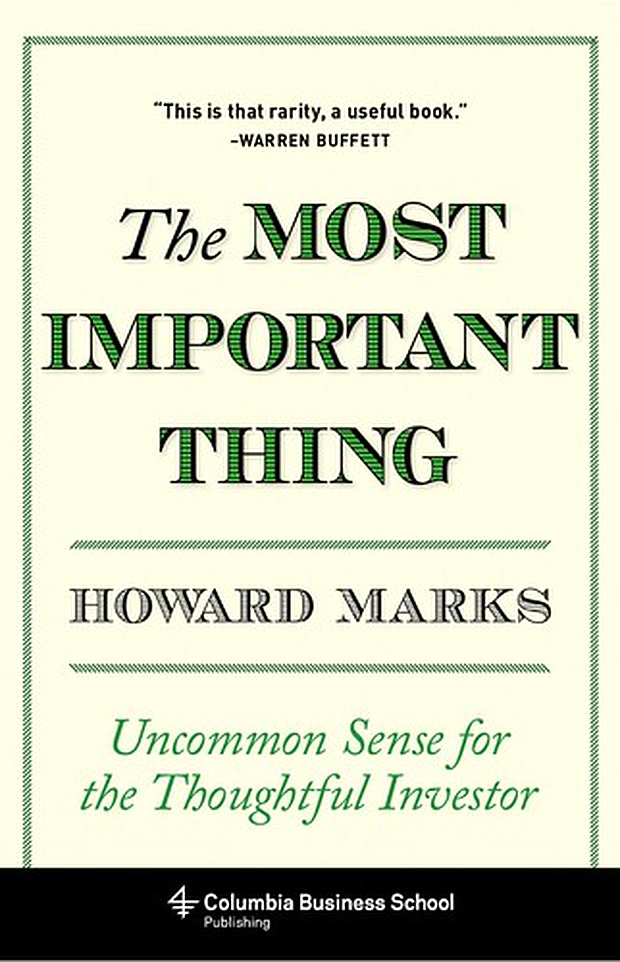
The Most Important Thing
Get on Amazon →
Fooled by Randomness
Get on Amazon →
The Big Short
Get on Amazon →
As an Amazon Associate I earn from qualifying purchases.