Howard Marks
Nobody Knows Ii
© 20 20 Oaktree Capital Management, L.P. All Rights Reserved
Follow us:
Memo to: Oaktree Clients
From: Howard Marks
Re: Nobody Knows II
I wrote most of this memo over th is past weekend, on the heels of the tumultuous seven -day
correction. But I couldn’t get it out on Monday, and that day the S&P 500 rallied by 4.5%, or 135
points, for the biggest point gain in its history. I just can’t update it daily to take into account every
rise or fall (or rate cut) . And my real goal – as usual – is to suggest how to think about
developments , not to say “buy” or “sell.” So please read this memo as of Sunday afternoon –
whatever the market s have done since – and let me show how I assess the recent events.
* * *
I last used this memo title on September 19, 2008, two days after Lehman Brothers’ bankruptcy
filing . This is certainly a n appropriate time to recycle it.
Over the last few weeks, I’ve been asked repeatedly for my view of the coronavirus and its
implications for the markets. I’ve had a ready answer, thanks to something from my January memo,
You Bet! As you may remember, I drew heavily on quotations from Annie Duke’s book on decision
making, Thinking in Bets . The one that stayed with me most – and that I’ve used a lot since the
memo was published on January 13 – is this one :
An expert in any field will have an advantage over a rookie. But neither the veteran
nor the rookie can be sure what the next flip will look like. The veteran will just
have a better guess . (Emphasis added)
In other words, if I said anything about the coronavirus, it would be nothing but a guess.
I’ve written in the past about my react ion when people in China ask for my view of their country’s
future. “You live there, ” I say . “I don’t . Why are you asking me? ” Not only am I not an expert on
China, but I firmly believe t he future of a country isn’t subject to prediction , especially one that
operates under a system that’s unique . I furnish my opinion of China’s future, but I hasten to point
out that it’s nothing but a hunch . People may ask me for my opinion because they think I’m
intelligent, think I’ve been a successful investor, or know I’ve lived through a lot of history.
But none of that should be confused with expertise on subjects of every kind.
And that leads me back to the coronaviru s. No one knows much about it, since this is its first
appearance. As Harvard epidemiologist Marc Lipsitch said on a podcast on the subject , there are (a)
facts, (b) informed extrapolations from analogies to other viruses and (c) opinion or speculation. The
scientists are trying to make informed inferences. Thus far, I don’t think there’s enough data
regarding the coronavirus to enable them t o turn those inferences into facts. And a nything a
non-scientist says is highly likely to be a guess.
© 20 20 Oaktree Capital Management, L.P. All Rights Reserved
Follow us:
So, overall, there are facts, inferences and guesses. It’s always essential to know which you’re
dealing with. As for the virus, I don’t think anybody knows the answers to the following questions :
How does the virus travel from person to person and community to community ? –
People have tested positive who had no known contact with other people who had it or who
were in countries in which there a re known outbreaks .
How many people will contract it ? – On February 28, the head of the World Health
Organization said it had “ increased our assessment of the risk of spread and the risk of impact
of COVID -19 to very high at a global level.” According to Dr. Lipsitch, it will affect 40 % to
70% of all adult Americans. ( I only provide this as an example. I don’t assert that it’s
correct, or that his is the opinion to accept .)
Will it recede? – According to the reported data, the number of new cases in China has
declined substantially, from 9 out of 13 days with more than 3,000 the first half of February,
to 8 out of 9 with less than 500 at the end of the month . How much of this is a function of
the restriction of people’s freedom of moveme nt? To what extent can this downtrend be
extrapolated to the rest of the world ? Some say the virus will recede when the weather turn s
warm, as happen s with other flus. Will th at apply in this case?
What will its effect be ? – To date , only 20% of those contracting the virus have experience d
something described as more than “mild, ” and the fatality rate has been only 2-3% of those
infected . Will th ese percentages hold ? Will the fatalities continue to be primarily among
people who are elderly and/or compromised ? 2% of Dr . Lipsitch’s 40 -70% suggests a
million deaths in the U.S. On the other hand, according to Dean Jamison, a global health
economist and professor emeritus at University of California, San Francisco:
. . . the U.S. has a superior health system to China, where the outbreak is
centered, and months of warning. . . . “I think we’re unlikely to see a really
large outbreak in the U.S. — meaning thousands of deaths ,” he said. (The Wall
Street Journal , March 2)
What countermeasures will be taken ? – Will schools and offices be closed? Will people
be told to stay in their homes? Will food be delivered to homes as in China? Will large
public events be canceled? Will a vaccine be inve nted, and when?
What will be the effect on the economy ? – If people are shut in at home and unable to go to
work, shop, eat out or travel as usual, how will GDP be impacted ? How will a negative
wealth effect impact people’s propensity to spend? “Zero GDP growth” means the same
thing as “same as last year” – is that a n optimistic expectation or a realistic one?
How will the markets react ? – Since the markets’ reaction ultimately will be a function of
both economics and emotion, it seems impossible to quantify how far it’ll go.
I want to stress that the purpose of the above discussion isn’t to give answers or to appear to be
complete or authoritative . If anything, it’s to indicate the degree of u ncertainty . If it’s true, as
I think, that these things are currently unknown and unknowable, then clearly there can be no
such thing as a reliable statement regarding the implications of the virus.
© 20 20 Oaktree Capital Management, L.P. All Rights Reserved
Follow us:
The Economic Impact
In the early days of the disease, when the coronavirus was something that was happening “over there,”
the effects likewise were mostly second -hand:
obviously, a major contraction of the Chinese economy due to factory closures,
the decline in retail spending in Asia,
the curtail ment of travel to and from Asia , and
the important impact of shutting down an essential part of the world supply chain.
The supply -chain effects are particularly important. The unavailability of a small Chinese component
can cripple the production of a large piece of equipment. And it only ta kes one, unless there are
alternative sources. Relocating sourcing will be a challenge: it’ll take time, and there’s no assurance
that the new location s won’t become engulfed in the disease.
More recently, the repercussions have moved beyond Asia and clo ser to the U.S. , and they have grown
in scale for the non -Asia world :
Nestlé SA told more than 290,000 employees to suspend international business
travel until March 15. Several U.S. airlines are canceling flights to China and waiving
change fees for passengers traveling to other affected destinations. U.S. apparel and
footwear companies are facing supply -chain delays, which could result in a shortage
of spring goods. Toy aisles may be bare as production of Barbies and Nerf guns in
China flattened. And containership operators have canceled 40 sailings at the Port of
Los Angeles through April 1, mostly for vessels coming from China. (The Wall
Street Journal , March 2)
The reasons for the economic impact are understandable, but their collective impact can’t be
quantified an y more than most economic phenomena, and probably less given how m uch the
elements in this situation are in flux . There are as many forecasts as there are forecasters:
S&P Global is forecasting the U.S. economy to slow to a 1% annua l growth rate in
the first quarter from 2.1% pace in the fourth quarter of 2019, with a half -percentage
point attributable to the coronavirus. For the full year, the effect would be modest,
shaving one or two tenths of a percentage point off growth. But th at forecast assumes
the impact is mainly overseas. (The Wall Street Journal , March 2)
Mr. Jamison [ the UCSF emeritus professor introduced above] said such a scenario
could still cause U.S. businesses and schools to close, grind transportation networks
to a halt, and trim a half percentage point from economic growth for the year. That is
enough to slow the economy but not cause a recession, or two straight quarters of
economic contraction. He expects any event wouldn’t last longer than several months
and b e followed by a sharp increase in economic activity. (Ibid.)
“You have all the ingredients for an interruption of economic activity here,” said Carl
Tannenbaum , chief economist for Northern Trust. “The impact of what’s going on is
being underappreciated,” he added. “I don’t think the presumption of a month ago,
that this will blow over, is an appropriate posture at this point.” (Ibid.)
© 20 20 Oaktree Capital Management, L.P. All Rights Reserved
Follow us:
Self-Fulfilling Expectat ions Pose Real Economic Risks : Consumers increasingly
expect the economy to get worse. Morning Consult’s Index of Consumer
Expectations (ICE) fell 2.5 points since Feb. 24 and currently stands at 112.9. The
fear for policymakers is that the slide in consum ers’ future expectations becomes a
self-fulfilling prophecy: As more consumers expect the economy to contract in the
coming months, they become more likely to delay discretionary purchases, which in
turn drives down aggregate U.S. demand. ( Morning Consult , March 1 )
Investor Reaction
The markets’ decline in the seven trading days February 20 -28 certainly represents a very strong
negative reaction. The S&P 500, for example, declined by 432 points, or 12.8%. Here are a couple
of indications of its magnitude:
The market crash in the past two weeks has been truly historic: its probability of
occurrence is ~0.1% since 1896; the velocity of the plunge and of the VIX surge is
the fastest on record; and the 10 -year [Treasury yield] is at all -time low. ( Hao Hong,
BOCOM International, a subsidiary of Bank of Communications , March 1 )
While we are merely days into it, this stress episode is already among the most
substantial of the last 25 years, joining an elite group that includes Asian Contagion
(1997), LTCM (1998), the WTC attack (2001), the Accounting Scandals (2002), the
Big One ( 2008 -2009), the Flash Crash (2010), the Eurozone Crisis (2011), the China
“re-peg” (2015) and the VIX event (2018). (Dean Curnutt, Macro Risk Advisors ,
March 1 )
There’s no doubt about the fact that the coronavirus represents a major problem, or that the reaction
so far has been severe. What really matters is whether the price change is proportional to the
worsening of fundamentals .
For most people, the easy thing is to say that (a) the disease is dangerous , (b) it will have a negative
impact on business , (c) it has kicked off a major reaction to date, and (d) we have no way of knowing
how far the decline will go, so (e) we should sell to avoid further carnage. But none of the above
means selling is necessarily the right thing to do.
All these stateme nts reflect a measure of pessimism. However, there’s no way to tell whether that
pessimism is appropriate, inadequate or excessive. I wrote in On the Couch , (January 2016) that “ in
the real world, things generally fluctuate between ‘pretty good’ and ‘not so hot.’ But in the world
of investing, perception often swings from ‘flawless’ to ‘hopeless.’ ” What I can say is that a month
ago, most people thought the macro outlook was uniformly favorable, and they had trouble thinking
of a possible negative catalyst with a serious likelihood of materializing. And now the unimaginable
catalyst is here and terrifying.
(There are a few important lessons here. Firs t, the catalyst for a recession or correction isn’t always
foreseeable. Second, it can seemingly appear out of thin air, as this virus seems to have done. And
© 20 20 Oaktree Capital Management, L.P. All Rights Reserved
Follow us:
third, the negative effect of an unforeseeable catalyst is likely greater when it collides with a market
that reflects so much optimism that it is “priced for perfection.”)
Before leaving this subject, I want to make mention of some illogicalities that mark the current
market reaction , telling me that the market can’t be relied on to reflect reason :
Some people are comparing the coronavirus and its market reaction to the events of 9/11.
But that was a one -day event , and there’s no reason to consider that a n appropriate model for
this instance.
It can be argued that the carnage to date has been ind iscriminate. The shares of Amazon and
Alphabet (Google) experienced declines in line with that of the overall market. But certainly
since they don’t rely on visits from customers, they might be expected to be more immune to
the effect of the virus than most. And Amazon – featuring e -tail orders and at -home
deliveries – could actually find advantages in the current situation.
Not only were stocks hit over the last week, but so was gold. Since gold is supposed to be
the ultimate source of protection in times of dislocation, I can’t imagine any reason why it
should decline in sympathy with stocks in a market correction.
In a flight to safety, people have flocked to the 10 -year Treasury note, bidding up its price
and dropping its yield to 1. 1%. If you think about it, this isn’t very different from the
negative interest rates I complained about in October. How can it be anything but a
manifestation of extreme fear to make an investment that guarantees a return of 1. 1% a year
for the next ten years? And consider that question in the light of the 2% dividend yield on
the S&P 500, or perhaps its earnings yield of almost 6 % (based on prior earnings forecasts) .
I’m not a dyed -in-the-wool devotee of equities, but how can buying the 10 -year at these
yields make better sense .
Finally I want to call your attention to the “elite group of stress episodes” of the last 25 years
enumerated just above by Dean Curnutt. Every one of them was gut -wrenching. And they were
followed by recoveries that produced significant gains for stalwart investors.
Most investors seem to think in terms of a very simple relationship: bad news → price declines. And
certainly we’ve seen some of that over the last week or so. But I’ve argued in the past that there’s
more to the story. The real process is: bad news + decline in psychology → price declines. We’ve
had bad news, and we’ve had price decline s. But if psychology has decline d too much, it might be
argued that the price declines have been excessive given the news, as bad as it is .
Monetary and Fiscal Policy
The good news is that many market participants are counting on the world’s central banks and
treasuries to help pull us out of any economic slowdown. Here’ s one example:
[On February 28,] Fed Chairman Powell released a short statement saying , “The
fundamentals of the U.S. economy remain strong. However, the coronavirus poses
evolving risks to economic activity. The Federal Reserve is closely monitoring
developments and their implications for the economic outlook. We will use our tools
and act as appr opriate to support the economy.” Following Powell’s statement,
© 20 20 Oaktree Capital Management, L.P. All Rights Reserved
Follow us:
futures markets moved to fully price in a 50‐basis‐point rate cut on March 18. (RDQ
Economics, February 28)
Market participants seem to think that (a) rate cuts and other stimulus are always a good thing and (b)
they’ll work. Yet, given that the economic impact of the disease is unknowable, how can investors
be sanguine about the ability of the Fed (plus other central banks and treasuries) to counteract it?
Fifty basis points this month m ay or may not be enough to stem the tide. But investors probably
infer from Powell’s “w e will use our tools and act as appropriate ” language that the Fed will “do
what it takes. ” But we must be mindful of the limitations on “ammunition” that exist. In On the
Other Hand (August 2019), I supplied a list of “ ways in which low rates are undesirable and
potentially harmful. ” The last one was this:
Finally , but very importantly, when interest rates are low, central banks don’t have at
their disposal as much of their best tool for stimulating economies: the ability to cut
rates.
The normal program of rate cuts covers roughly 500 basis points. That’s not a very encouraging
thought when we think about the fact that the short rate already stands at a mere 1 50 bp s. So the one
thing we know is that the Fed doesn’t have room for a normal regime of rate -cutting (there’s uniform
insistence that it won’t cut into n egative territory).
Further, we have to wonder about the desirability of using 50 bp s of the 150 bp s the Fed does have at
its disposal . Will it be enough? And what will the Fed be able to do when the economic impact
of the virus has been muted but we only have 100 bp s or less left with which to fight a ny
recession that appears ?
The facts regarding monetary and fiscal policy are these:
In 2009, to fight the G lobal Financial Crisis, the Fed cut short -term rates to zero for the first
time.
Not wanti ng to derail the subsequent recovery, it hesitated to raise rates before Chair Yellen
enacted a series of rate increases in 2015 -18 that took the Fed funds rate to 2.25 -2.50%.
When around the end of 2018 interest rates reached levels that investors feared would
jeopardize the economic expansion, Chair Powell ’s Fed reversed course and embarked on a
series of three rate cuts.
Thus today we have the 150 bps I mentioned above – “limited ammunition.”
In ad dition to rate cuts, the Fed has the ability to pump liquidity into the economy by
engaging in quantitative easing through purchases of government securities. But we can’t
know the long -term impact of expansion of the Fed’s balance sheet.
Finally, looking away from the Fed, we can think about fiscal policy (i.e., increased deficit
spending). But this will add even more to our national debt.
Normally, fiscal and monetary stimulus is applied in times of economic weakness. (Even Lord
Keynes, who m many peop le consider the father of deficit spending, advocated running deficits and
accumulating debt when the economy grows too slow to create jobs, and then repaying the debt when
the stimulus produces surpluses.) No w we have near -zero interest rates and trillio n-dollar deficits in
© 20 20 Oaktree Capital Management, L.P. All Rights Reserved
Follow us:
times of prosperity. No one wants a recession, but using up our ammunition preemptively may not
have been smart.
The Fed/government’s tool for fighting the economic impact of coronavirus are very limited. Thus I
believe it’s undes irable to be highly sanguine about their powers at this juncture.
What to Do?
These days, people have been asking me whether this is the time to buy. My answer is more nuanced:
it’s probably a time to buy. There can be no unique time to buy that we can identify. The only thing we
can be sure of today is that stock prices , for example, are a lot lower in the absolute than they were two
weeks ago.
Will stocks decline in the coming days, weeks and months? Th is is the wrong question to ask . . .
primarily because it is entirely unanswerable. Since we don’t have answers to the questions about
the virus listed on page two , there’s no way to decide intelligently what the markets will do. We know
the market declined by 13% in seven trading days. There can be absolutely no basis on which to
conclude that they’ll lose another 13% in the weeks ahead – or that they’ll rise by a like amount – since
the answer will be determined largely by cha nges in investor psychology. (I say “largely” because it
will also be influenced by developments regarding the virus . . . but likewise we have no basis on which
to judge how actual developments will compare against the expectations investors already have factored
into asset prices.)
Instead, intelligent investing has to be based – as always – on the relationship between price
and value. In other words, not “w ill the collapse go further? ” But rather “ has the collapse to date
caused securities to be pric ed right; or are they overpriced given the fundamentals ; or have they
become cheap ?” I have no doubt that assessing price relative to value remains the most reliable way
to invest for the long term . (It is the thrust of the whole discussion just above that there’s nothing
that provides reliable help in the short term.)
I want to acknowledge up front that ascertaining intrinsic value is never a simple, cut -and-dried
thing . Now – given the possibility that the virus will cause the world of the future to be very
different from the world we knew – is value too unascertainable to be relied upon? In short, I don’t
think so. What I think we do know is that the coronavirus is not a rerun of the Spanish flu pandemic
of 1918 , “which infected an estimated 500 million people worldwide – about one-third of the planet's
population – and killed an estimated 20 million to 50 million victims, including some 675,000
Americans .” (history.com) Rather, it ’s one more seasonal disease like the flu, something we’ve had
for years, have developed vaccines for, and have learned to deal with. The flu kills about 30,000 -
60,000 Americans each year, and that’s terrible, but it’s very different from an unmanageable
scourge.
So, especially after we’ve learned more about the corona virus and developed a vaccine, it seems to
me that it is unlikely to fundamentally and permanently change life as we know it, make the
world of the future unrecognizable , and de cimate business or make valuing it impossible. (Yes,
this is a guess: we have to make some of them.)
© 20 20 Oaktree Capital Management, L.P. All Rights Reserved
Follow us:
The U.S. stock market’s down about 13% from the top. That’s a big decline. It would be a lot
to accept that the U.S. business world – and the cash flow s it will produce in the future – are
worth 13% less today than they w ere on February 19. That sentence may make it sound like I
think the market’s undervalued. But that’s not the proper interpretation. If it was overvalued on the
19th, rather than being undervalued today, after the decline , it could just be less overvalued. Or it
could be fairly valued , or even undervalued, but it isn’t necessarily.
I think the stock market was overvalued two weeks ago . . . somewhat. That means I think that
toda y, even with the short -term prospects of business somewhat diminished, it’s closer to fairly
valued, but not necessarily a giveaway. In the starkest numerical terms, before the rout, the p/e
ratio on the S&P 500 was 19 or so , roughly 20% above the post -World War II average (and there are
arguments on both sides regarding the current applicability of that average). Thus , after a 13%
decline , you’d have to say the p/e ratio is pretty close to fair (unless earnings for the year will be very
different from w hat they previously had been expected to be).
Buy, sell or hold? I think it ’s okay to do some buying, because things are cheaper. But there’s n o
logical argument for spend ing all your cash , given that we have no idea how negative future events
will be . What I would do is figure out how much you’ll want to have invested by the time the bottom
is reached – whenever that is – and spend part of it today. Stocks may turn around and head
north, and you’ll be glad you bought some. Or they may continue down , in which case you’ll
have money left (and hopefully the nerve) to buy more. That’s life for people who accept that
they don’t know what the future holds.
But no one can tell you this is the time to buy. Nobody knows.
March 3, 2020
Legal Information and Disclosures
This memorandum expresses the views of the author as of the date indicated and such views are subject to
change without notice. Oaktree has no duty or obligation to update the information contained herein.
Further, Oaktree makes no representation, and it should not be assumed, that past investment
performance is an indication of future results. Moreover, wherever there is the potential for profit there
is also the possibility of loss.
This memorandum is bein g made available for educational purposes only and should not be used for any
other purpose. The information contained herein does not constitute and should not be construed as an
offering of advisory services or an offer to sell or solicitation to buy an y securities or related financial
instruments in any jurisdiction. Certain information contained herein concerning economic trends and
performance is based on or derived from information provided by independent third -party sources.
Oaktree Capital Manage ment, L.P. (“Oaktree”) believes that the sources from which such information
has been obtained are reliable; however, it cannot guarantee the accuracy of such information and has
not independently verified the accuracy or completeness of such information o r the assumptions on which
such information is based.
This memorandum, including the information contained herein, may not be copied, reproduced,
republished, or posted in whole or in part, in any form without the prior written consent of Oaktree.
Recommended Reading
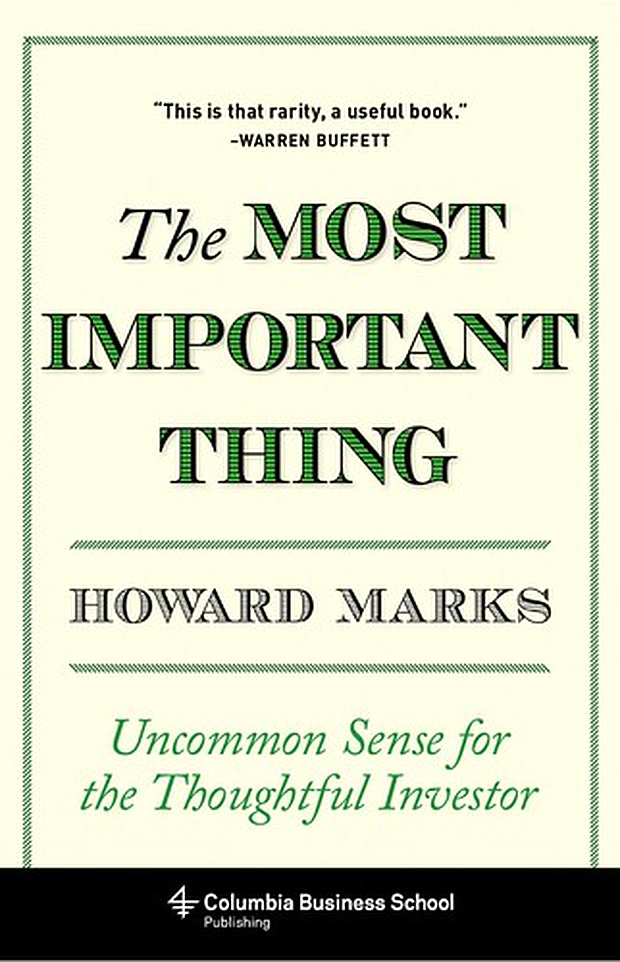
The Most Important Thing
Get on Amazon →
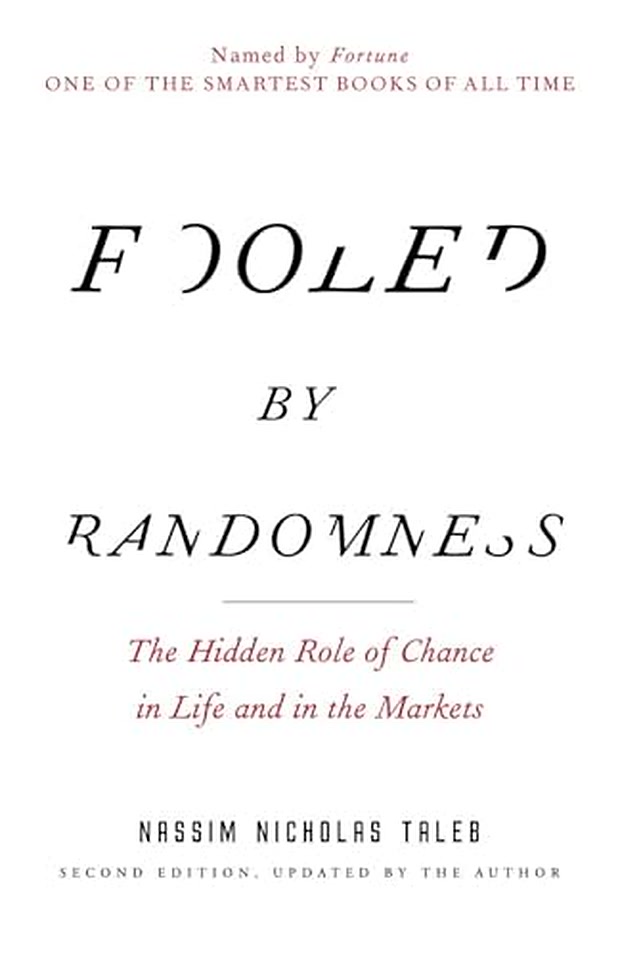
Fooled by Randomness
Get on Amazon →
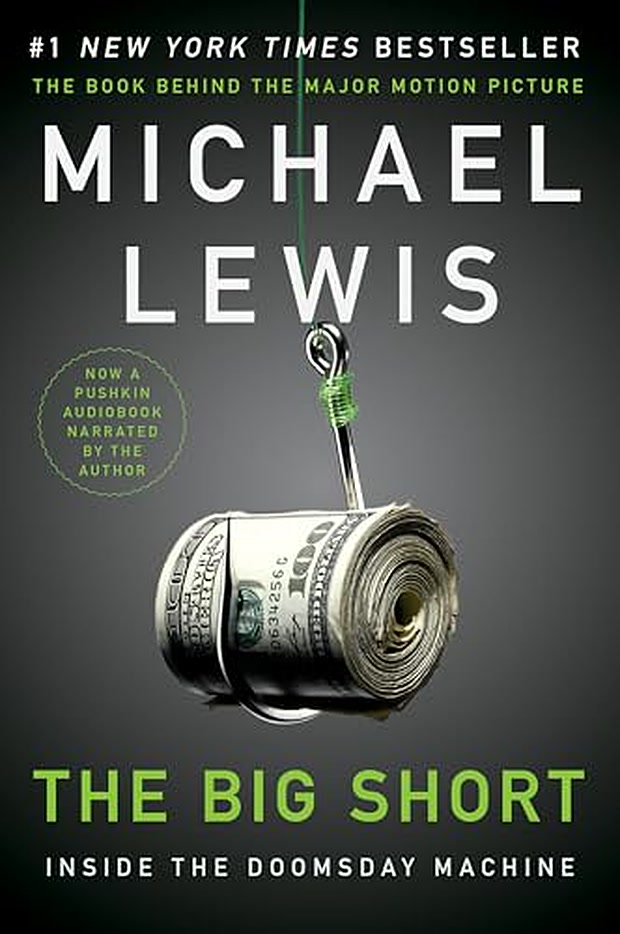
The Big Short
Get on Amazon →
As an Amazon Associate I earn from qualifying purchases.