Howard Marks
On The Couch
=== PAGE 992 ===
Memo to: Oaktree Clients
From: Howard Marks
Re: On the Couch
I woke up early on Saturday, December 12 – the morning after a day of significant declines in stocks,
credit and crude oil – with enough thoughts going through my mind to keep me from going back to sleep.
Thus I moved to my desk to start a memo that would pull them together. I knew it might be a long time
between inception and eventual issuance, since every time I dealt with one thought, two more popped into
my head. In the end, it took a month to get it done.
Professo
r Richard Thaler of the University of Chicago is a leading expert on behavioral economics and
decision-making (in fact, he ’s such a significant figure in the field that he was given a cameo role in the
movie The Big Short ). He opens his new book, Misbehavin g, with Vilfredo Pareto’s assertion that “the
foundation of political economy and, in general, of every social science, is evidently psychology.” I’d
apply that equally to the not- so-scientific field of investing.
It has been one of my constant refrains – dating back all the way to “Random Thoughts on the
Identification of Investment Opportunities ” (January 1994 ) – that in order to be successful, an investor
has to understand not just finance, accounting and economics, but also psychology . A thorough
understanding of how investors’ minds work is essential if one is to figure out where a market is in its
cycle, why, and what to do about it. For me, t he markets’ recent behavior – certainly on December 11,
but also at other points in 2015 – reinforces that observation.
This m
emo is my attempt to send the markets to the psychiatrist’s couch , and an exploration of what
might be learn ed there.
2012-14: An Uncertain World
In September 2012, I wrote a memo called “On Uncertain Ground.” To begin it, I observed that “The
world seems more uncertain today than at any other time in my life.” I went on to list the things that
worried me. Few of them are le ss troubling today. Certainly the period of the post-crisis recovery hasn’t
been carefree. Here are the things that concerned me in 2012, as viewed from that perspective:
Macro growth – It seems to be broadly accepted that overall economic growth will be slower in
the years ahead than in the latter part of the twentieth century. Do lower birth rates and slowing
gains in productivity doom us to reduced macro gains? What does this mean for everything else?
In particular, if growth remains slow, will it lead to slowing inflation, or even deflation?
Trends in the developed world – Will the developed nations be able to compete in a globalized
economy? How will incomes hold up as developing nations produce goods cheaper, and as the
quality of those goods improves? As we increasing ly become knowledge-based economies, will
we need as many less-educated workers as in the past? If not, what will be the ramifications for
unemployment, income inequality and society as a whole?
Consumer behavior – Will consumers regain the confidence required to return to their expansive
spending behavior? Will they employ credit as in the past to perpetuate growth in consumption?
2016 Oaktree Capital Management, L.P.
All Rights Reserved
=== PAGE 993 ===
Europe – Will Europe move forward in terms of cohesion, coordination and productivity? What
happens if it doesn’t? Will the ECB be able to engineer an economic recovery? Will the
departure from the European Union of Greece – or new Greeces – return as a worry in the future?
(And now, w ill the coming referendum mandate Great Britain’s departure? Will there be a new
referendum in Scotland with regard to remaining in the UK? Will Catalonia vote to leave Spain,
and what will that mean for its membership in the EU?)
Leadership – For years I gave speeches using PowerPoint slides listing sources of uncertainty,
but where it was supposed to say “dearth of leadership,” someone had mistakenly typed “death of
leadership” . . . and nobody quibbled. Throughout the world, few countries if any have leaders on
par with history’s best. Certainly that’s true in the U.S. You may think it’s a good thing, or you
may not, but it’s clear that Washington is too gridlocked to accomplish much . As I wrote in “On
Uncertain Ground,” “. . . U.S. politicians seem to value things like ‘ideological purity ’ (i.e.,
toeing the party line) and being reelected above real attempts at problem solving. Partisanship
and open warfare has surely reached a new zenith. ”
Entitlements – Social Security is a locomotive rumbling down the track to ruin. The cost of
health care programs is growing rapidly, as drugs become more expensive and Americans live
longer. Defined-benefit pensions have been promised to public employees but not fully funded.
How wil l federal, state and city governments meet their obligations? Not only does no one know,
but also few people in government (certainly not in Washington) seem to care.
China – As the world’s second -largest economy, China plays a very important role in
determining global growth. Its GDP advanced at double-digit rates over the last 20+ years –
wit
hout recessions – on the basis of (a) millions of people moving from farms to cities (and to
more pr
oductive roles in manufacturing), (b) the low-cost exports they produced and (c) readily
available capital and the heavy fixed-asset investment it permitted. Henceforth China will gain
less from the above and will have to transition to domestic consumption of goods and services, a s
well as a slower-growing economy . . . perhaps with ups and downs like the rest of the world.
Will th is result in a near-term hard landing? And what will be the impact on nations that sell
commodities and finished goods to China?
Geopolitical hotspots – From the fall of the Soviet Union at the end of 1991 until the 9/11
attacks in 2001, investors’ positive feelings were abetted by the presence of peace in the world.
But in recent years we have faced challenges involving Iran, Israel and the rest of the Middle
East; Russia and Ukraine; China and North Korea; and terrorist threats in many places. How will
markets react to the inevitable flare-ups?
The wor
ries listed above confront ed investors throughout the period 2012 through 2014. And in the last
few months of that period, we saw a halving of the price of oil; additional slowing in China; worsening
news from the Middle East ; and continuing uncertainty regarding the Fed’s likely action on interest rates.
Giv
en markets’ abhorrence of uncertainty, we normally would expect such issues to result in low asset
prices and negative returns. But in 2012-14, despite the many negatives, we saw a cumulative return of
74% on t
he S&P 500, as well as strong appreciation on the part of real estate and companies that had been
the subject of buyouts. Further reflecting investor confidence, the yield spread versus Treasurys for the
average U.S. high yield bond narrowed from 706 basis points at the end of 2011 to 522 b.p. at the end of
2014, at which point the prospective yield to worst was down to 6.67%. Thus, as 2014 moved to a close,
we saw:
the l
itany of meaningful macro risks described above,
investors engaging in pro-risk behavior in pursuit of adequate returns in a low-return world,
as a
consequence, full asset prices, and thus
little likelihood of achieving returns high enough to compensate for the risks.
2016 Oaktree Capital Management, L.P.
2
All Rights Reserved
=== PAGE 994 ===
To sum up, psychology (and thus prices) were high given the fundamentals. Our world was marked by
low prospective returns and plentiful problems, a troubling combination.
Here’s what I wrote in “Risk Revisited” in September 2014:
While
investor behavior hasn’t sunk to the depths seen just before the crisis (and, in my
opinion, that contributed greatly to it), in many ways it has entered the zone of
imprudence. . . .
It’
s the job of investors to strike a proper balance between offense and defense, and
between worrying about losing money and worrying about missing opportunity. Today I
feel it’s important to pay more attention to loss prevention than to the pursuit of gain. For
the last three years Oaktree’s mantra has been “move forward, but with caution.” At this
time, in reiterating that mantra, I would increase the emphasis on those last three words:
“but with caution” . . . .
Alt
hough I have no idea what could make the day of reckoning come sooner rather than
later, I don’t think it’s too early to take today’s carefree market conditions into
consideration. What I do know is that those conditions are creating a degree of risk for
which there is no commensurate risk premium.
The Negatives Build
Given th e many concerns, performance in the first half of 2015 w as sluggish at best. Most markets eked
out positive re turns, but gains came grudgingly, and few investors had a good time. Then, during the
summer, the accumulation of worries accelerated and became too much to withstand:
Grow
th remained flat or slowed in the U.S., Europe and Japan.
China ’s economy continued to slow .
The Fed continued to dither regarding interest rates. A potential increase caused worr y, but so
did t
he appearance that the Fed considered growth too weak to allow an increase.
The oil price decline resumed, and other metals and commodities joined in, weakening the prices
of related stocks and bonds.
The geopolitical picture went from bad to worse:
oSyria presented a choice between (a) enabling a despot to remain and (b) ousting him and
turning over another country to instability and insurgency.
oRussia intervened, flexing its muscles and reminding us of its intransigence.
oISIS and the flow of immigrants to Europe took on the appearance of insoluble problems;
Paris and San Bernardino showed terrorism to be a serious ongoing threat.
oAn agreement was reached to limit Iran’s nuclear progress, but no two experts seemed to
agree on whether it was a good or bad thing.
oIraq, Afghanistan, Israel and Palestine got no better.
oThe South China Sea heated up from time to time.
There was nothing positive to say about the U.S. political situation. Partisanship and gridlock
remained the rule. The grinding two-year campaign took up increased airtime and mindshare,
without a positive consensus concerning most candidates.
Finally, a number of issues internal to the markets – ranging from reduced liquidity to market-
repo
rting glitches to the meltdown of high-risk credit funds – shook investors’ fai th.
2016 Oaktree Capital Management, L.P.
3
All Rights Reserved
=== PAGE 995 ===
Somehow, market participants are able to live with uncertainties like these and retain their equanimity,
sometimes for long periods. Maybe it’s conviction, maybe it’s obliviousness, and maybe it’s denia l.
And that’s what prevailed in recent times; as Doug Kass put it in mid-2014, we ’ve been experi encing “a
bull market in complacency.”
But ev
entually something else happens – perhaps the house of cards grows too high – and investors’
feeling of serenity is pierced. A point is reached beyond which equanimity can no longer be maintained.
It was getting to that point that led to meaningful declines in U.S. credit markets in the latter half of 2015.
The Tipping Point
One of the most notable behavioral traits among investors is their tendency to overlook negatives or
understate their significance for a while, and then eventually to capitulate and overreact to them on
the downside. I attribute a lot of this to psychological failings and the rest to the inability to appreciate
the tr
ue significance of events.
As neg
atives accumulate – whether they surface for the first time or just are finally recognized as
signi
ficant – eventually a time comes when they can no longer be ignored, and instead they come to be
treated as being of overwhelming importance. The latest tipping point was reached last August.
Up to t
hat point, investors had pretty much resisted the negatives, and the S&P 500 was up 3.3% in the
first seven months of the year. (The media might say investors had “coped with” the negatives, but of
course they hadn’t dealt with them ; they’d ignored them.)
But t
hen, in August, a series of negatives occurred in China: reports of still more economic slowing; a
decline in A-share prices from June to August that reached 45 %; an unexpected devaluation of the
renminbi (whose value many people complained for years had been artificially depressed); and market-
support measures that some found ham-handed (e.g., restrictions on actions such as short selling, and
investigations of journalists writing negative articles about the stock market).
“Everyone
knew” for years that the Chinese economy had been overstimulated with cheap
financing, and that this had led to excessive investment in fixed assets. The effect was exceptional
GDP growth, but also a large stock of unneeded buildings and infrastructure. Everyone also knew that a
hard landing – a painful slowing in economic growth, and perhaps a recession – was among the possible
outcomes. But it was n’t until August that investors outside China began to notice A- shares’
collapse; consider the possibility that a slowdown in China could have negative ramifications for
the rest of the world; and import those worries to their own markets. Thus between August 17 and
25, the S&P 500 declined 11%. What was behind the extrapolation of China’s woes to other markets , like
ours? Here’s how I explained it in “It’s Not Easy ,” published in September on the heels of the events in
China:
Especial
ly during downdrafts, many investors impute intelligence to the market and look
to it to tell them what’s going on and what to do about it. This is one of the biggest
mistakes you can make. As Ben Graham pointed out, the day- to-day market isn’t a
fundamental analyst; it’s a barometer of investor sentiment. You just can’t take it
too seriously. Market participants have limited insight into what’s really happening in
term
s of fundamentals, and any intelligence that could be behind their buys and sells is
obscured by their emotional swings. It would be wrong to interpret the recent worldwide
drop as meaning the market “knows” tough times lay ahead. Rather, China came out
with some negative news and people panicked, especially Chinese investors who had
2016 Oaktree Capital Management, L.P.
4
All Rights Reserved
=== PAGE 996 ===
bought stocks on margin and perhaps were experiencing their first serious market
correction. Their selling prompted investors in the U.S. and elsewhere to sell also,
believing that the market decline in China signaled serious implications for the Chinese
economy and others.
Whatever the reason, the bottom line for me is that whereas risk tolerance had ruled through July,
risk aversion was reawakened in August. I picture an investor who ’s oblivious to risk in the earlier
months and then suddenly says, “O h yeah: there are things to worry about.” The tipping point finally
arrives, a sudden wake-up call to the existence and importance of risk.
Half-Full or Half-Empty?
Almost 25 years ago, in my second memo (“First Quarter Performance,” April 1991), I introduced the
concept of the investment pendulum:
Although the midpoint of its arc best describes the location of the pendulum “on
average,” it actually spends very little of its time there. Instead, it is almost always
swinging toward or away from the extremes of its arc. But whenever the pendulum is
near either extreme, it is inevitable that it will move back toward the midpoint sooner or
later.
One of the most significant factors keeping investors from reaching appropriate conclusions is their
tendency to assess the world with emotionalism rather than objectivity. Their failings take two
primary forms: selective perception and skewed interpretation. In other words, sometimes they take
note of only positive events and ignore the negative ones, and sometimes the opposite is true. And
sometimes they view events in a positive light, and sometimes it’s negative . But rarely are their
perceptions and interpretations balanced and neutral.
Ever si
nce the August events in China, I ’ve repeatedly found myself harking back to one of the oldest
cartoons in my file, and still one of the very best:
2016 Oaktree Capital Management, L.P.
5
All Rights Reserved
=== PAGE 997 ===
In 2015 we saw old problems get worse, new ones arise, and a general absence of anything to feel good
about. The sense of hopelessness regarding problems like ISIS and runaway immigration is something
investors handle particularly poorly. In August, the events in China sparked a revival of risk aversion and
fear, with effects that carried around the world for a couple of weeks. And with the door opened to
fearful interpretation, Pollyanna tolerance gave way to widespread negativism.
The bottom line is that investor psychology rarely gives equal weight to both favorable and
unfavorable developments. Likewise, investors’ interpretation of events is usually biased by their
emotional reaction to whatever is going on at the moment. Most developments have both helpful and
harmful aspects. But investors generally obsess about one or the other rather than consider both. And
that recalls another classic cartoon:
It all seems so obvious: investors rarely maintain objective, rational, neutral and stable positions. First
they exhibit high levels of optimism, greed, risk tolerance and credulousness, and their resulting
behavior causes asset prices to rise, potential returns to fall and risk to increase. But then, for some
reason – perhaps the arrival of a tipping point – they switch to pessimism, fear, risk aversion and
skepticism, and this causes asset prices to fall, prospective returns to rise and risk to decrease.
Notably, each group of phenomena tends to happen in unison, and the swing from one to the other often
goes f
ar beyond what reason might call for.
That’s
one of the crazy things: in the real world, things generally fluctuate between “pretty good”
and “not so hot.” But in the world of investing, perception often swings from “flawless” to
“hopeless.” The pendulum careens from one extreme to the other, spending almost no time at “the happy
2016 Oaktree Capital Management, L.P.
6
All Rights Reserved
=== PAGE 998 ===
medium” and rather little in the range of reasonableness. First there’s denial, and then there’ s
capitulation.
The Sources of Error
To explain why th ese bipolar episodes occur, I want to spend a little time on some of the factors behind
investor psychology. For the most part they’re easily observed and dissected, and not mysterious. I
discussed some of them in “It’s Not Easy”:
Emotion is one of the investor’s greatest enemies. Fear makes it hard to remain
optimistic about holdings whose prices are plummeting, just as envy makes it hard to
refrain from buying the appreciating assets that everyone else is enjoying owning.
Confidence is one of the key emotions, and I attribute a lot of the market’s recent
volatility to a swing from too much of it a short while ago to too little more recently. The
swing may [result] from disillusionment: it’s particularly painful when invest ors
recognize that they know far less than they had thought about how the world works.
It’s important to remain moderate as to confidence, but instead it’s usually the case that
confidence – like other emotions – swings radically.
While Ch
ina was the “proximate cause” of the recent volatility, other things often
contribute, and last month was no exception. The word that always comes to mind for
me is “confluence.” Investors can usually keep their heads in the face of one
negative. But when they face more than one simultaneously, they often lose their
cool. One additional negative last month was the glitch in Bank of New York Mellon’s
SunGard software, and the bank’s consequent inability to price 1,200 mutual funds and
ETFs that it administers. It was another dose of disillusionment: no one enjoys learning
that the market mechanisms they need to work can’t be depended on.
Another a
rea of error – be it the result of flawed perception or inadequate insight and analysis –
can be seen
in investors’ repeated failure to understand the potential for ramifications and second -
order consequences. One instance was the general lack of concern about contagion from sub-prime
mortgage backed securities that prevailed between early 2007 – when mortgages began to default in large
number
s – and the tumultuous events of mid/late 2008. Most people overlooked the potential for
contag
ion, and thus (for example), as of May 2008 the S&P 500 was essentially unchanged from the first
quarter of 2007. Yet sub-prime mortgage defaults contributed significantly to the subsequent bank
collapses and bailouts, the bankruptcy filing of Lehman Brothers, and the late-2008 emergence of fear of
a financial system meltdown. As a consequence, between May 2008 and March 2009 the S&P lost 52%.
The events that produced such extreme distress in late 2008 and early 2009 were unforeseen and
unimagined just a few months before . . . even though the clues had been there for a year.
Ther
e are many more ways in which non-objective, non-rational quirks commonly affect behavior. As
Carol Tavris points out in her May 15, 2015 Wall Street Journal review of Professor Thaler’s book:
As a soc
ial psychologist, I have long been amused by economists and their curiously
delusional notion of the “rational man.” Rational? Where do these folks live? Even 50
years ago, experimental studies were demonstrating that people stay with clearly wrong
decisions rather than change them, throw good money after bad, justify failed predictions
rather than admit they were wrong, and resist, distort or actively reject information that
disputes their beliefs.
2016 Oaktree Capital Management, L.P.
7
All Rights Reserved
=== PAGE 999 ===
The difficulty of understanding events, their significance and their potential ramifications comes in
good part from the kinks in investors’ psyches, and it contributes to – and feeds back to exacerbate
– investors’ responses. Th us investors tend to emphasize just the positives or the negatives much more
often than they take a balanced, objective approach. And they tend to become optimistic and eager to buy
when good news, positively interpreted, has forced prices up . . . and vice versa. All of this is obvious
(especially in retrospect), and thus equally obviously, understanding and dealing with it presents a
potential way to improve results.
Noti
ons of market efficiency – the idea that most assets are priced “right” – are based on belief in
invest
or rationality and objectivity. But certainly those traits are little seen in real life.
“Inefficiencie s” – i n everyday language, “mispricings” – stem from biases against one asset or in favor of
another: legal, cultural, informational, and especially behavioral and emotional. The first three of these
exist much less nowadays than they did 30 or 40 years ago, but the latter two still rear their head from
time to time. And I’m sure they always will.
Case In Point – Oil
On December 12, as I began to write this memo, the Financial Times provided several examples of the
negative thinking being applied. Here are some excerpts from an article about the recent market action:
Oil
prices fell sharply to a seven-year low, rattling stock markets at the end of a choppy
week. . . . The price of Brent crude, the global energy benchmark, was down 5.6% to
$37.49 . . . after Opec at its meeting a week ago failed to agree output cuts, leaving
prices at the mercy of a global glut.
“Lower o
il prices are here to s tay.”
The C
BOE Oil Vix is holding above the 54 level . . . as investors pay up to protect
themselves [against], or speculate upon, further sharp moves in crude.
That
all sounds very serious. But is it? Does it make any sense? What’s the real significance of
declining oil prices?
The bot
tom line for me is that, if you aren’t an oil company or a net oil-producing country, low oil prices
aren’t necessarily a bad thing. For net oil importers like the U.S., Europe, Japan and China, the drop
we’ve seen in the price of oil is analogous to a multi-hundred-billion-dollar tax cut, adding to consumers ’
disposable income. It can also increase an importer nation’s cost -competitiveness.
The U
.S. is both a producer of oil and an importer. That means the macro economy will enjoy the benefit
of cost reduction and income enhancement, but domestic oil companies and those who provide them with
products and services will gain less from production than had been expected, and some state and local
governments will be hard-hit. (And I must add that, thus far, the indicators fail to suggest a salutary
impact on the broad economy.) Eighteen months ago I thought the ability to produce oil through fracking
at a cost of $40-60 per barrel would give the U.S. a cost advantage in manufacturing; that ’s no longer
likely, at least for now.
But t
he one thing that’s beyond doubt is that the impact of the fall in the price of oil is far from all bad. In
fact, I’d say that it’s positive on balance for the U.S. and an unmitigated boon for the UK, Europe and
East Asia. So why did the FT attribute market weakness to it? First, the media have taken on the
unpleasant task of telling us why the markets went up or down each day, and the falling oil price is an
2016 Oaktree Capital Management, L.P.
8
All Rights Reserved
=== PAGE 1000 ===
easy answer . . . until you give it any real thought. Second, though, as the FT went on to explain, some
worry might be appropriate regarding what it connotes:
The f
all in commodity prices is causing market anxiety because investors are worried that
it signals a slowdown in global demand, and that any economic benefit from cheaper
costs for consumers and businesses is being counteracted by the cutting of investments
and jobs by the resources sector.
In other
words, they’re inferring that the price of oil declined because demand is off, and that this signals
economic weakness. But economic growth is what it is; we don’t need the oil price to tell us it’s weak.
And the price of oil is off another third in the last few months, even though world GDP is still growing.
The i
mportant thing is n’t what the oil price decline tells us about today. It’s what it says about tomorrow.
And to me, everything else being equal, I think low energy prices today will contribute to better economic
growth tomorrow. (Low prices today probably also imply higher prices eventually, through their impact
on supply and demand.) It’s just that everybody’s interpreting everything negatively these days.
Case In Point – Interest Rates
The FT also pointed out that investors were reacting to the likelihood the Fed would raise interest rates,
even though that should have been a foregone conclusion:
Next week, the Federal Reserve will raise interest rates. That at least now appears likely.
Anything else would be the biggest shock of a year in which markets and monetary
authorities have had serious misgivings. Let us assume for now that it happens.
This will be the longest-awaited and most-previewed tightening of monetary policy in
history.
There’s something wrong if an event that has been w idely anticipated for years – and considered a
near certainty for months – can be thought capable of significantly impacting the market when it
becomes a fact. People’s expectations should be incorporated in to the prices they assign to assets. So a
negative reaction to the imminence of a widely heralded interest-rate increase must imply that either (a)
invest
ors are too dense to have incorporated it into prices before this, (b) the increase will be a bigger deal
t
han people thought, or (c) the market is irrational.
On Decem
ber 15, Dow Jones published the following quote:
“It’s been mor
e shoot first, ask questions later ” in the shares of large asset managers, said
Kenneth Hill, an analyst at Barclays PLC. “The concern is largely that as rates move
higher, investors think returns will move lower and there will be some rotation out of
fixed income. People are anxious to see how that plays out, ” he added.
When Mr. H
ill said that, more than two and a half years had passed since May 2013, when Ben Bernanke
fore
shadowed a “tapering” of bond purchases and the possibility of higher interest rates. How can
investors not have had enough time to adjust to the possibility of higher rates and incorporate it in to asset
pric
es? Indeed, the increase that was just days away should have been mostly a non-event, and the idea
that it was a significant contributor to the declines on December 11 ma kes no apparent sense.
2016 Oaktree Capital Management, L.P.
9
All Rights Reserved
=== PAGE 1001 ===
Over the years since Bernanke’s statement in 2013, the ques tion I’ve been asked more often than any
other has been, “What month will the Fed begin to raise interest rates?” My response has been consistent:
“I have no idea, and why do you care?” If someone tells me he’ll do one thing if he thinks the Fed’s
going to raise rates in March and something different if it’s going to happen in January , what he’s
demonstrated is that he doesn’t understand how asset prices incorporate expectations. The difference in
timing should have little effect on the choice of a course of action. What matters is how far rates will go,
and how fast. I don’t expect much of either from this dovish and cautious Fed . . . unless the economy
surprises on the upside. And that would be good news, wouldn’t it?
While on
the subject of interest rates, I want to mention the thing about them that most annoys me these
days
. People who acted one way when rates were unchanged (even though everyone knew they wouldn’ t
rem
ain that way for long) are acting very differently now that there’s been a quarter-point increase. This,
t
hey say, is because “we’ re in a rising-rate environment. ” But the issue of interest rates, like most others,
shouldn’ t be viewed as binary . . . black or white . . . flat rates or rising. The essential questions are,
“how much will rates rise? ” and “w hen the series of increases is over, will rates be high enough to
meaningfully alter behavior ?” That’s what counts.
Yest
erday, The Wall Street Journal wrote as follows: “ Analy sts and investors attribut e the [auto stocks ’
recent greater-than-market] declines to worries that rising U.S. interest rates could crimp auto finance and
to f
ears that auto sales may have peaked. ” Does the interest rate outlook really mean significantly fewer
car
s will be sold . . . especially given that low gas prices are making consumers richer and driving
cheaper? I think people may have jumped to an unwarranted – and negatively tinged – conclusion.
Case In Point – Third Avenue
In terms of investor reaction, I find the announcement that Third Avenue’s Focused Credit Fund would
liquidate to be the most interesting recent event. According to the FT:
The liquidation of the biggest US mutual fund since 2008 has intensified concern for the
health of the US corporate bond market.
Some distinguished between a risk to the system, where issues at one fund trigger
redemptions from others, and so-called idiosyncratic problems related to a single fund.
Corporate bonds sold off again yesterday in the wake of the FCF liquidation
announcement and many investors rushed to buy default insurance contracts on junk debt.
There isn’t much to be in doubt about in the meltdown of the Focused Credit Fund; clearly it reflected
problems peculiar to that fund alone. In 2014, while a $3½ billion fund, it had substantial holdings in
particu
larly-high-risk, illiquid debt. Then it encountered snowballing capital withdrawals at a time of
reduced market liquidity. Under circumstances like these, portfolio managers generally raise cash by
liquidating their most salable holdings, causing the quality and liquidity of the remaining portfolio to
decline . Continuing withdrawals took FCF’s assets below $800 million in December 2015, and I hear it
was down to 20 or fewer holdings, all of extremely low quality. Further redemptions would have forced
the manager to sell those, realizing extremely low prices, eliminating any liquidity that may have been
present, and leaving investors who hadn’t redeem ed holding the bag.
The f
ault certainly lies with the fund’s managers . Risky, illiquid investments may be appropriate for
closed-end funds whose capital is secure, but probably not for mutual funds or other vehicles subject to
daily redemptions. It’s debatable whether a fund should be expected to be able to handle both an 80%
2016 Oaktree Capital Management, L.P.
10
All Rights Reserved
=== PAGE 1002 ===
loss of AUM and a substantial decline in liquidity. But, as I wrote in “Liquidity” (March 2015), “no
investor should shoulder more illiquidity than its realities permit” and, in particular, “no investment
vehicle should promise more liquidity than is afforded by its underlying assets.” Illiquid assets and the
possibility of capital flight: there are few surer recipes for investment disaster.
Investors lacking strong emotional and analytical foundations might have been scared into believing that
FCF’s problems connoted – or presaged – widespread weakness among high yield bonds and other forms
of risky debt. Those who were a bit less panicky might have understood that high yield bonds in general
were probably secure but still feared that illiquidity would combine with cascading redemptions to cause
a chain reaction of capital withdrawals from other funds, forced sales, and collapsing bond prices. But
those with adequate emotional and analytical resources would have recognized that FCF’s problems were
more endogenous and idiosyncratic than a function of high yield bonds broadly, and that adequate
creditworthiness provides the debtholder’s ultimate protection against chaos in the market.
Recent Developments
Behavioral economics and its younger cousin, behavioral investing, are n’t theoretical . In fact, they’re the
essence of practical: they’re about how human foibles cause real-life behavior to deviate from what
theory might dictate.
In recent months we’ve had occasion to watch how mood swings can alter the investment environment.
I’ll describe below the events that have occurred in the mark et for distressed debt.
In the U.S
., the years 2010-14 were characterized by gradual economic improvement, increasing
corporate profits, a dramatic switch of the credit markets to accommodativeness, and – because of all this
–some of the lowest default rates in history on low-grade debt. As a result, there was a paucity of
distressed debt. Further, the little that wa s available was concentrated in just a few areas: European
NPLs, real estate, shipping and power companies. Put these factors together, and Oaktree found itself
unable to assemble large or thoroughly diversified distressed debt portfolios. Noting this, we followed up
our record $10.9 billion fund raised in 2007-08 (and largely invested in the quarter following Lehman
Brothers’ bankruptcy filing) with one of $5.5 billion in 2010 and then another of $2. 7 billion in 2011. In
other words, we halved our investable capital and then halved it again.
Ther
e is no immediate connection (other than for companies doing business there) between the slowdown
in China or the price decline in the oil patch, on one hand, and the general creditworthiness and
des
irability of high-risk debt on the other. And yet, over the last few months, pronounced changes have
occurred in the market for distressed debt:
Aft
er a period of very stable prices – even for “iffy” debt – some securities have “ g apped down”
in t
he last f ew months (i.e., fall en several points at a time rather than correcting gradually). In
particular, investors have become highly intolerant of bad corporate news.
For the first time since 2008-09, the debt of some companies outside of energy and mining has
fallen from 90 to 60, and others from 50 to 20.
There is a general sense among my colleagues that investors have gone from evaluating
securities based on the attractiveness of the ir yield (with company fundamentals viewed
optimistically) to judging them on the basis of the likely recovery in a restructuring (with
fundamentals viewed pessimistically).
The capital markets have begun the swing from generous toward tight, as is their habit. Thus,
whereas they used to find it easy to refinance debt in order to extend maturities or secure “rescue
2016 Oaktree Capital Management, L.P.
11
All Rights Reserved
=== PAGE 1003 ===
financing,” now it’ s hard for companies – especially those experiencing any degree of difficulty –
to obtain capital.
On Dec
ember 7, Oaktree held a dinner in New York for equity analysts who follow our publicly traded
units. Bob O’Leary, a co-portfolio manager of our distressed debt funds, planned to be among the hosts.
But he called me on December 3 with a question I hadn’t heard in a long time from my distressed debt
colleagues : “Would you mind if I d on’t come? There’s too much going on for me to leave the office.”
The change in investor attitudes had created investment opportunities where they hadn’t existed just a few
months before – in some case s out of proportion to the change in fundamentals.
Devel
opments like these are indicative of rising pessimism, skepticism and fear. T hey’re largely what
Oaktree hopes for, since – everything else being equal – they make for vastly improved buying
opportun
ities. But note that we may be just in the early stages of a downward spiral in corporate
performance and credit market behavior. Th us, while this may be “a time ” to buy, I’m far from
suggesting it’s “the time.”
My Prescription
To help investors deal with their potential for “human error,” this shrink would prescribe a number of
elements that can help with the task:
The first essential element in coping with markets’ irrationality is understanding . The
importance of psychology and its influence on markets must be recognized and dealt with.
The second key lies in controlling one ’s emotions . An investor who is as subject as the crowd to
emotional error is unlikely to do a superior job of surviving the markets’ swings. Thus it is
absolutely essential to keep optimism and fear in the appropriate balance.
Emotional self- control isn’t enough. It’s also important to have control over one’s
circumstances . For professionals, that primarily means structuring one’s environment so as to
limit the impact on them of other people’s emotional swings. Examples include inflows to and
outflows from funds , fluctuations in market liquidity, and pressure for short-term performance.
At Oaktree we never fail to appreciate the benefit we enjoy from being able to reject “hot money”
and limit our funds’ redemption provisions.
And finally there’s contrarianism , which can convert othe r investors’ emotional swings from a
menace into a tool. Going beyond just fending off emotional fluctuation, it ’s highly desirable to
become more optimistic when others become more fearful, and vice versa.
I’m
lucky to have received many gifts of investment insight early in my career. Perhaps foremost among
them is one I picked up in New York about 40 years ago, at a lunch meeting of what we called the Third
Thursday Group. It concerned the three stages of a bull market:
the f
irst, when only a few especially insightful people suspect improvement might occur,
the second, when most people accept that improvement is actually taking place, and
the third, when everyone concludes that things are sure to improve forever.
Bet
ween the first stage and the last, nothing has to have changed in terms of fundamentals. The
difference lies in the perspective investors are bringing to their decisions. But clearly, it’s g reat to be
a buyer in the first stage and essential not to be in the last.
2016 Oaktree Capital Management, L.P.
12
All Rights Reserved
=== PAGE 1004 ===
We know investors swing from rejecting all possibilities to drinking the Kool-Aid, just as the three stages
say. Thus at Oaktree we want to buy when they’re pessimistic , not when they’re eager participants. If I
could know only one thing about an investment I’m contemplating, it might be how much optimism
is embodied in the price. In the first stage of the bull market, no optimism is present, and that makes for
great bargains. In the last stage, the level of optimism is terribly high, and thus so are purchase prices
relative to fundamentals. I want to buy when I can benefit from the herd’s neuroses, not when they ’ll
penalize me just as they do everyone else.
As I
mentioned above, since the middle of 2011 – by which time the quest for return had resulted in rather
full
prices for debt, over-generous capital markets and pro-risk investor behavior – Oaktree’s m antra has
been “ move forward, but with caution. ” We’ve felt it was right to invest in our markets, but also that our
inv
estments had to reflect a healthy dose of prudence. Except for the occasional air pocket, investors
didn’t suffer significant negative consequences prior to the last year or so. Thus, as usua l, we were early
in turning cautious. But opportunities (and returns) in the credit sphere have been only so-so since mid-
2011, and I don’t think our caution caused us to miss much.
Now
, as discussed above, investors’ optimism has deflated a bit, some negativi ty has come into the
equation
, and prices have moved lower. D epending importantly on which market we’re talking
about and how it has fared in recent months, we consider it appropriate to move forward with a
little less caution.
* * *
While I ha
ve your attention, I want to devote a few paragraphs to the two questions I’ m asked most
often these days : What are the implications for the U.S. and the rest of the world of China’s
weakness, and are we moving toward a new crisis of the magnitude of what we saw in 2008?
At a t
ime when the environment is marked by so many potential problems, it’s important to figure out
which if any are likely to present real problems. Declining oil prices: the implications for non-oil
producers seem mixed at worst. A terrorist event: horrifying, but for any one person or location, I’d put it
in the category of an “improbable disaster.” The p olitical picture: we’ll probably continue to muddle
through no matter who’s elected.
I w
ould say that, of all the things on the list, the possibility of a hard landing in China is of the greatest
significance when you combine magnitude, potential ramifications and the probability of it occurring. So
it’s important to look objectiv ely at what it means for the U.S.
First
, let’s remember that China doesn’t play a pivotal role in the U.S. economy (other than as a provider
of finished goods). It is estimated to account for only 1% of the combined profits of the S&P 500
companies. Exports account for about 13% of U.S. GDP, and in the first eleven months of 2015 less than
8% of our exported goods went to China ($106 billion of goods, versus an annual GDP approaching $18
trillion – again, well below 1%).
Going
on from there, I want to share Paul Krugman ’s analysis from The New York Times of January 8. (I
gener
ally don’t agree with Krugman’s politics, but I don’t think they’re relevant here.) :
Yes, C
hina is a big economy, accounting in particular for about a quarter of world
manufacturing, so what happens there has implications for all of us. And China buys
more than $2 trillion worth of goods and services from the rest of the world each year.
2016 Oaktree Capital Management, L.P.
13
All Rights Reserved
=== PAGE 1005 ===
But it’s a big world, with a total gross domestic product excluding China of more than
$60 trillion. Even a drastic fall in Chinese imports would be only a modest hit to world
spending.
What about financial linkages? One reason America’s subprime crisis turned global in
2008 was that foreigners in general, and European banks in particular, turned out to be
badly exposed to losses on U.S. securities. But China has capital controls – that is, it
isn’t very open to foreign investors – so there’s very little direct spillover from plunging
stocks or even domestic debt defaults.
All
of this says that while China itself is in big trouble, the consequences for the rest of us
should be manageable. But I have to admit that I’m not as relaxed about this as the above
analysis says I should be. If you like, I lack the courage of my complacency. Why?
Part
of the answer is that business cycles across nations often seem to be more
synchronized than they “should” be. For example, Europe and the United States export
to each other only a small fraction of what they produce, yet they often have recessions
and recoveries at the same time. Financial linkages may be part of the story, but one also
suspects that there is psychological contagion: Good or bad news in one major economy
affects animal spirits in others.
So I wor
ry that China may export its woes in ways back-of-the-envelope calculations
miss . . .
I w
ant to highlight Krugman’s reference to “psychological contagion.” It’s interesting in this regard that,
last week, the world’s stock markets saw the following declines: S&P 500 – 6.0%, FTSE 100 – 5.3%,
DA
X – 8.3% and Nikkei – 7.0%. I consider it highly unlikely that such uniform declines were the
re
sult of independent, objective analysis of the impact of events on each economy and company.
Rather, I think th ey show the extent to which markets are linked by t heir investors’ shared
psychology.
So what a
bout the likelihood of another 2008-style crash? The bottom line for me is that a rerun of the
Global Financial Crisis is n’t in the cards:
We haven’
t had a boom (either in the economy or in the stock market), so I don’t think
we’re fated to have a bust. Because most businesses have been particularly loath to
expand their facilities, I don’t think they’ll be slammed if revenues flatten or turn down.
The leverage in the private sector has been reduced. This is particularly true of the banks,
where leverage has gone from the region of 30+ times equity before the crisis to very low
double digits today. And, of course, banks are now barred from investing adventurously
for their own account.
Finally, the main villain in the crisis was sub-prime mortgage back ed securities. The raw
material – the underlying mortgages – was unsound and often fraudulent. The structured
mortgage vehicles were highly levered and absurdly highly rated. And the risky tranches
ended up in banks ’ portfolios , causing them to require rescues. Importantly, this time
around I see no analog to sub-prime mortgages and MBS in terms of the ir
combination of fragility and magnitude.
I don’t m
ean to suggest t here are n’t a lot of things to worry about: swol len central bank balance
sheets; complete ignorance as to how they will be unwound and how interest rates will be moved higher ;
the seeming inability to generate economic growth and inflation; and the many other macro negatives
2016 Oaktree Capital Management, L.P.
14
All Rights Reserved
=== PAGE 1006 ===
listed earlier. A hard landing and substantial devaluation in China, the world’s second largest economy ,
certainly could have far-reaching effects.
It’s important that investors (as well as economists) avoid using words like “always,” “never,” “will,”
“won’t,” “has to” and “can’t ,” and I try to do just that. But it’s my view that the GFC and its
preconditions were highly unusual , and I don’t think we’re heading for an encore. Remember, however,
that I’m not a seer, and Oaktree and I never bet heavily on opinions regarding the future – mine or anyone
else’
s.
* * *
Before I
close, I want to make it abundantly clear that when I call for caution in 2006-07, or active buying
in late 2008, or renewed caution in 2012, or a somewhat more aggressive stance here in early 2016, I do it
with considerable uncertainty. My conclusions are the result of my reasoning, applied with the benefit of
my experience (and collaboration with my Oaktree colleagues), but I never consider them 100% likely to
be correct, or even 80%. I think they’re right, of course, but I always make my recommendations
with trepidation .
I read t
he same newspapers as everyone else. I see the same economic data. I’m buffeted by the same
market movements. The same factors appeal to my emotions . Maybe I’m a little more confident in my
reasoning, and certainly I have more experience than most. But the key is that – for whatever reason –
I’
m able to stand up to my emotions and follow my conclusions. None of them can be documented or
proved. If they could be, most intelligent people would reach the same conclusions, with the same
degree of confidence. I tell you this only to communicate my feeling that no one should fe ar he’s not up
to the task just because he’s unsure of his conclusions. These are n’t things about which certainty is
attainable.
* * *
Lastly, they tell me Oaktree is now on social media. That means y ou ca n follow @oaktree on Twitter to
receive updates about my memos, videos and speaking engagements, and to hear from others at the
firm. You can also subscribe to my memos on our website, oaktreecapital.com/insights.
January 14, 2016
2016 Oaktree Capital Management, L.P.
15
All Rights Reserved
=== PAGE 1007 ===
Recommended Reading
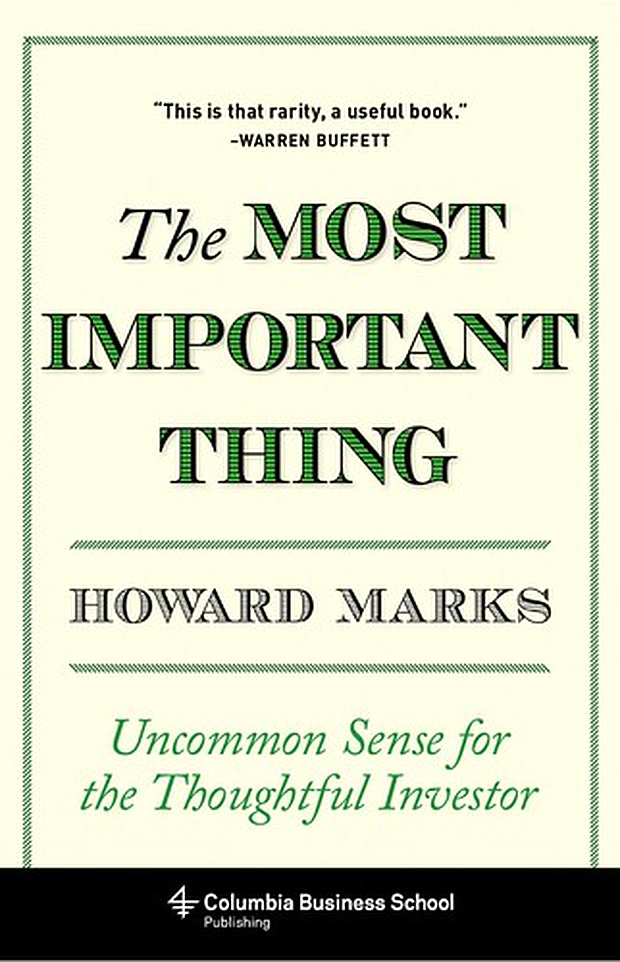
The Most Important Thing
Get on Amazon →
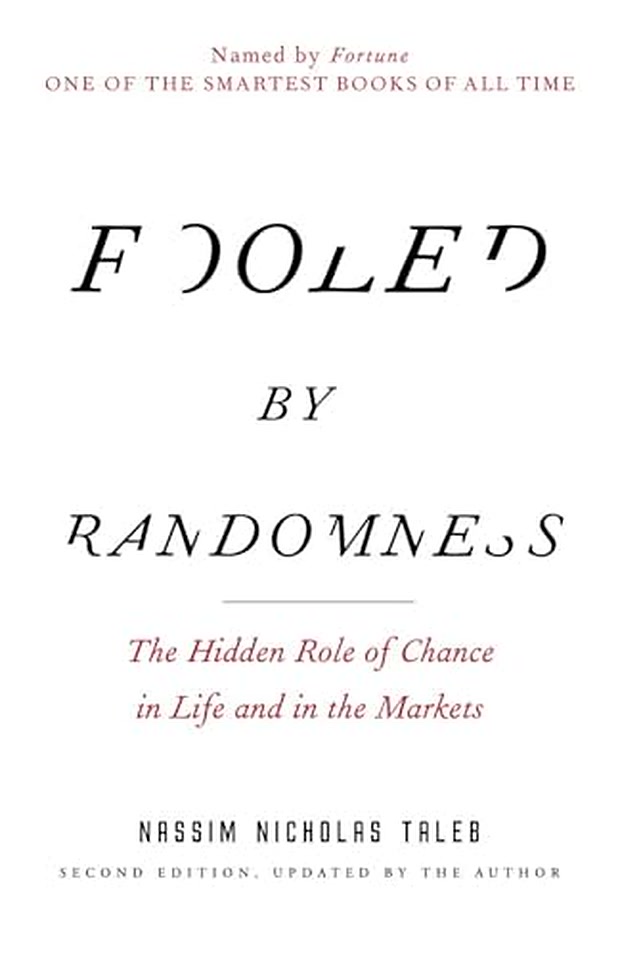
Fooled by Randomness
Get on Amazon →
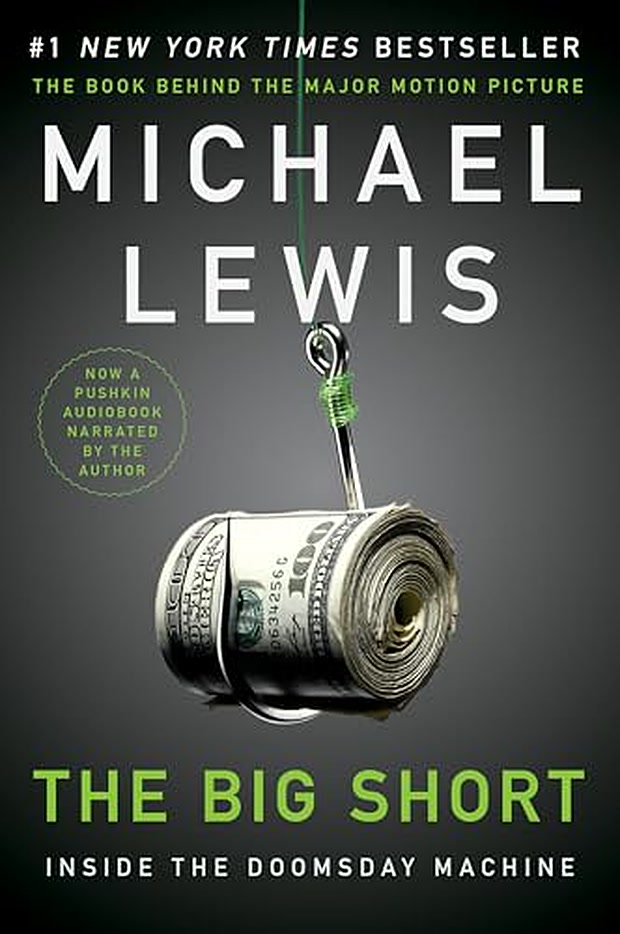
The Big Short
Get on Amazon →
As an Amazon Associate I earn from qualifying purchases.