Howard Marks
2011 03 02 On Regulation
CONFIDENTIAL © Oaktree Capital Management, L.P. All Rights Reserved.
Memo to: Oaktree Clients
From: Howard Marks
Re: On Regulation
I’ve been asked why there weren’t any memos during the twelve weeks between September 9
and December 1. Lack of ideas? Writer ’s block? Carpal tunnel syndrome? CIA posting? The
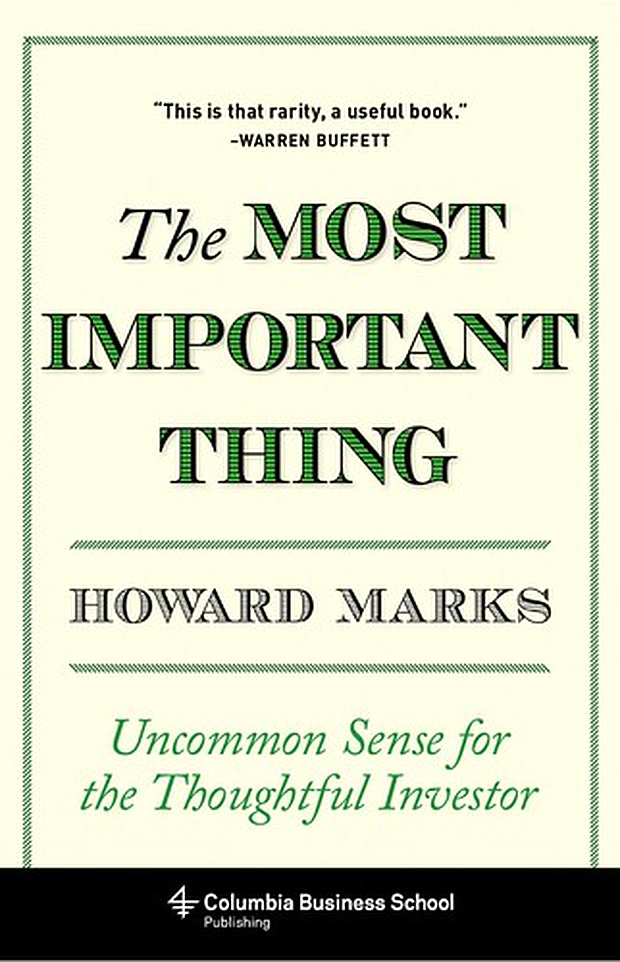
nswer is “ none of the above. ” I was putting the finishing touches on a book, The Most
Important Thing: Uncommon Sense for the Thoughtful Investor . It pulls together all of the
strands of my philosophy into what might be thought of as a super-memo. It will be published in
late Apr
il and I hope you’ll let me know what you think.
* * *
In the 3½ years since the financial crisis surfaced in July 2007, there has been extensive
discussion of
the part deregulation played in creating it, as well as the need for increased
re
gulation to prevent the next one. The release last month of the report of the Financial Crisis
Inquir
y Commission reawakened the debate. Thus I’m of ten asked nowadays how I feel about
regulation and what I think the future holds in that regard.
The Swing of the Regulatory Pendulum
I’ve written before that attitudes toward regulation follow the same pendulum-like swing
as most o
ther aspects of market behavior. They oscillate not only in response to events in the
ec
onomic environment, but also because neither total regulation nor total deregulation produces
an entirely satisfactory answer. As in so many things, there ’s no perf ect solution.
A great source on the subject is Wall Street Under Oath , a 1939 book on the causes of the Great
Crash of 1929 written by Ferdinand Pecora, who was counsel to the Senate committee
investigating the crash and later a New York State judge. I first read it about twenty years ago,
and I brought it out of storage in 2007. It is a typical polemic, assigning blame and touting
regulation pursuant to what I assume were the author’s philosophic al/polit ical bias es (see page
4).
Pecora describes a Wall Street that, up to and including the 1920s, was like the Wild West.
Bank ers and b rokers were out to make money for themselves; their behavior was largely
unreg
ulated; and conflicts between their interests and those of their clients were widespread and
disrega
rded. In particular, according to Pecora, disclosure standards were non-existent.
© Oaktree Capital Management, L.P.
All Rights Reserved
CONFIDENTIAL © Oaktree Capital Management, L.P. All Rights Reserved. These facts combined with other causes to produce a mar ket crash of epic proportions;
widespread losses; a drying up of capital; deflation ; a nd a massive depression with a resulting
incr
ease in unemployment to 25%. Unsurprisingly, fingers were pointed at the prior
administration and political power shifted to believers in an activist role for government. The
most
lasting result was the enactment of laws that governed the financial system for decades and
in ma
ny cases still do: the Securities Act, the Securities and Exchange Act, and the Glass-
Steagall Act. Thus the 1930s saw a massive swing of the pendulum in favor of regulation.
The ne
xt several decades on Wall Street were – perhaps thanks to the impact of those laws – a
relatively placid period. This led to a view that, with rare exceptions, market participants are
well
-behaved by nature. Further, steady growth with only moderate dips caused a perception of
an inherently benign and productive economy that could achieve even more if only the
re
gulatory shackles were loos ened . After President Carter deregulat ed the transportation
industry in the late 1970s, the door was open for much of the regulatory apparatus built in the
early part of the century to be relaxed. Ronald Reagan, whose famously free -market views
coincided with a period of peace and prosperity, led the deregulatory charge. We saw a similar
turn in Britain
under the leadership of Margaret Thatcher; the collapse of the USSR and a
re
sounding victory for capitalism; and the ascendance of free market adherents Alan Greenspan
and George W. Bush.
With the economy and financial system generating prosperity, people wanted more of the same.
And wit
h manufacturing in decline, we relied heavily on the financial sector for an increased
contribut
ion to GDP, job creation and standards of living. The prevailing view was that the less
regulation we had, the more productive business and finance could be. And what was there to be
fe
ared from an unregulated economy, anyway? The result in the past decade, according to a
reat newspaper quote that sadly I can’t locate, was “the kind of regulation you get from an
administrat ion that doesn’t believe in regulation.”
Thus, coming full circle from the 1930s, starting in 1999 we saw revocation of Glass-Steagall;
elimination of the up-tick rule limiting short sales to instances when stock prices were rising; a
pivota
l decision to exempt derivatives from regulation ; incre ased permitt ed leverage at
investment banks; and starvation of regulatory agency budgets. These developments were
followed by the global financial crisis of 2007-08. Coincidence or causality?
Free Markets Are Dangerous – Regulation is Essential
The free-market, capitalist system runs on self interest and the desire for profit. We need
regulation to ensure those things are kept within reasonable limits. Thus the goals of
fina
ncial regulation are roughly as follows:
to limit risk, especially risk to the overall financial system,
to restrict the concentration of economic power,
to protect customers, especially “the little guy,”
to prevent error, fraud, misrepresentation and theft, and
to democratize finance and make it a tool of social policy.
© Oaktree Capital Management, L.P.
All Rights Reserved
CONFIDENTIAL © Oaktree Capital Management, L.P. All Rights Reserved. If ethics, self-regulation, personal responsibility, respect for risk and a sense of limits could be
counted on, we wouldn’t need much in the way of regulation. But, sadly, they can’t.
Since the profit motive can lead financial institutions to aggressive risk taking, error and even
misdee
ds, regulation is counted on to prevent these things. T here’s also concern that individuals’
self-interest might drive them to actions that collectively might injure their companies and
societ
y.
Free markets do a great job of allocating economic resources – especially on average over the
long run – but the interim fluctuations produced by miscalculation can be intolerable and have to
be modulated. This makes regulation indispensable. Bot tom line: the financial system can’t
be
entrusted to untrammeled free markets.
Regulation is Imperfect and Harmful – Free Markets Do It Best
On the other hand, regulation is too imperfect to be relied on. (Thanks to “Soggy” Sweat for
this dialectic al approach – see “All that Glitters,” December 17, 2010. ) It’s easy to write hard -
and-fast rules, but rules sometimes impose undue costs or restrict activity in undesirable ways.
And their
specificity often makes them capable of being circumvented. Because financial
instit
utions are intent on innovation, rules rarely keep pace and regulators usually find
themselves playing catch-up. Rule-writing is reactive: rules are written in response to the last
problem, not to foresee and prevent the next one, which invariably is different. In addition,
regulators lack the financial motivation that drives those who can profit from getting around
reg
ulations and exploiting loopholes.
Since rules become outdated and circumvented, it might be preferable to regulate through
principles
. In other words, rather than numerical limits and defined borders, regulations might
be wr
itten in general terms to produce adherence to ideals and policy goals. But regulating this
way
requires that judgments be made, and regulators are rarely accorded the license required for
judgment-
making. Imagine the second-guessing, legal appeals and phone calls to congressmen
that would follow an individual regulator’s decision that a financial institution’s actions have
viol
ated vague principles . . . especially during a halcyon period when the warned-of
conseq
uences are slow in coming.
Principle-based regulation requires not only flexibility that is hard to build into and nurture in
burea
ucracies, but also significant business acumen, perspicacity and foresight. The evidence is
prima fac
ie: very few people saw the risk posed by sub-prime mortgages and structured
mortga
ge products, and certainly not the regulators. And no one I know of – regulator or
otherwise – foresaw the effect these things would have on banks, money market funds and the
comm
ercial paper market.
Why didn’t regulator s say a word about rating agencies ’ dispensing many thousands of triple- A
ratings to structured mortgage vehicles? Why were the highly regulated banks ground zero for
the conseq
uences of the financial crisis, while unregulated hedge funds were relatively
unscathed?
I just can’t imagine that regulators will ever have the ability to fully anticipate the
consequences of changes in the fast-developing financial system, or to fores ee the development
© Oaktree Capital Management, L.P.
All Rights Reserved
CONFIDENTIAL © Oaktree Capital Management, L.P. All Rights Reserved. of new problems for which rules and responses have yet to be drawn up. Here’s how Peter
ands, chief executive of Standard Chartered, was quoted in the Financial Times of January 27:
“It is not clear why some regulators who were there before the crisis s hould believe they now
have all the right solutions.”
What regulator would have been able to make a difference in protecting our financial institutions
(and the overall economy) from the developments of 2004-07? And given how valuable his
skil
ls would be in the private sector, how long would he have remain ed a regulator? No, it just
doesn’t make
sense to expect government employees to safeguard the financial system. The
con
clusion is inescapable : re sponsibility for the safety of the financial system can’t be
delegated to regulators.
The Origin of Attitudes
In December I wrote of gold that it’s like religion: either you believe in it or you don’t. I think
something very similar can be said about regulation of business and the economy.
Libe
rals who champion an expanded role for government tend to be pro-regulation, while
conservatives favoring laissez-faire policies and limitations on government will argue against it
with vehemence. Democrats generally like an activist government : that’s what makes them
Democrats. Republicans don’t .
Those partaking in the benefits of economic growth tend to favor free-markets and oppose
further
regulation, since they ’re happy with things the way they are. The reverse is true for thos e
who are failing to participate and those working in the public sector . . . although there are
mill
ions of exceptions on both sides. Businesspeople who trust the economy to perform for them
ge
nerally oppose regulation, while members of labor want it to prevent their being taken
advantage of by management and the owners of capital.
I think our
attitudes in this regard are highly correlated with those of our parents and largely a
functi
on of the time and place we grew up in. They can be altered through exposure to opposing
point
s of view, but I think most people ’s attitudes toward regulation stem far more from
upbringing and circumstances than from analytical and intellectual processes. Attitudes toward
reg
ulation, like politics, are largely hereditary and change slowly if at all.
Reconciling the Two Positions
It’s my belief that because both free markets and regulation are imperfect – and becaus e of
the strength of people’s political and philosophical biases – we will never settle
permanently on either a completely free market or a thoroughly regulated system. Any
positi
on will prove merely temporary, and the pendulum will continue to swing toward one end
of the spe
ctrum and then back toward the other.
Scandals and crashes will cause a cry for regulation.
Regulation will curb the excesses and punish the wrongdoers, discouraging repetition.
© Oaktree Capital Management, L.P.
All Rights Reserved
CONFIDENTIAL © Oaktree Capital Management, L.P. All Rights Reserved. The environment will calm, and economic progress will become the rule.
Memory of the events behind the demand for regulation will fade.
Free-marketeers will gain sway, and they’ll argue that we could do even better if the
sy
stem were deregulated.
Regulation will be eased.
Risk-taking and misdeeds will rise.
Scandals and crashes will occur anew.
Pro-regulation forces will regain influence, and free-marketeers will be in the doghouse.
And the pendulum will swing back toward regulation.
There will never be total, lasting agreement on either complete regulation or totally free markets.
Importantly, however, it might well be the case that compromise between the two has the
most dangerous consequences.
In the decade leading up to the crisis, politics favor ed home ownership and liberal
mortgage availability. These forces, combined with unregulated mortgage securities
mar
kets, gave rise to excessive lending, exaggerated demand for mortgage securities
(g
iven the illusion of safety), and thus artificially low mortgage rates and loose terms.
Which bailout recipients remain the biggest sinkholes, without any real chance of
repaying the government’s investment? The answer is Fannie Mae and Freddie Mac, the
gove
rnment-created mortgage agencies: supposedly private enterprises whose operations
were
distorted by a tacit federal guarantee. They engaged in uneconomic behavior,
advancing the policy goal of making home ownership available to people who couldn’t
afford it, and accepting vast risk on the basis of inadequate capital because they (and their
lenders) had no fear of loss.
Legislators turned regulation over to the private sector by putting credit rating agencies in
charge of financial institutions’ investing standards, giving commercial organizations
excessive imprimatur. Financial temptation pressured them to drop their standards, and
when they succumbed, the previously sacrosanct triple-A rating became a meaningless
label
Having witnessed the rescue of the banks and the financial system, we now have a system
whe
re free-market rewards will continue to motivate risk taking and no one believes the
ultim
ate price – meltdown – will be demanded of too-big- to-fail institutions that take it
too far. A free-market mechanism undercut by moral hazard may perform adequately
95% of the time, but it will pose terrible risks in the remainder.
The real bottom line is that since both free markets and regulation are imperfect, our
fin
ancial systems will continue to be imperfect. They will work well for us most of the time,
although not perfectly, and they will be subject to bubbles and crises every few decades
(hopefully not more often).
© Oaktree Capital Management, L.P.
All Rights Reserved
CONFIDENTIAL © Oaktree Capital Management, L.P. All Rights Reserved. The Recent Experience
Think about the last few years: the depth of the financial crisis, the pain it caused, the blunders
(or worse) that were behind the crisis, the financial sector bailouts it necessitated, and the
ac
rimony they elicited from a Main Street feeling left to fend for itself. Then add in a White
House a
nd Congress controlled by Democrats, with their leaning toward government
invol
vement in the economy. Certainly this was a formula for a powerful upswing in regulation.
In this context, I’m surprised that we haven’t seen much more government activism. The
new f
inancial regulations are mild and constrained, in my opinion. Increases in financial
instit
ution capital requirements and controls over executive compensation have generally been
more moderate in the U.S. than in Europe. No one has gone to jail (or even been subjected to
heavy fines) as in the Enron/Adelphia era. And there have been no punitive increases in taxes on
“the rich.”
And yet there have been enough steps toward regulation for their limitations to be manifest. One
of the pr
imary components of last year’s new financial reform law was the so-called Volcker
Rule, under which banks can no longer risk their capital on trading and investing for their own
ac
count. The bankers I meet with rail against the extent to which this will interfere with their
ability to serve their customers and lay off risk. They further complain that actions inherent in
market-making can be hard to distinguish from Volcker Rule violations. Where do positions
held for trading and hedging stop and prop trading start? Think about Goldman Sachs’s bets
against subprime mortgages:
Did they hedge Goldman’s long positions in mortgages?
Did they lessen the risk in Goldman’s overall portfolio?
Were they bets against Goldman’s clients?
Or did they enable Goldman to take positions that served its clients and otherwise engage
in client facilitation?
I’d guess the answer is “all of the above.” Clearly, however, a market maker can do far more to
provide liquidity if it is allowed to hedge through offsetting positions.
Mortgage shorts also shored up Goldman’s finances and made it one of the least needy financial
institutions. Which would we like to have more of, Goldman Sachs or Lehman Brothers, which
plunge
d into mortgages and derivatives without significant risk control and consequently went
bankrup
t? And yet Goldman’s a ctions have been vilified and proprietary investing has been
outlawed.
On February 6, a front-page Ne w York Times story indicated how difficult it is to rein in free-
market forces and self-interest. Although Washington pushed financial institutions to
compensate executives through stock grants in order to align interests with shareholders (and
mandated it at the very top), the article described non-mandated employees’ success in hedging
their shareholdings and thus sidestepping exposure to the risks affecting their companies.
© Oaktree Capital Management, L.P.
All Rights Reserved
CONFIDENTIAL © Oaktree Capital Management, L.P. All Rights Reserved. “Wall Street is saying it is reforming itself by granting stock to executives and
exposing them to the long- term risk of that investment,” said Lynn E. Turner, a
former chief accountant at the Securities and Exchange Commission. “Hedging
the risk can substantially undo that reform. . . .”
More
broadly, critics say, the practice of hedging represents another end run
around financial reform.
For example, new rules that cracked down on debit card fees have led several big
banks to eliminate free checking. Firms also plan to make up missing revenue by
adapting their businesses to the tougher new regulations on derivatives and
trading with the banks’ own capital.
The Wall Street Journal of February 18 provided another example:
In November, Barclays PLC quietly changed the legal classification of the U.K.
bank’s main subsidiary in the U.S. so that the unit would no longer be subject to
federal bank capital requirements. . . .
The maneuver allows them to escape a provision of the financial-overhaul law
that forces the pumping of billions of dollars of new capital into the U.S. entities,
known as bank -holding companies.
“It’s just not worth it to have all that capital trapped” in the holdin g company, said
a New York lawyer who is advising banks on how to restructure.
The moves are the latest example of how banks are scrambling to cushion the
impact of new laws and rules around the world.
The article went on to illustrate how a patchwork system can be evaded through
re
gulator-shopping. By deregistering its subsidiary as a bank-holding company, Barclays
escaped regulation by the Federal Reserve Bank, which would insist on greater capital.
Instead its units now fall under the FDIC and the SEC, which will impose no such
requirement.
The bottom line as far as I’m concerned is that you can enact a law or rule and tell
businesspeople precisely what to do, but you can ’t make the economy or companies comply
with policies and social aims. Regulations are limited in their scope and effect, and like a
balloon, when you push in one place, self-interested behavior pops out in another. As the se
articles indicate, those wh o enact regulation sometimes get it right at first glance, but they’re
rarely able to anticipate and control the response of those being regulated or the second-
ord
er consequences of the rules.
© Oaktree Capital Management, L.P.
All Rights Reserved
CONFIDENTIAL © Oaktree Capital Management, L.P. All Rights Reserved. Errors and misdeeds will occur as long as imperfect, self-interested humans stray into
xcessive risk-taking. And as long as these things lead to bubbles and resulting crashes, the
illingness to dispense with regulation and rely on free markets will never be complete,
regardless of regulation’s limitations .
* * *
I believe a free market is the best decision maker, causing financial resources, labor and
inte
llectual capital to flow where they are most valuable and thus have the potential to be
be
st rewarded. But the ride will be bumpy – by necessity – and some of society’s goals will
go unfulfilled. Of course, those who favor limits on government involvement in business argue
that financial and market regulation shouldn ’t be a vehicle for implementing social policy.
The collapse of the USSR shows the limits of a thoroughly controlled economy. On the other
hand, it’s likely that China’s impressive accomplishments over the last decade have been aided
by the fact that its economy is controlled, such that the movement of resources can be centrally
mandated in the short run. China’ s purposefulness is impressive, and China likely would have
accomplished less if it had to work entirely through free-market forces. Would we trade our
sy
stem (and results) for theirs? Will our answer be the same in twenty years? And will China
remain the same, or once the highly regulated system has raised standards of living, will people
insist on
freer markets as well ?
The de
bate will inevitably go on:
What system is most likely to produce the results we seek? In the last few years we’ve
seen calls for regulations to require “prudent” mortgage lending and pre vent “excessive”
compensa
tion. What system is best able to define these amorphous terms and produce
these results?
How will economic goals be integrated and balanced with society’s other pr iorities, and
should they be?
How will laissez-faire economics and financial regulation coexist, and what will be the
consequences?
These questions will never be answered conclusively. The swing of the pendulum will continue
unabated.
March 2, 2011
© Oaktree Capital Management, L.P.
All Rights Reserved
Legal Information and Disclosures
This memorandum expresses the views of the author as of the date indicated and such views are subject to
change without notice. Oaktree has no duty or obligation to update the information contained herein.
Further, Oaktree makes no representation, and it should not be assumed, that past investment
performance is an indication of future results. Moreover, wherever there is the potential for profit there
is also the possibility of loss.
This memorandum is being made available for educational purposes only and should not be used for any
other purpose. The information contained herein does not constitute and should not be construed as an
offering of advisory services or an offer to sell or solicitation to buy any securities or related financial
instruments in any jurisdiction. Certain information contained herein concerning economic trends and
performance is based on or derived from information provided by independent third-party sources.
Oaktree Capital Management, L.P. (“Oaktree”) believes that the sources from which su ch information
has been obtained are reliable; however, it cannot guarantee the accuracy of such information and has
not independently verified the accuracy or completeness of such information or the assumptions on which
such information is based.
This memorandum, including the information contained herein, may not be copied, reproduced,
republished, or posted in whole or in part, in any form without the prior written consent of Oaktree.
© Oaktree Capital Management, L.P.
All Rights Reserved
Recommended Reading
The Most Important Thing
Get on Amazon →
Fooled by Randomness
Get on Amazon →
The Big Short
Get on Amazon →
As an Amazon Associate I earn from qualifying purchases.