Howard Marks
2010 01 22 Tell Me Im Wrong
© Oaktree Capital Management, L.P.
All Rights ReservedMemo to: Oaktree Clients
From:
Howard Marks
Re: Tell Me I’m Wrong
My readers treat me well. They indulge my penchant for dissecting the past, and they send kind
messages of e
ncouragement. To repay their generosity, I’m going to venture into somet hing I
usually avoid: the future of the U.S. economy.
This memo won’t be about the future in general, just the elements I find worrisome. As I see it,
every investor is either predominantly a worrier or predominantly a dreamer. I’ve come clean
many times: I’m a worrier. By saying that, I absolve myself of having to describe the whole
future. I’m going to cover the negatives , starting with the immediate and ending with the
systemic (some of the latter repeats themes from “ What Worries Me, ” August 28 , 2008). For
the other side of the story, I’d suggest you consult the optimists who seem to be in charge of the
markets
these days.
The Near Term
One thing is indisputable: the rally in financial markets worldwide has outpaced the
fun
damentals . At the beginning of 2009, most onlookers expected a generally weak economy
and were concerned that the behavior of consumers and banks would remain conservative.
They were 100% right, and fundamentals are still tenuous. And yet, the rally has exceeded all
expecta tions of which I’m aware.
Market participants have grasped at slender “green shoots ”: things that are declining but at a
slower rate, or that have stopped getting worse, or that have be gun to improve, albeit anemically
(e.g
., “At some of the nation’s larg est lenders, the number of consumer loans that are going bad
is starting to level off.” The New York Times , January 21). Most of the good news falls into
those cate
gories; little or nothing has blown anyone’s so cks off. We haven’t seen much
economic new s that’s overwhelmingly positive, d espite the fact that (a) today’s comparisons are
against very weak periods a year ago, (b) our exports have been made cheaper by a doll ar that’s
10-20% lower, and (c) there’s been an enormous amount of government stimulus. The gains
being r
eported are often in tenths of a percent, and the other day my drive-time radio
commentator said, “ Hirings are almost equal to firings. ” That doesn’t tell me we’re in the midst
of a strong recovery, or on track for one.
In particular, most companies’ sales remain quite weak. The economy is generating very little
growth at the so-called “top line” on which Gross Domestic Product is based. Rather, the profit
gains bein
g reported have been aided in large part by cost cutting. But “co st cutting ” and
“productivity gains ” are nice-sounding ways of saying companies are getting by with less labor.
Thus t he e
mployer’s productivity gain can be the employee’s job loss. It doesn’t bode well for
© Oaktree Capital Management, L.P.
All Rights Reserved 2
the general welfare, consumer spending or GDP growth if the level of business activity, as seen
in revenue
s, isn’t rising; GDP doesn’t benefit from profit margin expansion .
Reliance on Government Stimulus
A year or so ago, the government came to the rescue of the economy with massive stimulus.
With t
he Great Depression as a reference point, Bernanke et al. were determined to limit the
contraction in liquidity, support financial institutions and encourage economic activity. Some
say too m
uch has been spent, the resulting deficits are worrisome, and the program ’s a flop,
since the economy ’s still languishing and unemployment remains high.
But the fact that growth is sluggish doesn’t mean the stimulus has failed. The relevant question
isn’t how the economy is doing, but how growth compares against what it would have been
without the stimul
us. “What if” questions like that are largely unanswerable, but I ’m sure we ’re
much better off than we would have been without the government’s help.
Home sales are weak, but what would they be if the federal government was n’t directly or
indirectly backing 80-85% of all new mortgages and providing $8,000 tax credits to first-time
home buye
rs? What would 2009 auto sales have been without the “cash for clunkers ” program?
GDP growth is insubstantial, but what would it be if government spending hadn’t risen by
double digits?
Although not all the money has been well spent – “a blunt and messy solution” according to
illiam Dudley, president of the New York Federal Reserve ( The New York Times , January 21)
– it seems clear the stimulus program has prevented a much more dire outcome. Regardless,
the ec
onomy’s response is tepid, and I wonder whether the slow growth reflects negative
underlying secular trends. This makes me tend toward an expectation that the recovery will be
lackluste
r, and that it will take years before we get back to anything approaching the vibrancy of
the period
preced ing the crisis.
I fall back on the analogy of a stalled car (the economy) being pulled by a tow truck
(gov
ernment stimulus). The tow truck will want to let the car down one of these days and go on
its way. Will the car be able to move on its own? We can only wait and see. I think it ’s more
li
kely to sputter along than it is to move forward energetically. But at least we don’t have to
worry any longer about the analogy of fifteen months ago: an airplane whose engine has flamed
out. A powerless plane in mid-flight presents a far more troubling image than a stalled car.
The Role of Interest Rates
Interest rate reduction has played an extremely important part in the government’s effor ts to end
the crisis and bring the economy back to life.
By reducing short-term interest rates (in this case to near-zero), the government mak es it
more attractive to spend and invest, stimulating the economy. This is the most direct effect.
© Oaktree Capital Management, L.P.
All Rights Reserved 3
Lower rates also provide a direct subsidy to financial institutions, which can borrow cheaply
and lend at high er rates. (If a bank can borrow $100 from the government at 1% and lend it
out at 6%, it’s as if the government wrote the bank a check for $5 – but more subtle and
perhaps less vexing to Main Street, and with potentially positive multiplier effects.) Given
the state of financial institutions in 2008, it’s clear this element was essential.
There’s a th ird, less direct effect. Rock-bottom rates on Treasurys push people to chase high
returns by
undertaking riskier investments. A year ago, the pensioner living on interest
opened his year-end mutual fund statement and s aw that the return on his T-bill or money
market fund was close to zero. He grabbed the phone and call ed the company to say, “Get
me out of that fund and into the one that’s paying 15%” . . . and so became a high yield
bond investor.
It’s clear from the behavior of the markets that somet hing has been goosing investment
performance, since the best gains have been seen in the fundamentally riskiest assets. Part of it
is ge
neral easing of the excessive risk aversion and fear of a year ago, and part is a justified
rebound from too
-low prices. But certainly near-zero interest rates have played a major part.
As with mos
t remedies – economic and otherwise – ultra-low interest rates raise questions:
Will economic recovery continue if rates go to market levels?
Will financial institutions remain viable without the subsidy of low rates?
Can the residential real estate market recover without support from cheap mortgages?
But wha
t if rates remain low?
Will foreigners continue to lend the U.S. the money it needs to cover its deficits?
Can the dollar hold its value against other currencies if international demand weakens for
dollars with which to invest in the low-yielding U.S.?
Most market participants tend to extrapolate currency movements (rather than project their
reversal). So if low rates cause the dollar to weaken, will non-U.S. investors shy further
from our cur
rency to avoid continued weakness, exacerbating these issues?
Global cons
iderations call for higher rates, but fighting domestic economic weakness relies
on low r
ates. Resolving this dilemma won’t be easy . . . or painless.
The Importance of Consumer Spending
At two-thirds of GDP, consumer spending was the linchpin of U.S. economic growth in the
deca
de-plus leading up to the credit crisis. And the foundation for the rapid growth in that
spending was the availability of consumer credit and the willingness to use it.
The innovation and ex
plosion of consumer credit, which I view as having begun in the 1970s,
ena
bled Americans to spend money they didn’t have to buy things they couldn’t afford. This
was compounde
d in the current decade by vastly lowered credit standards for first mortgages
and by
radical expansion of what used to be called second mortgages but were re -labeled “home
© Oaktree Capital Management, L.P.
All Rights Reserved 4
equity loans.” The final element in the equation was the decline in the savings rate to roughly
zero in the last decade. Thus consumers spent all they made and, in many cases, more.
These trends enabled growth in spending to exceed the growth in incomes, adding substantially
to the growth in GDP. Few people seemed to understand that increases in home prices were n ’t
inexorable, or that there was anything wrong with incurring debts without a foreseeable way to
repay them. S
hopping became a national pursuit, and fads like “investment dressing ” and
“investing in collectibles ” made reckless spending seem rational.
This all fell apart when the uptrend in home prices collapsed and consumer credit and home
loans became unavailable. Fear suddenly replaced limitless optimism among consumers,
shopping be
came dispensable, and the savings rate rebounded to around 5% – meaning
spending suddenly grew slower than incomes (which themselves were contracting). The trend
in consumer spending, which had buoyed the economy, now led its decline. Further, businesses
saw no reason to expand inventories or factory capacity, transferring the slowdown to the
manufacturing sector.
What will happen in the future? Will spending rebound? Or will the swing toward frugality
and savings be permanent? I recently read an article which dismissed the latter possibility,
saying, “ People still want a better life. ” I don’t doubt that, but w hat if that “better life ”
comes to be defined as having more savings and less debt, rather than a new car or
anoth
er handbag?
According to The Wall Street Journal of December 17:
. . . businesses ranging from shoemakers to financial services to luxury hotels
don’t expect American consumers to return to their spendthrift ways anytime
soon. They see consumers emerging from the punishing downturn with a new
mindset: careful, practical, more socially conscious and embarrassed by flashy
shows of wealth.
Prudence dictates that people should have savings. But I hasten to point out that “should ” isn’t
the same as “ will.” There’s a maxim that “No one ever went broke underestimating the
intelligence of the American consumer. ” I’d pr efer to see consumers save rather than return to
over-
spending – it’s healthier for families and for the economy in the long run, providing
reserves in case of emergency and capital for investment. But I won’t be shocked if they don’t.
The Outlook for Real Estate
Just as happened in homes, commercial real estate saw an explosion of excesses in the years
leading up to the crisis. Investors and funds – perhaps pursuing the myth that real estate is a
good inflation hedge regardless of the price paid – were aggressive buyers.
Ca
pitalization rates or “cap rates ” (the demanded ratio of net operating income to price) fell to
4% and som
etimes less, implying price/earnings ratios of 25 or more. Property buyers applied
those rati
os to peak operating income and financed their purchases with copious amounts of
debt.
© Oaktree Capital Management, L.P.
All Rights Reserved 5
Right now, most borrowers are avoiding default, sometimes abetted by lenders practicing
“pre
tend and extend.” What they’re pretending is that commercial real estate loans will be
repayable upon maturity.
It seems inescapable that over the next few years:
higher vacancy rates and lower rents will keep net operating income from returning to the
peak leve
ls of the last cycle,
property buyers won’t go back to finding sufficient risk compensation in pre-crisis cap rates,
and
financial institutions aren’t going to lend the same high percentage of property purchase
prices
as they did 3-4 years ago.
Any one of these factors would make it hard for commercial real estate to again command its
pre-crisis prices, or for it to be financeable or refinanceable at those levels. Together, the three
elements
mean many properties are “ upside-down ” today. That is, their market value is less
than the debt against them.
Wil
l a $100 million loan secured by an $80 million building be repaid or refinanced? Unlikely.
And since that de
scription covers a great deal of commercial real estate today, many real estate
loans will g
o unpaid at maturity. That implies widespread losses for investors and write-downs
for lenders.
Many small and medium-sized banks have too much local real estate and construction loans in
their portfolios. They fell for the myth of safety in real estate and forgot about the need for
geo
graphic diversification. Thus, in addition to real estate bankruptcies, the next few years may
see numerous small bank failures.
State and Local Governments
I’m surprised how little we read today about municipal finances. In addition to regularly
spending more than they took in (thanks to the miracle of borrowing), many state and local
governments got into the habit of ratcheting up budgets in good times, establishing or expanding
irr
eve
rsible spending programs. Thus, t oday’s substantial declines in sales, income and
prope
rty tax revenues can ’t be met with corresponding cuts in spending.
So now we
have massive deficits in places like New York and California – the result of strong
spending
at a time of soft income. The situation in the latter, my home state, is further
complicated by (a) the ability of voters to enact new spending programs through referendums
without having
to worry about where the money will come from, (b) the fact that the most
famous referendum of them all – Proposition 13 – essentially prevents homes from being
re
assessed to reflect appreciation and (c) the requirement that the annual budget be approved by
two-thirds of the legislators in each house, virtually ruling out any unpleasant medicine. It’s for
that r
eason that California resorted to paying its bills in scrip (a practice since discontinued) and
furloughing state employees.
© Oaktree Capital Management, L.P.
All Rights Reserved 6
Will states and cities go bankrupt in coming years? What will be the effect on their
bondholders, a
nd on the municipal bond market as a whole? How will bankruptcy be
reconc
iled with municipal bond issuers’ promise s to dedicate their full faith and credit to paying
interest and principal (and thus, implicitly, to raise taxes without limitation)? How will the
federal government respond? If it opens its coffers to bail out profligate states, what will that
say to
states that were prudent enough to stay out of trouble? No answers here, but lots of
trouble in sight.
Our Dance with China
Here are the facts:
China has vast resources, human and otherwise.
It produces goods cheaper than the developed countries.
China’s likely undervalued currency aids its competitiveness as an exporter.
The U.S. buys more from China than it sells to China.
That means dollars keep piling up in China.
The U.S. has to borrow back those dollars to fund its fiscal and trade deficits.
We’d prefer low interest rates in order to minimize our interest payments, and a weak dollar
so we can repay our debts (as if!) in devalued currency.
China, with its reserves growing, has to invest large amounts of dollars.
China wants high rates and a strong dollar in order to maximize the value of our future
paym
ents to them.
China would probably like to diversify the investment of its reserves away from the dollar,
but (a) i t’s ha
rd to figure out where to better invest them and (b) doing so would further
we
aken the dollar, of which China already owns so many.
The
great thing about not being an economist is that I don’t have a view on how all of this will
play out. But I’m s ure it implies considerable uncertainty.
Wherefore Jobs?
I wonder what will occupy the millions of Americans dependent until now on “ physical ” jobs.
In the late nineteenth century, agriculture became mechanized and many people left the South to
find manufac
turing jobs in the Midwest. Then manufacturing was automated over time, and the
conomy went global, reducing the need for American factory workers. Today, relatively little
manufac
turing takes place in the high-cost U.S. Increasing percentages of our jobs are now in
service
s, government, healthcare, retailing, intellectual property and information.
In “Wha
t Worries Me,” I expressed concern about an American economy that manufactures less
and less, as we
ll as puzzlement regarding the consequences. Where will jobs come from as the
population grow
s and manufacturing continues to shrink?
© Oaktree Capital Management, L.P.
All Rights Reserved 7
In addition to replacing 7.2 million lost jobs [since the recession began in
December 2007], the economy needs an additional 100,000 a month to keep up
with population growth. If the job market returns to the rapid pace of the 1990s
– adding 1.25 million private-sector jobs a year, double the 2001-2007 pace – the
U.S. wouldn’t get back to a 5% unemployment rate until late 2017, Rutgers
University economist Joseph Seneca estimated. ( The Wall Street Journal ,
October 5, 2009)
“We’ll g ive each person a diploma and a laptop ” seems to resonate from the last presidential
campaign, but I don’t see that as much of an answer to the problem since (a) not every strong
back can be redirected to a desk job, especially given that our system of public education is in
risis, and (b) one of the advantages of an information economy is supposed to be that it needs
fewer w
orkers to get business done.
In sh
ort, I worry that the growth in jobs in the recovery will be slow, and that
unemployment and underemployment will remain stubbornly at higher levels than in the
past. That doesn’t bode well for either the short -term cyclical recovery or the long-term
outlook.
Global Competitiveness
Now that the world is one big market and consumers have their choice of goods from anywhere
in it, succe
ss in producing and selling is largely a function of cost competitiveness. For years,
things like the superiority of American products blunted fo reign competition. One of the results
was that
the American worker enjoyed the highest wages and standard of living in the world.
But now C
hina, Korea and other nations have eclipsed much of our manufacturing advantage,
allowing them to produce goods that are not just cheaper but at times better.
It stands to reason that today, goods produced with high-priced inputs will not compete
successfull
y. In order for U.S. goods to be compet itive, our costs will have to come down, and
with them our relative standard of living. Why should any country’s workers be able to
command a higher standard of living if the goods they produce aren’t demonstrably superior ?
These trends have already tak en effect in “legacy industries ” like airlines and autos. For
example, one of the main goals of the auto bankruptcies was to limit retire es’ lifetime benefits.
I think w
e’ll continue to see declining relative c osts in the U.S., to the betterment of our
competitiveness but the detriment of our workers.
Inflation, Exchange Rates and Interest Rates
The macro question I get most often concerns the outlook for inflation. And as someone who
lived through stagflation in the 1970s and paid interest at 22- ¾%, I think it’s very much worth
considering.
The hyperinflation of the ’70s was sparked by the Oil Embargo of 1973. Labor contracts and
benefit pl
ans containing cost-of-living adjustments built on that to create a cost-plus cycle in
© Oaktree Capital Management, L.P.
All Rights Reserved 8
which inflation lifted wages, contributing further to inflation, and so forth. Rising prices
frightened people into demand-pull inflation by convincing them to stock up on goods to avoid
higher p
rices later. And people borrowed to invest in assets like land out of a belief that no
matter w
hat interest rate they paid to finance their purchase, the as set’s price would increase at a
faster rate (the epitome of inflationary thinking).
No one knew how
to solve the problem. I used to go to hear “Dr. Gloom ” and “Dr. Doom ”
(economists Al Wojnilower of First Boston and Henry Kaufman of Salomon Brothers) compete
to be more de
pressing. They talked about how hard it would be to get inflation down to “an
acceptable level. ” One day, I heard someone ask for the definition of “an a cceptable level.” He
was told “one-third less than whatever it is at the time. ”
Finally, however, in the early 1980s Paul Volcker and the Fed implemented the painful solution
of significantly higher interest rates, inflation subsided, and the stock market took off. Over the
next 25 years, rising inflation and interest rates were forgotten as possible sources of risk.
Today, l
abor in the U.S. lacks the power to demand strong wage increases or COLAs. Further,
the sluggish macro picture argues against demand-pull. Strong inflation is usually associated
with higher levels of prosperity and stronger demand for goods than I foresee. Finally, inflation
often pre
supposes pricing power on the part of manufacturers, which I also don’t see.
Those are the factors that argue against an increase in inflation. However, because of other
forces – primarily financial and international – it could take increasing numbers of dollars to
buy a given quantity of the imported goods on which we’ve become so dependent (a.k.a.
inflation).
As I mentioned earlier, debtors want there to be inflation so they can repay their debts with
curre
ncy that’s worth less. To accomplish this, debtor nations have the ability to debase
their currencies by printing more of it. For the clearest example, see “The Limits to
Negativism ” (October 15, 2008) on the subject of the Weimar Republic. Post-World War I
German
y was assessed war reparations it couldn’t afford, so it simply over -stamp ed its
1,000 mark notes “1 million marks. ” All of a sudden it had created enough marks to pay its
debt to the world . . . and destroyed the purchasing power of its currency.
A dollar weakened by reduced demand for it (e.g., as a vehicle for the investment of China’s
reserves) would, likewise, equate to more dollars per item bought from abroad.
Finally, “stores of value ” like gold hold value only because people agree they will. The
sa
me goes for currencies. Profligate spending, runaway deficits and declining world
position could reduce the role of the dollar as a reserve currency, again cutting into its
purchasing power.
I’m certainly in no position to predict a decline in the purchasing power of the dollar (that is, a
bout of strong inflation). However, I do think it’s very much worth worrying about.
When Paul Volcker left the Fed in 1987, he was asked at his first public appearance, “Will
int
erest rates go up or down? ” He answered presciently: “Yes.” Of course, his answer is still
the right one. But from today’s levels, I think rates are more likely to go up than down
(there’s so little room for the latter).
© Oaktree Capital Management, L.P.
All Rights Reserved 9
Reduced faith in the dollar means it would take higher interest rates to attract non-U.S. buyers
to dollar
investments. And, even domestically, (a) one of these days the government will stop
holding rates down and (b) higher inflation would require rates to rise to compensate for the fact
that the dollars with whic
h debts are repaid will buy less. For all these reasons, I think investors
must consi
der the prospect of higher inflation, dollar weakness and high er interest rates.
What to do about them? The list of possibilities is long:
Buy TIPS.
Buy floating rate debt.
Buy gold (but only at the “right ” price, and what’s that?)
Buy real assets, such as commodities, oil and real estate (ditto).
Buy foreign currencies.
Make investments denominated in foreign currencies.
Buy the securities of companies that will be able to pass on increased costs.
Buy the securities of companies that own commodities, or that own assets denominated in
foreign currencies.
Buy the securities of companies that earn their profits outside the U.S.
Hold cash (to invest once interest rates have risen ).
Sell long-term bonds (and possibly go short).
These are the actions that can profit from – or that provide the flexibility to adjust to –
increased inflation, a decline in the dollar and increased interest rates, all of which are
interconnected. The most important one is the last one: long-term bonds could suffer worst in
an inflationary, higher-rate environment, especially given today’s low starting yields.
One final point: When I provide this answer to the frequent question about inflation, I ask
people w
hether they agree. Usually they do. Then I ask how much of their portfolio they’re
willing to devote to protecting against these macro forces. If their answer is 5%, 10% or 15%, I
point out that that’s pretty close to doing nothing. The question is whether you’re willing to
devote at least 30-40%. Few people are.
But that’s the thing: It’s easy to say, “I’m worried about inflation.” It’s something very
different to say, “I’m worried enough about infla tion to do something meaningful about it. ” Let
me know when you decide how much you’re willing to devote.
The Environment for Business
Moving all the way out on the timescale , I’d like to say a few words about some of my biggest-
picture concerns.
I worry about long-term problems that are being left untreated , such as our massive deficits
and our under-funded Social Security, Medicare and education systems.
© Oaktree Capital Management, L.P.
All Rights Reserved 10
I worry about the long-term impact of government involvement in business decisions:
telling c
ompanies what they should pay top employees and setting minimums for the percentage
of premi
um revenue that a health insurer should pay out in benefits, for example. The Obama
administ
ration has the smallest percentage of Cabinet secretaries with backgrounds in the
private sec
tor of any president since Teddy Roosevelt, according to the November 24 issue of
Forbes . Pe
ople in the executive and legislative branches with no experience in business are
telling business how to operate.
Lastly, I wor
ry about the rising tide of populism and anti-business sentiment . I’v e never
seen negative attitudes like those toward financial institutions today. Administration members
with Wa
ll Street backgrounds are regarded with suspicion; high incomes are considered
wrong
ful; and banks and investment banks are seen as victimizing America, not rendering it
prosper
ous. Schadenfreude is in the ascendancy, with people wishing ill for successful bankers.
Politi
cians pander by throwing gasoline on the fire. With an election coming up, I expect
ca
ndidates to compete to see who can be tougher on Wall Street.
I mentioned in “Wha
t Worries Me ” that decades ago, when a socialist-leaning labor movement
was
ascendant in the U.K., I came a cross a good explanation for the success of U.S. business:
When
the worker in England sees the boss drive out of the factory in his Rolls
Roy
ce, he says, “I’d like to put a bomb under that car.” When the American
worker sees the boss drive out in his Cadillac, he says “I’d like to own a car like
that someday. ”
More recently, in 2005, Thomas Friedman compared old and new economi es as follows:
French voters are trying to preserve a 35-hour work week in a world where
Indian engineers are ready to work a 35-hour day. Good luck. . . .
Vote
rs in “old Europe ” – France, Germany, the Netherlands and Italy – seem to
be saying to their leaders: stop the world, we want to get off; while voters in
India have been telling their leaders: stop the world and build us a stepstool, we
want to get on. . . .
A few w
eeks ago Franz Müntefering, [then] chairman of Germany ’s Social
Democratic Party, compared private equity firms – which buy up failing
businesses, downsize them and then sell them – to a “swarm of locusts. ”
The fact that a top German politician has resorted to attacking capitalism to
win votes tells you just how explosive the next decade in Western Europe
could be, as some of these aging, inflexible economies – which have grown used
to six-week vacations and unemployment insurance that is almost as good as
having a job – become more intimately integrated with Eastern Europe, India and
China in a flattening world. ( “A Race to the Top, ” The New York Times , June 3,
2005 – emphasis added)
Capitalism, free enterprise, pro-business policies, adaptability, work ethic and profit –
these
are the concepts that have generated most of the material progress in this world .
© Oaktree Capital Management, L.P.
All Rights Reserved 11
They were behind much of America’s relative gains in the twentieth century, just as they now
hold gre
at promise for China, India and Brazil. Compare the growth records and prospects of
countries that ex
hibit them against countries that don’ t. Which kind of country will the U.S.
of the future be?
Today people seem to think of companies like Goldman Sachs and JPMorgan Chase as enemies,
not fr
iends – companies to be rooted against, not for (and there are non-financial examples as
well)
. I’d like those people to tell me what engine of progress will propel America ahead in the
twenty
-first century. It’s not going to be the barbershops and fast-food outlets. It has to be big,
world-leading businesses, working on behalf of their investor-owners.
We’re a big country, and we’d better pull for big business – not against it. We’d better
remember that “what’s good for business is good for America.” If we don’t, and if big business
isn’t allowed to thrive, wondering about the shape of the coming recovery or the outlook for
security prices in 2010 will amount to nothing more than “rearr anging the deck chairs on the
Titanic. ”
Investment performance in a single year should matter principally to people who ’re goin g
to liquidate their portfolios at the end of that year. Most of us expect our holding periods
to go on w
ell beyond 2010. So we’d better hope for a sal utary long-term environment in
which
to hold.
* * *
I’m not writing to be negative or to depress readers. And as I said earlier, I don’t claim to be
presenting the whole picture. Nevertheless, I hope I’m providing a service.
The question isn’t whether there’ll be a recove ry, but what type. In fact, a recovery is
doubtless underway as I write. But for the reasons enumerated above, I think i t’ll turn out to be
anemic and possibly marked by fits and starts, not a powerful “V.”
The recovery will face headwinds in the form of declining manufacturing and weak job
crea
tion.
Slow job growth, sluggish incomes, spending that grows slower than incomes, and scarcer
consumer credit likely will combine to limit the consumer’s ability to energize the economy.
Removing the props of elevated government spending, debt guarantees and artificially low
interest rates will limit its vibrancy.
We’ll continue to face challenges in terms of real estate losses, bank write -downs and fiscal
and trade deficits.
On the other hand, near-term economic statistics will benefit from the following:
easy comparisons against depressed prior levels,
the rebuilding of inventories and refilling of pipelines to meet recovering demand, and
© Oaktree Capital Management, L.P.
All Rights Reserved 12
big companies’ large cash holdings, delevered balance sheets and eagern ess to respond to
increased orders.
When people ask me when we’ll get back to normal, I ask what they mean by normal. If they
mean an environment like 1992-2007, I tell them those were unusually good times, not what the
“normal ” of the future is going to look like.
The fiftee
n (or 25) years just prior to the credit crisis were marked by strong, consumer-led
growth; rapidly increasing use of credit; American leadership in media, software, technology
and financial products; and powerful bullishness and expansiveness. I doubt the years just
ahead will be equally positive.
My
goal in this memo isn’t to express a forecast. I know no forecast – and certainly not mine –
is likely to be correct. What I do want to do is caution that the considerable risks I see may be
less than fully appreciated by those setting asset prices today. The greatest market risks lie in
failur
e of the macro economy to live up to the expectations embodied in today’s prices. Please
tell me if you think I’m wrong in letting the factors described above push me toward
caution. In fact, I’d love it if you told me my worries are unfounded, and that our
economic and business future will see a complete return to good times.
Most people view the future as likely to repeat past patterns, which it may or may not do. They
tend to thi
nk of the future in terms of a single scenario, whereas it really consists of a wide
range of possibilities. (Remember Elroy Dimson’s trenchant observation that “ risk means mor e
things can happen than will happen. ”) And to the extent they do consider a variety of
possibilities, few people include ones th at haven’t been part of recent experience .
The uncertainties discussed above tell me today’s distribution of possibilities has a
substantial left-hand (i.e., negative) tail, probably greater than at most times in the past.
The proper response should be to discount asset prices, allowing a substantial margin for
error. Forecasts should be conservative, yield spreads should incorporate ample risk
premiums, valuation parameters should be below the long-term norms, and investor
behavior should be prudent .
And yet, the powerful rally of 2009 has more than offset the decline of 2008 in many asset
classes. To the e
xtent that the resultant valuations incorporate optimism, I would argue for
caution today. A lot of “easy money ” was made last year; in retrospect, all you had to do was
have access to capital and the guts required to invest it at the absurd low prices of late
2008/early 2009 and hold on during the wild recovery. Of course, those things were far from
easy at t
he time.
The profits ahead won’t be easy money. They’ll require careful selection, appropriately
high risk consciousness, insistence on margin for error, and cooperation from the forces
that determine outcomes (such as luck). With most assets valued about fairly today,
cau
tion, discernment and discipline – not much needed in 2009 – have replaced guts as the
essential
elements in profitable investing.
Janua
ry 22, 2010
© Oaktree Capital Management, L.P.
All Rights ReservedLegal Information and Disclosures
This memorandum expresses the views of the author as of the date indicated and such views are subject
to change without notice. Oaktree has no duty or obligation to update the information contained herein.
Further, Oaktree makes no representation, and it should not be assumed, that past investment
performance is an indication of future results. Moreover, wherever there is the potential for profit there
is also the possibility of loss.
This memorandum is being made available for educational purposes only and should not be used for any
other purpose. The information contained herein does not constitute and should not be construed as an
offering of advisory services or an offer to sell or solicitation to buy any securities or related financial
instruments in any jurisdiction. Certain information contained herein concerning economic trends and
performance is based on or derived from information provided by independent third-party sources.
Oaktree Capital Management, L.P. (“Oaktree”) beli eves that the sources from which such information
has been obtained are reliable; however, it cannot guarantee the accuracy of such information and has
not independently verified the accuracy or completeness of such information or the assumptions on
which such information is based.
This memorandum, including the information contained herein, may not be copied, reproduced,
republished, or posted in whole or in part, in any form without the prior written consent of Oaktree.
Recommended Reading
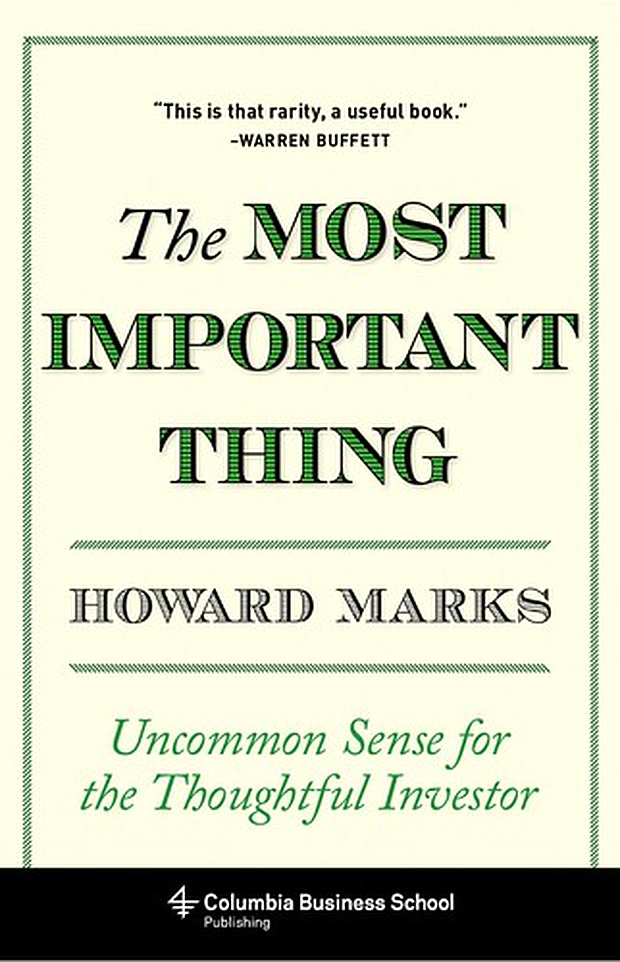
The Most Important Thing
Get on Amazon →
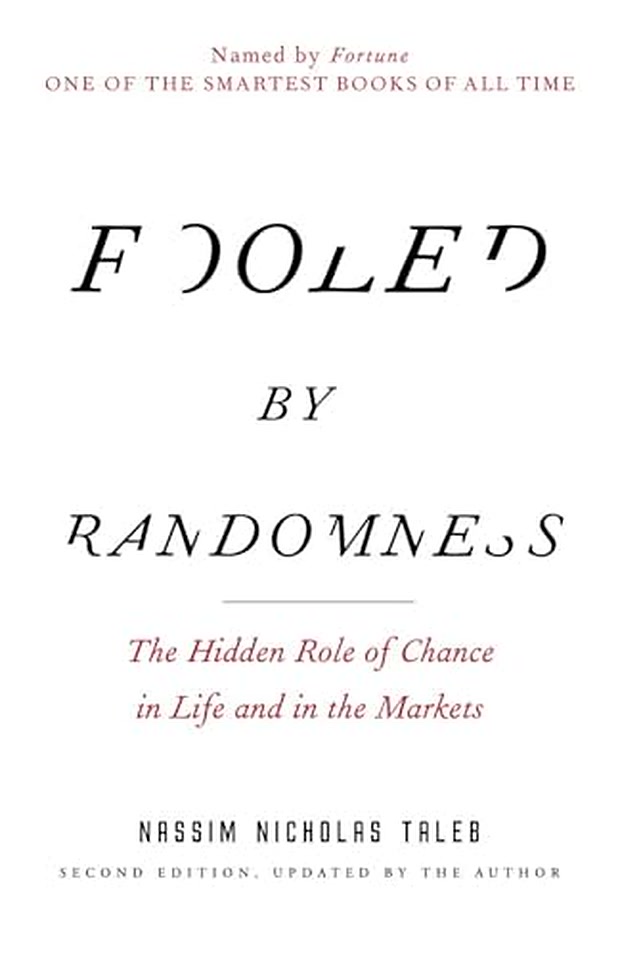
Fooled by Randomness
Get on Amazon →
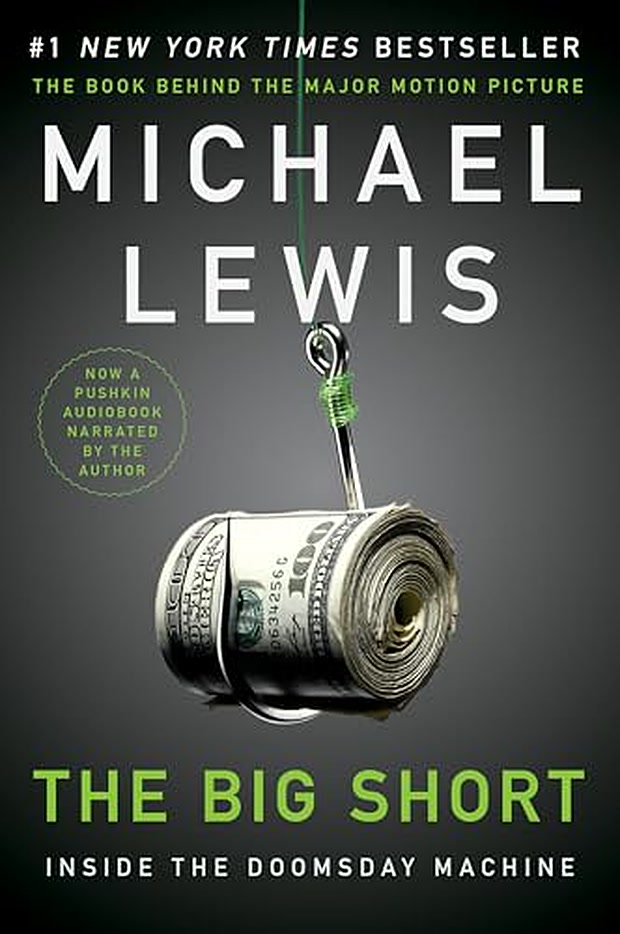
The Big Short
Get on Amazon →
As an Amazon Associate I earn from qualifying purchases.