Howard Marks
2009 07 08 So Much Thats False Nutty
© Oaktree Capital Management, L.P.
All Rights ReservedMemo to: Oaktree Clients
From: Howard Marks Re: So Much That’s False and Nutty
As reported in The New York Times of May 5, Warren Buffett told the crowd at this
year’s Berkshire Hathaway annual meeting:
There is so much that’s false and nut ty in modern investing practice and
modern investment banking. If you just reduced the nonsense, that’s a goal you should reasonably hope for.
As we look back at the causes of the cris is approaching its second anniversary – and
ahead to how investors might conduct themselves better in the future – Buffett’s simple,
homespun advice holds the key, as usual. I agr ee that investing practice went off the rails
in several fundamental ways. Perhaps this memo can help get it back on. The Lead-up: Progress and Missteps
Memory dims with the passage of time, but wh en I think back to the investment arena I
entered forty-plus years ago, it seems very di fferent from that of 2003-07. Institutional
investing was done mainly by bank investment departments (like the one I was part of),
insurance companies and investment counselor s – a pretty dull bunch. And as I like to
point out when I speak to business school cl asses, “famous investor” was an oxymoron –
few investment managers were well known, chosen for magazine covers or listed among the top earners. There were no swaps, index fu tures or listed options. Leve rage wasn’t part of most
institutional investors’ arsenal . . . or vocabulary. Private equity was unknown, and
hedge funds were too few and outré to matter. Innovations like quant itative investing and
structured products had yet to arrive, and few people had ever heard of “alpha.”
Return aspirations were modest. Part of this likely was a ttributable to the narrow range
of available options: for the most part st ocks and bonds. Stocks would average 9-10%
per year, it was held, but we might put together a portfolio that woul d do a little better.
And the admissible bonds were all investment gr ade, yielding moderate single digits.
We wanted to earn a good return, limit the ri sks, beat the Dow and our competitors, and
retain our clients. But I don’t remember any talk of “maximization,” or anyone trying to
“shoot the lights out.” And by the way, no one had ever heard of performance fees.
Quite a different world from that of today. Perhaps it would constitute a service if I
pulled together a list of some of the developments since then:
© Oaktree Capital Management, L.P.
All Rights Reserved 2
In the mid-1960s, growth investing was invented, along with the belief that if you
bought the stocks of the “nifty -fifty” fastest-growing comp anies, you didn’t have to
worry about paying the right price.
The first of the investment boutiques was created in 1969, as I recall, when highly
respected portfolio managers from a number of traditional firms joined together to
form Jennison Associates. For the firs t time, institutional investing was sexy.
We started to hear more about investment personalities . There were the “Oscars”
(Schafer and Tang) and the “Freds” (Carr, Mates and Alger) – big personalities with
big performance, often working outsi de the institutional mainstream.
In the early 1970s, modern portfolio theory began to seep from the University of
Chicago to Wall Street. With it came indexation, risk-adjusted returns, efficient
frontiers and risk/return optimization.
Around 1973, put and call options escaped from obscurity and began to trade on
exchanges like the Chicago Board Options Exchange.
Given options’ widely varying time frames, st rike prices and underlying stocks, a tool
for valuing them was required, and the Black-Scholes model filled the bill.
A small number of leveraged buyouts took place starting in the mid-1970s, but they
attracted little attention.
1977-79 saw the birth of the high yield bond market . Up to that time, bonds rated
below investment grade couldn’t be issued. That changed with the spread of the
argument – associated primarily with Michae l Milken – that incremental credit risk
could responsibly be borne if offset by more-than-commensurate yield spreads.
Around 1980, debt securitization began to occur, with pack ages of mortgages sliced
into securities of varying risk and return, with the hi ghest-priority tranche carrying
the lowest yield, and so forth. This proce ss was an example of disintermediation, in
which the making of loans moved out of th e banks; 25 years later, this would be
called the shadow banking system.
One of the first “quant” miracles came along in the 1980s: portfolio insurance.
Under this automated strategy, investors could ride stocks up but avoid losses by
entering stop-loss orders if they fell. It looked good on paper, but it failed on Black
Monday in 1987 when brokers didn’t answer their phones.
In the mid- to late 1980s, the ability to borrow large amounts of money through high
yield bond offerings made it possible for mi nor players to effect buyouts of large,
iconic companies, and “ leverage” becam e part of investors’ everyday vocabulary.
When many of those buyouts proved too highly levered to get through the 1990
recession and went bust, investing in distressed debt gained currency.
Real estate had boomed because of excessive tax incentives and the admission of real
estate to the portfolios of S&Ls, but it collapsed in 1991-92. When the Resolution
Trust Corporation took failed propertie s from S&Ls and sold them off,
“opportunistic” real estate investing was born.
Mainstream investment managers made th e big time, with Peter Lynch and Warren
Buffett becoming famous for consistently beating the equity indices.
In the 1990s, emerging market investing became the hot new thing, wowing people
until it took its knocks in the mid- to late 1990s due to the Mexican peso devaluation, Asian financial crisis an d Russian debt disavowal.
© Oaktree Capital Management, L.P.
All Rights Reserved 3 Quant investing arrived, too, achieving its first real fame with the success of Long-
Term Capital Management. This Nobel Pri ze-laden firm used computer models to
identify fixed income arbitrage opportunities. Like most other investment miracles, it
worked until it didn’t. Thanks to its use of enormous leverage, LTCM melted down
spectacularly in 1998.
Investors’ real interest in th e last half of the ’90s was in common stocks, with the
frenzy accelerating but narrowing to tech-media-telecom stocks around 1997 and
narrowing further to Internet stocks in 1999. The “limitless potential” of these
instruments was debunked in 2000, and the equity market went into its first three-year
decline since the Gr eat Crash of ’29.
Venture capital funds , blessed with triple-digit return s thanks to the fevered appetite
for tech stocks, soared in the late 1990s and crashed soon thereafter.
After their three-year slump, the loss of faith in common stocks caused investors to
shift their hopes to hedge funds – “absolute return” vehicles expected to make money
regardless of what went on in the world.
With the bifurcation of strategies and mana gers into “beta-based” (market-driven) and
“alpha-based” (skill-driven), investors c oncluded they could identify managers
capable of alpha investing, emphasize it, perhaps synthesize it, and “port” or carry it
to their portfolios in additive combinations.
Private equity – sporting a new label free from the unpleasant history of “leveraged
buyouts” – became another popular alternative to traditional stocks and bonds, and
funds of $20 billion and more were raised at the apex in 2006-07.
Wall Street came forward with a plan to package prosaic, reliable home mortgages
into collateralized debt obligations – the next high-return, lo w-risk free lunch – with
help from tranching, securiti zation and selling onward.
The key to the purported success of this latest miracle lay in computer modeling . It
quantified the risk, a ssuming that mortgage defaults would remain uncorrelated and
benign as historically had been the case . But because careless mortgage lending
practices unknowingly had altere d the probabilities, the default experience turned out
to be much worse than the models suggested or the modelers thought possible.
Issuers of collateralized loan obligations bought corporate loans using the same
processes that had been applied to CDOs. Their buying facilitated vast issuance of
syndicated bank loans carrying low interest rates and few protective covenants, now
called leveraged loans because the lending banks promptly sold off the majority.
Options were joined by f utures and swaps under a new heading: derivatives.
Heralded for their ability to de-risk the fina ncial system by shifting risk to those best
able to bear it, derivatives led to vast losses and something ne w: counterparty risk.
The common thread running through hedge funds, private equity funds and many
other of these investment innovations was incentive compensation. Expected to
align the interests of investment manage rs and their clients, in many cases it
encouraged excessive risk taking.
Computer modeling was furt her harnessed to create “value at risk” and other risk
management tools designed to quantify how much would be lost if the investment
environment soured. This fooled people into thinking risk was under control – a
belief that, if acted on, has the pote ntial to vastly increase risk.
© Oaktree Capital Management, L.P.
All Rights Reserved 4At the end of this progression we find an in stitutional investing worl d that bears little
resemblance to the quaint cottage industry with which the chronology began more than
forty years ago. Many of the developments served to increase risk or had other negative
implications, for investors indi vidually and for the economy over all. In the remainder of
this memo, I’ll discuss these tr ends and their ramifications.
Something for Everyone
One thing that caused a lot of people to lose money in the crisis wa s the popularization of
investing. Over the last few decades, as I described in “The Long View” (January 2009),
investing became widespread. “Less than 10% of adults owned stocks in the 1950s, in
contrast to 40% today.” ( Economics and Portfolio Strategy , June 1, 2009). Star investors
became household names and were venerated. “How-to” books were big sellers, and investors graced the covers of magazines. Television networks were created to cover
investing 24/7, and Jim Cramer and the “Mone y Honey” became celebrities in their own
right. It’s interesting to consider whether this “democratization” of investing represented
progress, because in things requiring special sk ill, it’s not necessarily a plus when people
conclude they can do them unaided. Th e popularization – with a big push from
brokerage firms looking for business and media hungry for customers – was based on
success stories, and it convinced people that “anyone can do it.” Not only did this
overstate the ease of investing, but it also vastly understated the danger. (“Risk” has
become such an everyday word that it sounds harmless – as in “the risk of underperformance” and “risk-adjusted perf ormance.” Maybe we should switch to
“danger” to remind people wh at’s really involved.)
To illustrate, I tend to pick on Wharton Pr ofessor Jeremy Siegel and his popular book
“Stocks for the Long Run.” Siegel’s research was encyclopedic and supported some dramatic conclusions, perhaps foremost among them his showing that there’s never been
a 30-year period in which stocks didn’t outperform cash, bonds and inflation. This
convinced a lot of people to invest heavily in stocks. But even if his long-term premise eventually holds true, anyone who invested in the S&P 500 ten years ago – and is now
down 20% – has learned that 30 years can be a long time to wait. The point is that not everyone is suited to manage his or her own investments, and not
everyone should take on uncertain investments. The success of Bernard Madoff’s Ponzi scheme shows that even people who are wealthy and presumed sophisticated can
overlook risks. Might that be bor ne in mind the next time around?
At Ease with Risk
Risk is something every investor should think about constantly. We know we can’t
expect to make money without taking chances. The reason’s simple: if there was a risk-
© Oaktree Capital Management, L.P.
All Rights Reserved 5free way to make good money – that is, a path to profit free from downside – everyone
would pursue it without hesitati on. That would bid up the pri ce, bring down the return
and introduce the risk that accompanies elevated prices.
So yes, it’s true that investors can’t expect to make much money without taking risk.
But that’s not the same as saying ri sk taking is sure to make you money. As I said in
“Risk” (January 2006), if risky investments always produced high returns, they wouldn’t
be risky. The extra return we hope to earn for holding st ocks rather than bonds is called an equity
risk premium. The additional promised yiel d on high yield bonds rela tive to Treasurys is
called a credit risk premium. All along th e upward-sloping capital market line, the
increase in potential return represents comp ensation for bearing incremental risk. Except
for those people who can generate “alpha” or access alpha managers, investors shouldn’t
plan on getting added return without bearing incremental risk. And for doing so, they
should demand risk premiums. But at some point in the swing of the pe ndulum, people usually fo rget that truth and
embrace risk taking to excess. In short, in bull markets – usually when things have been going well for a while – people tend to say, “Risk is my friend. The more risk I take, the
greater my return will be. I’d like more risk, please.”
The truth is, risk tolerance is antithetic al to successful investing. When people
aren’t afraid of risk, they’ll accept risk wi thout being compensated for doing so . . .
and risk compensation will disappear. This is a simple a nd inevitable relationship.
When investors are unworried and risk-toleran t, they buy stocks at high p/e ratios and
private companies at high EBITDA multiples, and they pile into bonds despite narrow
yield spreads and into real estate at minimal “cap rates.”
In the years leading up to the current crisi s, it was “as plain as the nose on your
face” that prospective returns were low and risk was high. In simple terms, there
was too much money looking for a home, and too little risk aversion. Valuation
parameters rose and prospective returns fell, and yet the amount of money available to
managers grew steadily. Investors were attr acted to risky deals, complex structures,
innovative transactions and leveraged instrume nts. In each case, they seemed to accept
the upside potential and ignore the downside.
There are few things as risky as the wide spread belief that there’s no risk, because
it’s only when investors are suitably risk-averse that prospective returns will
incorporate appropriate risk premiums . Hopefully in the future (a) investors will
remember to fear risk and demand risk premiu ms and (b) we’ll continue to be alert for
times when they don’t.
© Oaktree Capital Management, L.P.
All Rights Reserved 6Embracing Illiquidity
Among the risks faced by the holder of an inve stment is the chance that if liquidity has
dried up at a time when it has to be sold, he ’ll end up getting paid less than it’s worth.
Illiquidity is nothing but another source of risk, and it should be treated no
differently :
All else being equal, investors should prefer liquid investments a nd dislike illiquidity.
Thus, before making illiquid investments, investors should ascertain that they’re
being rewarded for bearing that risk with a sufficient return premium.
Finally, out of basic prudence, investors should limit the proportion of th eir portfolios
committed to illiquid investments. There are some risks investors shouldn’t take
regardless of the return offered.
But just as people can think of risk as a plus , so can they be attrac ted to illiquidity, and
for basically the same reason. There is something called an illiquidity premium. It’s the return increment investors should receive in exchange for accepting illiquidity. But it’ll
only exist if investors prefer liqui dity. If they’re indifferent, the premium won’t be there.
Part of the accepted wisdom of the pre-cris is years was that long-term institutional
investors should load up on illiquid investment s, capitalizing on their ability to be
patient by garnering illiquidity premiums . In 2003-07, so many i nvestors adopted this
approach that illiquidity premiums became e ndangered. For example, as of the middle of
2008, the average $1 billion-plus endowment is said to ha ve had investments in and
undrawn commitments to the main illiquid asset classes (private equ ity, real estate and
natural resources) equal to half its net worth. Some had close to 90%.
The willingness to invest in locked-up pr ivate investment funds is based on a
number of “shoulds.” Illiquid investments should deliver correspondingly higher
returns. Closed-end investment funds should call down capita l gradually. Cash
distributions should be forthcoming from some funds, enabling investors to meet capital
calls from others. And a secondary market should facilitate the sale of positions in
illiquid funds, if needed, at moderate discounts from their fair value. But things that
should happen often fail to happen. That’s why investors should view potential premium
returns skeptically and limit the ri sk they bear, in cluding illiquidity.
Comfortable with Complexity
Investors’ desire to earn money makes them willing to do things they haven’t done
before, especially if those things seem modern and sophisticated. Technological
complexity and higher math can be seductive in and of themselves. And good times and
rising markets encourage experimentation and erase skepticism. These factors allow
Wall Street to sell innovative products in bull markets (and only in bull markets). But
these innovations can be tested only in bear markets . . . and invariably they are.
© Oaktree Capital Management, L.P.
All Rights Reserved 7Many of the investment techniques that were embraced in 2003-07 represented
quantitative innovations, and people seemed to think of that as an advantage rather
than a source of potential risk. Investors were attracted to black-box quant funds,
highly levered mortgage securities critically dependent on computer models, alchemical portable alpha, and risk management based on sketchy historical data . The dependability
of these things was shaky, but the risks were glossed over. As Alan Greenspan wrote in
The Wall Street Journal of March 11:
It is now very clear that the levels of complexity to which market practitioners at the height of their euphoria tried to push risk-management
techniques and products were too much for even the most sophisticated
market players to handle properly and prudently.
Warren Buffett put it in simpler terms at this year’s Berkshire meeting. “If you need a
computer or a calculator to make th e calculation, you shouldn’t buy it .” And Charlie
Munger added his own slant: “Some of the wo rst business decisions I’ve ever seen are
those with future projections and discounts b ack. It seems like the higher mathematics
with more false precision should help you, but it doesn’t. They teach that in business
schools because, well, they’ve got to do something.”
To close on this subject, I want to share a quote I recently came across from Albert Einstein. I’ve often argued that the key to successful inves ting lies in subjective
judgments made by experienced, insightful professionals, not machinable processes, decision rules and algorithms. I love the way Einstein put it:
Not everything that can be counted counts, and not everything that
counts can be counted.
Relying on Ratings
My memos on the reasons for the crisis, li ke “Whodunit” (February 2008), show that
there’s more than enough blame to go around and lots of causes to cite. But if you boil it
down, there was one indispensable ingredient in the process that led to trillions of
dollars of losses: misplaced trust in credit ratings. The explanation is simple:
Competitive pressure for profits caused financial institutions to try to keep up with
the leaders. As is normal in good times, th e profit leaders were those who used the
most leverage.
Thus institutions sought to maximize their leverage, but the rules required that the
greatest leverage be used only with invest ments rated triple-A.
A handful of credit rating agencies ha d been designated by the government as
Nationally Recognized Statisti cal Rating Organizations, despite their highly imperfect
track records.
The people who guard the financial he nhouse often have a tough time keeping up
with the foxes’ innovations. Whereas tr aditional bond analysis was a relatively
© Oaktree Capital Management, L.P.
All Rights Reserved 8simple matter, derivatives and tiered securi tizations were much more complex. This
allowed rating agency employees to be manipulated by the investment banks’
quantitatively sophisticated and highl y compensated financial engineers.
The rating agencies proved too naïve, inept and/or venal to handl e their assigned task.
Nevertheless, financial institutions took the rati ngs at face value, enabling them
to pursue the promise of highly superi or returns from supposedly riskless,
levered-up mortgage instruments. This de al clearly was too good to be true, but
the institutions leapt in anyway.
It all started with those triple-A ratings. For his graduation from college this year, Andrew Marks wrote an insightful thesis on the behavior that gave rise to the credit
crisis. I was pleased that he borrowed an idea from “Whodunit”: “if it’s possible to start
with 100 pounds of hamburger and end up se lling ten pounds of dog food, 40 pounds of
sirloin and 50 pounds of filet mignon, the trut h-in-labeling rules can’t be working.”
That’s exactly what happened when mo rtgage-related securities were rated.
Investment banks took piles of residential mortgages – many of them subprime – and
turned them into residential mortgage-backed securities (RMBS). The fact that other
tranches were subordinated and would lose firs t allowed the rating agen cies to be cajoled
into rating a lot of RMBS investment gr ade. Then RMBS were assembled into
collateralized debt obligations , with the same process rep eated. In the end, heaps of
mortgages – each of which was risky – were turned into CDO debt, more than 90% of which was rated triple-A, meaning it was supposed to be almost risk-free. John Maynard Keynes said “. . . a speculator is one who runs risks of which he is aware
and an investor is one who runs risks of which he is unaware.” Speculators who bought
the low end of the CDO barrel with their eyes open to the risk suffered total losses on a
small part of their capital. But the highly le vered, esteemed investing institutions that
accepted the higher ratings without questioning the mortgage alchemy lost large amounts
of capital, because of the ease with which they’d been able to lever holdings of triple-A
and “super-senior” CDOs. Ronald Reagan said of arms treaties, “Trust, then verify.” If
only financial institutions had done the same. The rating agencies were diverted from thei r mission by a business model that made them
dependent on security issuers for their revenues. This eliminated their objectivity and co-
opted them into the rating-maximization pro cess. Regardless of th at happening, however,
it’s clear that the stability of our financial institutions neve r should have been allowed to
rely so heavily on the competence of a fe w for-profit (and far-from-perfect) rating
agencies. In the future, when people reviewing th e crisis say, “If only they had . . . ,”
the subject will often be credit ratings. Bottom line: investors must never again abdicate the essential task of assessing ri sk. It’s their number-one job to perform
thorough, skeptical analysis.
© Oaktree Capital Management, L.P.
All Rights Reserved 9The More You Bet . . .
If I had to choose a single phrase to su m up investor attitudes in 2003-07, it would
be the old Las Vegas motto: “The more you bet, the more you win when you win.”
Casino profits ride on getting people to bet more. In the financial markets just before the
crisis, players needed no such encouragemen t. They wanted to bet more, and the
availability of leverage helped them do so.
One of the major trends embedded in the ch ronology on pages two and three was toward
increasing the availability of leverage. Now, I’ve never heard of any of Oaktree’s
institutional clients buying on marg in or taking out a loan to ma ke investments. It might
not be considered “normal” for fiduciaries , and tax-exempt investors would have to
worry about Unrelated Business Taxable Income. None of us go out and buy Inte l chips, but we’ve all seen co mmercials designed to get us
to buy products with “Intel inside.” In the same way, investors became increasingly
able to buy investment products with levera ge inside . . . that is, to participate in
levered strategies rather than borro w explicitly to make investments. Think about
these elements from my earlier list of investment developments:
Investors who would never buy stocks on margin were able to invest in private equity
funds that would buy companies on le verage of four times or more.
The delayed and irregular nature of drawdowns caused people who had earmarked
$100 for private investment funds to make commitments totaling $140.
Options, swaps and futures – in fact, ma ny derivatives – are nothing but ways for
investors to access the return on large am ounts of assets with little money down.
Many hedge funds used borrowings or deri vatives to access the returns on more
assets than their capital would allow them to buy.
When people wanted to invest $100 in mark ets with skill-derived return bolted on,
“portable alpha” had them invest $90 in hedge funds with perceived alpha and the rest
in futures covering $100 worth of the passive market index. This gave them a stake
in the performance of $190 of a ssets for every $100 of capital.
Clearly, each of these techniques exposed investors to the gains or losses on
increased amounts of assets. If that’s not leverage, what is? In fact, an article entitled
“Harvard Endowment Chief Is Earni ng Degree in Crisis Management” in The New York
Times of February 21 said of Harvard, “The endowment was squeezed partly because it
had invested more than its assets . . .” (emphasis added). I find this statement quite
remarkable, and yet no one has remarked on it to me.
It shouldn’t be surprising that people engaging in these levere d strategies made more than
others when the market rose. But 2008 showed the flip side of that equation in action. In
the future, investors should consider wheth er they really want to lever their capital
or just invest the amount they have .
© Oaktree Capital Management, L.P.
All Rights Reserved 10Sharing the Wealth
Apart from the increasing use of leverage, anot her trend that characterized the five years
before the crisis was the widespr ead imposition of incentive fees.
In the 1960s, at the start of my chronology, only hedge funds commanded incentive fees,
and there were too few for most people to know or care about. But fee arrangements that
can be simplified as “two-and-twenty” flow ered with private equity in the 1980s,
distressed debt, opportunistic real estate and venture capital f unds in the 1990s, and
hedge funds in the 2000s. Soon they were everyplace. Here are my basic thoughts on this sort of arrangement. (Oaktree receives incentive
compensation on roughly half its assets; my objection isn’t with regard to the fees themselves, but rather the way they’ve been applied.)
It seems obvious that incentive fees shou ld go only to managers with the skill
needed to add enough to returns to more than offset the fees – other than
through the mere assumpti on of incremental risk. For example, after a high yield
bond manager’s .50% fee, a 12% gross retu rn becomes 11.5% net. A credit hedge
fund charging a 2% management fee and 20% of the profits would have to earn a
16.375% gross return to net 11.5%. That’s 36% more return. How many managers
in a given asset class can generate this incremental 36% other than through an
increase in risk? A few? Perh aps. The majority? Never.
Thus, incentive fee arrangements shou ld be exceptional, but they’re not . These
fees didn’t go to just the proven managers (or the ones whose returns came from skill
rather than beta); they went to everyone. If you raised your hand in 2003-07 and said “I’m a hedge fund manager,” you got a few billion to manage at two-and-twenty,
even if you didn’t have a record of succe ssfully managing money over periods that
included tough times.
The run-of-the-mill manager’s ease of obtai ning incentive fees was enhanced each
time a top manager capped a fund. As I wrote in “Safety First . . . But Where?”
(April 2001), “When the best are cl osed, the rest will get funded.”
In fact, whereas two-and-twenty was unhear d-of in the old days, it became the norm
in 2003-07. This enabled a handful of managers with truly outstanding records to
demand profit shares ranging up to 50%.
Clients erred in using the term “alignment of interests” to describe the effect of
incentive compensation on their relationships with managers. Allowing managers to
share in the upside can bring forth best effo rts, but it can also en courage risk bearing
instead of risk consciousness. Most mana gers just don’t have enough money to invest
in their funds such that loss of it could fully balance their potential fees and upside
participation. Instead of alignment, then, incenti ve compensation must be viewed
© Oaktree Capital Management, L.P.
All Rights Reserved 11largely as a “heads we win; tails you lo se” arrangement. Cl early, it must be
accorded only to the few managers who can be trusted with it.
Finally, the responsibility for overpaying doesn’t lie with the person who asks
for excessive compensation, but ra ther with the one who pays it. How many
potential LPs ever said, “He may be a great manager, but he’s not worth that fee.” I
think most applied little price discipline, as they were driven by the need to fill asset
class allocations and/or the fear that if they said no, they might miss out on a good
thing (more on this subject later).
I’m asked all the time nowadays what I expe ct to happen with investment manager
compensation. First, I remind people that what should happen and what will happen are two different things. Then I make my main point: there should be much more differentiation. Whereas in past years everyone’s fees were generous and pretty
much the same, the post-2007 period is providing an acid test that will show who
helped their clients and who didn’t. Appropriate compensation adjustments should
follow.
Managers who actually helped their clients be fore and during this difficult period – few
in number, I think – will deserve to be very well compensated, and their services could be
in strong demand. The rest should receive smaller fees or be denied incentive
arrangements, and some might turn to other lines of work. Oaktree hopes to be among
the former group. We’ll see. Ducking Responsibility
The inputs used by a business to make its products are its costs. The money it receives for its output are its revenues. The difference between revenues and costs are its profits.
At the University of Chicago, I was taught that by maximizing profits – that is,
maximizing the excess of output over input – a company maximizes its contribution to
society. This is among the notions that have been dispelled, exposing the imperfections
of the free-market system. (Hold on; I’m not saying it’s a bad system, just not perfect.) When profit maximization is exalted to exce ss, ethics and responsibility can go into
decline, a phenomenon that play ed a substantial role in gett ing us where we are. The
pursuit of short-term profit can lead to actions that are c ounterproductive for others, for
society and for the long run. For example:
A money manager’s desire to add to assets under management, and thus profits, can
lead him to take in all the money he can. But when asset prices and risks are high and
prospective returns are low, this clearly isn’t good for his clients.
Selling financial products to anyone who’ll buy them, as opposed to those for whom
they’re right, can put inve stors at unnecessary risk.
And cajoling rating agencies into assigning the highest rating to debt backed by
questionable collateral can put whole economies in jeopardy, as we’ve seen.
© Oaktree Capital Management, L.P.
All Rights Reserved 12
One of the concepts that governed my early years, but about which I’ve heard little in
recent years, is “fiduciary duty.” Fiduciary duty is the obligation to look out for the welfare of others, as opposed to maximizing for yourself. It can be driven by ethics or by
fear of legal consequences; either way, it te nds to cause caution to be emphasized.
When considering a course of action, we sh ould ask, “Is it right?” Not necessarily
the cleverest practice or the most profitable, but the right thing? The people I think
of perverting the mortgage securitization process never wondered whether they were
getting an appropriate rating, but whether it was the highest possible. Not whether they
were doing the right thing for clients or society, but whether they were wringing
maximum proceeds out of a pile of mortgage collateral and thus maximizing profits for
their employers and bonuses for themselves.
A lot of misdeeds have been blamed on excessive emphasis on short-term results in setting compensation. The more compensation stresses the long run, the more it creates
big-picture benefits. Long- term profits do more good – for companies, for business
overall and for society – than does short-term self-interest.
Focusing on the Wrong Risk
The more I’ve thought about it over the la st few months, the more I’ve concluded
that investors face two main risks: (1) the risk of losing money and (2) the risk of
missing opportunity. Investors can eliminate one or th e other, but not both. More
commonly, they must consider how to balance the two. How they do so will have a great
impact on their results. This is the old dile mma – fear or greed? – that people talk about
so much. It’s part of the choice between offense and defense that I often stress (see, for
example, “What’s Your Game Plan?” September 2003).
The problem is that investors often fail to strike an appropr iate balance between the two
risks. In a pattern that exemplifies th e swing of the pendulum from optimistic to
pessimistic and back, investors regularly os cillate between extremes at which they
consider one to the exclusion of th e other, not a mixture of the two.
One of the ways I try to get a sense for what’s going on is by imagining the conversations
investors are having with each other . . . or with themselves. In 2003-07, with most
investors worried only about achieving returns, I think the conversation went like this: “I’d better not make less than my peers. Am I behaving as aggressive ly as I should? Am
I using as much leverage as my competit or? Have I shifted enough from stocks and
bonds to alternatives, or am I being an old f ogey? If my commitments to private equity
are 140% of the amount I actually want to invest, is that enough, or should I do more?” Few people seemed to worry about losses. Or if they were worried, they played anyway,
fearing that if they didn’t, they’d be left behind. That must be what drove Citigroup’s Chuck Prince when he said, “as long as the music’s playing, you’ve got to get up and
© Oaktree Capital Management, L.P.
All Rights Reserved 13dance. We’re still dancing.” The implication’s clear: No worries; high prices. No
risk aversion; no risk premiums . Certainly that descri bes the markets in 2003-07.
In the fourth quarter of 2008, when asset pr ices were collapsing, I imagined a very
different conversation from that of 2003-07, with most investors sayi ng, “I don’t care if I
never make another dollar in the market; I just don’t want to lose any more. Get me out!”
Attitudes toward the two risks were still unbalanced, but in the opposite direction.
Just as risk premiums disapp ear when risk is ignored, so can prospective returns soar
when risk aversion is excessive. In la te 2008, economic fundamentals were terrible;
technical conditions consisted of forced se lling and an absence of buyers; and market
psychology melted down. Risk aversion pr edominated, and fear of missing out
disappeared. These are the conditions under whic h assets are most likely to be available
for purchase at prices way below their fair va lue. They’re also the conditions in which
most people go on buying strikes.
In the future, investors should do a better job of balancing the fear of losing money
and the fear of missing out. My resp onse is simple: Good luck with that.
Pursuing Maximization
When markets are rising and investors are obsessed with the fear of missing out, the
desire is for maximum returns. Here’s the in ner conversation I imagin e: “I need a return
of 8% a year. But I’d rather have 10%. 14% would be great, and the possibility of 16%
warrants adding to my risk. It’s worth using le verage for a shot at 20 %, and with twice as
much leverage, I might get 24%.” In other words, more is better. And of course it is . . . except that to pursue higher
returns, you have to give up something. That something is safety. But in hot times, no
one worries about losing money, just missi ng out. So they try to maximize.
There should be a point at wh ich investors say, “I need 8% , and it would be great if I
could get 16%. But to try, I would have to do things that expose me to excessive loss.
I’ll settle for a safer 10% instead.” I’ve labeled this concept “good-enough returns .”
It’s based on the belief that the possibilit y of more isn’t always better. There should
be a point at which investors decline to take more risk in the pursuit of more return, because they’re satisfied with the return they expect and would rather achieve that
with high confidence than try for more at the risk of falling short (or losing money).
Most investors will probably say that in 2003-07, they didn’t blindly pursue
maximization; it was the other guys. But so meone did it, and we’re living with the
consequences. I like it better when society bala nces risk and return rather than
trying to maximize. Less gain, perhaps, but also less pain.
© Oaktree Capital Management, L.P.
All Rights Reserved 14* * *
“Apropos of nothing,” as my mother used to say, I’m going to use the opportunity
provided by this memo to discuss market cond itions and the outlook. On the plus side:
We’ve heard a lot recently about “green s hoots”: mostly cases where things have
stopped getting worse or the rate of dec line is slowing. A few areas have shown
actual improvement, such as consumer conf idence and durable goods orders. It’s
important when you consider these improve ments, however, to bear in mind that
when you get deep into a recession, the comparisons are against depressed periods,
and thus easier.
It’s heartening to see the capital markets open again, such that banks can recapitalize
and borrowers can extend maturities and delever. Noteworthil y, Michael Milken and
Jonathan Simons wrote in The Wall Street Journal of June 20 that, “Global
corporations have raised near ly $2 trillion in public and private markets this year . . .”
Investor opinion regarding markets and th e government’s actions has grown more
positive, and as Bruce Karsh says, “Armageddon is off the table.” (He and I both felt
6-9 months ago that a financial system me ltdown absolutely couldn’t be ruled out.)
These positives are significant, but ther e also are many unresolved negatives:
Business is still terrible. Sa les trends are poor. Where prof its are up, it’s often due to
cost-cutting, not growth. (Remember, one man’s economy measure is another’s job
loss – not always a plus for the overall picture.)
Unemployment is still rising, and with incomes shrinking, savings rising as a
percentage of shrinking incomes, and credit scarcer, it’s hard to see whose spending
will power a recovery.
The outlook for residential and, particularly, commercial real estate remains poor, with implications for further write-offs on th e part of the banks. Ditto for credit card
receivables.
Many companies are likely to experience debt refinancing challenges, defaults,
bankruptcies and restructurings.
Developments such as rising interest rates and rising oil prices have the power to
impede a recovery.
Finally, no one can say with confidence what will be the big-picture ramifications of
trillions of dollars of federal deficit spending, or the stat es’ fiscal crises.
I’m not predicting that these things will turn out badly, merely citing potential
negatives that may not be fully reflect ed in today’s higher asset prices. My greatest
concern surrounds the fact that we’re in the middle of an unprecedented crisis, brought on
by never-seen-before financial behavior, against which novel remedies are being
attempted. And yet many people seem confident that a business-as-usual recovery lies ahead. They’re applying normal lag times and extrapolating normal decline/recovery
relationships. The words of the late Amos Tversky aptly represent my view: “It’s
frightening to think that you might not know something, but more frightening to
© Oaktree Capital Management, L.P.
All Rights Reserved 15think that, by and large, the world is run by people who have faith that they know
exactly what’s going on.”
Peter Bernstein, a towering intellect who sa dly passed away a month ago, made some
important contributions to the way I think about investing. Perhaps foremost among
them was his trenchant observation that, “Risk means more things can happen than will happen.” Investors today may think they know wh at lies ahead, but they should at
least acknowledge that risk is high, the ra nge of possibilities is wider than it was
ever thought to be, and there are a few that could be particularly unpleasant.
Unlike 2003-07 when no one worried about ris k, or late 2008 when few investors cared
about opportunity, the two seem to be in bett er balance given the revival of risk taking
this year. Thus the markets have recovere d, with most of them up 30% or more from
their bottoms (debt in December and stocks in March).
If you and I had spoken six months ago, we mi ght have reflected on the significant stock
market rallies that occurred during the d ecade-long Great Depression, including a 67%
gain in the Dow in 1933. How uncalled-for thos e rallies appear in retrospect. But now
we’ve had one of our own.
Clearly, improved psychology and risk tolerance have played a big part in the
recent rally. These things have streng thened even as economic fundamentals
haven’t, and that could be worrisome. (On June 23, talking a bout general resilience –
not investor attitudes – President Obama said the American people “. . .are still more
optimistic than the facts alone would justif y.”) On the other ha nd, there’s good reason to
believe that at their lows, security prices ha d understated the merits. So are prices ahead
of fundamentals today, or have they merely recovered from “too low” to “in balance”?
There’s no way to know for sure.
Unlike the fourth quarter of last year – when assets were depressed by terrible
fundamentals, technicals and psychology – they’r e no longer at giveaway prices. Neither
are they clearly overvalued. Maybe we should say “closer to fair.”
With price and value in reasonable balance, the course of security prices will largely
be determined by future economic developments that defy prediction. Thus I find it
hard to be highly opinionated at this juncture . Few things are compelling sells here,
but I wouldn’t be a pedal-to-the-metal buye r either. On balance, I think better buying
opportunities lie ahead. July 8, 2009
© Oaktree Capital Management, L.P.
All Rights Reserved 16Legal Information and Disclosures
This memorandum expresses the views of the author as of the date indicated and such views are
subject to change without notice. Oaktree has no duty or obligation to update the information contained herein. Further, Oaktree makes no rep resentation, and it should not be assumed, that
past investment performance is an indication of future results. Moreover, wherever there is the
potential for profit there is al so the possibility of loss.
This memorandum is being made available for educational purposes only and should not be used
for any other purpose. The information contai ned herein does not constitute and should not be
construed as an offering of advisory services or an offer to sell or solicitation to buy any
securities or related financial instruments in any jurisdiction. Certain information contained herein concerning economic trends and performan ce is based on or derived from information
provided by independent third- party sources. Oaktree Capita l Management, L.P. (“Oaktree”)
believes that the sources from which such informa tion has been obtained are reliable; however, it
cannot guarantee the accuracy of such inform ation and has not independently verified the
accuracy or completeness of such information or the assumptions on which such information is
based. This memorandum, including the information cont ained herein, may not be copied, reproduced,
republished, or posted in whole or in part, in any form without the prior written consent of
Oaktree.
Recommended Reading
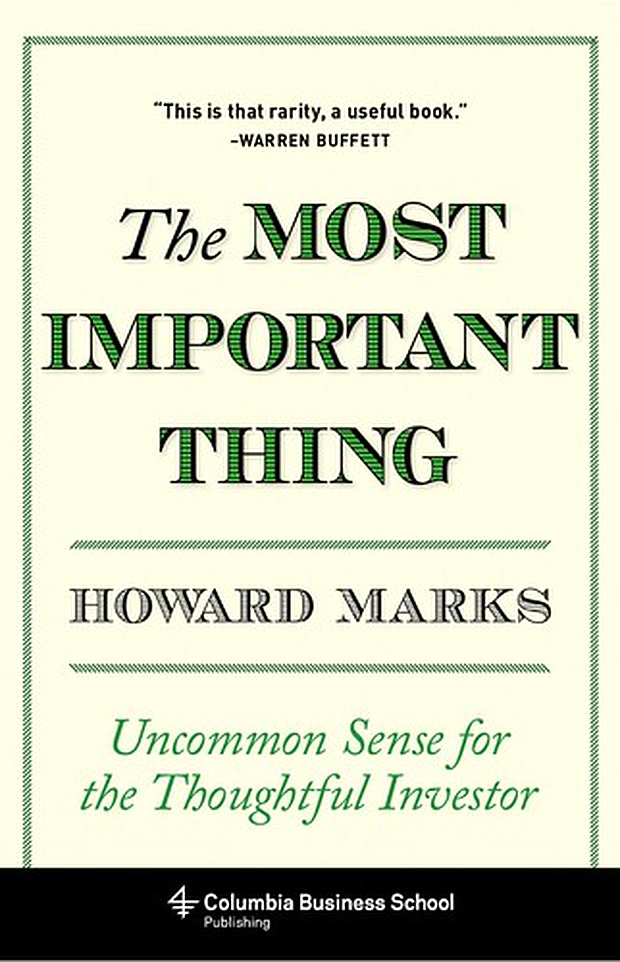
The Most Important Thing
Get on Amazon →
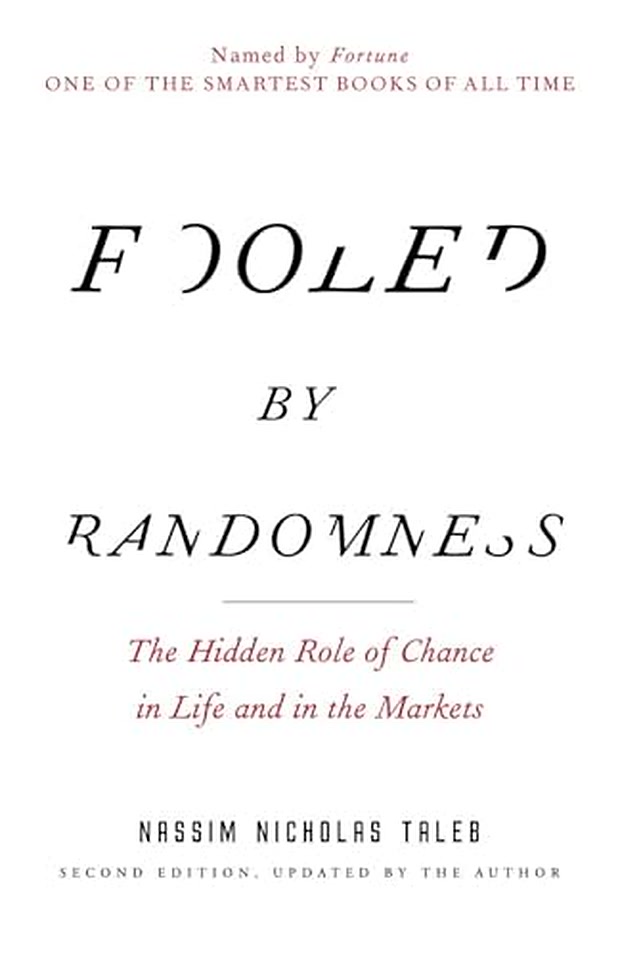
Fooled by Randomness
Get on Amazon →
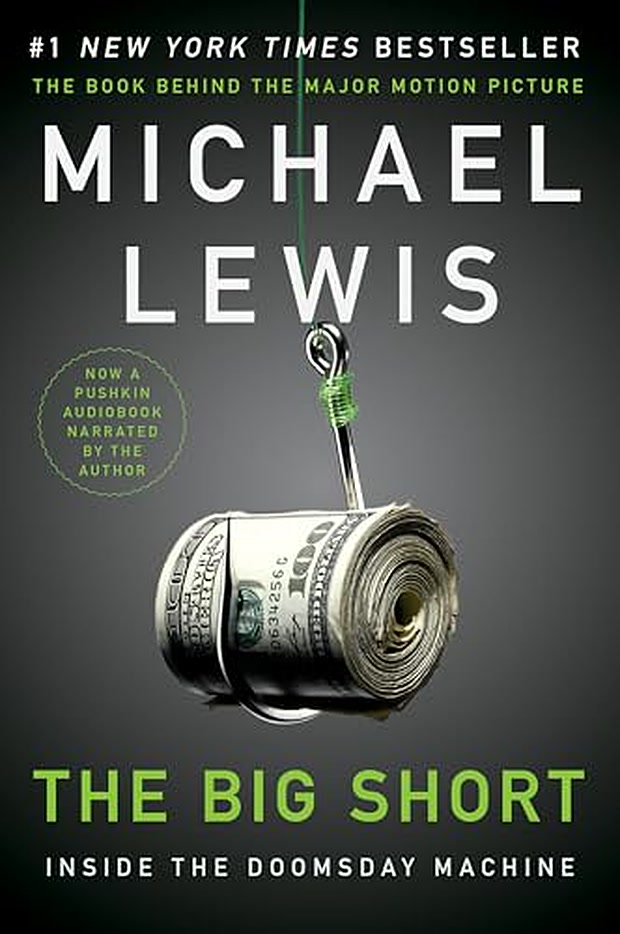
The Big Short
Get on Amazon →
As an Amazon Associate I earn from qualifying purchases.