Howard Marks
2009 01 09 The Long View
© Oaktree Capital Management, L.P.
All Rights ReservedMemo to: Oaktree Clients
From: Howard Marks Re: The Long View
Many of my memos over the last year and a half have touched on the developments in
2003-07 that brought on the current financial cr isis. By now, everyone understands the
role of innovation, risk toleran ce and leverage in the boom that led to the bust, so I think
it’s now time to look back considerably further. The Importance of Cycles
In my opinion, there are two key concepts that investors must master: value and
cycles . For each asset you’re considering, you mu st have a strongly held view of its
intrinsic value. When its pri ce is below that value, it’s generally a buy. When its price is
higher, it’s a sell. In a nuts hell, that’s value investing.
But values aren’t fixed; they move in res ponse to changes in the economic environment.
Thus, cyclical considerations influence an asset’s current value. Value depends on
earnings, for example, and earnings are shaped by the economic cycl e and the price being
charged for liquidity. Further, security prices are gr eatly affected by investor behavi or; thus we can be aided in
investing safely by understanding where we stand in terms of the market cycle. What’s
going on in terms of investor psychology, and how does it tell us to act in the short run?
We want to buy when prices seem attractive. But if investors are giddy and optimism is
rampant, we have to consider whether a better buying opportunity mightn’t come along later. The Lessons – and Limits – of Experience
I feel good about having been aw are of where we stood in term s of the market cycle and
investor behavior over the last four or five years. There were memos that talked about
low prospective returns and meager risk pr emiums (“Risk and Return Today,” October
2004), repetition of past mistakes (“Ther e They Go Again,” May 2005), investor
inattention to warning signs (“Hindsight First, Please,” October 2005), and the rising willingness to accept lower returns and less safety (“The Race to the Bottom,” February 2007). Importantly, these views were factored into Oaktre e’s actions, enabling us to
make some good decisions on behalf of our clients.
© Oaktree Capital Management, L.P.
All Rights Reserved 2I recite these successes not for the purpose of self-congrat ulation, but to point out
that while I was highly aware of the short-te rm cycle, I – like al most everyone else, it
seems – failed to fully appreciate the big-pi cture peril implied by the level to which
the cycle had risen. In short, I though t 2003-07 was like the other cycles I’ve lived
through, just more so. I missed the fact th at it was different not only in degree, but
also in kind.
This episode is different because over th e preceding decades, the accretion of
progressively higher highs and higher lows – in a large number of phenomena –
brought us to a macro-high that hadn’t been witnessed for many years and held great danger . . . as we’re seeing.
Forty years have passed since I first served as a summer trainee in First National City Bank’s Investment Research Department. My experience in seeing investors punished in
1969-70, 1973-74, 1977, 1981, 1987, 1990, 1994 and 2000-02 is what enabled me to detect the excesses of 2003-07. But since I didn’t live through the Great Depression or
work through the full run-up to the painful 1970s , I didn’t have the pe rspective needed to
understand where those relatively short cycl es of boom/bust/recovery were taking us.
Long-Term Trends
Looking back over my career, it’s clear that the securities market s have been riding a
number of salutary secular tr ends (“secular,” as in “of or relating to a long term of
indefinite duration” per Webster’s New Collegiate Dictionary ). Some of these actually
began at the end of World War II and ran through 2007, for a total of more than six
decades. Macro Environment – The period following World War II was one of American
dominance and prosperity. The U.S. benef ited from the “baby boom,” the fact that our
shores hadn’t been reached by the war, and the effective transition of our factories and
labor force to peacetime use. We were aided by a modern infrastructure, strong
education and healthcare syst ems, and gains in technology.
Corporate Growth – The last sixty years have seen strong growth in corporations and
their profits. Especially in the early part of this period, the U.S. developed superior
products, produced them very efficiently a nd found ready markets in the rest of the
world. Gains in automation, informati on technology, management practices and
productivity all contributed. Growth in sale s was supported by strong consumer demand.
The Borrowing Mentality – As further discussed below, advances in financing – and
greater acceptance of the use of debt – allowed companies to augment their growth rates
and returns on capital and allo wed consumers to increase cons umption. In fact, over the
last several decades, economic units of all sort s in the U.S. increased their use of debt.
Consumers, businesses, governments and inve stors all wanted to borrow more, and the
financial services industry developed pr oducts to accommodate them. Spending and
© Oaktree Capital Management, L.P.
All Rights Reserved 3
investment was facilitated through the extensio n of credit at all le vels, contributing to
economic expansion but also sowing th e seeds for the current situation.
Popularization of Investing – Back in 1968, working in investment management was no different from entering banking or insurance. Investing wasn ’t the high-profile area it’s
been the last two decades. “Famous inve stor” was an oxymoron; none were household
names, like Warren Buffett, George Soros a nd Peter Lynch would become. Investment
firms weren’t the B-school employer of choi ce, and investment managers didn’t dominate
magazine covers and the top income brackets. But over the last forty years, increased
attention was paid to equities, mutual funds, hedge funds and alternative niche markets.
Even homes came to be viewed as investment vehicles. Investor Psychology – Attitudes morphed over time. Instead of a generation scarred by the Great Depression, people became increasingly confident, optimistic and venturesome.
Experience convinced prospective investors that stocks could be counted on for high
returns. In the last few decades, there’ve been times when people concluded the business cycle had been tamed. During Alan Green span’s reign, people came to believe
inordinately in his ability to keep the economy growing steadily. And most recently,
people swallowed the canard that innovati on, financial engineeri ng and risk modeling
could take the uncertainty out of investing. The developments enumerated above consti tuted a strong tailwind behind the economy
and the markets over the last several decad es, and they produced a long-term secular
uptrend.
Short-Term Cycles
Despite the underlying uptrend, there’s been no straight line. The economy and markets
were punctuated every few years by cyclical bouts of short-term fluctuation. Cycles
around the trend line made for frequent ups a nd downs. Most were relatively small and
brief, but in the 1970s, economic stagnation set in, inflation reached 16%, the average
stock lost almost half its value in two years, and Business Week magazine ran a cover
story trumpeting “The Death of Equities.” N o, my forty years haven’t been all wine and
roses.
© Oaktree Capital Management, L.P.
All Rights Reserved 4
From time to time we saw better economi es and worse – slowdown and prosperity,
recession and recovery. Markets, too, rose and fell. These fluctuations were attributable
to normal economic cycles and to exogenous developments (such as the oil embargo in 1973 and the emerging market crisis in 1998). The S&P 500 had a few down years in the period from 1975 to 1999, but none in which it lost more than 7.5%. On the upside, however, 16 of those 25 years showed retu rns above 15%, and seven times the annual
gain exceeded 30%. Despite the ups and downs, investors prof ited overall, investing became a national
pursuit, and America’s richest man got that way by buying common stocks and whole companies. A serious general uptrend was underway, reaching its zenith in 2007. The Rest of the Elephant
There’s an old story about a group of blind men walking down the road in India who
come upon an elephant. Each one touches a di fferent part of the elephant – the trunk, the
leg, the tail or the ear – and comes up w ith a different explanation of what he’d
encountered – a tree, a reed, a palm leaf – based on the small part to which he was
exposed. We are those blind men. Even if we have a good understanding of the
events we witness, we don’t easily gain th e overall view needed to put them together.
Up to the time we see the whole in action, our knowledge is limited to the parts we’ve touched.
Until mid-2007, my experience as a money manage r had been limited to part of the long-
term story. Perhaps what looked like an underlying long-term uptrend should have
been viewed instead as the positive part of a long-term cycle incorporating downs as
well as ups. Only when you step back from the beast can you gauge its full proportions.
© Oaktree Capital Management, L.P.
All Rights Reserved 5
Cycles in Long-Term Trends
The main thing I want to discuss in this me mo is my realization that there are cycles
in the long-term trend, not just short-term cycles around it, and we’ve been living
through the positive phase of a big one.
Over the last few decades, investors have reacted to the generally positive economic environment by taking actions reflecting increa sed optimism and trust, as well as reduced
caution and conservatism. In hindsight, we can see nearly uninterrupted growth in
behavior that (a) relied on a continuati on of the favorable underlying trends and
thus (b) can be described as increasingly bullish.
Looking for just one word, I’d say there was a steady rise in “willingness.” Over my
forty years in business – but probably carryi ng on from the end of the World War II – I
believe investors grew increasingly willing . . .
to forget old-fashioned concepts like “savi ng for a rainy day,” fi duciary responsibility
and preservation of capital,
to pursue capital appreciation rather than settle for more modest, steady income,
to invest on the basis of growth pot ential rather than existing value,
to trust that stocks would provide superior performance (see separate section below),
to drastically reduce the representation of high gr ade bonds in portfolios,
to move away from stocks and bonds a nd toward more exotic investments,
to believe that diversificati on into risky assets would incr ease return more than risk,
to pursue profit through proprie tary investing if you were a bank or investment bank,
and for endowments to try to be “more like Yale,”
to assume that markets would function smoothly even in tough times,
to trust in markets to solve all problems, induce constructive behavior and efficiently
allocate capital, allowing regulation to be reduced,
to accept that, thanks to market efficien cy, asset prices are always “right,”
to trust in the Fed, Alan Greenspan and the ability to restrain cycles,
to rely on quants and financial engine ers, spreadsheets and risk modeling,
to feel confident they had a good handle on what the future held,
to believe in alpha, absolute return, wide spread genius among money managers, free
lunches, and superior asset classes regardless of how they’re priced,
to revere and trust money ma nagers sporting good returns,
to share investment gains with money manage rs, perhaps in ways that motivated them
to take increased risk in pursuit of short-term profits,
to view houses, art, jewelry and co llectibles as financial assets,
to believe th
at real estate prices couldn’t go down,
to treat investing as a national pastime via TV, magazines and books,
to “buy the dips,”
to accept new paradigms,
to relax diligence standards and forget to question skeptically,
© Oaktree Capital Management, L.P.
All Rights Reserved 6 to use past statistical averages – someti mes covering brief time periods – to
gauge the safety of prospective investments,
to partake in financial innovation and inve st in things too complex or opaque to
be understood,
to believe that risk had been banish ed, most recently through securitization,
tranching and decoupling,
to forgo liquidity,
to make increasing use of leverage (see separate section below),
to finance investment activities wi th undependable capital: short-term
borrowings and deposits, impermanent equity, and future cash receipts,
to forget to worry and be risk-averse, and thus
to accept additional risk at shrinking risk premiums.
The “era of increasing willingness” carried many trends to higher highs. The last
ten listed above were the prime ingredient s giving rise to the current crisis.
Together they produced an investment house of cards that was enormously
dependent on continued prosperity, bullishness and easy money.
Expansiveness
In addition to “willingness,” one of the mo st significant trends during the period
under discussion has been a massive increase in “expansiveness,” my new label for
the desire to increase the ratio of activity to capital. If that sounds unfamiliar, the
common term in America is “leverage ,” and in England it’s “gearing.”
My last memo was on the subject of leverage and its major role in the crisis we’re all experiencing. Today’s problem s are largely a function of th e high levels of leverage
employed in 2003-07, but those levels were just the apogee of a progression that spanned
decades. Every business, government, non-profit organi zation or individual has a certain amount
of equity capital, net worth or surplus. That capital, in turn, will support a certain level of
activity: production and sale s, lending, government acti on, charitable grants or
consumption. But over the last several decades, if you wanted to do more of these
things than your capital p ermitted, you could borrow capital from someone else.
Over the course of my lifetime, there have been extraordinary changes in the extent of
borrowing:
Consumers – When I went off to college 45 years ago, I paid for purchases with
checks or cash, and I saved up coins for th e payphone. “Travel and entertainment”
cards like American Express and Diners Cl ub were available only to those with top
credit ratings, and the masses lived without credit cards until Citibank introduced The
Everything Card (now MasterCard) around 1967. In the old days, consumers who
lived beyond their incomes were often described as being “in debt.” We don’t hear
© Oaktree Capital Management, L.P.
All Rights Reserved 7that term anymore, since people with unpaid credit card balances and consumer loans
are the rule, not the excep tion. As a result, consumer credit outstanding grew 260
times from 1947 to 2008, increasing from 4.2% of gross domestic product to 17.9%.
(Federal Reserve data and Economagic)
Homeowners – In the old days, homebuyers, ha ving saved for years, usually put
down 20% of the cost of a home and borrowe d the rest through a thirty-year fixed-
rate mortgage. They made payments until that debt was eliminated, and they held
mortgage-burning parties to celebrate the event, which would enable them to retire mortgage-free. Only people who were “in trouble” took out second mortgages,
perhaps to meet emergency expenses. All of these concepts we nt out the window in
recent times, when down payments, fixed rates and paid-off mortgages became things of the past, replaced by 100% financing, adjustable rates, teasers and serial
refinancings. Second mortgages were relabe led “home equity loans,” little miracles
that would let people draw out the inevita ble appreciation in th eir homes, spend it,
and end up with the same home and larger pa yments – perhaps just as interest rates
moved up or as the borrowers hoped to be able to retire.
Corporations – “In the beginning,” corporate borrowing was most undemocratic.
Prior to the late 1970s, only firms with inve stment-grade credit ratings of triple-B or
better could publicly issue bonds. But that changed with the introduction of high
yield bonds, an innovation permitting low-rate d issuers to borrow at high interest
rates. Before the advent of high yiel d bonds, companies could be acquired only by
companies bigger than themselves. But w ith high yield bonds, small firms and even
wealthy individuals could borrow enough to acq uire corporate giants. This created
the leveraged buyout industry. In recent ye ars, not only was debt added to capital
structures (particularly through buyouts), but equity wa s subtracted. Buyout
companies used borrowed funds to divide nd out their owners’ equity and provide
quick profits, and non-buyout companies bought back their shares, often using
borrowed money. These activities substituted debt for equity in companies’ capital
structures, levering up their resu lts and reducing their margin for error. In the current
credit crisis, this has led to large-scale capital destruction.
Financial Institutions – Over the decades in question, banks and investment banks
moved away from working for interest, f ees and commissions as lenders, advisers,
brokers and agents. Instead, they went increasingly into po sitioning (buying or
selling blocks of stock to accommodate clie nts when the market wouldn’t take that
side of a trade), proprietary trading (mak ing investments for their own accounts, not
on behalf of clients), and cr eating derivatives (sometimes ending up with a holding),
all on the basis of increased leverage. “In 1980, bank indebtedness was equivalent to
21 percent of U.S. gross domestic product. In 2007 the figure was 116 percent. . . . It
was not unusual for investment banks’ balance sheets to be as much as 20 or 30 times
larger than their capital, thanks in large part to a 2004 rule change by the Securities
and Exchange Commission that exempted th e five largest of those banks from the
regulation that had cappe d their debt-to-capital ra tio at 12 to 1.” (Vanity Fair,
Decem
ber 2008)
© Oaktree Capital Management, L.P.
All Rights Reserved 8
Governments – Similarly, governments at all leve ls learned increasingly to spend
borrowed money in addition to their revenues. Federal, state and local debt ballooned
to facilitate both capital proj ects (reasonably) and defic it spending (less reasonably).
The Federal debt grew from $1 trillion in 1980 to $11 trillion today. How? In 2003
and 2004, for example, the government spent $1.42 per $1 of income taxes. In this
way, the U.S. became a debtor nation, depe ndent on bond buyers – particularly from
abroad – to let it spend beyond its means. Likewise, state and local debt grew from
$1.19 trillion in 2000 to $1.85 trillion in 2005, an average increase of 9.2% per year.
In an extreme example of unwise innovation, much of the issuance of muni bonds was made possible because weak issu ers could obtain bond insurance; few
prospective investors, however, looked into the financial strength of the insurers.
Investors in General – Fifty years ago, the main way investors expanded their
activities was through the use of “margin,” borrowing from their brokers to buy stock.
Initial margin for new purchases was strict ly limited to 100% (e.g., at most you could
buy $2 worth of stock for every $1 of equity in your account). But Wall Street
proved increasingly creative, and in the current decade it came up with products “with
the leverage inside.” These made much more than 100% leverage available to investors without any explic it borrowing. Hedge and arb itrage funds, collateralized
loan obligations, collateralized debt ob ligations, leveraged buyout funds, credit
default swaps and other deri vatives; all of these deliver ed participation in highly
leveraged investments without requiring the e nd investor to use margin or take out
loans. In what approached a joke, the prim limit on margin was maintained even as regulators declined to apply any limits or regulation to these other investment
structures, despite their ability to provide almost infinite leverage.
Institutional Investors – Given their tax-exempt status , pension funds and charitable
and educational endowments can’t borrow to increase their re turns. But they can (and
did) make use of some of the strategies listed above. Institutional investors also
employed “portable alpha,” overlaying hedge fund investments with index futures to
simulate more-than-100%-invested positions, and they overcommitted to private
equity partnerships to ensure thei r capital would be fully deployed.
The use of borrowed money expanded at all le vels over the last few decades. This
occurred largely without changes in laws or institutions. Instead, the changes were in
customs and attitudes, abetted by financia l institutions’ innovation of new products.
Of all the investment adages I use, this one remains the most important: “What the
wise man does in the beginning, the fool does in the end .” Practices and innovations
often move from exotic to mainstream to overdone, especially if they’re initially
successful. What early investors did safe ly, the latecomers tried in 2003-07 with
excessive leverage applied to overpriced and often inappropriate assets. As I wrote
in “It’s All Good” (July 2007), leverage was the “ketchup” of this period, used to
make unattractive underlying investments appear tasty. The results have been disastrous.
© Oaktree Capital Management, L.P.
All Rights Reserved 9
Here’s another way to put it, from The Wall Street Journal of November 24,
When it comes to booms gone bust, “over-investment and over-speculation are often important; but they would have far less serious
results were they not conducted with borrowed money.”
That statement wasn’t made in reference to current events; that was Irving Fisher
writing 76 years ago (“The Debt-Inflation Theory of Great Depressions,” Econometrica ,
March 1933). Borrowed money lets economic units expand the scale of their activity.
But it doesn’t add value or make things better ; it just makes gains bigger and losses more
painful. There’s an old saying in Las Vegas: “The more you bet, the more you win when
you win.” But they always forget to add “. . . and the more you lose when you lose.”
In one of those beautiful phrasings that de monstrate his mastery of language, Jim Grant
of Grant’s Interest Rate Observer has described liquidity and leverage as “money of the
mind.” By this he means they’re intangible and e phemeral, not dependable like assets or
equity capital. Someone may lend you mone y one day but refuse to renew your loan
when it comes due. Thus, leverage is purely a function of the lender’s mood. The
free-and-easy lending of 2003-07 has turned in to an extreme credit crunch, and the
unavailability of cred it is both the root and the hallma rk of today’s biggest problems.
Those who expand the scope of their opera tions on the basis of borrowed money
should always consider the possibility that lenders will change their mind.
Use of Debt in the Corporate World
Note three things regarding debt. First, all businesses borrow . Debt is used broadly to
finance things ranging from inve ntories to capital investment . If companies had to wait
to get paid by buyers before ordering new goods to sell, business woul d go much slower.
And if all their capital had to be equit y, capital would be much more costly and
companies would be much smaller. Borrowing makes the business world go ’round. Second, debt is rarely repaid . Businesses rarely reduce thei r total indebtedness. Rather
than being paid off, debt is simply rolled over. That makes the solvency of the borrowers contingent on the continuous availability of credit.
Third, given that the yield curve normally slopes upward, short-term borrowing is
almost always the least expensive . That’s what led First Na tional City Bank to invent
commercial paper in the 1960s, enabling compan ies to borrow at shor t-term rates through
short-dated paper that would be renewed ev ery month or so. The upward slope of the
yield curve encourages people to borrow shor t even when investi ng long, resulting in
economic maximization when they’re able to ro ll over their debts but disaster when they
aren’t. (The recent failure of “auction-rate preferreds” was a good exam ple of the folly of
trying to game the yield curve by financing for the long term at short-term rates.)
© Oaktree Capital Management, L.P.
All Rights Reserved 10
Here’s what follows from the above:
Most companies have debt, not just those th at have made acquisitions or built plants.
Companies borrow in the normal course of business.
Many companies have heavy short-term borro wings and thus the need to deal with
substantial maturities in the period immediately ahead.
With the capital markets closed, not only will growth be difficult to finance, but
significant defaults may also arise due to a widespread inability to refinance.
While I always hesitate to pr edict the future, I th ink there’s a good chance the next year
or so will be characterized by significant di fficulty repaying and refinancing borrowings.
It’s worth noting in that c ontext that “In November, ther e wasn’t one sub-investment
grade corporate bond issued, according to Reuters – the first such hiatus since March 1991.” ( breakingviews.com , December 3)
Attitudes Regarding Equities
One of the biggest changes in the past centu ry – fully visible only to those who already
were adults several decades ago or who’ve re ad about it – took place in terms of attitudes
towards equities (or what we us ed to call common stocks).
Up until the middle of the last century, stocks were considered highly speculative, and bonds were the bedrock of most investment portf olios. Interestingly in that connection, it
was reported recently that the S&P 500 now out-yields the 10-year Treasury for the first time in 50 years. Until the 1950s, equities always pr ovided higher current yields . . .
for the simple reason that they had to. People invested primarily for yield, and
riskier securities – stocks – would attract buyers only if they promised higher yields than bonds.
This changed in the second ha lf of the 20th century:
Common stock investing was popularized; I be lieve Charlie Merril l of Merrill Lynch
deserves a lot of the credit for this.
Prior to some pioneering computer work at the University of Chicago in the 1960s,
the historic returns on stocks had never b een scientifically quantified. Then the
Center for Research in Security Prices came up with the 9.2% compound annual
return that fired many investors’ appetites.
The concept of growth-stock investing was popularized in th e 1960s; I remember
reading a broker’s brochure a bout companies with exciting ea rnings growth. This led
to the “nifty-fifty” investing craze, in which investors (and especially bank trust
departments) bought the stocks of fast-growi ng companies regardless of valuation.
The equity boom burst in the 1970s. We e xperienced an oil embargo, a very serious
recession, inflation rates ranging up to 16%, a 45% decline in the S&P 500 in 1973-74,
© Oaktree Capital Management, L.P.
All Rights Reserved 11and considerably larger losses in nifty-fifty stocks. The stock market stayed in the
doldrums for years, brokers dr ove cabs (literally), and Business Week ended a dismal
decade with its downbeat cover story on stocks.
In fact, the economy, markets and attitudes turn ed so negative for so long in the 1970s
that rather than a downward cycle around the long-term upward trend, one might say
the decade marked a downturn in the long-term trend (clearly there’s no standard for
these things). Regardless of what you call it, the decline was so bi g that it took almost
eleven years for the Dow Jones Industrials to get back to the high it reached at the
beginning of 1973. But in 1982, stocks returned to what would be a 25-year bull market, and there arose an
even greater cult of equities. Whar ton Professor Jeremy Siegel wrote Stocks for the Long
Run, showing there’d never been a long period in which stocks hadn’t outperformed cash,
bonds and inflation. Everyone concluded stocks were the asset class of choice and the
ideal investment. “65/35” was the usual st ock/bond balance in in stitutional portfolios,
but eventually stocks became more heavily weighted, as st rong performance in the 1980s
and ’90s further fired peoples’ ardor and as stocks’ long-te rm return was upgraded to
11%. Few investors recognized that increasing past returns bode poorly – not well –
for subsequent returns, or that common st ock returns couldn’t forever outpace the
rate of growth in corporate profits. In 1999, James Glassman chimed in with his book
Dow 36,000 , asserting that because stocks were such solid investments, equity risk
premiums were higher than they should have been, meaning their prices were too low.
That pretty much marked the long-cycle top.
When the “tech-media-telecom” bubble burst in 2000, stocks went into their fi rst three-
year decline in almost 70 years. The broad indices stabilized after 2002 and returned to
their 1999 highs in 2007 but, wanting more than equities’ unlevered return, investors shifted their focus to private equ ity and to equity hedge funds. All of this occurred just in
time for the onset of the credit crisis. La st year’s 38.5% decline in the S&P 500 was the
biggest since 1931, zeroing out more than a decade of gains. I wonder whether and to what extent equities will be retu rned to the pedestal of
popularity. The Wall Street Journal put it aptly on December 22:
One of the hallmarks of the long mark et downturns in the 1930s and the
1970s has returned: Rank-and-file inve stors are losing faith in stocks.
In the grinding bear markets of the past, huge stock losse s left individual
investors feeling burned. Failures of once-trusted firms and institutions further sapped their confidence. Many disenchanted investors stayed
away from the stock market, holding back gains for a decade or more. Today’s investors, too, are surveying a stock-market collapse and a wave
of Wall Street failures a nd scandals. Many have headed for the exits:
© Oaktree Capital Management, L.P.
All Rights Reserved 12Investors pulled a record $72 billion from stock funds overall in October
alone . . . .
If history is any guide, th ey may not return quickly.
I want to make a heretical assertion: that equities aren’t the greatest thing since
sliced bread, but rather an asset class that can do well or poorly depending on how
it’s priced. Investors fell into a trap at th e 1999 peak because they were seduced by
stocks’ long-term average return in addition to their recent gains. Rather than ask
“What’s been the historic return on stocks?” they should have asked “What’s been the
historic return on stocks if you bought them when the average p/e ratio was 29 (which it
was at the time)?” Once again, investors cam e to believe in the magic asset class and
forgot the importance of reasonable valuation.
The truth is, rather than being superior, e quities are an inferior asset class . . .
structurally, that is . Unlike debt, they don’t promise annual interest or repayment at
maturity, and they don’t carry a senior claim against the company’s assets in case of
trouble. All they offer is an uncapped particip ation in profits. Debt promises a stream of
contractual payments, and common stocks prov ide the residual that remains after those
payments have been made. Thus equities’ higher historic average and potential
future returns should be viewed as nothing more than compensation for their inferior status and greater volatility. They ’re not magic, just securities that can
perform well when they’re pri ced right for the coming prof its. If sluggish growth
lies ahead for the economy in the next few years, it’s no given that common stocks
will outperform corporate bonds.
Go Around, Come Around
Mark Twain is alleged to have said “History doesn’t repeat itself, but it does rhyme.”
Mistakes follow long-standing pa tterns, but applied in new ways. Thus it’s worth noting
a few of the many ways in which events of the pre-crisis years are reminiscent of the
Roaring Twenties that preceded the Great Crash.
In the 1920s, stock manipulators banded togeth er to force down the price of stocks
through non-stop short selling. The damage caused by these “bear raids” led to
implementation of the “uptick rule,” under which shares could be shorted only at
prices higher than the last. This rule ma de it hard for short sellers to drive down
prices, and it remained in effect right up until July 2007. Its elimination enabled
bears to once again drive down the stocks of weakened financial institutions, an
emblematic event in 2008.
The combination of banking and investme nt banking under the same roof received a
good part of the blame for the Great Crash (see one of my favorite books, Wall Street
Under Oath by Ferdinand Pecora, 1939). This le d to passage of the Glass-Steagall
Act mandating separation of the two. It wa s revoked in 1999, and when they were
© Oaktree Capital Management, L.P.
All Rights Reserved 13recombined, the battle between bankers’ caution and invest ment bankers’ risk
tolerance was won by the latter, putting instit utions that were “t oo big to fail” in
jeopardy. This played no sma ll part in the current crisis.
Also in the ’20s, “bucket shops” provided easy access to investment risk. They
would take “side bets” on the direction of stocks from small customers without
actually sending orders to the exchange. Instead, they’d throw order slips “in the
bucket” and hold the risk themselves. Voilà : investment exposure without a stock
market transaction. The other day, Charlie Munger reminded me of the similarity of
bucket shops to today’s de rivative contracts, which likewise permit bets on
investments without any actual transactions taking place in the underlying securities.
Massively levered derivatives played a big part in this decade’s build-up of risk.
Developments like these don’t happen randoml y. They’re the logical next step after
optimism and ardor have increased, caution has subsided, and the desire for
protective regulation has abated. The relaxation of worry eventually leads to
environmental changes that permit excesses.
The Culmination
When the long-term pendulum is at its negative extreme, it can be counted on to turn for the better at some point, passing the midpoint and continuing toward the positive part of its arc. Eventually the pendulum will reach an apex so high that it’ll be incapable of staying there. Then it will swing back, whether under its own weight or because of exogenous forces, or both. In the course of moving from merely heated to torrid,
however, I believe it can be counted on to bring out behavior which is manic and
dangerous.
The current long-term cycle may have begun in the post-World War II recovery. It
benefited from the positive factors discusse d on pages 2 and 3 and resulted in great
capital creation for consumers, homebuyers, businesses, non-pro fits and investors. But it
continued on from “healthy” to “excessive,” resulting in the events of the last eighteen
months, many of which can be summed up und er the heading of capital destruction.
The greatest single example may be the case of Bernard Madoff, in which a trusted, high-
performing investment manager allegedly fabricated his record, deceived friends and strangers alike, and lost or stole $50 billion. An increase in fraud can be viewed as a normal component – in fact, perhaps emblematic – of frothy, cycle-dr iven markets. Who
hears of embezzlement during bearish times? A few lines from the Financial Times of
December 20 indicate the cyclical aspects of the Madoff affair:
The size of the alleged Bernard Madoff scam . . . is astounding, yet unsurprising. History tells us that bubbles spawn swindles. After the
biggest credit bubble of all time, we now may have the biggest swindle of
all time. . . . The historian Charle s Kindleberger believed that “swindling
© Oaktree Capital Management, L.P.
All Rights Reserved 14is demand-determined, following Keynes’s law that demand determines its
own supply. . . .” Mr. Madoff’s story was dull . . . but compelling in a credit bubble where
yields were everywhe re falling. . . .
When a wave of redemptions hit the Madoff funds, the Ponzi scheme . . .
became unworkable. . . . Reputations inflated in the bubble [of the 1920s]
promptly evaporated in the 1929 crash, which exposed a plethora of swindles. Redemptions of the hedge funds business are having the same effect today.
Having appreciated in the up cycle, mainstr eam securities offered only meager returns
going forward, causing investors to turn else where. Madoff’s steady 10-11% returns
wouldn’t have blown off anyone’s socks in the 1990s, but they were enticing in the
2000s. Add in the optimism, credulity and lo osey-goosey attitudes that always
accompany the top of a cycle, and the atmosphere was right for what John Kenneth
Galbraith called a good “bezzle.” But when things retreated from the lofty level that
couldn’t be maintained, investors put in for redemption and the falsehoods came to light.
The Madoff scam was cut from the same up- cycle-gone-wild cloth as the elimination
of the uptick rule. Scams; unsupportable mortgages on overpriced homes; over-
leveraged hedge funds, debt pools and buyouts; insurers with inadequate capital;
managers incapable of doing what they said they could . . . as Warren Buffett says,
they’re all exposed when the tide goes out. What are the results to date? The outing of
the biggest fraud in history; $1 trillion of write-offs by the banks thus far; $7.8 trillion
committed to “recovery activities” by the U. S. alone; the biggest decline in the Dow
Jones Industrials in 77 years; more than a decade of equity appreciation lost; the
disappearance of every major U.S. non-bank investment bank; and a cry for more and
better regulation. Now that th e bursting of the credit bubble has affected the general
economy, we’re seeing declining consumer incomes, confidence and spending;
plummeting home sales, home prices and housing starts; a nd the highest unemployment
rate in many years. All of this is part and pa rcel of the long-term cycle.
Trends Just Ahead
Unlike the “era of increasing willingness,” ma ny things will face increased difficulty
in the months and years just ahead. It’l l be tougher times for anything dependent
on:
bullishness, willingness and expansiveness,
increasing economic activity and consumer spending,
the ability to incur, servi ce, repay or refinance debt,
asset sales and the ability to delever, and
strong asset values a nd investment returns.
© Oaktree Capital Management, L.P.
All Rights Reserved 15
Clearly, it was in the financial world, not th e “real world,” that the great excesses of
bullishness, willingness and expansiveness de veloped, planting the seeds for the current
crisis. But financial-sector attitudes and i nnovations allowed excesses in all the things
listed above to be visited upon the real worl d, where we’re now experiencing difficulty in
them. It’s no coincidence that history-maki ng excesses in the financ ial sector – and the
correction thereof – led to history-ma king weakness in the real economy.
It may be a good while before the elements listed are fully restored and the long-
term trend roars upward again. The govern ment is doing everything it can to
reinstate them, but there’s no roadmap for su ccess. We all have to wait with fingers
crossed. However, in the coming period, while we’ll be hoping for the short-term
cycle to recover, it’s quite likely that the long-term t rends listed on pages 2 and 3
will be less salutary than they were in decades leading up to the current crisis.
When will cyclical recovery ar rive? For this, too, there’s no roadmap. Most economists
rely for their predictions on models that extrapolate relationships between investment, production, employment and consumption, for example, but they omit psychological considerations such as bullishness, willingness and expansiveness. On January 3, a New
York Times article reported that a survey of economists had found consensus that
recovery would commence in the second half of 2009. But it added that the economists:
. . . base their forecasts on computer models that tend to see the American economy as basically sound, ev en in the worst of times. That makes these
forecasters generally a more optimistic lot . . . their computer models do not easily account for emotional fact ors like the shock from the credit
crisis and falling housing prices that have so hindered borrowing and spending. Those models also take as a given that the natural state of a market
economy like America’s is a high leve l of economic activity, and that it
will rebound almost reflexively to that high level from a recession. But that assumes that banks and ot her lenders are not holding back on
loans, as they are today, depriving th e nation of the credit necessary for a
vigorous economy.
These forecasters might assert that their mode ls have worked on average. But I’d guess
the period during which they worked didn’t in clude sluggishness in long-term trends of
the nature I’m discussing here. Recognizing times when hist oric data shouldn’t be
extrapolated is an important part of dealing prudently with the future.
Importantly in this context, I want to po int out that the recent decades shouldn’t be
considered a norm to which we’re sure to re turn. Instead, they were the best of
times. Most years saw good returns; most inve stments paid off (often the riskier the
better); and most investors made a lot of money. The financial services industry
© Oaktree Capital Management, L.P.
All Rights Reserved 16prospered, and its people made a lot of money and had inor dinate fun doing so. From
1987 to 2007, “securities, commodity contracts, a nd investments” grew twice as fast as
total gross output. And according to The New York Times of December 19, in 2007, “. . .
the average salary of employees [in that cate gory] was more than four times the average
salary in the rest of the economy.”
In other words, it was high tide. All fi nancial boats were lifte d, obscuring who was
swimming without a bathing suit. In time s like those, you can make money through
skill or just aggressiveness, and it’s hard to tell which is which.
In my view, superior inve stors are the ones who make more money in the good times
than they give back in the bad. The ebb tid e in the next few years will show us which
they were. Managers who perform relatively well for their clients in this period will be
recognized and rewarded. The rest shouldn’t be able to amass funds or command fees as
effortlessly as they did in the past. Of course, we hope Oaktree will be among the
former. We’ll all know in a few years. In the new, chastened environment, I don’t
think anyone will jump to conclusions as readily as they did in the past.
The other day, I was speaking with a repor ter who summed up what I had said: “So
skepticism will be greater; investors will be mo re risk-averse; fund raising will be harder;
and fees will receive more sc rutiny. That’ll be worse for business, right?” For the short
run and for managers who failed their clients, it likely will. But in the long run, it’ll
make for a much healthier environment for all of us.
The Importance of the Long View
As usual, some of the most important le ssons concern the need to (a) study and
remember the events of the past and (b) be co nscious of the cyclical nature of things.
Up close, the blind man may mistake th e elephant’s leg for a tree – and the
shortsighted investor may think an uptrend (or a downtrend) will go on forever.
But if we step back and view the long sweep of history, we should be able to bear in
mind that the long-term cycle repeats and understand where we stand in it. The
failure to do so can be most painful. John Kenneth Galbraith provided a reminder in A
Short History of Financial Euphoria :
Contributing to . . . euphoria are two fu rther factors little noted in our time
or in past times. The first is the extreme brevity of the financial memory. In consequence, financial disaster is quickly forgotten. In further
consequence, when the same or closely similar circumstances occur again, sometimes in only a few years, they are hailed by a new, often youthful, and always supremely self-confident ge neration as a brilliantly innovative
discovery in the financial and larger economic world. There can be few
fields of human endeavor in which hist ory counts for so little as in the
world of finance. Past experience, to th e extent that it is part of memory at
© Oaktree Capital Management, L.P.
All Rights Reserved 17all, is dismissed as the primitive refuge of those who do not have the
insight to appreciate the incred ible wonders of the present.
Jim Grant did a good job of putting a cyclical movement into perspective in the January
31, 2003 issue of Grant’s Interest Rate Observer :
Wall Street today is in one of its r ecurrent sinking spe lls. Many call it a
crisis of confidence, by which they mean under-confidence. Less attention
is given to the preceding crisis of overconfidence. Material progress is
cumulative, but markets are cyclical. First, investors trust too much, then
they doubt too much. They believe that no price is too high to pay for a
stock or a bond, then they doubt that any price is too low. So credulity is
followed by cynicism, unreasonably high prices by ridiculously low ones.
Central banks will try to stabilize economi es, and company managers will strive for
smooth earnings growth. But as long as human beings determine security prices,
market cycles will be the rule, not the exception. The extremes of greed, fear and worry over missing out will never be banished.
At times investors will be too risk-tolerant, and at others they’ll be too risk-averse.
They’ll forget to inquire skepti cally after things have gone well for a while, just as they’ll
ask too many questions and hesitate too much when recent events have decimated securities prices (and investors’ psyches). As little as two years ago, investors rushed
headlong into things, fearing that if they didn’t, they’d miss out on big gains. Now they’re keeping their money in their wallets , saying “I don’t ca re if I ever make a
penny in the market again, I just don’t wa nt to lose any more.” This change in
attitudes – throughout the financial system – is responsible for a lot of today’s deep
freeze.
Over the last several decades, our economy and markets benefited from positive underlying trends and investors were well reward ed for bearing risk. As a result, there
was rising bullishness, willingness and expansiveness. When these trends reached unsustainable excesses, they were corrected with a vengeance. I’m now of the opinion
that not only will short-term economic cycl es of boom and bust repeat regularly, but
also that favorable long-term trends are bound to see a recurrence of this sort of
occasional massive pullback . . . at that moment when the passage of time has erased all memory of past corrections and taken investor behavior (and thus asset prices) to unsustainable highs.
Buoyant, decades-long up-trends and thei r explosive endings are the inevitable
results of the tendency of hum an nature to go to extremes. Hopefully the current
bursting of the long-term bubble will end within the next few years, and hopefully the
next iteration is another 30, 50 or 70 years away. This one’s providing enough
excitement for a lifetime. January 9, 2009
© Oaktree Capital Management, L.P.
All Rights Reserved 18Legal Information and Disclosures
This memorandum expresses the views of the author as of the date indicated and such views are
subject to change without notice. Oaktree has no duty or obligation to update the information contained herein. Further, Oaktree makes no rep resentation, and it should not be assumed, that
past investment performance is an indication of future results. Moreover, wherever there is the
potential for profit there is al so the possibility of loss.
This memorandum is being made available for educational purposes only and should not be used
for any other purpose. The information contai ned herein does not constitute and should not be
construed as an offering of advisory services or an offer to sell or solicitation to buy any
securities or related financial instruments in any jurisdiction. Certain information contained herein concerning economic trends and performan ce is based on or derived from information
provided by independent third- party sources. Oaktree Capita l Management, L.P. (“Oaktree”)
believes that the sources from which such informa tion has been obtained are reliable; however, it
cannot guarantee the accuracy of such inform ation and has not independently verified the
accuracy or completeness of such information or the assumptions on which such information is
based. This memorandum, including the information cont ained herein, may not be copied, reproduced,
republished, or posted in whole or in part, in any form without the prior written consent of
Oaktree.
Recommended Reading
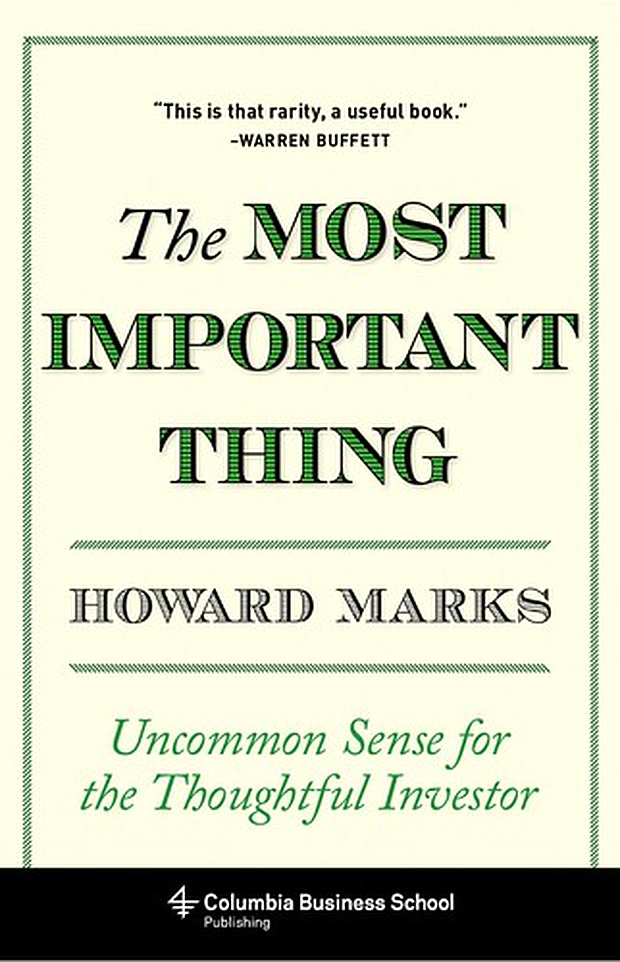
The Most Important Thing
Get on Amazon →
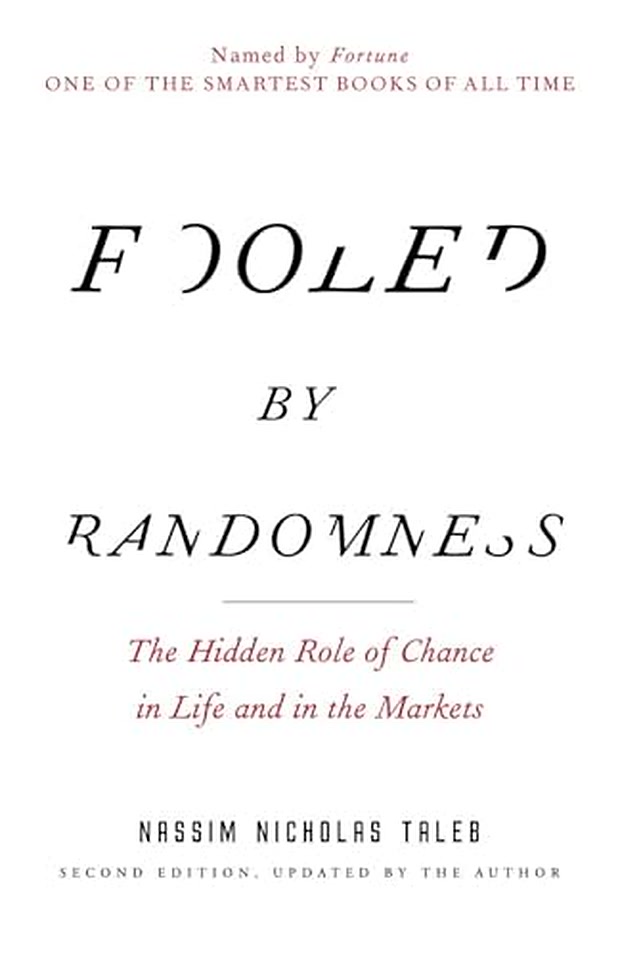
Fooled by Randomness
Get on Amazon →
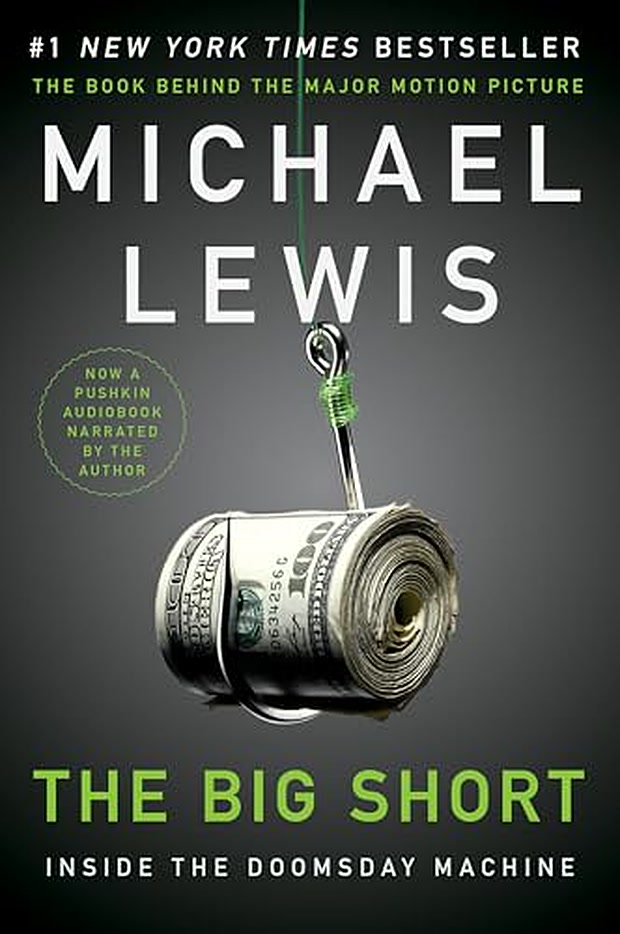
The Big Short
Get on Amazon →
As an Amazon Associate I earn from qualifying purchases.