Howard Marks
2008 12 17 Volatility Leverage Dynamite
© Oaktree Capital Management, L.P.
All Rights ReservedMemo to: Oaktree Clients
From: Howard Marks Re: Volatility + Leverage = Dynamite
Nearly fifteen years ago, in April 1994 – at a time when absolutely no one was reading
my memos – I published one called “Risk in To day’s Markets Revisited.” That’s when I
first proposed the formula shown above. I recycled it in “Geniu s Isn’t Enough,” on the
subject of Long-Term Capital Management (October 1998). The last few years have provi ded a great demonstration of how dangerous it can be to
combine leverage with risky assets, and that’s the subject of this memo. It’ll also pick up
on some ideas from my last memo, “The Limits to Negativism.” My memo “Plan B” on the bailout proposal went out on September 24, and as I lay in bed
later that night, I realized that I hadn’t taken one part of it nearly far enough. In
discussing a prime cause of the credit crisis, I wrote the following:
I’ll keep it simple. Suppose you have $1 million in equity capital. You
borrow $29 million and buy $30 million of mortgage loans. Twenty percent (or $6 million) of the mortgages go into default, and the recovery on them turns out to be only two-thirds ($4 million). Thus you’ve lost $2 million . . . your equity capital twice over. Now you have equity capital of
minus $1 million, with assets of $28 million and debt of $29 million. Everyone realizes that ther e’ll be nothing left for th e people who’re last in
line to withdraw their money, so th ere’s a run on the bank. And you slide
into bankruptcy.
That’s true as far as it goes, but I’m going to devote this memo to things which could
have followed that paragraph.
UThe Problem at Financial Institutions
It’s no coincidence that today’s financial crisis was kicked off at highly leveraged
banks and investment banks. The paragraph above shows why that’s true, and why the
problem is as big as it is . As I wrote in “Plan B”:
Because of the high regard in which financial institutions were held;
because of the implied government backing of Fannie Mae and Freddie Mac; and because permissible levera ge increased over time, financial
institutions’ equity capital was permitted to become highly inadequate given the riskiness of the assets th ey held. Or perhaps I should say
© Oaktree Capital Management, L.P.
All Rights Reservedinstitutions took on too ma
ny risky asse ts given the limitations of their
equity capital. That, in a nutshell, is why institutions have disappeared.
So what exactly did these institutions do wr ong? Here are a few examples, using Bank
X, with $10 billion of ca pital, to illustrate:
Bank X uses leverage to buy $100 billion of triple-A mortgage-re lated debt, under the
assumption that it can’t lose more than 1% . Instead, home prices decline nationwide,
causing it to write down its holdings by 10%, or $10 billion. It s capital is gone.
Alternatively (but in fact probably s imultaneously), Bank X sells Hedge Fund G $10
billion of credit default sw aps on the bonds of Company A, and it buys $10 billion of
the same credit protection from Investme nt Bank H. Compan y A goes bankrupt, and
Bank X pays Hedge Fund G $10 billion. Bu t Investment Bank H goes bankrupt, too,
so Bank X can’t collect the $10 billio n it’s due. Its capital is gone.
Bank X lends $50 billion to Hedge Fund P with equity of $10 billion, which then
buys $60 billion of securities. The value of the fund’s portfolio fa lls to $50 billion;
the bank sends a margin call; no additional collateral can be posted; so the bank
seizes and sells out the portfolio. But in the downward-spiraling market, the bank
only realizes $40 billion. Its capital is gone.
Hedge Fund Q also borrowed to buy securiti es. When Hedge Fund P got its margin
call and its portfolio was sold out, that for ced securities prices downward. So Fund Q
– which holds many of the same positions – al so receives a margin call, perpetuating
the downward spiral and bringing mo re losses to more institutions.
All of these scenarios, and many others, are connected by a common thread: the
combination of leverage and illusory safet y, which allowed institutions to take on too
much risk for the amount of capital they had.
First, it should be clear from the ab ove that the amount of borrowed money –
leverage – that it’s prudent to use is purel y a function of the ri skiness and volatility
of the assets it’s used to purchase. The more stable the assets, the more leverage it’s
safe to use. Riskier assets, le ss leverage. It’s that simple.
One of the main reasons for the problem tod ay at financial institutions is that they
underestimated the risk inherent in assets su ch as home mortgages and, as a result,
bought too much mortgage-backed paper with too much borrowed money.
Let’s go back to the paragraph on page one. Here it is again:
I’ll keep it simple. Suppose you have $1 million in equity capital. You
borrow $29 million and buy $30 million of mortgage loans. Twenty percent (or $6 million) of the mortgages go into default, and the recovery on them turns out to be only two-thirds ($4 million). Thus you’ve lost $2
© Oaktree Capital Management, L.P.
All Rights Reservedmillion . . . your equity capital twice over. Now you have eq
uity capital of
minus $1 million, with assets of $28 million and debt of $29 million.
Everyone realizes that ther e’ll be nothing left for th e people who’re last in
line to withdraw their money, so th ere’s a run on the bank. And you slide
into bankruptcy.
Suppose you set up your leveraged portfolio as described but only 2% of your mortgage
holdings go bad, not 20%. Then, you onl y lose $200,000 (not $2 million) of your $1
million of equity, and you’re still solvent. Or suppose 20% of your mortgages default as in the original example, but you only levered up ten times, not 30. You lose the same 6.7% of your assets, but based on $10 million, so it’s just $670,000, or two-thirds of your equity. You’re still alive. The problem lies entirely in th e fact that the institutions
combined highly risky assets wi th a large amount of leverage.
By now, everyone recognizes (a) how silly it wa s for the financial modelers to be so sure
there couldn’t be a nationwide drop in home prices (they felt that way because there never had been one – but did their data includ e the Depression?) and (b) the terrible job
the agencies did of rating mortgage-related se curities. So the risk was underestimated,
permitting the leverage to become excessive: end of story. Reason number one for
today’s problem, then, is the mismatch inst itutions turned out to have made between
asset risk and leverage.
The second reason is that, given the degree by which mortgage defaults have
exceeded expectations, no one feels like taking a chance on how bad things will get. Everyone agrees it’ll be bad, but no one can say how bad.
As I said in October in “The Limits to Negativism,” when things are going well, no
assumption is too optimistic to be accepted. But when things turn down, none seems too
pessimistic. Today, with the ability to lose money on mortgages having been
demonstrated so painfully, investors consider themselves unable to say where the losses
will stop.
So if a highly leveraged financial instit ution has significant mortgage holdings, few
people are willing to risk money in the be lief that the losses will be bearable. If a
financial institution has book equity of $100 m illion and $500 million of mortgage assets,
no one will grant that future losses will be less than $100 million – that is, that it’ll
remain solvent. Maybe the writedowns will be $100 million. Or $300 million. Or $500
million. There’s no assumption too negative. As a result, investors will just keep their
money in their pockets. A few sovereign wealth funds and others jump ed in a year ago, and based on results so
far, it looks like they acted too soon. In July, Goldman Sachs reported that 52 banks had
raised capital and the providers of that capital were underwater at 50 of them, by an average of 45%. Certainly th ings are much worse now.
© Oaktree Capital Management, L.P.
All Rights ReservedMost people are behaving as if there’s no su ch thing as investing safely in a financial
institution. This widespread belief has the ability to greatly delay the restoration of
faith, capital and viability. Peter Bernstein put it succinctly in The New York Times of
September 28. (Peter’s one of the very wise st men around, in part because he’s one of
the few who can talk about the Depression from experience. I recommend his op-ed
piece, “What’s Free About Free Enterprise?”)
This time around, assets are evidently so rotten in so many places that no financial institution wants to risk doi ng business with any other financial
institution without a government backstop.
That’s the reason why no buyer could be f ound for Lehman Brothers over the weekend
preceding its bankruptcy. No one could assess its assets and get comfortable regarding
the status of its highly leve red net worth, so everyone required a government backstop . . .
which wasn’t forthcoming.
UThe Right Level of Leverage
Although I communicate primarily in words, I tend to think a lot in pictures – certainly
more than in numbers. My concept of appr opriate leverage can eas ily be demonstrated
through a few diagrams. I’m going to ove rlook the differences between accounting
value, market value and economic value and confuse the terms. But I think you’ll get the idea. The drawings below show the value of comp anies of different types. Due to the
variability of their earn ings, the values fluctuate differently over time.
Here’s a financial structure, except with the equity above the debt, not below as it would
be on a balance sheet:
© Oaktree Capital Management, L.P.
All Rights Reserved
Now let’s combine the two concepts
. The bottom line is that in order for a company to
avoid insolvency, its financial st ructure has to be such that its value won’t fall through the
equity and into the debt. In naïve and fa r-from-technically correct terms, when the
amount of debt exceeds the va lue of the company, it’s insolv ent, as suggested below.
What the following doodles illustrate is that for every level of ri skiness and volatility,
there’
s an appropriate limit on leverage in the capital structure.
© Oaktree Capital Management, L.P.
All Rights ReservedDuring the first leveraged buyout boom in the late 1970s and the 1980s, it was a
atchword that they should be done only with stable companies. But in bullish
times, rules like that are forgotten or i gnored, and we get buyouts of companies in
cyclical industries like semiconductors or autos.
Extremely leveraged companies have existed for more than a century. They’re called
utilities. Because their profits are regulated by public commissions and fixed as a percentage of their stable asset bases, they’ve been extremely dependable. This shows
that high leverage isn’t necessarily risky, just the wrong level of leverage given the
company’s stability.
It can be safe for life insurance companies to take risk on limited capital, because their
operations are steady and their risks can be anticipated. They know everyone will die,
and roughly when (on average). But if a firm like MBIA was going to guarantee
mortgage securities, it should have recognized their instability and unpredictability and
limited its leverage. The insurance industry’s way of saying that is th at its capital should
have been higher as a percentage of the ri sks assumed. MBIA in sured $75 billion of
residential and commercial mortgage paper on the basis of total capital – not capital
devoted to its insuring mortgage securities , but total capital – of only $3 billion. Did
anyone worry about the possibility that 5% of the mortgages would default?
Leverage is always seductive. If you have $1 million of capital and write $25 million of
insurance at a 1% annual premium, you br ing in $250,000 of premiums, for a 25% return
on capital (before losses and expenses). But why not write $50 million of insurance and bring in $500,000? The answer is that policy losses might exceed 2% of the insurance written, in which case your losses would be greater than the capital you have to pay them
with . . . and you might be insolvent. But in order to resist using maximum available
leverage, you need discipline and an appreciation for the risks involved. In recent
years, few firms had both.
UWhy Mortgages?
Why is it residential mortgage-related pape r that set off the process endangering our
institutions? Why not high yield bonds or le veraged loans or even equities? One reason,
of course, is the sheer size of the residential mortgage-related securities market: $11 trillion. But there are two others. The first is the inability to value the underlying collateral. I feel comfortable when
Oaktree’s analysts value the debt or equity of a cash-flow-producing company. To the
extent an asset produces a stream of cash flows, and assuming they’re somewhat
predictable, the asset can reasonably be valued. But assets that don’t pr oduce cash flows
can’t be valued as readily (this has b een a regular theme of mine of late).
What’s a barrel of oil worth? $33 in Ja nuary 2004, $147 in mid-2008, or $42 earlier this
month? Which price was “right”? All of them? Or none of them? We all know about
© Oaktree Capital Management, L.P.
All Rights Reservedthe things that will influence the price of o il, such as finite su pply, growing dema
nd, and
the unreliability of some of the producing nations. But what do those factors make it
worth? No one can convert these intangibles into a fair price. That’s why, a few
months ago at $147, we were seeing predicti ons of $200 oil. And now, with the price
down two-thirds, there’s talk of $25. The same is true of commodities, gold, currencies, art and diamonds. And houses.
What’s a house worth? What it cost to bu ild? What it would cost to replace today?
What it last sold for? What the one ne xt door sold for? The amount that was
borrowed against it? (Certainly not.) Some mu ltiple of what it could be rented for?
What about when there are no renters? The answer is “none of these.” On a given
day, houses – and all of the things listed just above – are worth only what someone
will pay for them. Well, that’s true in the short run for corporate securities, too, as we’ve seen in the last few months. But in the long run, you can expect security prices to
gravitate toward the discounted present value of their future cash flows. There’s no such
lodestone for houses. Think about one of the biggest jokes, the home appraisal. If a house doesn’t have a
“value,” what do mortgage appraisers do? Th ey research recent sales of similar houses
nearby and apply those values on a per-square -foot basis. But such an appraisal
obviously says nothing about what a house will bring after being repossessed a few years
later. Nevertheless, in recent years, a purchase price of $X, supported by an appraisal of $X,
was used to justify lending 95% of $X – or maybe 100% or 105% – when a home was
bought or refinanced. No wonder homes valu ed in the biggest boom in history have
turned out to be unreliable collateral.
Second, these overrated mortgages were packaged into the most alchemical and
fantastic leveraged structures. It is th ese, not mortgages themselves, that have
jeopardized our institutions . There was a limited market for whole mortgage loans;
they were considered a specialist market en tailing risk and requi ring expertise. But
supposedly those worries would be obviated if one bought the debt of structured entities
that invested in residential mort gage-backed securities (RMBS).
First question: where did the risk go? We were told it disappe ared thanks to the magic of
structuring, tranching and diversifying, permittin g vast amounts of leverage to be applied
safely. Second question: how reliable was the diversification? Answer: again we were
told, highly reliable; there had never been a national decline in home prices, so mortgages
could be considered uncorrelated with each other. The performance of a mortgage on a house in Detroit would be unaffected by what went on in Florida or California. (Well, so
much for what we were told.) The institutions’ writedowns generally are in co llateralized debt oblig ations (CDOs), debt
issued by special-purpose entities that borrowe d huge amounts relative to their equity in
order to purchase mortgage-rel ated securities. As describe d earlier, underestimated risk
© Oaktree Capital Management, L.P.
All Rights Reservedled to the use of unwise amounts of l
everage. But interestingly, the key losses aren’t in
the riskier junior tranches of CDO debt, about which there was some leeriness. Rather,
they’re in the triple -A-rated tranches. It’s to buy t hose tranches that our leading
institutions took on too much leverage. Once again, greatly underestimated risk led to
great leverage and thus great losses.
What did you need to steer clear of CDO debt? Computers, sophisticated programs
and exceptional analysis? Genius? No: skepticism and common sense . In RMBS,
CDOs and CDO-squareds (entities that borrowed to buy CDO debt), 90% or so of their
capital structure was rated higher than th e underlying collateral, all based on the
linchpin assumption that mortgages were unc orrelated. That’s all you had to know.
How good a piece of collateral is a s ubprime mortgage covering 100% of the
purchase price of a house bought in a soaring market by an applicant who’ll pay a
higher interest rate to be able to sk ip documenting income or employment? That’s
not a secured loan; it’s an opti on on future appreciation. If the house goes up in price, the
buyer makes the mortgage payments and continues to own it. If it goes down, the buyer
walks away, in which case the lender gain s ownership of a house worth less than the
amount loaned against it. Thus the viability of the mortgages was entirely dependent on
continued home price appreciation. Given the above, what was the credit quality of subprime mortgages? I’d say double-B at
best. (I’d much rather b uy even the single-B “junk bonds” of profitable companies that
we’ve held over the last 30 years than this in flated “home option” paper.) And yet, in a
typical CDO, 80% of the debt was rated tr iple-A and 97% was rated investment grade
(triple-B or better). Those high ratings ma de CDO debt very at tractive to financial
institutions that were able to borrow cheaply to buy high-rated assets , satisfying the strict
rules regarding the “quality” of their portfolio holdings.
Financial engineers and investment bankers took unreliable coll ateral and packaged
it into highly leveraged structures support ing debt that was rated high enough to
attract financial institutions. What a superb example of the imprudent use of
leverage. And what a simple explanation of how our highly leveraged institutions got
into trouble.
UHow Bad is Bad?
One of the prime lessons that must be le arned from this experience is that in
determining how much leverage to put on , you’d better make generous assumptions
about how risky your assets might turn out to be.
The example in the paragraph on page one demons trates the role of risk in the equation.
The more your assets are prone to perman ent loss, the less leverage you should employ.
But it’s also important to recogni ze the role of volatility. Even if losses aren’t permanent,
a downward fluctuation can bring risk of ruin if a portfolio is highly leveraged and (a) the
© Oaktree Capital Management, L.P.
All Rights Reservedlenders can cut off credit, (b) invest
ors can be frightened into withdr awing their equity, or
(c) the violation of regulatory or contract ual standards can trigger forced selling.
The problem is that extreme volatility and loss surface only infrequently. And as
time passes without that happening, it a ppears more and more likel y that it’ll never
happen – that assumptions regarding risk were too conservative. Thus it becomes tempting to relax rules and increase leverage. And often this is done just before the risk finally rears its head. As Na ssim Nicholas Taleb wrote in Fooled by Randomness :
Reality is far more vicious than Russian roulette. First, it delivers the fatal
bullet rather infrequently, like a revol ver that would have hundreds, even
thousands of chambers instead of six. After a few dozen tries, one forgets
about the existence of a bullet, under a numbing false sense of security . . .
Second, unlike a well-defined precise game like Russian roulette, where the risks are visible to anyone capable of multiplying and dividing by six, one does not observe the barrel of reality. . . . One is thus capable of
unwittingly playing Russian roulette – and calling it by some alter-
native “low risk” name. (p. 28; emphasis added)
The financial institutions played a high-ris k game thinking it was a low-risk game,
all because their assumptions on lo sses and volatility were too low. We’d be
watching an entirely different picture if only they’d said, “T his stuff is potentially risky.
Since home prices have gone up so much and mortgages have been available so easily,
there just might be widespread declines in hom e prices this time. So we’re only going to
lever up half as much as past performance might suggest.”
It’s easy to say they should have made more conservative assumptions. But how
conservative? You can’t run a business on the basi s of worst-case assumptions. You
wouldn’t be able to do anything. And anyway, a “worst-case assumption” is really a
misnomer; there’s no such thi ng, short of a total loss. Now we know the quants shouldn’t
have assumed there couldn’t be a nationwide decline in home prices . But once you grant
that such a decline can happen – for the first time – what extent should you prepare for?
Two percent? Ten? Fifty?
One of my favorite adages concerns the six-foot-tall man who drowned crossing the
stream that was five feet deep on average. It’s not enough to surv ive in the investment
world on average; you have to survive every mo ment. The unusual turbulence of the last
two years – and especially the last three months – made it po ssible for that six-foot-tall
man to drown in a stream that was two feet deep on average.
UShould the possibility of
today’s events have been anticipated? It’s hard to say it should have been. And yet,
it’s incumbent upon investors to prepare for adversity. The juxtaposition of these
sentences introduces an interesting conundrum.
© Oaktree Capital Management, L.P.
All Rights ReservedConsider these tales from the front lines:
There had never been a national decline in home prices, but now the Case-Shiller
index is down 26% from its peak in July 2006, according to the Financial Times of
November 29.
In my twenty-nine previous years with high yield bonds, including four when more
than 10% of all outstanding bonds defaulte d, the index’s worst yearly decline was
7%. But in 2008, it’s down 30% (even though th e last-twelve-months’ default rate is
only about 3%).
Performing bank loans never traded much be low par in the past, and holders received
very substantial recoveries on any that defa ulted. Now, even though there have been
few defaults, the price of the average loan is in the 60s.
The headlines are full of entities that have seen massive losses, and perhaps meltdowns,
because they bought assets using leverage. Going back to the diagrams on pages 4-5, these investors put on leverage that might have been appropri ate with moderate-volatility
assets and ran into the greatest volatility ever seen. It’s easy to say they made a
mistake. But is it reasonable to expect them to have girded for unique events?
If every portfolio was required to be able to withstand declines on the scale we’ve
witnessed this year, it’s possible no le verage would ever be used. Is that a
reasonable reaction? (In fact, it’s possibl e that no one would ever invest in these
asset classes, even on an unlevered basis.)
In all aspects of our lives, we base our decisions on what we think probably will
happen. And, in turn, we base that to a great extent on what usually happened in
the past. We expect results to be close to th e norm (A) most of the time, but we know
it’s not unusual to see outcomes that are better or worse (B). Although we should bear in
mind that, once in a while, a result will be outside the usual range (C), we tend to forget
about the potential for outliers. And impor tantly, as illustrated by recent events, we
rarely consider outcomes that have happened only once a century . . . or never (D).
10
© Oaktree Capital Management, L.P.
All Rights ReservedEven if we realize that unusual, unlikely things can happen, in order to act we ma
ke
reasoned decisions and knowingly accept that ri sk when well paid to do so. Once in a
while, a “black swan” will materialize. But if in the future we always said, “We can’t do
such-and-such, because we could see a repeat of 2007-08,” we’d be frozen in inaction.
So in most things, you can’t prepare for the worst case. It should suffice to be
prepared for once-in-a-generation events. But a generation isn’t forever, and there will be times when that standard is exceeded. What do you do about that? I’ve mused in the
past about how much one should devote to preparing for the unlikely disaster.
Among other things, the events of 2007-08 prove there’s no easy answer.
UAre You Tall Enough to Use Leverage?
Clearly it’s difficult to always use the right amount of leverage, because it’s difficult to
be sure you’re allowing sufficiently for risk. Leverage should only be used on the basis
of demonstrably cautious assumptions. And it should be noted that if you’re doing
something novel, unproven, risky, volatil e or potentially li fe-threatening, you
shouldn’t seek to maximize returns. Instead, err on the side of caution. The key to
survival lies in what Warren Buffett cons tantly harps on: margin of safety. Using
100% of the leverage one’s assets might ju stify is often incompatible with assuring
survival when adverse outcomes materialize. Leverage is neither good nor bad in and of itself. In the ri ght amount, applied to the right
assets, it’s good. When used to excess given the underlying assets, it’s bad. It doesn’t
add value; it merely magnifies both good a nd bad outcomes. So leverage shouldn’t be
treated as a silver bullet or magic solution. It’s a tool that can be used wisely or
unwisely.
Our attitude at Oaktree is that it can be wise to use leverage to take advantage of
high offered returns and excessive risk prem iums, but it’s unwise to use it to try to
turn low offered returns into high ones, as was done often in 2003-07.
Once leverage is combined with risky or vola tile assets, it can lead to unbearable losses.
Thus leverage should be used in prudent amount s, to finance the right assets, and with a
great deal of respect. And it’s better used in the trough of the cycl e than after a long run
of appreciation. Bottom line: handle with care.
* * *
I never want to give the impression that doing th e things I discuss is easy, or that Oaktree
always gets it right. This memo calls on inve stors to gauge risk and use only appropriate
leverage. At Oaktree we assess fundamen tal riskiness and look to history for how
markets might behave, and we heavily emphasi ze trying to build in sufficient room for
11
© Oaktree Capital Management, L.P.
All Rights Reservederror. But history isn’t a perfect guide. Wh
ile we’ve made no use of leverage in the vast
majority of our investment activities, th ree of our evergreen funds did borrow to buy
bank loans: the senior-most debt of companie s, which in the past always has traded
around par. Another used it to buy low-pr iced Japanese small-cap stocks. The
companies generally are doing fine, but the prices of their loans and equities have
collapsed under current market cond itions, causing the funds to suffer. This shows how
tough it is to prepare for all eventualitie s . . . in other words, to know in advance
how bad is bad . So I apologize if I ever come across as holier-than-thou . We’ve tried to
use leverage only when it’s wise, bu t no one’s perfect. Certainly not us.
* * *
The financial markets have delivered a lifetime of lessons in just the last five years.
Some of the most important ones center around the use and abuse of leverage.
Leverage doesn’t add value or make an investment better. Like everything else in
the investment world other than pure skill, leverage is a two-edged sword – in fact,
probably the ultimate two-edged sword. It helps when you’re right and hurts when
you’re wrong.
The riskier the underlying assets, the less leverage should be used to buy them.
Conservative assumptions on this subject will keep you from maximizing gains but
possibly save your financial life in bad times.
A levered entity can be caught up in a dow nward spiral of asset price declines,
market-value tests, margin calls and forced selling. Thus, in addition to thinking
about the right amount of leverage, it’s impor tant to note that there are two different
kinds: permanent leverage, with its magnify ing effect, and leverage which can be
withdrawn, which can introduce co llateral tests and the risk of ruin. Both should be
considered independently. Leverage achieved with secure capital isn’t nearly as
risky as situations where you are subject to margin calls or can’t bar the door
against capital withdrawals.
Leverage was too easily accessed as recentl y as two years ago, and now it’s virtually
unavailable. And just as its use was often unwise a few years ago, this might be just
the right time to employ some if you can get it . . . and if you can arrange things so
you won’t drown if the streambed dips ahead.
December 17, 2008
12
© Oaktree Capital Management, L.P.
All Rights Reserved 13Legal Information and Disclosures
This memorandum expresses the views of the author as of the date indicated and such views are
subject to change without notice. Oaktree has no duty or obligation to update the information contained herein. Further, Oaktree makes no rep resentation, and it should not be assumed, that
past investment performance is an indication of future results. Moreover, wherever there is the
potential for profit there is also the possibility of loss. This memorandum is being made available for educational purposes only and should not be used
for any other purpose. The information contai ned herein does not constitute and should not be
construed as an offering of advisory services or an offer to sell or solicitation to buy any
securities or related financial instruments in any jurisdiction. Certain information contained herein concerning economic trends and performan ce is based on or derived from information
provided by independent third- party sources. Oaktree Capita l Management, L.P. (“Oaktree”)
believes that the sources from which such informa tion has been obtained are reliable; however, it
cannot guarantee the accuracy of such inform ation and has not independently verified the
accuracy or completeness of such information or the assumptions on which such information is
based. This memorandum, including the information cont ained herein, may not be copied, reproduced,
republished, or posted in whole or in part, in any form without the prior written consent of
Oaktree.
Recommended Reading
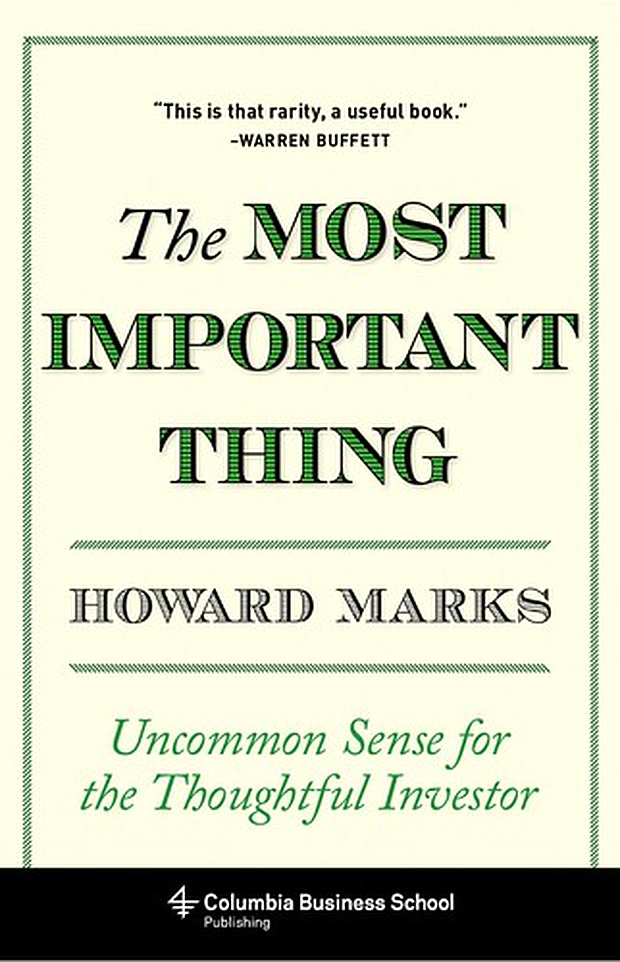
The Most Important Thing
Get on Amazon →
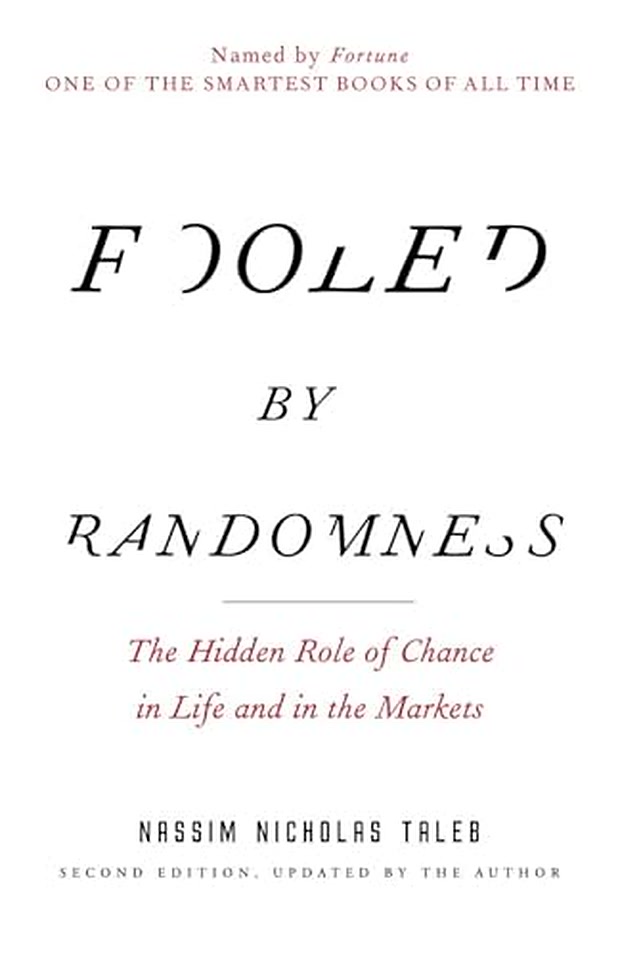
Fooled by Randomness
Get on Amazon →
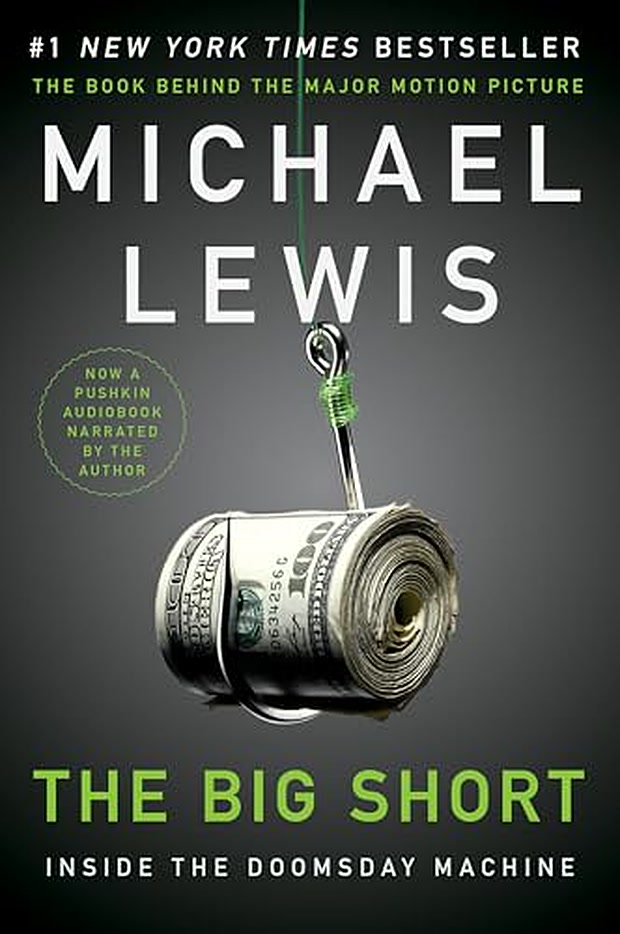
The Big Short
Get on Amazon →
As an Amazon Associate I earn from qualifying purchases.