Howard Marks
2008 09 24 Plan B
© Oaktree Capital Management, L.P.
All Rights ReservedMemo to: Oaktree Clients
From: Howard Marks Re: Plan B
Over the last decade or two, Plan A consisted of relying on the free market to maximize
economic growth and efficiency (as describe d in “The Aviary,” May 2008). What can
we say about that? Oops? We don’t hear much at this moment about market efficiency,
or about the proposition that it would cause complex mortga ge-backed securities to be
priced right.
So now we have Plan B, better known as TA RP, the Troubled Asset Relief Program. On
the heels of other injections of capital by the U.S. Treasury and Fed and central banks
elsewhere, it was proposed on Friday that up to $700 billion be spen t to purchase “toxic”
mortgage securities from financial institutions that are weighed down with them.
UYa’ Gotta Believe
Those who have more money than they need lend it to those with use for more money
than they have. This process is called pr oviding credit. The move ment of credit puts
otherwise-idle money to work and thus adds to economic output. Economies run on credit.
According to Merriam-Webster, the word “credit” is derived from the Latin
credere : “to believe, entrust.” We provide credit when we believe in borrowers and
trust that they’ll pay us back (although we be lieve in some more than others and charge
the latter more interest). Further, the enti re economy runs on trust: that the people to
whom we provide goods and services will pay their bills; that cont racts will be adhered
to; and that money will retain value, or at least the part that inflation doesn’t erode.
Belief is what makes the economic world go round. Take a minute to think about how
we would behave in a world in which there wasn’t trust in money, the institutions that store it and the mechanisms that move it from one place to another. Clearly, we’d be
sunk without trust in the financial system.
I’ve described in the past how financial in stitutions are vulnerable to loss of faith
because of their unique combination of op acity, leverage, conscious risk bearing,
and their use of short-term deposits and borrowings to fund longer-term, illiquid
assets . When providers of capital lose faith in a financial institution, they line up to
withdraw their money. But the institution can ’t give them all back their money, because
it can’t liquify all of its assets immediately. Attempts to do so increase the downward
© Oaktree Capital Management, L.P.
All Rights Reservedpressure on asset prices, further weakening financial positions and reinfo
rcing the loss of
faith. And thus the circle becomes vici ous and we have a “run on the bank.”
We saw many runs on banks during the Great Depression; the result was the introduction
of federal deposit insurance. We also sa w a bank run in the U.K. last year, when
depositors lined up at the Northern Rock building society until the Bank of England calmed fears by guaranteeing all deposits. (I had money there, and believe me, absent the guarantee, the 2% penalty for early withdraw als would have been powerless to dissuade
me from moving the remaining 98% to a safer institution. Take a few hundred or
thousand of me, and you have a run on the bank.) In short, the government is attempting to pr event a loss of belief. Is such a thing
possible? Ask yourself whether eight m onths ago you thought possible this year’s
developments at Bear Stearns, IndyMac, Le hman Brothers, AIG, Fannie Mae and Freddie
Mac. To some extent, they all stemmed from a loss of faith.
UThe Source of the Problem
There are two principal fundamental causes behind the events we’re seeing. The
first is the huge losses in comp lex mortgage-backed securities. As I’ve written before,
the issuance and purchase of these securitie s resulted from the following confluence of
factors:
Quest for return, decline in risk aversion and lowering of skepticism.
A boom in home prices and a belief that they couldn’t fall back en masse .
Securitization and selling onw ard of debt – which eliminated lenders’ hesitance to
lend and led to a process in which everyone profited when a loan was made.
Thus an increased willingness to lend higher percentages of the skyrocketing prices of
homes, even where the borrower couldn’t demonstrate creditworthiness.
Widespread use of leverage (because the risks were underrated) and complexity in
fashioning mortgage-backed securities.
Massive shortcomings at rating agencies that erroneously described the resulting
securities as investment grade, and sometimes even “super senior.”
In this way, enormous amounts of overrated secu rities came to the market. They went to
financial institutions that didn’t understand the riskiness of what they were buying and
thus permitted themselves to become vastly overleveraged. I’ll keep it simple. Suppose you have $1 m illion in equity capital. You borrow $29
million and buy $30 million of mortgage loans. Twenty percent (or $6 million) of the
mortgages go into default, and the recovery on them turns out to be only two-thirds ($4
million). Thus you’ve lost $2 million . . . your equity capital twice over. Now you have equity capital of minus $1 million, with a ssets of $28 million and debt of $29 million.
Everyone realizes that there’ ll be nothing left for the pe ople who’re last in line to
withdraw their money, so there’s a run on the bank. And you slide into bankruptcy.
© Oaktree Capital Management, L.P.
All Rights Reserved
Because of the high rega
rd in which financ ial institutions were held; because of the
implied government backing of Fannie Mae a nd Freddie Mac; and because permissible
leverage increased over time, financial institutions’ equity capital was permitted to become highly inadequate given the riskiness of the assets they hel d. Or perhaps I should
say institutions took on too many risky assets give n the limitations of their equity capital.
That, in a nutshell, is why institutions have disappeared.
The second fundamental factor leading up to the current mess was the creation of
the vast market in derivatives, especially credit default swaps (CDS). In the current
decade, CDS came into broad use as a mechanism for insuring against defaults. For an
up-front fee and an annual premium, holders of debt could get someone else to promise
that they’d buy that debt at face value in th e case of a default or other “credit event.”
The buyers of CDS accepted at face value that the writers of the insurance would pay if there was a default. For this reason, b ecause Bank A had bought insurance on Company
X’s debt from Hedge Fund B, it considered it safe to sell insurance to Bank C. But what
if X defaults and A has to pay C but can’t collect from B? There’s over $60 trillion of
CDS outstanding, and a lot of it is well hedged in theory; thus the net e xposure to defaults
if everyone pays might be rather small. Bu t if some counterparties are unable to pay,
institutions that bought insurance from th em (or from others that bought from those
institutions) might fail to receive billions in payments. Consider it one big daisy chain.
It’s probably because of its position as a count erparty that Bear Stearns wasn’t permitted
to fail in March (while Lehman was cut adrift this month when its failure was judged to
be bearable).
Of course, these two developments have been complicated by (a) the fact that no one can
reasonably say what the home underlying a mort gage is worth (the intrinsic value of a
non-cash-producing asset is a useless concept in the short run), (b) the fact that no one
knows how the credit swap market will function in a crisis, and (c) their own sheer
magnitude. The sum of the foregoing has the po tential to place in jeopardy any financial
institution that lacks federa l backing. It’s for this r eason that the government has
assumed the liabilities of Fannie Mae and Freddie Mac, lent money to AIG, accepted Goldman Sachs and Morgan Stanley as bank holding companies (with permanent access to Fed borrowings), backstopped money market funds, and now proposes to purchase $700 billion of mortgage securities.
UDoes Ben Know Something We Don’t?
I cited the above headline in “Now Wh at?” last Januar y. That’s what breakingviews.com
asked about the Fed’s September 2007 decision to cut rates by 50 basis points rather than
the expected 25. Clearly Fed Chairman Ben Bernanke thought the circumstances called for stronger medicine than most observers.
© Oaktree Capital Management, L.P.
All Rights ReservedNow it’s clear that both Bernanke and Treasury Secretary Hank Paulson envision
possible consequences justifying the stronge st possible action. Last weekend, for
exam
ple, Paulson said in an interview, “I don’ t like the fact that we have to do this. I
hate the fact that we have to do it. But it’s better than the alternative .” (Emphasis
added) What is the alternative? As I suggested la st week in “Nobody Knows,” there really is no
outcome so negative that it can’t be imagined. That doesn’t mean terrible things will happen if no action is taken, but the possibi lities are there, causing fear. Obviously,
Bernanke and Paulson feel some of them c ould come to pass, and I respect their opinion.
So what is that alternative Paulson alludes to? Cascading bank failu res? Interlocking
dependence on counterparties in the derivatives markets who lack the ability to make
good on their liabilities? Ultimately, reduced faith in U.S. Treasury securities and the
dollar? As I said last week, I don’t know. But it’s not unreasona ble to respect these
possibilities. Our leaders want to justify the strongest ac tion in history without spooking
the market by enumerating the possibilities, so they’re not being too specific. The Great
Depression is our only model. I believe it justif ies strong action.
Let me take a moment to say we’re enormously lucky to have the right team in place at this time. Bernanke is a highly respected academic expert on the Great Depression, and
Paulson is the very successful practitioner who chaired Goldman Sachs, an institution for
which I have enormous respect. Being human, they’re unlikely to get it all right. But I
can’t think of anyone I’d rath er have in their jobs.
UThe Plan and the Stumbling Blocks
The plan is simple. In fact, to some it’s too un-bureaucratic to be acceptable. The Treasury will use up to $700 billion to purchase the most toxic mortgage-backed
securities from financial institut ions – both U.S. and foreign – that do business in the U.S.
This will reduce the doubt about the institutio ns’ solvency and, in place of unsalable
assets, give them cash they can lend. No ex ternal oversight or internal process is
specified, and the result will be immune from examination by other authorities and from
litigation. Having described the plan in one paragraph, it’ll take much more space to discuss the
complaints being voiced and the obstacles in its path.
We’re asked to trust the judgment and inte grity of the Treasury Department. I find
this a pragmatic and direct so lution. Others more skeptical than me disagree. Some
think Paulson will be biased in favor of Goldman Sachs and the rest of Wall Street,
but I’m convinced he took the job out of noblesse oblige – not for money or fun, I
think – and I trust him to do his level best.
© Oaktree Capital Management, L.P.
All Rights ReservedOn that subject, let me
share a little hist ory. Fifteen years ago, the staff of the
Resolution Trust Company asked if we coul d help them achieve fair prices in
disposing of the assets they’d taken on from failed S&Ls. I outlined a plan under
which brokers would be asked for bids a nd we would watch the brokers, judging the
adequacy of those bids. “But who’ll watch you,” they asked. My reply: “I’ve got
bad news: you’re going to have to trust someone.” I’m perfectly happy trusting the
Paulson-led Treasury.
In a similar vein, some are complaining about the lack of supervision in the plan. The
Financial Times quoted Barack Obama as saying, “W e cannot give a blank check to
Washington with no oversight or accountability . . .” Well, for my part, I’d rather
entrust power to one wise man than a co mmittee or bureaucracy consisting of average
people. I think Paulson is that one wise man, but I’m also sure he’s smart enough to
surround himself with others who are equally capable.
What will the marching orders be? In partic ular, what sort of prices will be paid?
Fair market prices or higher? First of all, it’s almost impossible to come up with a
fair or “market” price for many of these a ssets today. Second, paying just the market
price in the current highly depressed market wouldn’t do much for the institutions’ net capital position. But third, if more than the market price is paid, that’ll be seen as
a “giveaway to Wall Street.” It has to be made explicit – to those expected to
approve the plan, and certainly to those ex pected to carry it out – whether these
will be straight sales at market or they’ll include a subsidy . I think a bunch of the
latter is called for.
Even beyond the points listed above, another issue may present a bigger
stumbling block. The greatest reluctance may relate to the fact that, under the
plan, when the process restores the viab ility of institutions that now are
burdened with negative book value and inadequate confidence, the immediate
financial benefits would go to shareholders and executives who either
participated in the creation of the problem or, at any rate, should be penalized
for the companies’ failings.
To solve the problem, some say that in exchange for taking securities off institutions’ hands – especially at above-market prices – the government should get ownership positions in those institutions. But how much? What would be the proper quid pro quo? If a $1 billion purchase of debt at $200 million above market saved a $15
billion institution, what piece of the compa ny should the government receive? Do we
want the government owning large pieces of private companies, or running them?
And would that ownership stake then put the government in a conflict position vis-à-
vis the institutions where it’s not an owner? This is obviously a complex issue, and
I’d hate to see it delay the so lution of the problems we face.
Further, there are calls for requiring executiv es at the institutions involved to accept
limits on their compensation. What could be worse than setting up reasons for people to hesitate before reaching for this lifeline?
© Oaktree Capital Management, L.P.
All Rights Reserved
Certainl
y politics will be a major factor in whether the plan is enacted and in what
form. In that regard, there couldn’t be a worse time for this to be debated than six
weeks before the election.
After being well ahead in the polls until la te August, Barack Obama lost his lead
when the Republicans held their conven tion and made Sarah Palin their vice
presidential candidate. Bu t last week, when the economic crisis exploded and John
McCain described the economy as strong, th e Democrats pulled back into the lead.
That’s not lost on them, and I’m sure they ’ll continue to use the issue to maximum
advantage. They’ll complain about the one -sidedness of the Wall Street bailout and
demand something for “the rest of us,” like further economic stimulus, direct relief
for mortgage borrowers, and loans to the auto makers. This politicizing might delay the process, encumber it with baggage, or make it unattractive to its supporters.
Democrats will attack the plan to make Republicans look bad, and conservative
Republicans may resist it as an unwarranted extension of the government’s reach. In the end I feel it’ll pass, but who knows in what form.
I don’t view the plan as mainly a bailout for Wall Street and fat cats. Saving the
financial system will benefit all users of capital, including home buyers and auto
makers. Of course, that may sound like “trickle-down economics,” which some are
happy to rail against.
I think federal ownership would be a very ha iry matter. But in this case I do have a
solution, at least regarding the prices at which the gove rnment resells the debt: Why not
simply say that the government should receive half of the buyers’ return in excess of
a 20% yearly rate, or some such? Ownership would present challenges, but sharing in
the benefit would not.
UWho’s In the Wrong?
There’ll be cries for scalps, and politicians will play to the crowd by assigning blame.
This should be primarily a side-show, but it can grow into a significant distraction.
Short sellers are in the crosshairs most prominen tly. It is a simple fact that ever since the
up-tick rule was revoked fourteen months ago, short sellers have had the ability to drive
down stock prices, which they couldn’t do if a short sale could only take place at a price
higher than the last trade. It’s also a fact that some financial stoc ks have fallen, and that
their declines have added to worries about th e companies, inducing further declines. Of
course, no connection between th e two has yet been proved.
As a result of the recent market action, short selling was outlawed in roughly 800
financial stocks, including outliers such as Ge neral Electric. This action was coincident
with last Friday’s rally, and people breathed a sigh of relief. Had short sellers been
© Oaktree Capital Management, L.P.
All Rights Reservedresponsible for the demi
se of Lehman? Should short selling be banne d? As usual, the
answer isn’t clear.
Balancing out the simple truths stated above, a number of factors argue in favor of short
selling or against a ban:
Short selling isn’t “worse” than outrigh t buying. One makes stocks go down; the
other makes them go up. Why is shorting – selling what you don’t own – any worse
than buying what you don’t own?
Short selling is a highly legitimate way fo r investors to act on their belief that a
stock’s price is too high. Thus it tends to help stocks sell at fair prices.
Short selling can bring losses to those w ho hold stock, but unabated buying can force
stock prices to too-high le vels where no one should buy. What can we do to prevent
injury from purchases during unjustified booms?
Sure you can keep stock prices from being forced down by outlawing short
selling. But then why not outlaw all selling? Think of what that would do for
stock prices!
In the short run, protecting the financial system is more important than preserving market
efficiency or heeding the above arguments. Thus I do not think it was a mistake to ban
short selling for the time being. In the long run, however, I feel a ban on short se lling is not in order, although I consider
it desirable for the up-tick rule to be brought back.
Finally, as with many other things, the real problem isn’t with short selling, but with
abusive short selling. Manipulating the ma rket to make short positions profitable by
spreading negative rumors or bidding up CDS (see “Nobody Knows” from last week)
should be driven out . . . although doing so won’t be easy.
* * *
The trouble with memo writing at times like these is that there’s always more. But this is
a good time to wrap up regarding the Treasury’ s plan. My conclusions are as follows:
In the period 2003-07, the government, and especially the Fed, stimulated the
economy and the financial system when they should have been acti ng restrictively to
curb excesses. On the contrary, stimulat ion is in order today to prevent serious
damage. I think we’re going to get it.
But I also expect to see a rising tide of regul ation of financial institutions in the period
ahead, and I don’t think restrictiveness will be the right thing until the system is on a firm
footing. It’s widely agreed that the aut horities contributed to the severity of the
© Oaktree Capital Management, L.P.
All Rights ReservedDepression by withdrawing liquidity when they should have been increasing it. Let’s not
tighten again.
In “Doesn’t Make Sense” in July, I listed four
things that have to happen in order for the
trends in mortgages and financial institutions to turn positive:
Home prices have to stop going down.
Home mortgages have to be made available.
Financial institutions have to stop experiencing incremental write-offs.
Financial institutions have to be able to raise additional capital with which to rebuild
their balance sheets.
I also pointed to the complication: that each of these four things is dependent on the
occurrence of another. The good news is that the Treasury plan has the potential to
break into the cycle of negativity, directly ad dress the third and fourth of these, and
thus contribute to the first and second. That’s why I’m all for it. In the Depression, the engine of capital provision went into a long-term stall, and we know the consequences. The attempt now is to jump-start processes that have stalled and prevent the rest from doing so. I’m sure this is the ri ght thing to do, and
I hope for its success.
September 24, 2008 P.s., In “You Can’t Predict. You Can Prepare.” (November 2001), I described the
process through which stock markets pull out of declines and turn upward:
Stocks are cheapest when everything l ooks grim. The depressing outlook keeps
them there, and only a few astute and da ring bargain hunters ar e willing to take
new positions. Maybe their buying attr acts some attention, or maybe the
outlook turns a little less depressing, but for one r eason or another, the market
starts moving up.
In the latest development, it was announced yesterday that Berkshire Hathaway would
invest $5 billion in Goldman Sachs stock. Warren Buffett exemplifies the kind of person
who can step out of the crowd. Perhaps his example can make a few more people stop
worrying about losing money and start worrying about missing out on gains. One of
these days, that’ll happen, and things will turn for the better.
© Oaktree Capital Management, L.P.
All Rights Reserved9
Legal Information and Disclosures
This memorandum expresses the views of the author as of the date indicated and such views are
subject to change without notice. Oaktree has no duty or obligation to update the information contained herein. Further, Oaktree makes no rep resentation, and it should not be assumed, that
past investment performance is an indication of future results. Moreover, wherever there is the
potential for profit there is also the possibility of loss. This memorandum is being made available for educational purposes only and should not be used
for any other purpose. The information contai ned herein does not constitute and should not be
construed as an offering of advisory services or an offer to sell or solicitation to buy any
securities or related financial instruments in any jurisdiction. Certain information contained herein concerning economic trends and performan ce is based on or derived from information
provided by independent third- party sources. Oaktree Capita l Management, L.P. (“Oaktree”)
believes that the sources from which such informa tion has been obtained are reliable; however, it
cannot guarantee the accuracy of such inform ation and has not independently verified the
accuracy or completeness of such information or the assumptions on which such information is
based. This memorandum, including the information cont ained herein, may not be copied, reproduced,
republished, or posted in whole or in part, in any form without the prior written consent of
Oaktree.
Recommended Reading
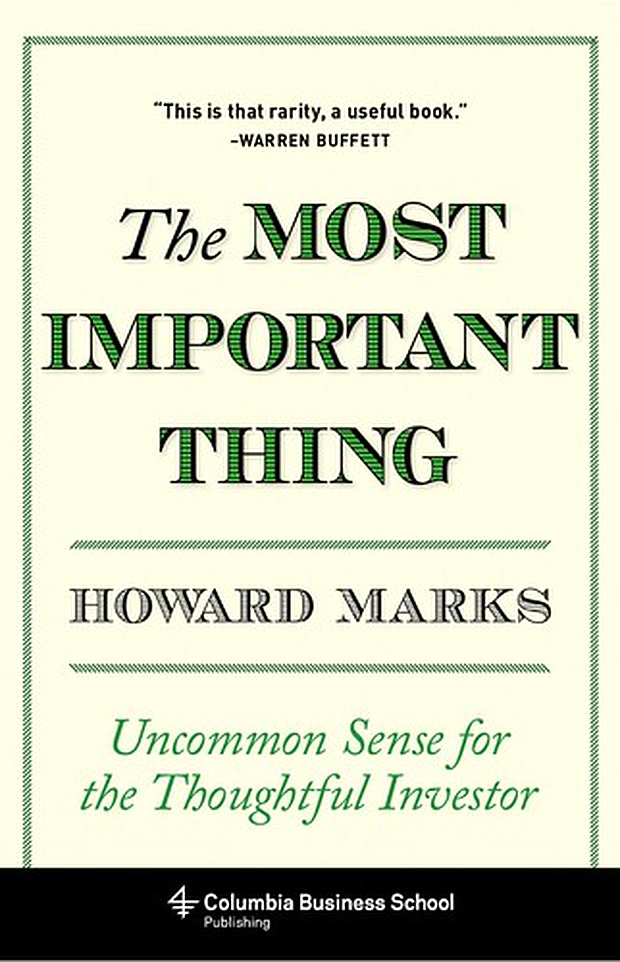
The Most Important Thing
Get on Amazon →
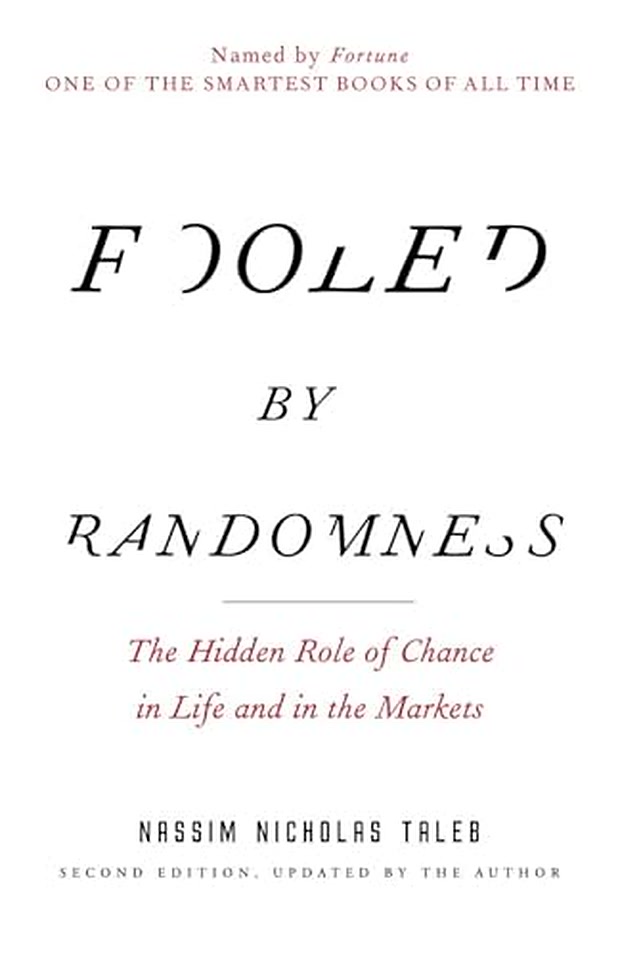
Fooled by Randomness
Get on Amazon →
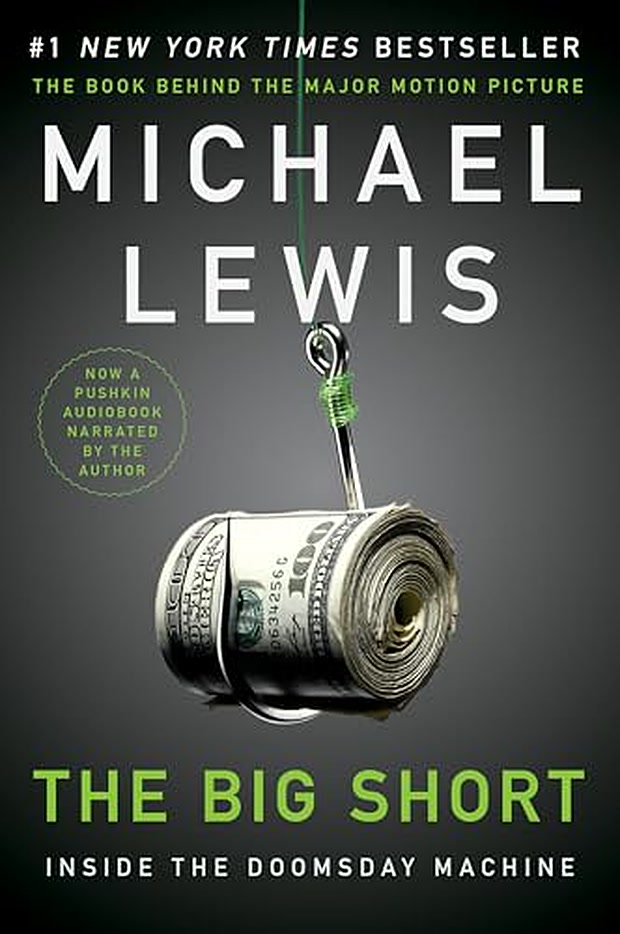
The Big Short
Get on Amazon →
As an Amazon Associate I earn from qualifying purchases.