Howard Marks
2008 09 19 Nobody Knows
© Oaktree Capital Management, L.P.
All Rights ReservedMemo to: Oaktree Clients
From: Howard Marks Re: Nobody Knows
The title of this memo isn’t a joke; I mean it. Nobody knows the real significance of
the recent events in the financial world, or what the future holds. Everyone has an
opinion – there’s an off-color joke to that effect – but opinion s are entirely different from
knowledge. As usual, the bulls are optimistic, the bears are pessimistic, and the rest are
uncertain.
This is a great time for my favorite quote from John Kenneth Galbraith: “There are two kinds of forecasters: those who don’t know, and those who don’t know they don’t know.”
No one knows about the future, and that’s more true now than ever . . . literally. Excesses were committed at financial institutions that we’ve never seen before in terms of their scale or their breadth, and many new inventions are in pla ce that never existed
before. So clearly no one can know how things will pan out. My conviction that this is tr ue frees me from having to methodically assess the strength
and weakness of economies and institutions, and it permits me to limit my comments to what I consider strategic realities. I’m flattered that people have asked for my opi nion, and I will give it. But that’s all it is:
an opinion. In setting it down, I will repeat things I’ve written before. So if you find
something that you think you’re reading fo r the second time, you’re probably right.
UBoom-Bust
Those two words say it all. If you have a boom, eventually you’ll have a bust. And
the further the boom goes, the worse the bust is likely to be. If there’s no boom, on the
other hand, there needn’t be a bust. There was no great boom in the U.S. econom y in 2003-07, and that’s one of the reasons
why it has held up reasonably well despite the recent turmoil. But there was an incredible boom in the financ ial sector, and it has led to an incredible
bust. (It remains to be seen whether its e ffects will slop over into the real economy. As
you know, we think they will.) Finally, there wasn’t a boom in the U.S. st ock market, and so it hasn’t busted. (If you
think your stocks have given you pain, realize th at their decline isn’t at all commensurate
with the end-of-the-world thinki ng roiling the financial sector).
© Oaktree Capital Management, L.P.
All Rights ReservedUHow Things Got This Way
Much of the current problem can be attribut ed to a decades-long bubble in the financial
sector that made it the employer of obvious choice; attracted employees who were “the
best and the brightest” (alt hough often untrammeled by experience); contributed to greed
and risk taking; drove out fear and skepticism; and carried institutions, behavior, expectations and asset prices to unsustainable levels.
What are the factors that got us in the current mess?
Excess liquidity, which had to find a home.
Interest rates that had been re duced to stimulate the economy.
Dissatisfaction with the resulting prosp ective returns on low-risk investments.
Inadequate risk aversion, and thus a willingness to step out on the risk curve in search
of higher returns.
A broad-scale willingness to try new things, such as structured products and derivatives, and to employ massive leverage.
A desire on the part of financial institu tions to supplement ope rating income with
profits from proprietary risk taking – that is, to be “more like Goldman.”
A system of disintermediation, selling onward, and slicing and dicing that caused
many participants to overlook risk in the belief that it had been engineered away.
Excessive reliance on rating agencies which we re far from competent to cope with the
new instruments, and on black-box financial mo dels that extrapolat ed recent history.
Unquestioning acceptance of financial plat itudes without wondering whether altered
circumstances and elevated asset prices had rendered them irrelevant:
o Houses and condos are good investments and can be counted on to appreciate.
o Mortgages rarely go into default.
o There can never be a nation-wide decline in home prices.
o It’s okay to grossly lever a balan ce sheet if you’ve hedged enough through
derivatives.
o It’s safe to borrow and invest funds equal to a huge multiple of your equity
capital if the probabilistic expected value is positive, because “disasters rarely
happen.”
Individuals such as mortgage brokers and mortgage borrowers who were given
incentives to do the wrong thing.
Newly minted financial “masters of the unive rse” encouraged to maximize returns for
themselves and their employers without c oncern for whether they were adding value
to the financial system or endangering it.
In general, the above can be summed up as a shortage of adu lt supervision, common
sense, skepticism, ethical concern and good old- fashioned prudence. As often happens in
booms, the kids shouldered the adults aside or impressed them too much. The list of errors can make you laugh . . . or cr y. I mentioned in “Hindsight First, Please”
how often financial people do th ings that look downright silly afterwards. But that never
stops them from
repeating the old mistakes or making new ones.
© Oaktree Capital Management, L.P.
All Rights Reserved
So now w
e find financial institutions that endangered themselves by using extensive
short-term borrowings or deposits to make investments that turned out to be
enormously risky when an unlikely disaster – a nationwide decline in home prices –
occurred.
In many ways, changes in the environment c ontributed as well. They crept up one by
one, unnoticed, but their combined eff ect is significant. For example,
The Glass-Steagall Act was repealed, permitting banks and investment banks to
combine. (It had been enacted in 1933 to outlaw such combinations because they
were felt to have contributed to the Crash of ‘29. It’s ironic – and certainly not
irrelevant – that it was repealed in 1999, in time to contribute to the current credit
crunch.)
The rule limiting short sales to up-ticks was revoked in July 2007, enabling short
selling to force stock prices down unabated.
Derivatives were created whos e prices were determined by the price of their “real”
underlying securities; now we see that in an Alice-in-Wonderland way, they’re able to influence the price of real securities (see below).
And mark-to-market accounting exposed precariously leveraged institutions to the
risk that technically-d riven declines in asset values might leave them too weak to
make it through to a better day.
It was during my working lifetime that the ph rase “too big to fail” was coined. More
recently, Citibank caused some people to observe that it had become too big to manage.
In the current go-round, financial institutions have been described as too big to
understand and, finally, too big to disentangle (g iven the proliferation of derivatives and
swap transactions, a key element in assessing an institution’s essentialness is the degree
of counter-party risk it presents to others). There’s no doubt that these developments are
frightening. But heroes aren’t people who’re unafraid, but rather those who act bravely
despite their fears. Investors mustn’ t let emotion control their actions.
Because of this combination of altered behavior, financial innovation and changes in
the environment, I feel unabl e to tell you what lies ahead. But that doesn’t mean
I’m not going to suggest a course of action.
UDoes the Market Know?
For reasons both systematic and unsystemat ic, the market is in many cases taking
its lead from . . . the market. Price d eclines cause fear, and thus further price
declines.
In some cases, the signal for increased worry comes from increases in the price of credit
default swaps, which provide insurance agains t debt defaults. Ri sing CDS prices imply
that creditors have become more concer ned. This can send down the prices of a
© Oaktree Capital Management, L.P.
All Rights Reservedcomp
any’s stock and debt instruments and frighten customers and depositors into
withdrawing funds, potentially leading to dow ngrading and failure. In other words,
increases in prices for credit in surance can serve as self-fulfilling prophesies. This is the
unintended consequence of one of the recent innovations.
I want to mention the potential for manipulati on present in this situ ation. One strong bid
for default protection in the thin market for CDS on a given company can massively
depress the price of billions of dollars worth of stock and/or debt. Clearly, an
unscrupulous short-seller can use this tactic to his advantage. No one knows the extent to
which it is in play . . . or how to stop it.
In the end, people once again have to appl y skepticism and their own judgment, this
time to bad news. Is the market smart or dumb? Is it giving us a valid signal to get
out or the buying opportunity of a lifetime? I seem to remember a useful quotation to
the effect that “The market is an ass.” Thus I think there’s more money to be made by
being a contrarian than a trend follower.
UThe End of the Financial System
We’re seeing and hearing things today that we never imagined.
The demise or bailout of Lehman Brothe rs, Bear Stearns, Freddie Mac, Fannie Mae
and AIG.
Concern about the viability of Goldma n Sachs and Morgan Stanley, and huge
declines in their stocks.
Rising prices for CDS protecti on on U.S. Treasury securities.
Rates on short-term T-bills close to zero because of an extrem e flight to safety.
Awareness for the first time, I think, that the U.S. government’s financial resources
are finite, and that there are limits on its ability to run the printing press and solve
problems.
Will the financial system melt down, or is this merely the greatest down cycle we’ve
ever seen? My answer is simple: we have no choice but to assume that this isn’t the
end, but just another cycle to take advantage of.
I must admit it: I say that primarily b ecause it is the only viable position. Here are
my reasons:
It’s impossible to assign a high enough probability to the meltdown scenario to justify
acting on it.
Even if you did, there isn’t much you could do about it.*
The things you might do if c onvinced of a meltdown would tu rn out to be disastrous
if the meltdown didn’t occur.
© Oaktree Capital Management, L.P.
All Rights Reserved Most of the time, the end of the world doe sn’t happen. The rum
ored collapses due to
Black Monday in 1987 and Long-Term Capital Management in 1998 turned out to be
just that.
* -- Money has to be someplace; where would you put yours? If you put it in T-bills,
what purchasing power would be accorded the dollars in which they’re denominated? If
the government’s finances collapsed, what good would your dollars be, anyway? What depository wouldn’t be in dange r? If you and many others deci ded to put billions into
gold, what price would you have to pay for it? Where would you store it, and how would
you pay for the truck to move it? How w ould you spend it to buy the things you need?
What would people pay you for your gold, and wh at would they pay you with? And what
if you bought credit insurance on all of your holdings: who would be able to make good
on your claims?
No, I don’t see any viable way to plan for the end of the world. I don’t know any
more than anyone else about its probab ility, but I see no use in panicking.
I think the outlook has to be viewed as bina ry: will the world end or won’t it? If you
can’t say yes, you have to say no and act accordingly. In particular, saying it will end would lead to inaction, while saying it ’s not going to will permit us to do the
things that always have worked in the past. We will invest on the assumption that it will go on, that companies will make money,
that they’ll have value, and that buying claims on them at low prices will work in the long run. What alternative is there?
UWhat Kind of Future Do We Face?
Of course, even assuming there will be a recove ry, we have to think about what it will
look like. As I wrote in “Doesn’t Make Se nse,” we aren’t counting on a “V.” We will
continue to emphasize companies that we f eel serve basic economi c functions and can do
relatively well even in bad times. Many elem ents in the economy are being damaged,
especially confidence, and they may take a relatively long time to recover. In particular,
the mechanism for providing capital is in great disrepair, and less credit certainly means a
slower recovery and less growth. The financial institutions deserv e a special mention. If there’ s ever been a sector that’s
down-and-out, this is probably it. Neve rtheless, Oaktree generally demands more
transparency in order to invest than most of them provide. It can seem almost impossible
to ascertain their condition through due diligence, and ab solutely impossible without
access to their books. For example, possible buyers probably found the risks at Lehman Brothers to be unanalyzable. As The Wall Street Journal said on Tuesday,
© Oaktree Capital Management, L.P.
All Rights ReservedEven understanding Leh
man’s current trading positions was tough.
Lehman’s roster of interest-rate swap s (a type of derivative investment)
ran about two million strong . . .
What kind of effort would it require to understand the significance of two million
derivatives positions: are they thoroughl y hedged, or bullish or bearish on
balance? And what about Lehman’s m illions of other derivatives and complex
securities? This opacity, combined with heavy leverage, reliance on short-term
funds, liquidity and conscious risk taki ng, is the reason why a loss of confidence
is conceivable at any financial institution in times of panic. What will the Wall Street of the future look like? We read – and I don’t doubt –
that for at least a while it will be smaller, less leveraged, less profitable, and more highly regulated. But I also think it will be less competitive and less risky.
In the course of my career, Wall Street went from being (1) brokers handling
riskless trades for commission to (2) d ealers buying and selling inventory for a
spread to (3) block traders purchasing large amounts of stock when market
liquidity was inadequate to (4) proprietary traders risking their own capital in pursuit of profit for the house. Backing down this progression wouldn’t be the worst thing in the world.
UWhat Will Start the Recovery?
Eventually, someone will walk out of the crowd and take advantage of the lows.
He may start an investment bank unburdene d with a legacy of losing positions.
Or a bond insurer like Warren Buffett did when MBIA and Ambac became
impaired. The cause of the recovery can’t be predicted. There may not even
be a visible one. Maybe things will just get so cheap that they can’t stay
down. (In ancient history – November 2001 – I wrote “You Can’t Predict; You
Can Prepare,” with a thorough description of how cycles happen, based on energy
all their own. It might be worth digging up.)
I like to point out that, even in retrospect, no one can sa y what started the collapse
of the tech stock bubble in 2000. But it did start . . . just, I think, because stock
prices rose far too high. Th at works in reverse, too.
In March, in “The Tide Goes Out,” I men tioned the three stages of a bull market,
a notion I’ve been carrying around in my head for about 35 years:
the first, when a few forward-looking peopl e begin to believe things will get better,
the second, when most investors reali ze improvement is actually underway, and
the third, when everyone’s sure things will get better forever.
© Oaktree Capital Management, L.P.
All Rights ReservedAs we all know, buying during the first st age can be highly profitable, while buying
during the last euphoric stage us ually leads to disaster.
Then I went on to create the converse of th e above, the three stages of a bear ma
rket:
the first, when just a few prudent invest ors recognize that, despite the prevailing
bullishness, things won’t always be rosy,
the second, when most investors rec ognize things are deteriorating, and
the third, when everyone’s convinced things can only get worse.
In the final stage, you can buy assets at prices that reflect litt le or no optimism.
There can be no doubt that we are in the th ird stage with regard to many financial
institutions. Not necessarily at the bo ttom, but in a serious period of unremitting
pessimism. No one seems able to imagine how the current vicious circle will
be interrupted. But I think we must assume it will be.
It must be noted that, just like two years ago, people are accepting as true
something that has never held true befo re. Then, it was the proposition that
massively levered balance sheets had been rendered safe by the miracle of
financial engineering. Today, it’s the non-viability of the essential financial
sector and its greatest institutions.
Everyone was happy to buy 18-24-36 months ago, when the horizon was
cloudless and asset prices were sky-high. Now, with heretofore unimaginable
risks on the table and priced in, it’s appropriate to sniff around for bargains: the
babies that are being thrown out with the bath water. We’re on the case.
September 19, 2008
© Oaktree Capital Management, L.P.
All Rights Reserved 8Legal Information and Disclosures
This memorandum expresses the views of the author as of the date indicated and such views are
subject to change without notice. Oaktree has no duty or obligation to update the information contained herein. Further, Oaktree makes no rep resentation, and it should not be assumed, that
past investment performance is an indication of future results. Moreover, wherever there is the
potential for profit there is also the possibility of loss. This memorandum is being made available for educational purposes only and should not be used
for any other purpose. The information contai ned herein does not constitute and should not be
construed as an offering of advisory services or an offer to sell or solicitation to buy any
securities or related financial instruments in any jurisdiction. Certain information contained herein concerning economic trends and performan ce is based on or derived from information
provided by independent third- party sources. Oaktree Capita l Management, L.P. (“Oaktree”)
believes that the sources from which such informa tion has been obtained are reliable; however, it
cannot guarantee the accuracy of such inform ation and has not independently verified the
accuracy or completeness of such information or the assumptions on which such information is
based. This memorandum, including the information cont ained herein, may not be copied, reproduced,
republished, or posted in whole or in part, in any form without the prior written consent of
Oaktree.
Recommended Reading
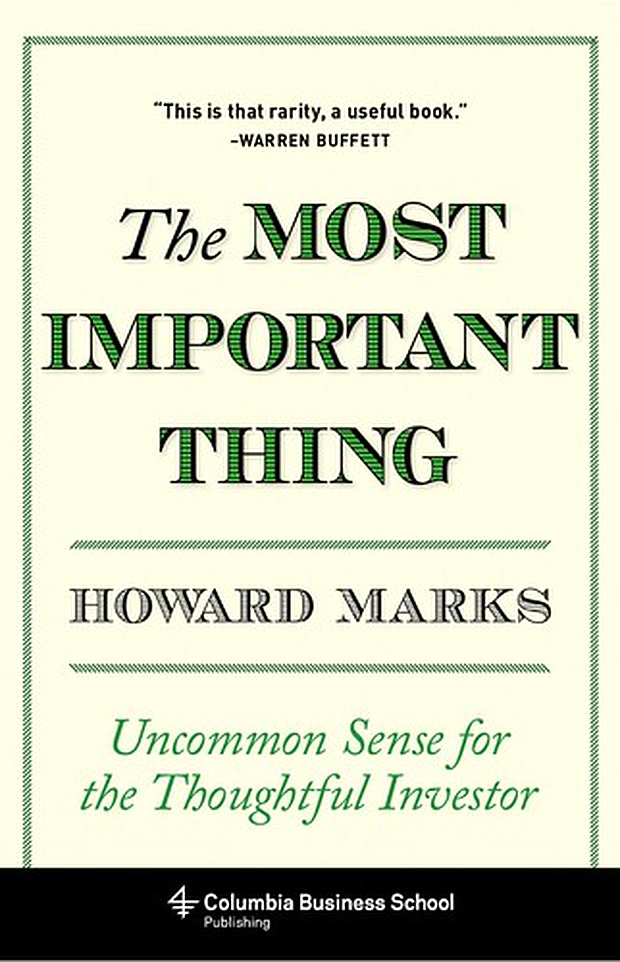
The Most Important Thing
Get on Amazon →
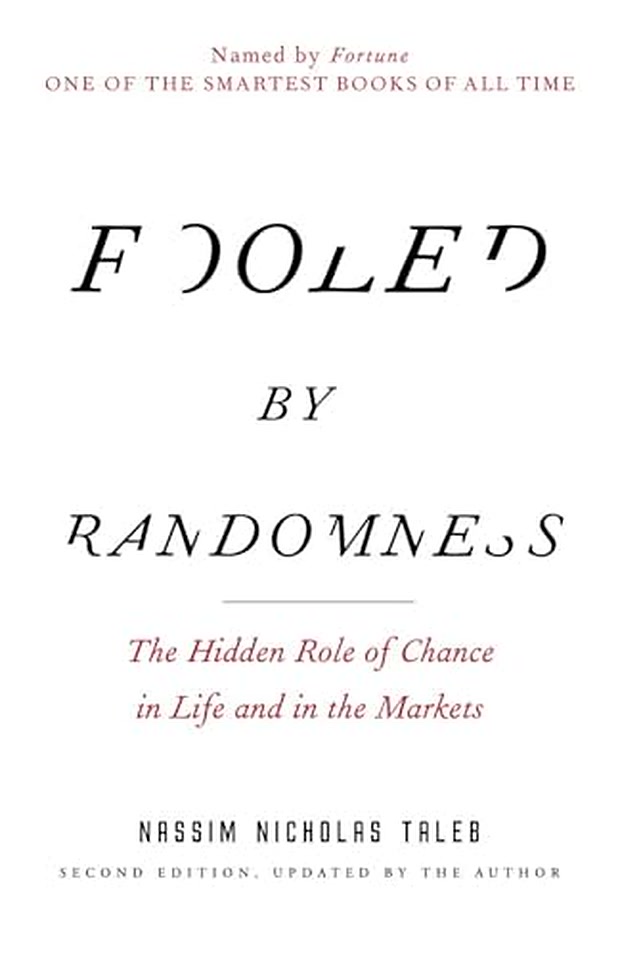
Fooled by Randomness
Get on Amazon →
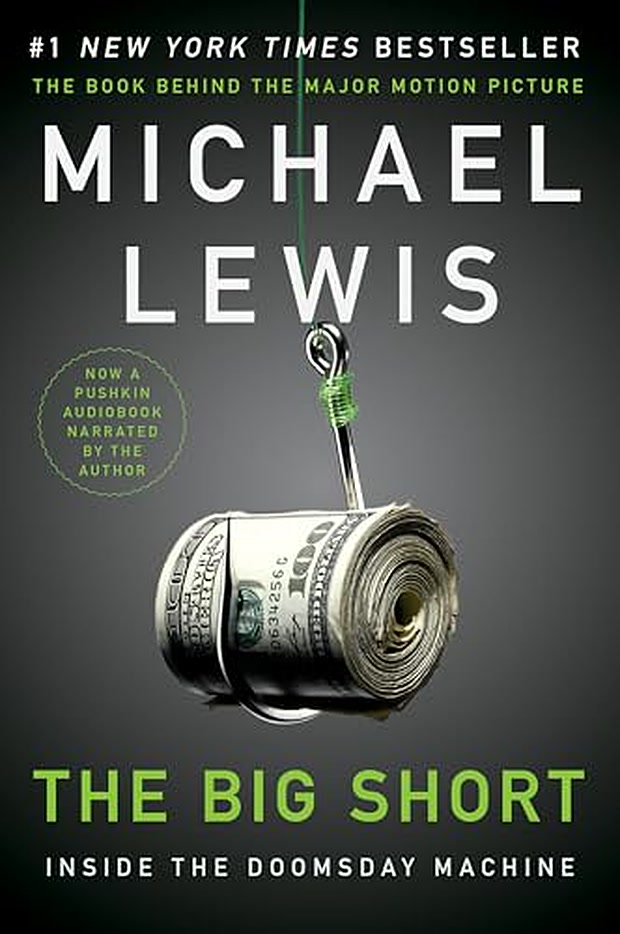
The Big Short
Get on Amazon →
As an Amazon Associate I earn from qualifying purchases.