Howard Marks
2008 02 20 Whodunit
© Oaktree Capital Management, L.P.
All Rights ReservedMemo to: Oaktree Clients
From: Howard Marks Re: Whodunit
who·dun·it – (hōō dun´ it) n. a narrative dealing with a
murder or a series of murd ers and the detection of the
criminal (The Random House Dictionary of the English Language)
The subprime crisis, credit crunch and po ssible recession are subjects of daily
conversation. In addition to wanting to talk about how things got this way and what’s
going to happen in the future, a lot of people are eager to discuss who’s to blame. It’s the purpose of this memo to say wher e I think responsibility lies.
UThe Subprime Factory
I’ve heard it said about laws that, “like sausages, you don’t want to see how they’re made.” I’d like to suggest something el se where the manufacturing process was
particularly distasteful: subprime mortgages. This decade’s vast expansion of the subprim e factory originated in the ability of Wall
Street to sell a lot of mortgage-related Collate ralized Debt Obligations, or CDOs. The
high interest rates on subprime mortgages enable d the Street to promis e a lot of return on
the lower CDO tranches and a lot of safety on the upper ones. With high-enough ratings, the debt looked very attrac tive to potential buyers. Thus , there was a use for large
amounts of the underlying raw material: subprime mortgages. It happened, however, that
Wall Street could sell more bologna sandwiches than there was bologna. That is, there
was more appetite for securities built from high yielding mortgages than there were
qualified borrowers. No problem: just provide incentives to increas e production and turn
a blind eye to creditworthiness. Mortgage brokers played an essential and often ugly pa rt in this process. They were
tasked with creating mortgage s in quantity, and that’s where their incentives lay. Since
neither they nor the Wall Street firms would hold the mortgages for long, the
emphasis was on volume rather than creditworthiness. Making loans was good;
rejections were bad. The website of broker Kevin Schmidt’s firm in Louisiana said it best, “We don’t get paid unless we say YES.” ( The Wall Street Journal , January 17) The
Journal went on to point out that, “Key players often get a cut from what a transaction is
supposed to be worth when first structured, no t what it actually delivers in the long term.”
© Oaktree Capital Management, L.P.
All Rights ReservedThus I believ
e mortgage brokers committed many sins. They offered more debt than
many subprime borrowers could carry. They assured borrowers that they’d always be
able to refinance into new loans at teaser ra tes, so they needn’t worry about a reset to
market rates. They probably weren’t clear on all the terms and practiced the old bait-and-
switch. They hid from first-mortgage lenders the fact that bo rrowers were borrowing
their equity too. And I’m sure some encouraged borrowers to lie about their incomes,
invoking “Everyone does it,” “Why should Joe and Sue have a nicer house than you?”
and “Nobody gets hurt.” Appraisers made a similarly negative contribution to the process. In the days when
home prices were stable, appr aisals were based on establis hed parameters like price per
square foot. But with prices rising rapidly, they could only reference “comps” to other
highly appreciated homes. Like the credit rating agencies, appraisers lent a veneer of
respectability to a faulty process. And like rating agencies, the job probably went to
the appraiser willing to assign the highest value. I’ve read about appraisers being black-
listed because they were too conservative, restraining loan volume. According to the L.A.
Times of January 27, a Wharton professor, Susan Wachter, has estimated that “appraisers
helped inflate mortgage values by $135 billion during 2006 alone.” Borrowers, home
sellers, mortgage brokers and Wall Street all had a vested interest in seeing high values
assigned. There’s something fundamentally wr ong when there’s no party to a
transaction who wants the a ppraisal to be conservative. But that became the case
when far-away, ratings-assured buyers of sli ced-and-diced mortgage securities took the
place of lenders risking their own money and expecting to hold to maturity.
Mortgage insurers played a similar role by lending their imprimatur and thus implying
instruments were safe. Everyone thinks of taking out insurance as a cautious thing to do.
When risks are insured, the pe ople exposed to them believe they’re safe to behave
differently than they otherwise would. But wh at happens when the insurers miscalculate
the risks involved, and thus issue more cove rage than their capit al can support in tough
times? In the extreme, losse s can go unreimbursed, meani ng the insureds don’t really
have the protection they think they have and th eir situation is riskier than they intended.
Certainly in this cycle, insufficiently caut ious insurers abetted the bearing of risks
that have exceeded expectations.
Let’s remember that the mortgage borrowers don’t deserve a free pass. It was stupidity
or cupidity, naïveté or mora l turpitude. At best th ey took on massive financial
responsibilities they didn’t understand, and at worst they were fraudsters. Many took out
“no-doc loans” at interest rates above those charged on lo ans requiring documentation of
income. Why? I assume they wanted to be free to lie. And many agreed to terms they
couldn’t decipher. But why worry, if the resu lt is a great house at a low initial monthly
payment (and maybe cash taken out in the pr ocess)? I hate to see the borrowers’
suffering, but each one willingly participated in a deal that was too good to be true.
© Oaktree Capital Management, L.P.
All Rights ReservedUTurning Mortgage Loans into CDOs
CDO investors are in the headlines for having lost $100 billion-plus (thus far) on
subprime-related obligations. Someone sold them something that turned out to have been massively overpriced. Thus I have to start with the investment bankers . Again, was it
naïveté or avarice? When Oaktree considers a new product, we ask a number of questions: First, will it work
for our clients; what’s the return potential; and are the risks controllable? And second,
can we sell it; and will it be profitable for us? Which of these did Wall Street ask
regarding subprime CDOs? The second group of questions undoubtedly, but the results
provide no assurance regarding the first. They sold something that failed massively, and
they’ve gotten off somewhat easy in terms of society’s judgment. Fittingly, investment banks like Merrill Lynch, Citigroup and UBS ate a lot of their own cooking (and a good
part of the losses). But that does not absolve them of res ponsibility, for others were hurt
as well. I believe firmly in caveat emptor , but that doesn’t mean there’s no such thing as
misconduct on the part of sellers. Did they perform thoughtful and balanced due diligence? Did they give enough thought to th e buyers’ downside risk? Did they suspect
that the good deal might be illusory? Did they see the flaws in the mortgage origination process? When they marshaled data with which to prove to customers and rating
agencies that CDOs were secure, did they consider the data’s sparseness or limited
relevance? Did they fail to disclose information regarding the “exceptions” in CDO
portfolios – mortgages that didn’t meet minimum lending standards – as the New York Attorney General is investigating ( WSJ, January 31)?
Some of the same questions can be asked about the role of CDO managers. I haven’t
been close to the process – Oaktree didn’t ha ve any involvement – but I believe managers
met with investment bankers who offered a ne ar-turnkey proposal: “H ere’s how it works.
The documents are ready to go. We have the assets in inventory. The debt is teed up for issuance. Your fees will be x million per billion.” Did the managers vet the process? Did they undertake an independent effort to ga uge the risks? Or did they just sign on to
the magical fee machine? Next up, in my opinion, are the credit rating agencies . In summary, everything was
wrong with the process through which CDO debt was rated, a process fed by the
agencies’ hunger for profit. The agencies worked with CDO sponsors to design the
products, so how could they then be object ive in evaluating them? They accepted
payment from the companies whose offerings they were rating; they all did, but that
doesn’t mean the arrangement left them objectiv e. They competed for the business, with
the fees going to the agency that would assign the highest rating.
But in the end, the rating agencies’ greate st failing lay in giving their blessing to
securities whose risk they couldn’t accurately assess . The eventual default rate was
crucial and unknowable. The historic data on su bprime defaults related to mortgages that
© Oaktree Capital Management, L.P.
All Rights Reservedwere issued through a far different process a nd incentive system. Bu t I can’t im
agine any
agency saying, “The risks are unknowable; we just can’t assign a rating.”
How do we know the agencies bobbled the ball? The twelve-digit losses to date give a
pretty good indication. An article in The Wall Street Journal of January 31 gives another:
Standard & Poor’s downgraded or threatened to downgrade more than 8,000 mortgage investments and project ed a widening array of financial
institutions would ultimately face mort gage securities losses totaling more
than $265 billion. . . S&P’s rating actions touched on $534 billion in mortgage-related
investments, including 47% of the U.S. subprime mortgage bonds rated in
2006 and the first half of 2007. . .
S&P . . . has now placed 69% of the triple-A rated subprime bonds
from 2006 on negative watch . (emphasis added).
I’d call that a thorough indictment . It indicates a flawed proc ess, not occasional error.
The situation is remarkably similar for the monoline insurers . . . but with an added
wrinkle. These firms carved out a good but dull and slow-growing bus iness in insuring
municipal bonds. Since munis default so infre quently, they needed l ittle in the way of
capital to cover potential losses, and they probably started to f eel they were pretty good at
gauging losses. In the 1990s, they concluded that mortgage-backed securities were no more risky than munis. (Not so, it turns ou t: MBIA recorded mort gage-related losses of
$714 million in the fourth quarter, versus losses of $920 million on munis over its 36-
year history, for an average of $26 million a y ear.) Thus the insurers applied their capital
and acumen to insuring $125 billion of CDO de bt. They acted out of the same ignorance
as the rating agencies, but they promised to make good on any losses .
The results are potentially disastrous. Their cap ital is clearly insufficient to cover their
responsibilities. ACA Financial Guaranty Co rp., for example, wrote $69 billion of credit
protection on the basis of its $425 million of capital. And if CDO losses eat into the monoline insurers’ capital and/or cause them to lose their triple-A ratings, it will diminish
the reliability of their assurance with regard to $1 trillion-plus of munis they backed.
Loss of the triple-A rating would hurt the out standing insured munis, wreak havoc in the
muni market generally, and make it harder for new bonds to be issued, at just the time
that cities and states need money to cover economy- and subprime-related revenue
declines. Also of critical importance, it will require holders of insured CDO paper to take
additional writedowns. The monoline situa tion has begun to contribute to the credit
crisis, and people are scurrying to find a solution (thus far without success).
All the participants in the CDO creation proc ess took part in an activity we can call
“ratings arbitrage.” If you can take a bunch of assets with low ratings and – without
adding to the intrinsic value of the collateral in any way – turn them into securities with
© Oaktree Capital Management, L.P.
All Rights Reservedmuch higher average ratings, you can ma
ke a lot of money. But the ability to do so
means there’s something wrong. (In other word s, if it’s possible to start with 100 pounds
of hamburger and end up selling ten pounds of dog food, 40 pounds of sirloin and 50
pounds of filet mignon, the truth-in-lab eling rules can’t be working.) In the case of
CDOs, ratings and insurance were supplied by parties who underestimated the risk,
and the end product was sold – and bought – by people who were willing to participate in this purported miracl e without asking the hard questions.
UThe Failure of Risk Management
I’ve long been critical of risk management as a distinct investment discipline. Now, a convincing case for my view can be made on the basis of prima facie evidence: The fact
that most financial institutions appointed risk managers after the collaps e of Long-Term
Capital Management in 1998 doesn’t seem to have helped them avoid the subprime mess.
If you trust someone to be expert enough to make an investment, then that’s the
person who can best assess its risk. If you trust someone to assemble portfolios, it’s
they who can best judge how things will behave in combination. In the isolated risk
management function, I feel people who know less about the underlying investments
second guess the people who know more.
There’s an ongoing dilemma, as expressed in a joke I posted on my bulletin board in
1970, about the fact that analys ts know a great deal about a few things, while portfolio
managers know a little bit about a lot of things. In my view, however, risk managers
know the littlest bit a bout the most things, so they’re l east suited to evaluate portfolio
risk. In December’s “No Different this Time,” I included a discussion of the leading risk
modeling tool, “value at risk” or VaR, which provides a “worst case” estimate of the risk
in a portfolio. I mentioned th at in the first nine years af ter the model was adopted, its
predicted maximum trading loss was never exce eded. And then, in the third quarter of
2007, it was exceeded on a quarter of the trading days.
TSo clearly, this model proved to
be less than totally reliable. The model may be flawed, the historic data on which it was
based may have been non-representative or in sufficient, or the world may have changed.
Regardless of the reason, VaR failed. When you read about Goldman Sachs’s success in avoiding the CDO turmoil and getting net-short, (see The Wall Street Journal of December 14), you see it was done on the basis
of the reasoned judgment of executives on its proprietary trading desk. Ironically, when
mortgage-related security prices first began to plummet, the increase in volatility raised
Goldman’s VaR, causing the elimination of pos itions that eventually would have been
highly profitable. According to the WSJ, “a client who had similar positions at the time
. . . says he made $100 million by relieving Goldma n of [a] short bet. ‘It appeared to me
that [the traders] constantly fought a VaR ba ttle with the firm once the market started to
© Oaktree Capital Management, L.P.
All Rights Reservedbreak.’” But in the end, subjective ju
dgment was permitted to override risk management
science, with great results.
Interestingly, many banks got into troubl e because their top executives wanted to
“be like Goldman” and demanded that more be bet for the house’s account. But
they lacked people capable of correctly maki ng the needed judgments and relied instead
on statistical risk managers. They’ve lost a lot of money, and a lot of the executives and
the risk managers are out of a job.
UEnough with the Quants Already
Over the forty years since I attended grad sc hool at the University of Chicago – largely
inspired by theories originated there – there’ s been a pronounced rise in the participation
of “quants” in the investment business. Th ese are people who know a lot about statistics
and computer modeling. They specialize in manipulating large amounts of data and predicting how portfolios are likely to perform under a variety of scenarios. But usually
they don’t know much about the individual securities that ma ke up the portfolios . . . or
feel the need to do so. In other words, you might say they know the price of
everything and the value of nothing.
In recent years – and in the excesses we’re examining – the ranks of quants grew to
include the risk managers discussed just above ; “financial engineers” at investment banks
who structured complex entities and simulated their future performance; analysts at monoline insurers who assessed the risks th ey were asked to insure; and people who
managed portfolios, usually hedge funds, on the basis of mathematical algorithms.
However, it should be noted that quants and their computer models primarily
extrapolate the patterns that have held true in past markets. They can’t predict
changes in those patterns; they can’t anti cipate aberrant periods; and thus they
generally overestimate the reliability of past norms.
To give you a context in which to think about that, I’ll ag ain borrow some wisdom from
my friend Ric Kayne: “99% of financial history has taken place within two standard
deviations,” he says, “but everything interesting has taken place outside of two
standard deviations.” In other words, most of th e time markets follow their normal
patterns, and when they do, assets are priced reasonably and there isn’t much to do. But
on rare occasion, the markets go off the rails, and that’s when big money is made and
lost.
Now think about the quants. They know all about how things will work if times are
normal, but their analysis is of no help wh en events occur that reside in the far-off,
improbable tails of the probability distribution – like when it turns out that 2% isn’t
the right default rate for subprime mortgages, and the actual figure is several times that.
© Oaktree Capital Management, L.P.
All Rights ReservedOne of the great investment books of the 1960s was The Money Game by the
pseudonymous Ada
m Smith. Smith talked abou t a veteran investor, the Great Winfield,
who knew he was falling behind the times but had the answer: “Our trouble is that we are too old for this market. . . . My solution to th e current market: kids.” In the last decade
or two, everyone hired quantitative whiz kids, and the results were disastrous.
Hopefully, the events of the last few ye ars will produce a sea change, in which
investors come to rely more on seasoned judgment and less on financial engineers.
UGreenspan and the Fed
Alan Greenspan deserves a lot of credit for pr esiding over one of the greatest periods of
prosperity and market gains in our history, and for saying, prescientl y, “. . . history has
not dealt kindly with the afte rmath of protracted periods of low risk premiums.” With
apologies to my indirect pers onal connection to the ex-Fed Chairman, I must express my
view that his stewardship wasn’t perfect. (Of course, I doubt he’d say it was perfect.)
Because he rarely used his bully pulpit to warn about excesses, advances were
permitted to run unchecked. For example, his warning against “irrational
exuberance” attracted a lo t of attention, but I’ve al ways wondered why, if he
considered it justified in 1996 with th e Dow at 6,400, we heard nothing from him on
the subject in 2000, when it topped out at 11,700. And mightn’t he have warned in recent years about overheated home prices a nd aggressive mortgage lending tactics?
He did little to “remove the punchbowl,” or puncture bubbles. He could have pushed
for higher margin requirements in 1998-99, or for mortgage reforms in 2004 or 2005,
but he didn’t, insisting that it’s difficult to identify bubbles other than in hindsight.
He was too much of a cheerleader, providing justification for mark et advances, often
on the basis of productivity gains.
In 2004, he urged people to take out adjustable rate mortgages rather than fixed-rate
loans, since they always carry the lowest initial interest rate. But he overlooked the
fact that (a) low-income borrowers might be ill-equipped to handle the risk of resets
to higher rates, and (b) with mortgage ra tes at multi-generational lows, that would
have been a great time for them to fix their in terest cost. Just thi nk where we’d be if a
good portion of today’s adjust able-rate mortgages carried fixed rates instead.
Having cut interest rates to head off ne gative ramifications from the bumps in
the road, he left them low fo r too long. I learned in the hyperinflationary late
1970s and early ’80s that when people feel an asset will always appreciate at an
annual rate in excess of the cost of mo ney, the result is speculative demand.
That certainly was the case this decade.
In general, it seems the Fed – including th e current Bernanke regime – wants to let
advances run and limit declines, whether in the economy or the markets. Everyone wants
© Oaktree Capital Management, L.P.
All Rights Reservedadvances and no one – except bargain hunter s and investors in distress – relishes
pullbacks. But I wonder if that stance ma
kes sense.
How can we have gains but not losses? How can a free-market economy allocate
capital effectively if capital creation is ab etted and capital destruction is prevented?
The fact is, excesses like we’ve just seen have to be corrected – painfully – and if
they aren’t, they’ll just grow bigger and bigger as the cycles wear on. “Moral
hazard” will arise, convincing people that risk takers will always be bailed out,
something that’s bound to encour age greater risk taking.
The Fed’s actions in the current situation have been dramatic:
an unexpectedly large half-point cut in the discount rate in September,
strong steps to inject liquidity a nd encourage borrowing by banks, and
an unusual ¾-point rate cut on January 21, followed by another ½ point a week later.
In two decades as Fed Chairman, Alan Greenspan was required to deal with the emerging market crisis and meltdown of Long Term Ca pital Management in 1998; the possibility
of a Y2K glitch; the tech stock and broader bear market in 2000-02; the ramifications of the 9/11 attack; and concern over the possibility of deflation. And yet he never cut
rates by ¾ point in one step or by 1-¼ points in just eight days. Thus Bernanke’s
actions seem extreme. Is the Fed attempti ng to prevent a normal recession? Does it
foresee an unusually serious one, perhaps driven by unprecedented weakness in home prices? Or is it concerned about profound fina ncial system weakness, centered at banks
and the monoline insurers?
UKudos and Brickbats
I hesitate to single out an i ndividual for criticism, especi ally after he’s been punished
through loss of his job, but CEO Chuck Prince of Citigroup contributed the unfortunate
quote that just has to stand as th e symbol of the last few years’ excesses. In early July, he
showed foresight by saying “when the music stops, in terms of liquidity, things will get complicated.” Unfortunately, he added, “as long as the music is playing, you’ve got to
get up and dance. We’re still dancing.”
What I think Prince was saying is that even if the market’s overheated, a financial
institution has to participate or risk losing market share to th ose who will. But that’s my
point. Is there any business a company won’t do? Is there any profit a company
won’t pursue? Might there be somethin g worse than losing market share? What a
wonderful thing it would have been to lose ma rket share in the crazy period leading up to
last summer. Doing so held the key to avoiding the CDO carnage. Short-termism is
one of the greatest problems in U.S. busin ess today, and it makes it tough to go left
when all your competitors are going right. But our business leaders should dare to be great.
© Oaktree Capital Management, L.P.
All Rights ReservedBank of America CEO Ken Lewis won m
y respect early la st year when he said, “We
are close to a time when we’ll look back and sa y we did some stupid things . . . We need a
little more sanity in a period in which everyone feels invincible and thinks this is different.”
He was dead right. The questi on is what he did about it. B of A took a $5.4 billion write-
down in the fourth quarter a nd has $12 billion of CDO exposure left. Those numbers are
about a third of Citigroup’s. Is that good or bad?
Who else saw what was coming?
Jim Grant was very outspoken about CDO exce sses in his newsletter, “Grant’s
Interest Rate Observer,” and early en ough for heedful investors to have done
something about it. He was one of the firs t, for example, to question the fact that
most of the collateral behind CDOs was rate d below investment grade, and yet a vast
majority of CDO debt was rated above investment grade.
William Conway of Carlyle Group attracted a lot of attention – but perhaps not all he
deserved – for a January 2007 memo to his Carlyle colleagues, in which he wrote:
As you all know (I hope), the fabulous pr ofits that we have been able to
generate for our limited partners are not solely a function of our
investment genius, but have resulted in large part from a great market and
the availability of enormous amounts of cheap debt. . . . Frankly, there is
so much liquidity in the world financial system, that lenders (even “our” lenders) are making very risky credit decisions. . . . I know that this
liquidity environment cannot go on foreve r. . . . I know that the longer it
lasts, the greater the pressures will be on all of us to take advantage of this
liquidity. And I know that the longer it lasts, the worse it will be when it
ends.
John Paulson won well-deserved fame for gene rating returns up to 590% in his
hedge funds last year. He did three things well: He recognized the excesses in the
residential real estate arena. He figured out how to profit from their inevitable
reversal. And he was lucky enough to get the timing right; rather than reach his
conclusion earlier, look wrong for a long time a nd give up – as others did – he turned
bearish in 2005 and was able to hold on until events began to prove him right in 2006.
I’m glad to say our clients’ sectors of the investment world – such as pension and
endowment funds and insurance companie s – generally haven’t reported much
participation in the most highly leveraged entities.
Goldman Sachs has distinguished itself thus far by avoiding subprime and CDO
losses, being short mortgage pape r and skating through the crisis. Lehman Brothers,
Credit Suisse, Deutsche Bank and JP Morgan Chase are other institutions that
seem to have signed on for less subprime pain than their competitors.
© Oaktree Capital Management, L.P.
All Rights ReservedFinally, a statement by the Chief Executiv
e of UBS provided another insight into the
recent events. Early last December, he sai d, “the ultimate value of our subprime holdings
. . . remains unknowable.” I admire his candor, and I’m sure he’s right. But the question
I’m left with is whether it might have been possible for buyers of subprime-related paper
to reach that realization at the tim e they first evaluated those assets?
UWhere Does the Buck Stop?
In affixing ultimate responsibility for losing investments, I tend to look to the
investors who made them. Sometimes investors are blind-sided by unforeseeable
events, and sometimes they’re preyed upon by une thical or even criminal purveyors.
But usually the process couldn’t have gone as far as it did if it wasn’t for buyers who
sought return too avidly, trusted too much, failed in some way to be alert to the
potential for loss, and fell for someth ing that was too good to be true.
Everyone dreams of return without high risk. But where can it be f ound? Not in markets
that are working properly – that is, markets th at are efficient. Not in leverage, which
should be expected to cut both ways, magnifyi ng both risk as well as return. Not in doing
what everyone else is doi ng, or in buying the product du jour that’s being touted broadly
and purchased unquestioningly. At best it can be found, with regard to markets that are
less than fully efficient, in possessing – or aligning yourself with investors who possess –
that scarce attribute: personal skill . . . superior insight . . . alpha.
To fully understand how superior returns are achieved and why they’re rare, you
have to grasp the concept of “excess return.” It’s what everyone wa nts. It’s “superior
risk-adjusted return”: the amount by which an active invest or’s return exceeds that which
can be achieved through a passive port folio of the same riskiness. For active investing
to work and for excess return to exist, ma rket participants – and thus, collectively,
the market – have to be making mistakes . That’s how I think of the thing called
“market inefficiency.” Thus, people who think excess return is readily available fail to
ask a few simple questions:
Why should a free lunch exist despite the pres ence of thousands of investors who’re
ready and willing to bid up the price of anything that’s too cheap?
Why is the seller of the asset willing to part with it at a price from which it’ll give me
an excessive return? Do I really know more about the asset than he does?
If it’s such a great proposition, why ha sn’t someone else snapped it up?
Why is the broker offering it to me (rathe r than grabbing it for his prop desk)?
And if the return appears so generous in proportion to the risk, might I be
overlooking some hidden risk?
How do the CDO buyers measure up in this rega rd? I’d guess they were told they could
get better returns from a doubl e-A mortgage security than a double-A corporate without
any incremental risk (or else leveraging up woul dn’t have seemed so safe). I believe they
were told the source of this return would be the market, as opposed to great skill on the
10
© Oaktree Capital Management, L.P.
All Rights Reservedpart of CDO ma
nagers. I imagine they relied heavily on the particip ation of the rating
agencies and monoline insurers. Each of these was flawed.
What made them believe that mortgage lo ans could be bought up and packaged into CDO
securities (with multiple fees paid along the way) with the resulting return still excessive? Why should one legitimate double-A significantly out-yield another? Why didn’t they
ask more about the process through which th is miracle was being accomplished? Why
did they accept that narrow sp reads could safely be turned into generous returns through
leverage? Why did they trust so heavily in the simulated pe rformance of securities for
which the existing track record wasn’t appli cable? Did they look into the motivation and
capabilities of the rating agencies an d insurers on which they depended? In short, were
they skeptical enough?
Many CDO buyers had no independent ability to assess the risks of CDOs. But they
bought anyway. They followed their desire for high risk-adjusted returns, took action
based on the relationship between promised return and rating, and went astray.
The bottom line of all of this is that one of the main functions of markets is to drive
out excess return by bringing buyers and se llers together at prices from which the
return will be just fair. Realizing that ma kes skepticism an indispensable ingredient
in superior investing. Most investment failures are preceded by a dearth of it.
* * *
I often think back to an early 1990s issue of Forbes on the subject of compensation. It
quoted an experienced corporate director as saying something like, “I’ve given up on
trying to get people to do what I tell them to do. They do what I pay them to do.”
It’s clear that in recent year s, improper incentives caused a lot of people to do the
wrong thing. Loan originators with nothing riding on the loans’ long-term performance.
Investment bankers who expected to package and resell loans before they went bad.
Rating agencies and appraisers – the investor’s protectors – incentivized to come in high.
Companies that (a) were lured by potential profit into areas where there was no way to understand what would happen in tough times, a nd thus (b) accepted risks for which they
were unprepared. Financial in stitutions that failed to sit out when the markets became
overheated. My wife Nancy says she likes this memo more than most, because the lesson is so easy to
understand. “People can’t be counted on to do the right thing,” she said, “when they
don’t have anything at risk.”
Far more participants in this process c overed themselves with dishonor than with
distinction, as attested to by the magnitude and ubiquitousness of the losses. But the
11
© Oaktree Capital Management, L.P.
All Rights Reservedblame for the current problem
s falls primarily on two groups, and there’s nothing new
about either:
middlemen who were improperly motivated by the ability to profit from actions for
which they wouldn’t remain responsible, and
buyers who believed too readily that return was available without proportionate risk
and thus were willing to buy th ings they didn’t understand.
Errors in process, judgment and character like those of the last few years cannot be
kept from occurring. All any of us can do is try to avoid joining in.
February 20, 2008
12
© Oaktree Capital Management, L.P.
All Rights Reserved 13Legal Information and Disclosures
This memorandum expresses the views of the author as of the date indicated and such views are
subject to change without notice. Oaktree has no duty or obligation to update the information contained herein. Further, Oaktree makes no rep resentation, and it should not be assumed, that
past investment performance is an indication of future results. Moreover, wherever there is the
potential for profit there is also the possibility of loss. This memorandum is being made available for educational purposes only and should not be used
for any other purpose. The information contai ned herein does not constitute and should not be
construed as an offering of advisory services or an offer to sell or solicitation to buy any
securities or related financial instruments in any jurisdiction. Certain information contained herein concerning economic trends and performan ce is based on or derived from information
provided by independent third- party sources. Oaktree Capita l Management, L.P. (“Oaktree”)
believes that the sources from which such informa tion has been obtained are reliable; however, it
cannot guarantee the accuracy of such inform ation and has not independently verified the
accuracy or completeness of such information or the assumptions on which such information is
based. This memorandum, including the information cont ained herein, may not be copied, reproduced,
republished, or posted in whole or in part, in any form without the prior written consent of
Oaktree.
Recommended Reading
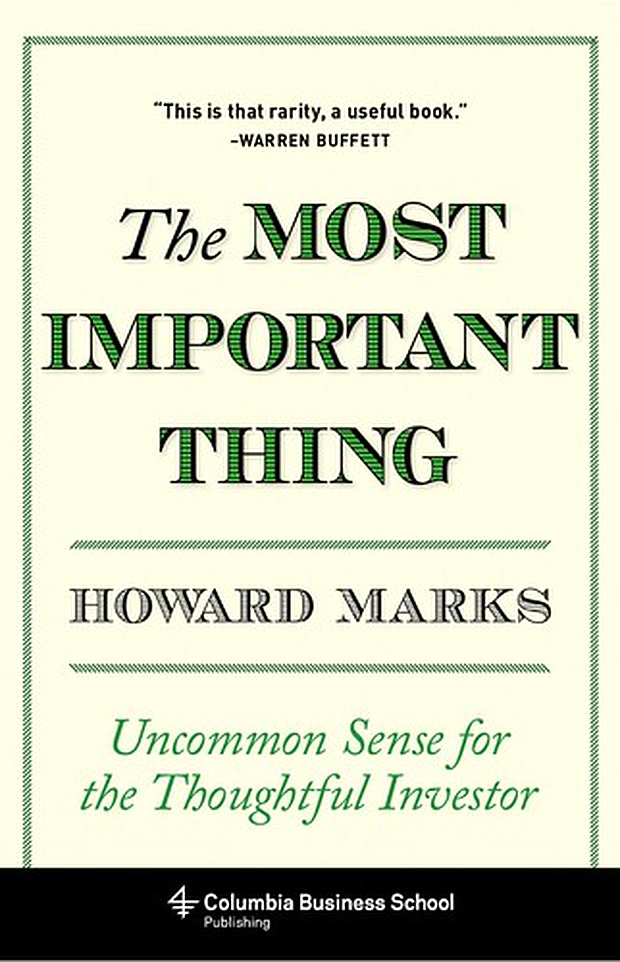
The Most Important Thing
Get on Amazon →
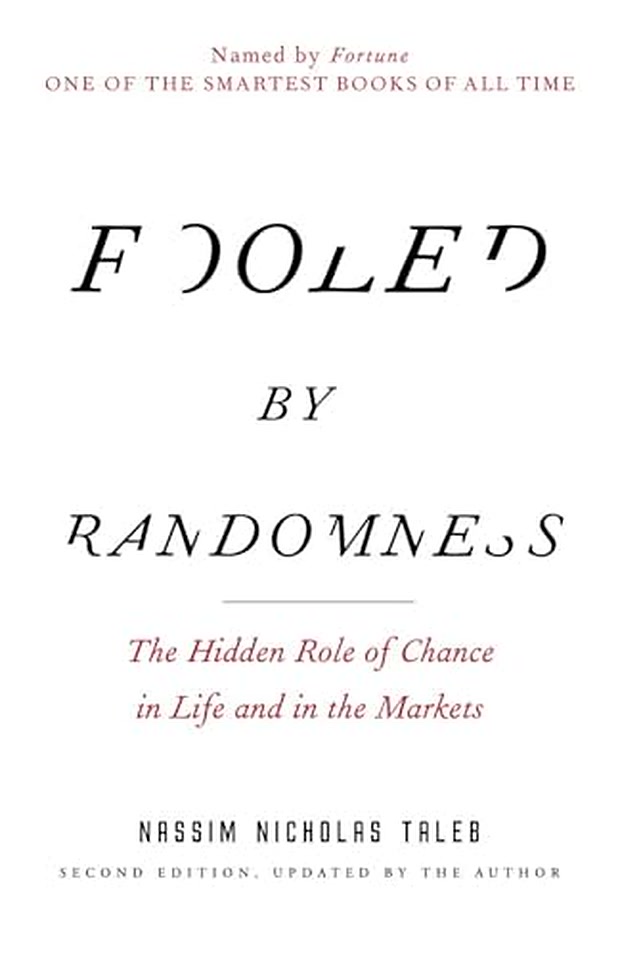
Fooled by Randomness
Get on Amazon →
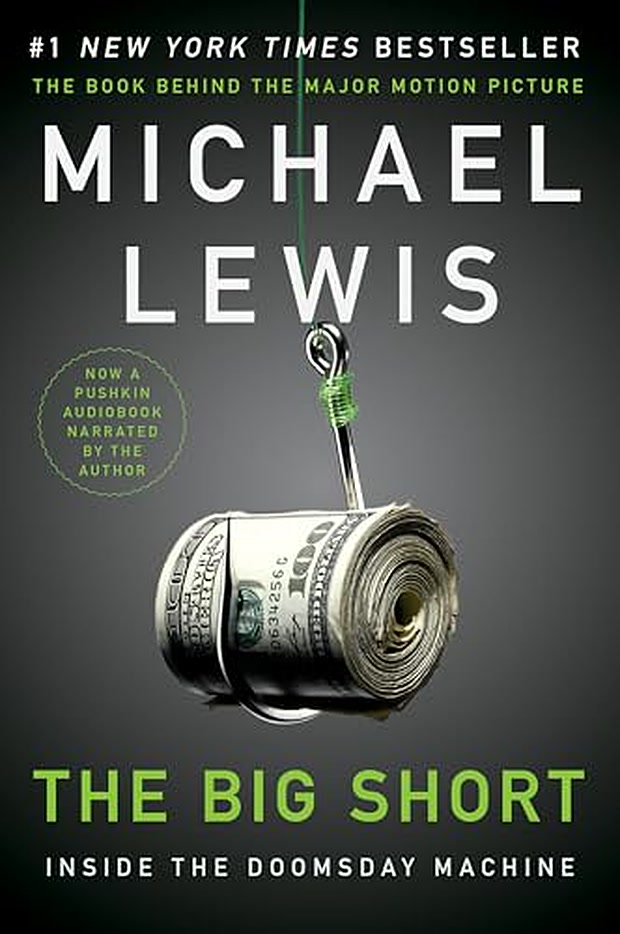
The Big Short
Get on Amazon →
As an Amazon Associate I earn from qualifying purchases.