Howard Marks
2007 07 16 Its All Good
© Oaktree Capital Management, L.P.
All Rights ReservedMemo to: Oaktree Clients
From: Howard Marks
Re: It’s All Good
Readers of my memos know that one thing I believe in most strongly – and harp on most frequently –
is the inevitability of cycles. They’re something we can depend on absolutely.
Several of my memos have dealt with cycles, starting from the very beginning: “First Quarter Performance” (April 11, 1991), “Will It Be Different This Time?” (November 25, 1996), “You Can’t
Predict. You Can Prepare.” (November 20, 2001) and “The Happy Medium” (July 21, 2004). I’ve
said in the past that I consider “You Can’t Predict,” a primer on cycles, to have been one of my best¸
and also that it evoked the least response of any memo in this decade. Thus I’m offering it as a
twofer with this memo; copies are available on request at no additional cost.
I always say that while we can’t know where we’re going, we ought to know where we are (in
cyclical terms). Understanding our environment can help us decide what tactics to employ, how aggressive to be, and which potential mistakes we should try hardest to avoid. Being conscious of
cycles can be extremely helpful, even if we can’t see the future.
Thus I’m going to devote this memo to the cycle that’s been underway for the last few years. In
terms of amplitude, breadth and potential ramifications, I consider it the strongest, most heated upswing I’ve witnessed. A lot of this is because people seem to think everything’s good
and likely to stay that way.
UCycles in the World of Investing
The basics of cycles are simple. The economic cycl e gives rise to recessions and recoveries, creating
the business environment. This produces a business cycle marked by rising and falling sales and
profits. The credit cycle swings more radically, such that capital market conditions alternate between
irrationally generous and unfairly restrictive. Likewise, market cycles fluctuate much more than do
the more “fundamental” economic and business cycles, due largely to the volatile cycle in investor
psychology.
In this latter regard, I’ll reprint a few paragraphs from “First Quarter Performance,” the 1991 memo
cited above. I think they capture investors’ pattern of behavior.
The mood swings of the securities markets resemble the movement of a pendulum.
Although the midpoint of its arc best describes the location of the pendulum “on
average,” it actually spends very little of its time there. Instead, it is almost always
swinging toward or away from the extremes of its arc. But whenever the pendulum is
near either extreme, it is inevitable that it will move back toward the midpoint sooner
or later. In fact, it is the movement toward the extreme itself that supplies the energy
for the swing back.
© Oaktree Capital Management, L.P.
All Rights Reserved
Investment markets make the same pendulum-like swing:
between euphoria and depression,
between celebrating positive developments and obsessing over negatives,
and thus
between overpriced and underpriced.
This oscillation is one of the most dependable features of the investment world, and investor psychology seems to spend much more time at the extremes than it does at
the “happy medium.”
UPolar Opposites
My 2004 memo, “The Happy Medium,” took its title fro m this last phrase and went beyond the three
listed above to discuss additional pairs of oppo sites between which the investment pendulum
oscillates:
between greed and fear,
between optimism and pessimism,
between risk tolerance and risk aversion,
between credence and skepticism,
between faith in value in the future and insistence of concrete value in the present, and
between urgency to buy and panic to sell.
I find particularly interesting the degree to which the polarities listed above are interrelated. When a
market has been rising strongly for a while, we invari ably see all nine of the elements listed first.
And when the market’s been declining, we see all nine of the elements listed second. Rarely do we
see a blend of the two sets, given that the components in each are causally related, with one giving
rise to the next.
Usually, when either set of polar extremes is in the ascendancy, that fact is readily observable, and
thus the implications for investors should be obvious to objective observers. But of course, the
swing of the market pendulum to one set of extremes or the other occurs for the simple reason
that the psyches of most market participants are moving in the same direction in a herd-like
fashion. Few of the people involved actually are objective. To continue a thread from my last memo, “Everyone Knows,” expecting widespread clinical observation during a market mania
makes about as much sense as saying “everyone knows the market has gone too far.” If many
people recognized that it had gone too far, it wouldn’t be there.
Between the two sets of cyclical extremes, I have no doubt that the environment of the last few
years has been marked by the elements listed first above, not second: euphoria, greed, optimism, risk tolerance and credence; not de pression, fear, pessimism, risk aversion and
skepticism. Certainly it’s been the recent co nsensus of investors that, “It’s all good.”
© Oaktree Capital Management, L.P.
All Rights ReservedUUnusual Breadth
In the past we’ve seen bull markets in equities, commodities and real estate. And we’ve seen bull
markets in the U.S., Japan and the emerging markets. But this time around, we’ve been seeing a
near-global bull market, where the participating sectors vastly outnumber those left out.
In his April letter to investors, entitled “The Fi rst Truly Global Bubble,” Jeremy Grantham summed
up the worldwide nature of the good times.
Never before have
Uall U emerging countries outperformed the U.S. in GDP growth over
a 12-month period until now, and this when the U.S. has been doing well. Not a single country anywhere – emerging or developed – out of the 42 listed by The
Economist grew its GDP by less than Switzerland’s 2.2%! Amazingly uniform
strength, and yet another sign of how globalized and correlated fundamentals have
become, as well as the financial markets that reflect them.
Bubbles, of course, are based on human behavior, and the mechanism is surprisingly
simple: perfect conditions create very strong “animal spirits,” reflected statistically in
a low risk premium. Widely available cheap credit offers investors the opportunity to
act on their optimism. Sustained strong fundamentals and sustained easy credit go
one better; they allow for continued reinforcement: the more leverage you take, the better you do; the better you do, the more leverage you take.
A critical part of the bubble is the reinforcement you get for your optimistic view
from those around you. And of course, as often mentioned, this is helped along by
the finance industry, broadly defined, that makes more money when optimism and activity are high. . . . To say the least, there has never ever been anything like the
uniformity of this reinforcement.
The March issue of Marc Faber’s Gloom, Boom & Doom Report described the pervasiveness of the positive effect on markets. He listed four “bubbles of epic proportions” that he has witnessed: metals, mining and energy in the 1970s; Japanese equities and real estate and Taiwanese equities in
the late 1980s; emerging markets in the 1990s; and TMT at the end of the 1990s. In contrast to the
present experience, he pointed out,
. . . all had one common feature: they were concentrated in just one or very few
sectors of the economic or investment universe and were accompanied by a poor
performance in some other asset classes. . . . Currently, looking at the five most
important asset classes – real estate, equities, bonds, commodities, and art (including
collectibles) – I am not aware of any asset class that has declined in value since 2002!
Admittedly some assets have performed better than others, but in general every sort of asset has risen in price, and this is true everywhere in the world.
It’s interesting not only to see just about everything rise at the same time, but also to see people act as if this is likely to continue for a prolonged period. Usually that just doesn’t happen.
© Oaktree Capital Management, L.P.
All Rights ReservedUIt’s Different This Time
My memos are full of quotations, adages and old saws. I’m attached to a few and tend to use them
over and over. Why reinvent the wheel, especially if the old one can’t be improved upon? Hopefully
the things I borrow contain enough wisdom to make them worth repeating.
Equally worth repeating are the statements I cite as investor mistakes. They, too, are highly
instructive . . . in the sense that they’re heard often and must be recognized for how potentially toxic
they are. None is as dangerous as “it’s different this time.” Those four little words are always
heard when the market swings to dangerously high levels. Like so many of the polar opposites enumerated above, it’s not just the sign of an absurd condition. It’s a prerequisite.
I first came across the phrase in what for me was a seminal article, “Why This Market Cycle Isn’t Any Different,” by Anise C. Wallace (New York Times, October 11, 1987). The stock market’s
rapid ascent at the time was being attributed to (or excused by), among other things, (1) the outlook
for continued economic growth, given that the economy had learned how to correct itself painlessly, (2) the likelihood of continued buying of U.S. stocks by foreign investors piling up dollars with no
better place to go, and (3) the fact that stocks weren’t overvalued compared to other assets, which
had also appreciated.
But Ms. Wallace countered as follows: “No matter what brokers or money managers say, bull markets do not last forever. In general, investment professionals say, cycles and markets differ only
by degree.” And of course, in the next eight days the Dow fell 30%.
It wasn’t just 1987. People also came to believe the business cycle had been tamed in 1928 and in
the late 1990s. And wouldn’t you know, I’m hearing it again today:
The Fed’s skillfully walking the tightrope between stimulus and restrictiveness. (A few years
ago people felt Greenspan was indispensable; now there’s suddenly faith in Bernanke.)
A service economy is less volatile than a manufacturing-based economy.
As the Chinese and Indians get rich, thei r purchases from us will buoy our economy.
The truth is, we couldn’t have great cyclical extremes if people didn’t occasionally fall for a
justification that’s never held true before. How else might investors rationalize holding or
buying despite highly elevated valuation parame ters, low prospective returns and just-plain-
wacky security structures? I still believe what I wrote in “The Happy Medium”:
Cycles are inevitable. Every once in a while, an up- or down-leg goes on for a long
time and/or to a great extreme and people start to say “this time it’s different.” They
cite the changes in geopolitics, institutions, technology or behavior that have rendered
the “old rules” obsolete. They make investment decisions that extrapolate the recent
trend. And then it turns out that the old rules do still apply, and the cycle resumes. In
the end, trees don’t grow to the sky, and few things go to zero. Rather, most phenomena turn out to be cyclical.
I’m hearing again – as often in the past – that we’re in a Goldilocks economy. It’s not so hot that
there’s risk of inflation accelerating, which would require restrictive measures on the part of the Fed.
© Oaktree Capital Management, L.P.
All Rights ReservedOr so cold that business will slow, with a depressing effect on profits. No, it’s just right. Of course,
this condition has never held for long in the past.
Earlier this year, Kenneth Lewis, chairman of Bank of America, summed it up candidly and simply:
“We are close to a time when we’ll look back and say we did some stupid things . . . We need a little
more sanity in a period in which everyone feels invincible and thinks this is different.”
And while I’m on the subject, I want to offer an important observation. No matter how
favorable and steady fundamentals may be, the markets will always be subject to substantial
cyclical fluctuation.
UThe reason is simple: even ideal conditions can become overrated and
therefore overpriced. U And having reached too-high levels , prices will correct, bringing capital
losses despite the idealness of the environment (see tech stocks in 2000). So don’t fall into the
trap of thinking that good fundamentals = positive market outlook (and especially not forever).
As I said in “Everyone Knows,” profit potential is all a matter of the relationship between
intrinsic value and price. There is no level of fundamentals that can’t become overpriced.
UWilling Suspension of Disbelief
One of the key requisites for enjoying a trip to the movies is a willingness to suspend disbelief. If
they wanted to, moviegoers invariably could find plot glitches, technological impossibilities or historical inaccuracies. But they tend to overlook them in the interest of having a good time.
Similarly, investors’ recurring acceptance that it’s different this time – or that cycles are no
more – is exemplary of a willing suspension of disbelief that springs from glee over how well
things are going (on the part of people who’re in the market) or rationalization of the reasons
to throw off caution and get on board (from those who’ve been watching from the sidelines as prices moved higher and others made money).
The fact is, the higher asset prices go, the more people think assets are worth, and the more eager
they become to buy them. A rip-roaring rally fuels buying appetites rather than make people think the appreciation may have moved prices to precarious levels. In the same way, price collapses cause
people to worry rather than start combing the market for bargains.
In this way, the bullish swing of the investment cycle tends to cause skepticism and risk
tolerance to evaporate. Faith, credence and open-mindedness all tend to move up – at just the
time that skepticism, discrimination and circu mspection become the qualities that are most
needed.
UFinancial Innovation
Another element that I notice tends to rise and fall with the cycles is the level of financial innovation.
Again, this is a cycle that’s easily understood.
Wall Street exists to develop and sell new pro ducts, no less so than toothpaste manufacturers
and movie studios. So why is it that some periods are rife with innovation and other periods
totally lacking? It’s because it’s only in bullish times that investors accept financial inventions.
When the market’s in an up-swing, people tend to say, “Sure, I’ll give it a chance” or “Good, I’ve
© Oaktree Capital Management, L.P.
All Rights Reservedbeen looking for new ways to make money.” But when the market has been moving down and
people are tallying their losses, they tend to be much less open to new ideas. In the financial world,
the mother of invention isn’t necessity, its salability.
In the roaring 1960s we saw Nifty-Fifty investing, dual shares from mutual funds and discounted
shares issued through unregistered private placem ents without any mechanism for subsequent
liquidity. In the ’80s we saw portfolio insurance – a surefire way to enjoy the appreciation potential
that comes with large commitments to equities, but with much less risk. And in the ’90s, no one could think of a reason why every dot-com, e-tailer, media aggregation and venture capital fund
wouldn’t be successful. Of course, all of these things failed to function as promised and either
disappeared forever or experienced severe corrections.
And what have we seen in the last few years? CDOs, CLOs, CPDOs, SPACs and securitizations of
every type. In the current environment – marked by decent returns; disinterest in conventional, safe
assets; and openness to risky investments – few people seem to dwell on the reasons why something
new might not work. No one asks why, if a $2 billion fund was successful, a $20 billion fund shouldn’t be as well.
Derivatives deserve particular attention in this regard. On July 8 The Wall Street Journal noted that,
Over the last six years, global futures trading on exchanges has grown nearly 30% a
year. The total derivatives market is valued at about $500 trillion, four times the value
of all publicly traded stock and bonds. . . . The four biggest futures exchanges have
launched more than 300 new derivatives products in just the last few years . . .
Particularly intriguing, it seems the value of outstanding credit default swaps – insurance against defaults among corporate debt instruments – exceeds the value of the instruments insured. How will
this work if a wave of defaults occurs? How well are the provisions of these insurance contracts documented? How readily will the writers of the insurance pay up? What will be the effect if
conditions are chaotic? No one knows the answers to these questions. Inventions originate in up
markets, but they’re tested in down market s. Rarely do they work entirely as hoped.
In down markets, people see potential risks that can’t be argued away. But in markets like this
one, they see opportunities they must seize to avoid being left behind. Thus, like the other
things I’m discussing, a high level of financia l innovation is symptomatic of a market that’s
been rising for a good while and may be behaving in an overconfident manner.
UWhat, Me Worry?
Two recent innovations deserve particular attention here: structured entities and what the British call “selling onward.” Both embody an impractical expectation: that financial engineering can
eliminate risk. Combined, they’re particularly dangerous.
In creating structured entities such as CDOs, mana gers bring together investors with different
risk/return appetites. To satisfy those varying appe tites, the investors are sold claims with different
priorities with regard to the entity’s portfolio a nd cashflows, and with projected returns that are
proportional. The managers use the investors’ capital to assemble a portfolio of assets. And each
investor receives a security with risk and return tailored to its needs.
© Oaktree Capital Management, L.P.
All Rights Reserved
It should work . . . in theory. My biggest knocks on structuring are these: First, many of the people
who develop the structured entities and rate their securities know more about probabilities than they
do about the specific assets in the portfolio, something that’s particularly dangerous when portfolios
are highly leveraged. And second, there seems to be a belief that this process – at Oaktree we call it
“slicing and dicing” – can reduce the overall risk in the system.
If risk is reduced, I’d like to know where the eliminated part goes. If ten people each hold a share of
ten highly correlated risky assets, I don’t think the ov erall system is much less risky than if each of
the ten people held one entire risky asset. At the extreme, however, it may be true that risk sharing reduces the likelihood that a spate of failures will precipitate a generalized credit crunch.
Selling onward is the process through which the originating of assets and the owning of assets are
separated. In the old days, banks made loans and mostly held on to them, syndicating a bit to build
relationships and limit risk. Nowadays, banks originate loans largely to generate loan and
syndication fees, and actually living with the loans is much less prevalent. After they’re originated,
assets such as corporate loans, mortgages, auto paper and credit card receivables are often packaged
and sold, sometimes in the form of securities. There’s a belief that this process, too, makes the world
less risky.
I fail to see net benefits here as well. Instead, I think this process introduces great moral hazard. When the people making loans aren’t going to remain dependent on the borrowers they give money
to, they have little incentive to actively police risk. Thus I have grave doubts about a lot of the credit
decisions being made.
For an extreme example, take a look at the subprime mortgage brokers. Were they motivated to make prudent credit decisions? No; they were motivated to create a lot of paper. There’s
something wrong when it’s in someone’s best interests to lend money to unqualified borrowers,
but this was the case in subprime mortgages. Obviously this occurred because mortgage brokers
weren’t risking their own money. With selling onward so prevalent, an originator just had to hope
the borrower would make the first few payments, so that delinquencies wouldn’t surface before the originator’s repurchase obligation expired and th e loans became the buyer’s problem. How could
buyers have been silly enough to purchase loans made by brokers operating under this set of incentives?
Now, let’s combine structuring and selling onward. Here’s how I see it working:
A mortgage broker makes a bunch of loans without knowing much about creditworthiness (think
about so-called “liar loans”) or caring much about creditworthiness (because he intends to sell them momentarily).
An investment banker buys a few hundred of these loans, also without knowing much about them (because of their sheer numbers), in order to package them into residential mortgage-backed securities (RMBS) and sell them onward.
An investment manager buys a few dozen RMBS, about which he doesn’t know much (also the numbers) or care much (because the fees and potential profits incentivize him to put a lot of money to work fast). They become part of the portfolio of a CDO, against which debt is issued.
A rating agency analyst assigns ratings to the CDO debt, about which he can’t know much (lack of specialized expertise; vast number of underlying assets; structural complexity and the newness
© Oaktree Capital Management, L.P.
All Rights Reserved A hedge fu n
d manager buys CDO debt about which he doesn’t know much (with thousands of
underlying mortgages having been sliced and diced) or worry much (given the high debt ratings).
Concoctions like this are tolerated only in heady times. Clearly the results can be incendiary. We’re
waiting to see the final outcome – and perhaps to pick among the ashes.
One last thought: Let’s say slicing, dicing and selling onward do have the potential to reduce the
overall level of risk in the system, all other things being equal. Even if that were true, the other
things wouldn’t remain equal; market participants would adjust their behavior to the new
reality and in so doing return risk to its old level. On May 23, the Financial Times said this about
trying to reduce risk by selling onward and by obtaining credit insurance via derivatives:
This makes banks less vulnerable to individual defaults. But it could also be making
them feel so comfortable about lending risks that they are making more risky
loans. Outside investors such as hedge funds are gobbling them up, either because
they also think they are protected with credit derivatives or because they are
desperate to find somewhere to place their cash. This has triggered a collapse in the standards used to conduct and fund deals. (Emphasis added)
Again, no matter how good fundamentals may be, humans exercising their greed and propensity to err have the ability to screw things up. Perhaps Myron Scholes put it most succinctly (The Wall
Street Journal, March 6): “My belief is that beca use the system is now more stable, we’ll make
it less stable through more leverage, more risk taking.”
UThe L Word
Some of the most glaring innovation this time around has taken place in the area of leverage. It’s not
that leverage hasn’t been available and been used before: In the late 1980s, companies like RJR were
the subject of leveraged buyouts in which 95% of the purchase price was borrowed. Nowadays, debt rarely constitutes much more than 80% of buyout ca pital structures, but the terms of the debt and the
ease of obtaining it are startlingly accommodating.
Unlike the historic norm, it’s routine today to issue CCC-rated bonds. It’s easy to borrow money for
the express purpose of distributing cash to equity holders, magnifying the company’s leverage. It’s so easy to issue bonds with little or no creditor protection in the indenture that a label has been
coined for them: “covenant-lite.” And it’s possible to issue bonds whose interest payments can be
paid in more bonds at the option of the borrower.
The first requirement for an elevated opportunity in distressed debt is the unwise extension of
credit, which I define as the making of loans whic h borrowers will be unable to service if things
get a little worse. This happens when lenders fail to require a sufficient margin of safety.
Here the interrelatedness of cycles is quite evident. Good economic times bring rising profits.
Rising profits cause the default rate to subside. And the low default experience erases lenders’ reticence. Among other things, they become willing to lend money so that troubled companies can
© Oaktree Capital Management, L.P.
All Rights Reservedstay afloat and hopefully outgrow their problems. Today that’s called “rescue finance”; in less rosy
times it might be called “throwing good money after bad.”
The default rate in the high yield bond universe is at a 25-year low on a rolling-twelve-month
basis. Under such circumstances, how could th e average supplier of capital be expected to
maintain a high level of risk aversion and prudence, especially when doing so means ceding all
the loan making to others? It’s not for nothing that they say “The worst of loans are made in
the best of times.”
UThe Downside of Leverage
If lenders are acting in an imprudent fashion, what’s the effect on the borrowing companies? If loans
are available too readily, is it right or wrong to borrow? These are among the most interesting
questions of the day. Lots of good things have been said about leverage. In the late 1980s, when venerable American
companies were being bought in leveraged buyouts structured with debt/equity ratios of 25-to-one,
we were told that an underleveraged balance sheet is indicative of a sub-optimal capital structure and
excessive use of high-cost equity, and that significant leverage sharpens management’s focus on cash
flow and leads to better expense control.
The only thing omitted was the reminder that equity – which doesn’t require the periodic payment of
interest or the repayment of principal at maturity – represents a company’s margin of safety. It’s the
capital layer that absorbs the first blow in tough times without occasioning an event of default.
While leverage may magnify gains in good times, it’s a healthy layer of equity that gets
companies through the bad times.
It’s inescapable that, all other things equal, greater leverage increases a company’s likelihood
of experiencing financial distress. Thus, with lenders enjoying a carefree recent experience and
consequently financing some unwise deals – and with borrowers eager for the enhanced upside potential that comes with leverage – it seems clear that we’ll see rising rates of default and
bankruptcy a few years down the pike. This is especially true if, as has often been the case
recently, debt is incurred not just to leverage the company’s equity, but to finance payouts to equity
holders that reduce or eliminate the equity.
So then, are private equity funds – raising much more equity capital than ever, and doing the biggest
deals in history at a rapid-fire pace, at rising tr ansaction prices and rising leverage ratios – doing a
smart thing or making a mistake? It all depends on how you look at things. The funds seem to be looking in terms of optionality.
UKetchup, Easy Money and Optionality
I was a picky eater when I was a kid, but I loved ketchup, and my pickiness could be overcome with
ketchup. I would eat hamburgers, frankfurters, veal cutle ts, filet of sole and frozen fish sticks, but as
far as I was concerned, they were all just vehicles for ketchup. The ketchup of today is easy
borrowing, and private equity managers are entering into a large number of transactions to access it.
© Oaktree Capital Management, L.P.
All Rights ReservedLet me illustrate what I consider to be the thought process: If you were offered the chance to buy
companies with 100% debt financing and no money of your own, how many would you buy? The
smart answer is, “All of them.” Not just the well-run ones? Or the growing ones? Or the profitable
ones? No; all of them. Some would produce positive cash flow and/or appreciation, which you’d
welcome. The others would be unsuccessful, but with none of your own money invested, you’d just
walk away. That’s optionality.
Optionality is a new-age finance term for the ability to cheaply obtain a call on asset
appreciation, creating the possibility of profits out of proportion to potential losses. That’s the
way it is in venture capital: all you can lose is your investment, but you can multiply it hundreds of
times simply by finding the next Google. Even though venture capital investing produces only occasional success, it’s justified by the occasional outsized payoff.
I think that’s the deal today in mega-private equity. In their highly successful first decade of 1975-
85, LBO funds invested in small, underpriced indust rial concerns or orphaned corporate spinoffs.
They paid low prices for stable companies, financed their purchases with moderate amounts of debt,
and put a lot of energy into improving the companies’ operations. Both their batting averages and
their overall rates of return were attractive.
But I’m not sure that’s the model today. Few companies are languishing on the bargain counter, and
everyone knows that if buyout funds bid for a company, the shareholders had better take a good look at what they’re giving up. Likewise, buyout funds are buying well into a period of economic
expansion, and the scope for improvement in operations may be limited.
No, the model today seems different: pay premiums to open-market prices for prominent, multi-
billion dollar companies, sometimes after the boards, shareholders or other bidders have forced prices higher. Borrow large sums to finance the deals. Generate whatever fundamental improvement you
can. Hope the market will provide a highly leveraged payoff. And, given the enormity of the scale, get rich off management fees, ancillary fees and the profits from the ones that work.
In other words, it seems that, relative to the past, the thought process in mega-private equity is based on the combination of (1) ultra-cheap financing, (2) high fees, (3) quick withdrawal of equity capital
and (4) a lower batting average but big payouts on the winners. The optionality is certainly on the
GPs’ side. Let’s hope it works for the LPs as well.
UIf the Lender’s a Sap, Is the Borrower a Genius?
I have a lot of experience looking at leveraged trans actions from the standpoint of the lender, but less
experience as a borrower. Thus I found it novel – even surprising – to read a January memo on this subject from Carlyle founder William Conway to his colleagues, with thoughts echoing mine:
As you all know (I hope), the fabulous profits that we have been able to generate for our limited partners are not solely a function of our investment genius, but have
resulted in large part from a great market and the availability of enormous amounts of
cheap debt. This cheap debt has been available for almost all maturities, most industries, infrastructure, real estate, and at all levels of the capital structure. Frankly,
there is so much liquidity in the world financial system, that lenders (even “our”
lenders) are making very risky credit decisions. . . .
10
© Oaktree Capital Management, L.P.
All Rights Reserved
I know that this liquidity environment cannot go on forever. I know that the longer it
lasts the more money our investors (and we) will make. I know that the longer it
lasts, the greater the pressures will be on all of us to take advantage of this liquidity.
And I know that the longer it lasts, the worse it will be when it ends. And of course
when it ends the buying opportunity will be a once in a lifetime chance. But, I do not know when it will end. . . .
Last year, I asked you to be humble, ethical and optimistic. This year I am asking
you to be careful as well.
In 1990-91, our distressed debt funds made a fortune buying the obligations of companies that had
been loaded up with too much debt in LBOs in the late ’80s. Chastened by that experience, lenders
in the ’90s didn’t provide enough leverage to make buyout companies much of a factor in the debt
collapse of 2002. But with the memory of having 1990-91 faded, leverage became freely available in
the last few years, and thus we have little doubt we ’ll be buying a great deal of distressed LBO debt
the next time around.
When all the above is taken together, it seems likely that a few years out, we’ll see a landscape
littered with companies that were crippled with exce ssive debt loads and lend ers who weren’t repaid.
What happens to private equity funds and their investors will depend on the outcome of a game of
hot potato: will they get their capital – and their gains – out of the over-leveraged companies before they go sour? We’ll see.
UBut Don’t the Borrowers Have a Free Pass?
Much is being made of the possibility that today’s debt is default-proof. “Toggle bonds” give
borrowers the option of paying interest in the form of more bonds for a while. And covenant-lite
indentures mean the likelihood of an interim technical default has been reduced. Do these
developments reduce the overall risk?
This, too, goes back to the concept of optionality. The value of an option is greater the longer it has
to run, and options that can’t be extinguished early are worth more than those that can.
Think of someone who issues ten-year bonds to raise the money with which to buy a company. On the surface, it seems he has ten years for his purchase to work out profitably, at the end of which
period he has to repay his lenders. In other words, he has a ten-year option on the company’s
appreciation potential. But what if the company gets in a bind in the early years and misses an
interest payment? Or if an economic slowdown causes a technical breach of a covenant? In past
downturns, these things have forced borrowers to pay lenders for extensions or forbearance, and they have led to defaults. Those things may be somewhat less likely nowadays.
It is true that payment-in-kind and covenant-lite loans reduce the likelihood of interim defaults. But
does that mean the credit landscape is risk-free and lenders can breathe easy? Sooner or later, debt
has to be repaid or refinanced, and the credit market may not be accommodating at that moment; this is especially true if the company’s fortunes have deteriorated. Not enough of a company’s debt may
be default-proof to make it invulnerable. The pr ice of the debt may decline with the fundamentals,
11
© Oaktree Capital Management, L.P.
All Rights Reservedeven if default isn’t an immediate threat. And the free pass in the interim may just delay – but also
worsen – the eventual outcome.
Under a traditional structure, a company might default in the third year of a bond’s life, by which
time 20% of its value may have evaporated. But with these new wrinkles, it might not happen until
year five . . . when 60% of the value is gone. Yes, lenders are giving borrowers more rope. But
will it prove to be a lifeline for th e company or a hangman’s noose? A lot will depend on how
things go while the postponed default is in abeyance.
This is yet another area where up-cycle faith that risk has been reduced can convince people to add
back the risk. As The Wall Street Journal said of standby revolvers on May 11, “Thanks to debt
arrangements like this, some private-equity buyers say they are doing deals they would otherwise not
do.”
UWhat Could Cause This Upward Cycle to Falter?
Since I insist that the good times can’t roll on forever, I’m often asked what might make them stop. I
don’t have any inside information on this subject, but I can enumerate the possibilities:
1. economic slowdown,
2. reduced willingness to lend or insistence on higher interest rates, perhaps due to increased worry about credit risk,
3. systemic problems like a crisis in derivatives or a cluster of hedge fund meltdowns,
4. exogenous factors such as $100 oil, a dollar crisis, terrorist acts, and
5. the things I haven’t thought of.
First, I want to point out that these things ar e not unrelated. A reduction in lenders’ willingness to
lend may stem from an economic slowdown. An economic slowdown could be brought on by an exogenous event. It’s when there’s a confluence of these things that the debt market gets into real
trouble, as was the case in 1990 and 2002.
Second, these things are often unpredictable. I like to remind people that the best buying opportunity
we ever had in distressed debt arose in the summer of 2002, when recession, credit crunch, 9/11,
Afghanistan, telecom meltdown and the scandals at Enron et al. occurred all at once. Few if any of
these were predictable twelve months earlier.
And third, the one we should worry about most is number five. Investors can cope with the things
they can anticipate, analyze and discount. They have more trouble with the rest. I love hearing
people from the “I know” school say, “I’m not anticipating any surprises.” Those are the
developments that can knock a market into a cocked hat. As Martin Wolf wrote in the Financial Times on May 2, “The most obvious reason for taking today’s euphoria with a barrel of salt is that
nobody ever expects shocks. That is what makes them shocks.”
Where do we stand in the cycle? In my opinion, there’s little mystery. I see low levels of
skepticism, fear and risk aversion. Most people are willing to undertake risky investments, often because the promised returns from traditional, safe investments seem so meager. This is true even
though the lack of interest in safe investments and the acceptance of risky investments have rendered
12
© Oaktree Capital Management, L.P.
All Rights Reservedthe slope of the risk/return line quite flat. Risk premiums are generally the skimpiest I’ve ever seen,
but few people are responding by refusing to accept incremental risk.
Peter Bernstein put it this way in the February 15 issue of Economics and Portfolio Strategy:
I hear over and over that we live in an era of low expected returns. The rational
response to low expected returns is to withdraw and wait until expected returns are
higher. That response to low expected returns appears to have gone out of fashion.
Today’s response is to seek higher returns from higher risks in a low-risk
environment – or, worse, to underestimate the risks taken. [Of course, I am less
certain than Peter that we are in a low-risk environment.]
Markets have tended recently to move up on positive developments and to recover easily from negatives. I see few assets that people are eager to get rid of, and few forced sellers; instead, most
assets are strongly bid for. As a result, I’m not aw are of any broad markets that I would describe as
under-priced or uncrowded. I will say, however, th at some of the excess confidence that usually
accompanies booms may be missing. Some of the people making risky investments today seem to be doing so with their fingers crossed. And even though they’re optimistic enough to make these
prosperity-oriented investments, they’re also wary enough to want to hedge their bets by
participating in distressed debt as well.
It is what it is. We’ve been living in optimistic times. The cycle has been swinging strongly
upward. Prices are elevated and risk premiums are slender. Trust has replaced skepticism,
and eagerness has replaced reticence. Do you ag ree or disagree? That’s the key question.
Answer it first, and the implications for investing become clear.
In the first quarter of this year, significant deli nquencies occurred in subprime mortgages. Those
directly involved lost a lot of money, and onlookers worried about contagion to other parts of the
economy and other markets. In the second quarter, the impact reached CDOs that had invested in
subprime mortgage portfolios and hedge funds that had bought CDO debt, including two Bear
Stearns funds. Those who had to liquidate assets were forced – as usual – to sell what they could sell, not what they wanted to sell, and not just the offending subprime-linked assets. We began to
read about ratings downgrades, margin calls and fire-sales, the usual fuel for capital market
meltdowns. And in the last few weeks we’ve begun to see investor reticence on the rise, with new
low-grade debt issues repriced, postponed or pulled, leaving bridge loans un-refinanced.
It is in this way that awareness of the inevitabil ity of cycles is reawakened, and it is for reasons
like these that the pendulum starts to swing back from one extreme toward the center of its arc
. . . and then the other extreme. We never know whether a little jiggle is the start of the swing
back and, if so, how far it will go. But we always should be aware that reversion will occur.
The last 4½ years have been carefree, halcyon times for investors. That doesn’t mean it’ll stay that
way. I’ll give Warren Buffett the last word, as I often do: “It’s only when the tide goes out that you
find out who’s been swimming naked.” Pollyannas take note: the tide cannot come in forever.
Time, tide and cycles wait for no man.
July 16, 2007
13
© Oaktree Capital Management, L.P.
All Rights Reserved 14Legal Information and Disclosures
This memorandum expresses the views of the author as of the date indicated and such views are subject to
change without notice. Oaktree has no duty or obligation to update the information contained herein. Further, Oaktree makes no representation, and it should not be assumed, that past investment performance is an indication of future results. More over, wherever there is th e potential for profit there
is also the possibility of loss. This memorandum is being made av ailable for educational purposes only and should not be used for any
other purpose. The information contained herein do es not constitute and should not be construed as an
offering of advisory services or an offer to sell or solicitation to buy any securities or related financial
instruments in any jurisdiction. Certain inform ation contained herein concerning economic trends and
performance is based on or derived from informatio n provided by independent third-party sources.
Oaktree Capital Management, L.P. (“Oaktree”) believes that the sources from which such information has been obtained are reliable; however, it cannot g uarantee the accuracy of su ch information and has
not independently verified the accuracy or completeness of such information or the assumptions on which
such information is based.
This memorandum, including the information cont ained herein, may not be copied, reproduced,
republished, or posted in whole or in part, in an y form without the prior written consent of Oaktree.
Recommended Reading
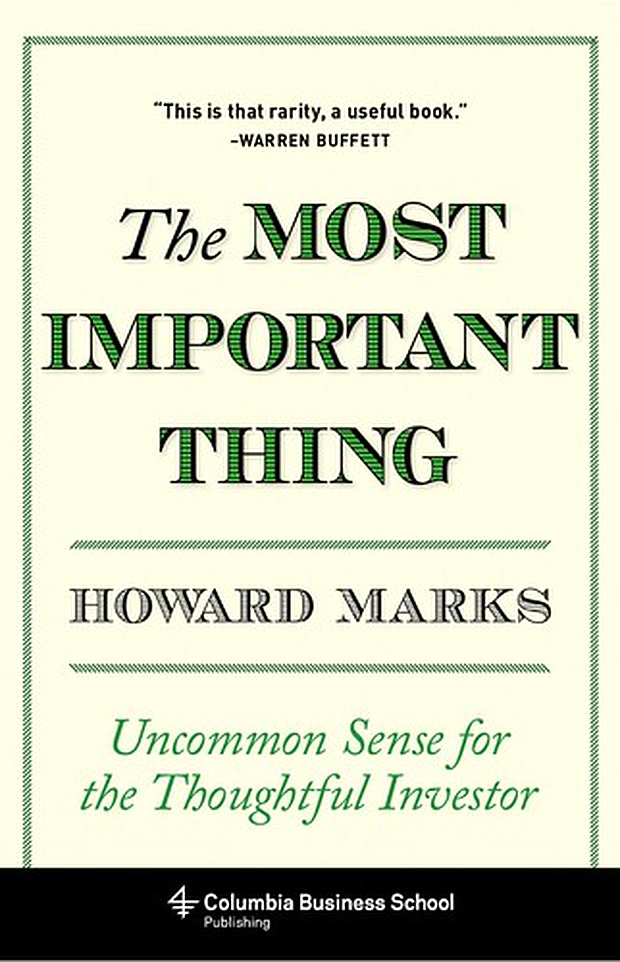
The Most Important Thing
Get on Amazon →
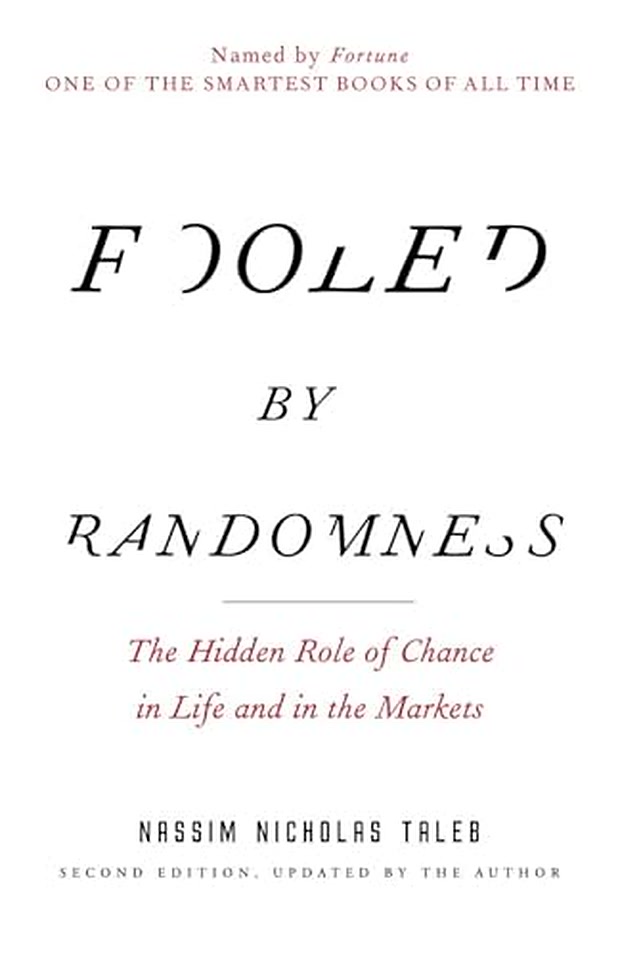
Fooled by Randomness
Get on Amazon →
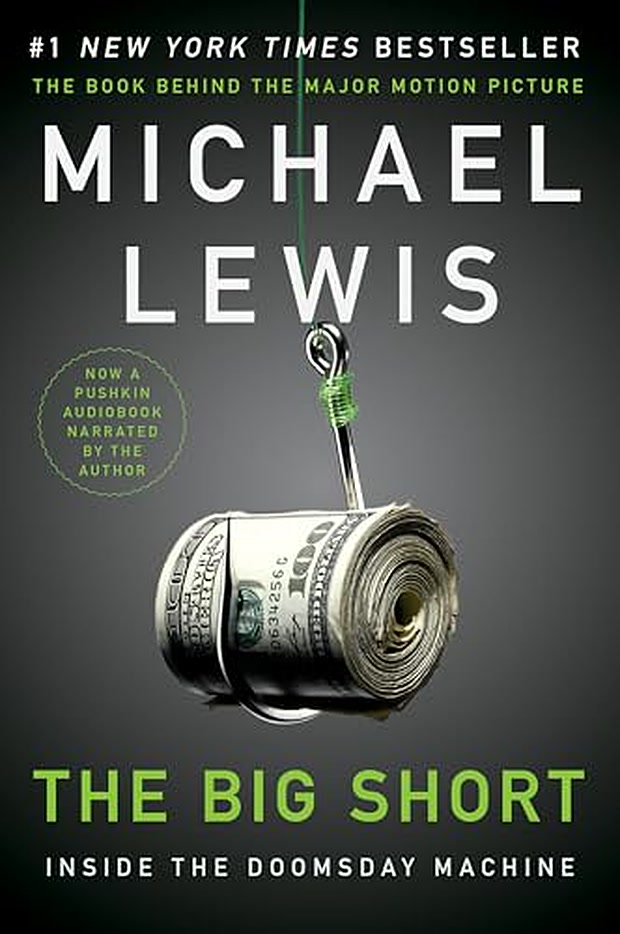
The Big Short
Get on Amazon →
As an Amazon Associate I earn from qualifying purchases.