Howard Marks
2007 04 26 Everyone Knows
© Oaktree Capital Management, L.P.
All Rights Reserved
Memo to: Oaktree Clients
From: Howard Marks Re: Everyone Knows _____________________________________________________________________________
par·a·dox n 1 a seemingly absurd or self-contra dictory statement that is or may
be true . . . 4 an opinion that conflicts with common belief. (Collins English
Dictionary)
I’m sometimes asked to speak about investing with the choice of topic wide open. I like to begin
by saying the thing I find most in teresting about investing is how paradoxical it is: how often the
things that seem most obvious – on which every one agrees – turn out not to be true.
I’m not saying accepted investment wisdom is sometimes valid and sometimes not. The reality is simpler and much more systematic: What’s clear to the broad consensus of investors is
almost always wrong.
First, most people don’t understand the proc ess through which something comes to have
outstanding moneymaking potential. And seco nd, the very coalescing of popular opinion
behind an investment tends to el iminate its profit potential.
I’ve been saving up ideas for a memo about how often the investing herd is wrong and accepted
wisdom should be bet against. Then along cam e the March 1 issue of Mark Faber’s “Gloom,
Boom and Doom Report” and its lead quotat ion from William Stanley Jevons (1835-1882).
Another chance for someone else to help me say it better, this time from 100-plus years ago:
As a general rule, it is foolish to do just what other people are doing, because there are almost sure to be t oo many people doing the same thing.
“Common Sense” and Other Oxymorons
Take, for example, the investment that “everyon e” believes to be a great idea. In my view
by definition it simply cannot be so.
If everyone likes it, it’s probably because it has been doing well. Most people seem to
think outstanding performance to date presages outstanding future performance. Actually, it’s more likely th at outstanding performance to date has borrowed from the
future and thus presages sub-pa r performance from here on out.
If everyone likes it, it’s likely the price has ri sen to reflect a level of adulation from which
relatively little further appreciation is likely. (Sure it’s possible for something to move from “overvalued” to “more overvalued,” but I wouldn’t want to count on it happening.)
If everyone likes it, it’s likely the area has been mined too thoroughly – and has seen too
much capital flow in – for many bargains to remain.
© Oaktree Capital Management, L.P.
All Rights Reserved 2 If everyone likes it, there’s sign ificant risk that prices will fall if the crowd changes its
collective mind and moves for the exit.
Superior investors know – and buy – when the pr ice of something is lower than it should
be. And the price of an investment can be low er than it should be only when most people
don’t see its merit. Yogi Berra is famous fo r having said, “Nobody goes to that restaurant
anymore; it’s too crowded.” It’s just as nonsensical to say, “Everyone realizes that
investment’s a bargain.” If everyone realizes it , they’ll have bought, in which case the price
will no longer be low.
The Anatomy of a Bargain
“Is it a good idea?” That’s what everyone wa nts to know. And from time to time, popular
opinion unites behind an investment , anointing it as a good idea – the next solution – the low-risk
sure thing – the “silver bullet.” Often this crowd mentality creates a self-f ulfilling prophecy . . .
for a while. I’ve seen it many times in my 39 years in this busi ness: “it’s a good idea to i nvest in the stocks of
high-growth companies” (or energy stocks, sma ll companies, disc drive companies, emerging
markets, venture capital funds, technology stocks, hedge funds, real estate, China and India, or
private equity). But just as often, I’ve stated my view: There’s no such thing as a good idea.
Only a good idea at a price. Something can be a very good id ea at one price and a very bad
idea at another. Invariably when I hear the media and the herd describe something as a good buy, it’s without
regard for price. They never say, “Internet stocks are a good buy at p/e ratios up to 50.” Or
“class-A office buildings are a good buy as long as the cap rate exceeds 7%.” Or “private
equity’s a good idea at purchase prices below seven times EBITDA.” Just “it’s a good buy.”
My response is simple: There is no investment idea so good that it can’t be ruined by a too-
high entry price. And there are few things that can’t be attrac tive investments if bought at
a low-enough price. When investors forget these simple tr uths, they tend to get into trouble.
How Money Is Made
The fact is, there is no dependable sign pointi ng to the next big mone ymaker: a good idea at a
too-low price. Most people simply don’t know how to find it. If someone really knew, why
would he share his knowledge? And when the investing herd or so me media commentator
expresses an opinion, they’re invariab ly pointing in the wrong direction.
Large amounts of money (and by that I me an unusual returns, or unusual risk-adjusted
returns) aren’t made by buying what everybo dy likes. They’re made by buying what
everybody underestimates.
© Oaktree Capital Management, L.P.
All Rights Reserved 3In short, there are two primary el ements in superior investing:
seeing some quality that others don’t see or appreciate (and that isn’t reflected in the
price), and
having it turn out to be true (o r at least accepted by the market).
It should be clear from the first element that the process has to begin with investors who
are unusually perceptive, unconventional, iconoc lastic or early. That’s why successful
investors are said to spend a lot of their time being lonely. As I wrote in “Dare to Be Great,”
non-conformists don’t get to enjoy the warmth that comes with being at the center of the herd.
But it should be clear that when you’re one of many buying something, it’s unlikely to be a
special opportunity. It’s only when few others will buy that you can get a bargain.
That’s the thinking behind a br illiant observation that I heard in the 1970s, describing the three
stages of a bull market:
the first, when a few forward-looking peopl e begin to believe things will get better,
the second, when most investors reali ze improvement is actually underway, and
the third, when everyone believes things will get better forever.
The loners who buy from a crowd of dispirited sellers can get a good deal – and high returns –
because they’re few in number a nd early. But when every Tom, Di ck and Harriet joins the herd,
after the merits of the situation have become obv ious to all, they can’t expect a bargain; the
merits must be reflected fully – or to excess – in the price. In fact, ea ch of those latecomers
bears the risk of being the last to jump on the bandwagon . . . just before it goes off the cliff.
The Best Companies in America
As readers of these memos know, I first worked in the Investment Research Department of First
National City Bank (now Citibank) in 1968. Wh ereas common stocks traditionally were bought
on the basis of their issuers’ current book value and earnings, “g rowth investing” recently had
come into fashion. Under this new approach, buyers paid higher-than-usual valuation multiples for the stocks of “growth companies” in recogn ition of the above-average rates at which their
earnings were projected to increase in the future. Growth investing reached its zenith in the pursuit of the “Nifty Fifty,” and that’s the style the
bank pursued to the virtual exclusion of all others . It consisted of buying the stocks of the best,
fastest-growing companies in America, compan ies like IBM, Xerox, Polaroid, Kodak, Hewlett
Packard, Texas Instruments, Perkin Elmer, Me rck, Lilly and Avon. Each one was a corporate
icon, or what I call a “head nodder” – one person says “Xerox” and everyone else nods and says “great company.” Head nodders are like silver bulle ts: always the subject of broad,
unquestioning adoration, and thus invariably overpriced.
The trap, of course, is that when everyone ag rees something’s a great company, it invariably
comes at a great-company price. Some will turn out to actually be great companies, but the
© Oaktree Capital Management, L.P.
All Rights Reserved 4buyers of their stocks have already paid in full for greatness. Others will disappoint, and the
stock of a disappointing company th at’s been bought at a great-co mpany price can be a disaster.
By 1970, the scene had been set for just such a development by the Nifty Fift y investors’ attitude
toward valuation: “These companies are so good, and grow ing so fast, that there’s no such
thing as a price that’s too high . If the price seems excessive given this year’s earnings, just
wait; the earnings will grow enough to justify the price.” Those who participated can say they
cared about price, but I never heard of anyone re fusing to hold those stocks just because they
were priced too high. Such discipline is rarely seen during investment manias.
The rest, as they say, is history. In the early and mid-70s, the wheels fell off. Common stock
investing, which had become extr emely popular, fell out of favor. Business Week ran its famous
cover story, “The Death of Equities.” The economy became mired in stagflation. Great companies’ earnings failed to grow and sometimes contracted. Nifty Fifty stocks that had traded
at p/e ratios of 80 and 90 fell to p/e ratios of 8 and 9 (really). And The Wall Street Journal
eventually ran its customary listing of stocks that had lost 90% – a possible buy signal that
depressed investors routinely ignore. So we had a quick lesson in the folly of buying on supposed merit alone, without regard to price.
But the lesson continued. Here in 2007, only a few of those “Best Comp anies in America” are
still thought of as such. In f act, IBM, Xerox, Kodak and Polaroid all became distressed in the
interim and required turnarounds. Warren Buffett made a related observation in this year’s
Berkshire Hathaway Annual Report: “Of the ten non-oil companies having the largest market capitalization in 1965 – titans su ch as General Motors, Sears, DuPont and Eastman Kodak – only
one made the 2006 list.”
The lesson is simple: beware sweeping statemen ts, accepted wisdom and eternal verities,
and look for pearls others haven’t recognized.
The Worst Companies in America
I know I tend to repeat myself in these memos – my wife Nancy never fails to remind me – but I
don’t think I’ve ever told the w hole story of my entry into th e world of high yield bonds.
In 1978, shortly after having organized and begun to manage Citibank’s convertibles securities
fund, I got a call from the boss: “There’s some guy named Milken or something who works for a small brokerage firm in California. He deals in ‘high yield bonds,’ and a client wants us to
manage a portfolio for them; can you find out what they are?” Obviously, that brief conversation
changed my life. Everyone associates Michael Milken with high yield bonds (no one says “junk” anymore), but
few people know exactly why or how. Mike was ne ither the inventor (fir st to create) nor the
discoverer (first to find) of bonds rated below investment grade. He’s just the person who did
the most with them. Here are the facts:
© Oaktree Capital Management, L.P.
All Rights Reserved 5 For as long as bonds have been rated, there’ve been low-rated bonds. But prior to the late
1970s, non-investment grade bonds couldn’t be issu ed as such. Rather, they were “fallen
angels”: bonds issued with investment-grade ratings that were subsequently downgraded due
to deterioration on the part of their issuers.
At Wharton, Mike read a 1958 study by W. Braddock Hickman wh ich showed that over the
period 1900 to 1949, lower-rated bonds had produced higher realized retu rns on average than
higher-rated bonds. Sure some low-rated bonds defaulted, but higher yields and lower
purchase prices on the many that didn’t defaul t more than made up for the ones that did.
Mike concluded that low-rated bonds were an overlooked asset cla ss; even for a weak credit,
there had to be some yield that would compen sate for the credit risk; thus it should be
possible to issue bonds with speculative ratings; and he could make it happen.
Thus Mike’s contribution consiste d of raising the prof ile of the asset class and proselytizing
for it, making a market in high yield bonds and underwriting new issues. He wasn’t the only
one, just the most prominent fi gure by far. And the expansion of the universe of new issue
high yield bonds from $2 billion to $200 billion that Mike presided over between 1978 and
1990 provided early impetus for the growth of buyout investing into the major activity it is
today.
By the time I got the call described above, Mike ha d joined Drexel Burnham Lambert, started the
high yield bond department, moved it to California and begun to underwrite new issue high yield
bonds for corporate borrowers. He visited me at the bank in the fall of 1978, and it was even more of a learning experience than the one I got from the Nifty Fifty. Mike’s logic was the
direct opposite, and to me much more a ppealing. Here’s what he told me:
If you buy triple-A or double-A bonds, there’s only one way for them to go: down. The
surprises are invariably negative, and the reco rd shows that few top-rated bonds remain so
for very long.
On the other hand, if you buy B-rated bonds and they survive, all the surprises will be on the
upside.
Because the investment process is prejudiced ag ainst high yield bonds, they offer yields that
more than compensate for the risk.
Thus you’ll earn a superior yield for having accepted the incremental credit risk, and
favorable developments can lead to capital gains as well.
Your main goal should be to weed out bonds that may default.
But diversification is essential, too, because some of the bonds you hold will default anyway,
and your positions in them mustn’t be larg e enough to jeopardize the overall return.
What an object lesson! What an epiphany! Buy the stocks of the best companies in
America at prices that assume nothing can go wrong? Or buy the bonds of unloved
companies at prices that overstate the risk of default, and from which the surprises are
likely to be on the upside? Having seen fortunes lost investi ng in the best, it seemed m
uch
smarter to buy the worst at too-low prices.
© Oaktree Capital Management, L.P.
All Rights Reserved 6“If we avoid the losers, the winners will take care of themselves.” Sound familiar? The
motto we chose for Oaktree was inspired by a lo t of people and events, but the morning I spent
with Mike Milken in 1978 was the biggest single source of inspiration.
The Perversity of Risk
“I wouldn’t buy that at any pri ce – everyone knows it’s too risky.” That’s something I’ve
heard a lot in my life, and it has given rise to the best investment opportunities I’ve participated
in. In fact, to an extent, it has provided th e foundation for my career. In the 1970s and 1980s,
insistence on avoiding non-investme nt grade bonds kept them out of most institutional portfolios
and therefore cheap. Ditto for the debt of bankrupt companies: what could be riskier?
The truth is, the herd is wrong about risk at least as often as it is about return. A broad
consensus that something’s too hot to handle is almost always wrong. Usually it’s the opposite
that’s true.
I’m firmly convinced that investment risk resi des most where it is least perceived, and vice
versa:
When everyone believes something is risky, their unwillingness to buy usually reduces its
price to the point where it’s not risky at all. Broadly negati ve opinion can ma ke it the least
risky thing, since all op timism has been driven out of its price.
And, of course, as demonstrated by the experien ce of Nifty Fifty investors, when everyone
believes something embodies no risk, they us ually bid it up to the point where it’s
enormously risky. No risk is feared, and thus no reward for risk bearing – no “risk premium”
– is demanded or provided. That can make th e thing that’s most esteemed the riskiest.
This paradox exists because most investors think quality, as opposed to price, is the
determinant of whether something’s risky. But high quality assets can be risky, and low
quality assets can be safe. It’s just a matter of the price paid for them.
The foregoing must be what Lord Keynes had in mind when he coined one of my favorite
phrases: “. . . a speculator is one who runs risks of which he is aware and an investor is one who
runs risks of which he is unaware.” In 1978, triple-A bonds were considered respectable
investments, while buying B-rated bonds was viewed as irresponsible speculation. Yet the latter
have vastly outperformed the former, fe w of which remain triple-A today.
Elevated popular opinion, then, isn’t just th e source of low return potential, but also of
high risk. Broad distru st, disregard and dismissal, on the other hand, can set the stage for
high returns earned with low risk. This obs ervation captures the essence of contrarianism.
© Oaktree Capital Management, L.P.
All Rights Reserved 7The Unhelpful Consensus
The bottom line is that what “everyone knows” isn’t at all helpful in investing. What
everyone knows is bound to already be reflected in the price, meaning a buyer is paying for
whatever it is that ever yone thinks they know. Thus, if the consensus view is right, it’s likely
to produce an average return. And if the consensu s turns out to be too ro sy, everyone’s likely to
suffer together. That’s why I remind people that merely being right doesn’t lead to superior
investment results. If you’re right and the consensus is right, your return won’t be anything to
write home about. To be superior, you have to be more right than the average investor.
Let me give you an outstanding example of a dange rous consensus. Historic data, buttressed by
two decades of good returns, produced near unanim ity in the late 1990s regarding future equity
returns. Ask 100 institutional investors and consultants in 1999, and virtually 100 would say
“about 11%.” There was little seri ous dissent. As a result, equity allocations were ratcheted up.
Those who’d fallen behind because they were un derweighted in equities earlier in the decade
capitulated and bought more. Where did the support for that 11% number come from ? It’s simple: recent results. Earlier work
at the University of Chicago had put the average annual return on stocks closer to 9% into the
1960s, but a couple of decades of much higher re turns pushed the cumulative experience – and
thus the expectation – toward 11%. Shouldn’t there have been support apart from experience?
Was there an underlying economic process that would make stocks worth 11% more each year?
Couldn’t the last fifteen years, averaging well above 11%, have borrowed from the future by
pushing up p/e ratios? Few people i nquired. “You can’t fight the tape,” they said in essence.
Who was willing to take the risk associ ated with a below-average weighting?
Well, the elevated prices produced by that unani mously positive expectation, a reversal of the
optimism it embodied, and the fact that those ab ove-trend results had in fact borrowed heavily
from the future all led eventually to the first three-year declin e in equities since 1930. And, not
surprisingly, to a new consensus. Now everyone says “about 7%.” But is today’s consensus any
more likely to be right? Or does it just reflect more of that oxymoronic quality, common sense?
Asset Class Returns
Further on the topic of consensus expectations, let me visit the que stion of whether asset classes
even “have” expected returns. I learned from managing fixed income portfolios that bonds come
closest to having a dependable return. Over its life, a bond that’s bought at a 10% yield to
maturity and doesn’t default will return 10%, w on’t it? An obvious truth? No, actually
something of a misstatement. The majority of the lifetime return on a long- term bond comes not from the promised interest
payments and redemption at maturity, but from the interest earned on interest payments after they’re received. The yield to maturity at wh ich a bond is bought expresses the overall return
that will be earned if interest rates don’t change – that is, if interest payments are reinvested at
the rates prevailing at the time of purchase. But because interest rates ar e highly variable, so is
the “interest on interest” component. Few non-bond people realize how un-fixed even fixed
© Oaktree Capital Management, L.P.
All Rights Reserved 8income investing is, and how s ubstantial is the “reinvestment risk.” And beyond bonds, it’s even
more up for grabs.
What rate of return is implicit in equity investing? Certainly we should look to more than just
returns over the last ten or twenty years for the an swer. The rate of growth in corporate profits
provides a clue, but in the shor t run, changes in p/e ratios tend to swamp changes in profits.
In 1999, investors asked, “What’s been the retu rn on common stocks?” an d were seduced by the
11% answer propounded by authorities like Prof. Je remy Siegel in his book, “Stocks for the
Long Run.” What they should have asked, however, is, “What’s been the return on common
stocks bought when the Standard & Poor ’s 500 was priced at 29 times earnings?” (which it
was at the time). In other words, people ma de the mistake of believing that common stocks
have a single rate of return you can depend on, regardless of entry point. They forgot the great
extent to which the return on an asset is dependent on the price you pay for it.
In the March/April 1997 issue of the Financial Analysts Journa l, Peter Bernstein set forth a
helpful way to consider returns from equities – one I’d thought about but had never seen in use.
He calculated returns on the S&P 500 for peri ods spanning widely separated dates between
which the p/e ratio didn’t change. He called the result “valuation-adjusted long-run equity
returns.” In December 2006, he published some in teresting results. With the S&P 500 trading at
17.2 times earnings, he looked at four periods whic h had begun with the p/e at the same 17.2 and
found that the returns over those periods had ranged from 10.4% to 11.1%.
In other words, over periods when multiples we re unchanged, the S&P 500 did deliver roughly
11%. And in the very long run, over the course of which the impact of p/e fluctuations is
watered down, stocks also have returned 11%. T hus it seemed reasonable for buyers of stocks in
1999 to expect returns of 11% per year. But they failed to think about what might happen if p/e
ratios fell in the short run. It shouldn’t take a Ph.D. (or even an MBA) to know that if you buy the S&P in 1999 at a p/e
ratio of 29, one of the highest multiples ever seen , the p/e ratio could decline and the resulting
return could be below 11% – well below 11% if it happened quickly. In 1999, investors derived
excessive comfort from an optimistic consensu s that was based on long-run data. But in 2002,
they were licking wounds inflicted in the short run. It’s worth noti ng that for the seven years that
ended March 31, 2007, the annualized return on the S&P 500 was 0.9%. So much for the
crowd’s certainty regarding 11%.
And what about the return on priv ate equity? Before saying what it’ll be, investors should think
about where returns come from. Some markets de rive their returns from an underlying process.
As far as I’m concerned, owning interests in money-making companies and income-producing real estate has such an underlying basis for returns, whereas owning gold and art does not.
Companies produce profits, and thus buying interests in them represents buyi ng into a stream of
returns. When a private equ ity fund buys a company today at nine times EBITDA (which, let’s
say, equates to eleven times cash flow after cap ital expenditure needs), that implies a 9% free-
cash-flow return on invested capita l – and maybe 5% after fees a nd expenses. The rest of the
return that’s hoped for must come from doing ot her things: leveraging up the equity at a cost
© Oaktree Capital Management, L.P.
All Rights Reserved 9below 9%, making the company more productive, or selling it at an increased valuation. But the
ability to do these things is either highly de pendent on market conditions (leveraging cheap or
selling dear) or skill-based. The wide disparity among private equity results for any given period
of time shows how much they are a function of the skil l of the general part ners, and thus that
most of the return on private equity is far from intrinsic to the asset class. Everyone Knows
Two years ago, the herd knew reside ntial real estate was a can’t-miss way to build wealth. “You
can live in it,” “it’s a hedge against inflation,” and “they’re not making a ny more land” were oft-
recited mantras . . . just as they had been in the mid-1980s (See “There They Go Again,” April
2005). After ten years of rapid appreciation, ow ners of condos felt they had it made, and non-
owners felt they were on the outside looking i n. People lined up to put down deposits on condos
that hadn’t been built yet, and many assembled portfolios that way.
No one talks that way anymore. The air came out of the condo balloon fast once prices stopped
going up, putting the virtuous circle in to a stall. The cheap financing that appeared to provide a
ticket to financial security is now seen to have lured many buyers into water over their heads.
“It can only go up” and “if it stops working, I’ ll get out” – two phrases that are heard in
the course of virtually every financial mani a – proved once again to be highly flawed.
To avoid the trap in residential real estate, one needed a memory of events that occurred
more than ten years earlier, th e ability to understand their implications, and the discipline
to resist joining the herd. Many failed the test and succumbed to yet another investment craze.
Just think about the many things everyone agreed on in the last decade, and how overdone these
fads turned out to be – or may turn out to be in the future.
“Everyone” loved emerging markets in the mid-90s, with their concept of per capita
consumption catch-up . . . until the Russian debt debacle and the collapse of Long-Term Capital Management busted that bubble for a while.
A fellow member of a non-profit investment committee insisted in 1999 that we had to invest
the endowment in a hi-tech fund . . . just be fore its portfolio lost more than 90%.
Hedge funds were widely touted as the sure fire solution to the weakness that stocks
demonstrated in 2000-02, in time to see the average return recede to unexciting single digits.
Great recent performance and a fa ilure to detect risky patterns have cost investors money
on several recent occasions . . . and always w ill. Now silver bullets ranging from private
equity to art are being touted as ways to ma ke big money without risk . . . ignoring the
unlikely nature of that proposition, as usual. There’s plenty of evid ence of the popularity of
these ideas. Maybe they’ll work forever. Maybe these trees will grow to the sky. But if they do,
they’ll be the first.
* * *
© Oaktree Capital Management, L.P.
All Rights Reserved 10
Finally, it’s important to remember that investment trends regularly go to great extremes, meaning “overpriced” and “overdone” are far from synonymous with “going down tomorrow.”
As Lord Keynes said, “The market can remain irrational longer than you can remain solvent.” Thus, whatever it is the herd is favoring, a manage r might either (a) hold a li ttle to ensure that it
doesn’t continue doing well without him on board, making constituents question his judgment, or
(b) avoid holding any, but he should be prepar ed to look wrong for a while. Anyone who’s
tempted to blow the whistle on a market trend ju st because it has gone too far or is priced too
high must bear in mind one of the greatest adages of all: “Being too far ahead of your time is
indistinguishable from being wrong.”
There’s always a period – sometimes a long one – when those who follow the crowd look smart
and the abstainers look dumb. But the roles are inevitably reversed in the long run. Insisting on
buying value and controlling risk can seem awfully dowdy at times, but for us, there is no other way.
April 26, 2007
© Oaktree Capital Management, L.P.
All Rights Reserved 11Legal Information and Disclosures
This memorandum expresses the views of the author as of the date indicated and such views are subject to
change without notice. Oaktree has no duty or obligation to update the information contained herein. Further, Oaktree makes no representation, and it should not be assumed, that past investment performance is an indication of future results. More over, wherever there is th e potential for profit there
is also the possibility of loss. This memorandum is being made av ailable for educational purposes only and should not be used for any
other purpose. The information contained herein do es not constitute and should not be construed as an
offering of advisory services or an offer to sell or solicitation to buy any securities or related financial
instruments in any jurisdiction. Certain inform ation contained herein concerning economic trends and
performance is based on or derived from informatio n provided by independent third-party sources.
Oaktree Capital Management, L.P. (“Oaktree”) believes that the sources from which such information has been obtained are reliable; however, it cannot g uarantee the accuracy of su ch information and has
not independently verified the accuracy or completeness of such information or the assumptions on which
such information is based.
This memorandum, including the information cont ained herein, may not be copied, reproduced,
republished, or posted in whole or in part, in an y form without the prior written consent of Oaktree.
Recommended Reading
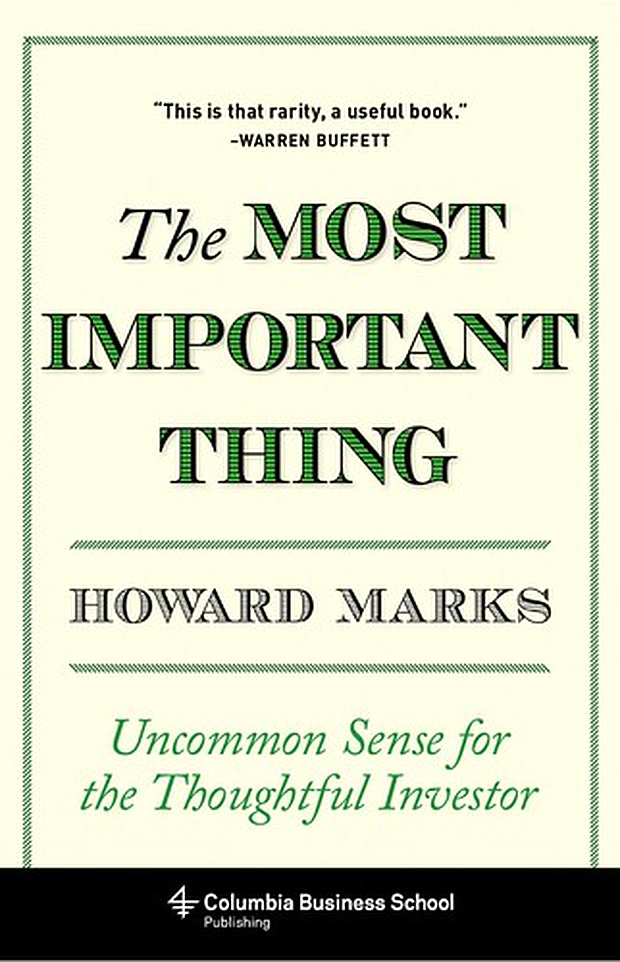
The Most Important Thing
Get on Amazon →
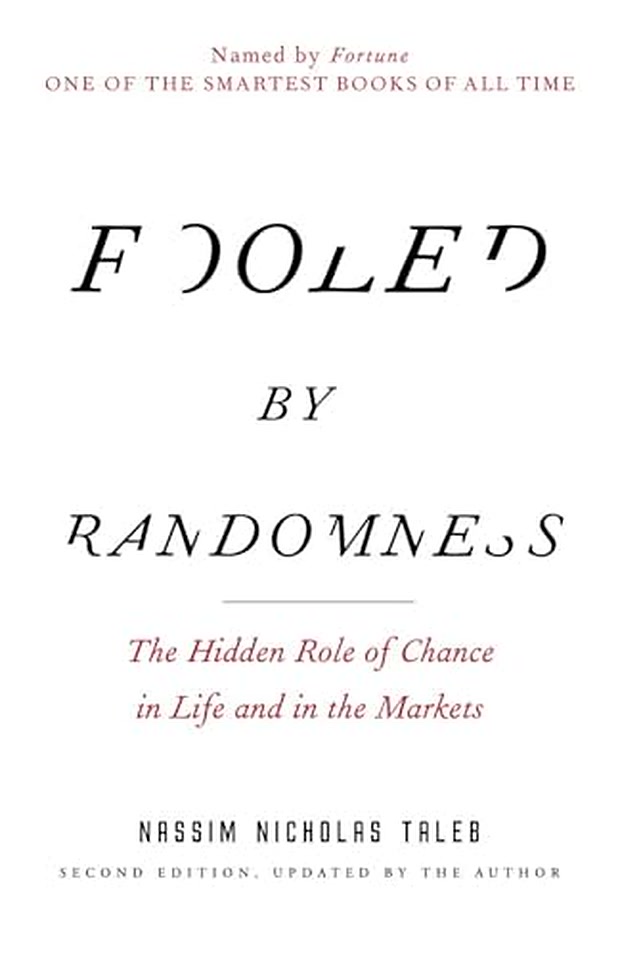
Fooled by Randomness
Get on Amazon →
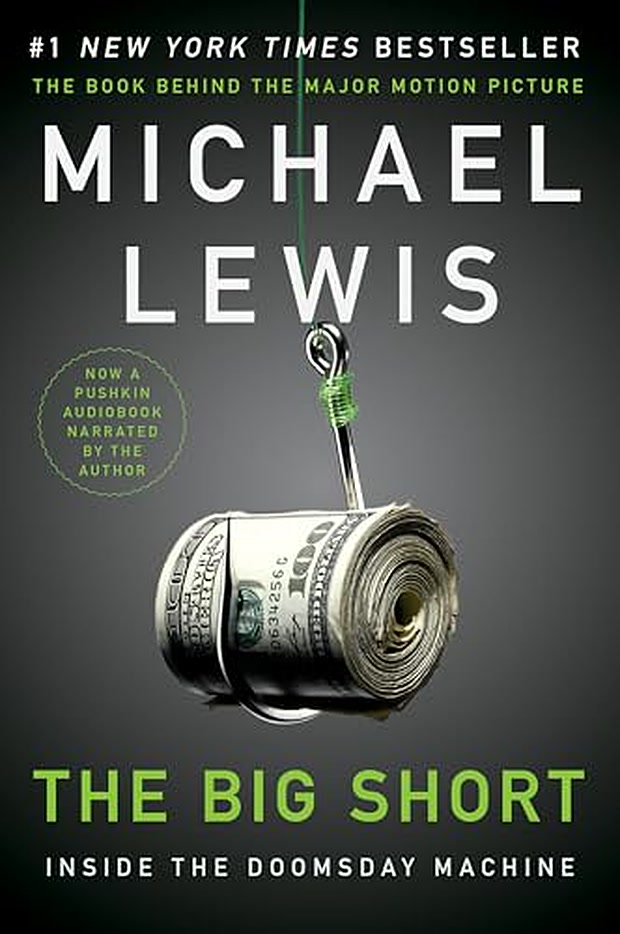
The Big Short
Get on Amazon →
As an Amazon Associate I earn from qualifying purchases.