Howard Marks
2007 02 14 The Race To The Bottom
© Oaktree Capital Management, L.P.
All Rights ReservedMemo to: Oaktree Clients
From: Howard Marks Re: The Race to the Bottom
UCheapening Money
If you make cars and want to sell more of them over the long term – that is, take
permanent market share from your competitors – you’ll try to make your product better.
(You might cut your prices or increase your a dvertising, but neither of those will work for
long if your cars are demonstrably inferior.) “Building a better mousetrap” should also be effective for sellers of toothpaste, com puters, televisions, magazines, movies and
dresses, or any other product that can be differentiated from its competitors. That’s why – one way or the other – most sale s pitches say, “Ours is better.”
However, there are products that can’t be differentiated, and economists call them
“commodities.” These are generic goods like gold, West Texas crude oil, pork bellies,
steel ingot, orange juice, el ectricity and telecommunications bandwidth. They’re goods
where no seller’s offering is much different from any other. They tend to trade on price
alone, and each buyer is likely to take the offering at the lowest delivered price. Thus, if you deal in a commodity and want to se ll more of it, there’s generally one way to
do so: cut your price. It’s fu tile to make claims for product superiority, and advertising is
unlikely to alter buying habits. Thus in order to gain market share, you have to make
your product cheaper than someone else’s.
It helps to think of money as a co mmodity just like those others. Everyone’s money is
pretty much the same. Yet institutions seeking to a dd to loan volume, and private
equity funds and hedge funds seeking to in crease their fees (see “The New Paradigm”),
all want to move more of it. So if you want to place more money – that is, get people
to go to you instead of your competitors for their financing – you have to make your
money cheaper. As with the other commodities, low price is the most dependable route
to increased market share. One way to lower the price for your money is by reducing the intere st rate you charge on
loans. A slightly more subtle way is to agree to a higher price for the thing you’re
buying, such as by paying a higher p/e ratio for a common stock or a higher total transaction price when you’re buying a company. Any way you slice it, you’re settling
for a lower prospective return. But there are other ways to cheapen your money, and they’re the primary subject of this memo.
© Oaktree Capital Management, L.P.
All Rights ReservedUCongratulations!
What else is there – besides return – that you can accept less of in order to
accelerate the pace at which you put out you r money? The answer is simple: safety.
So a provider of capital who wants to increase market share – that is, make a bigger percentage of the loans or investments that are made – will accept risks that others won’t. That’s another way to get the deal in stead of having it go to someone else.
I sometimes buy at auctions. When the biddi ng’s over, the aucti on house personnel come
up and say “congratulations.” I usually say, “On what? All I did is pay more than
anyone else would pay.” That’s how auctions work – most market mechanisms, in fact:
the deal goes to the person who’ll pay th e most for the goods (or, looked at
conversely, get the least for his money). The capital markets are no different .
Of course, when the subject is price, it’s obvious that the person who’s willing to pay the most wins the auction. It’s a little more subtle that, when it comes to quality and safety, the person who’ll accept the least is likely to be congratulated as the “winner.” Winner in
quotes, that is, because in putting out capital, the person who gets the deal is likely to
be a loser if he accepts a level of sa fety that turns out to be inadequate.
That leads me to one of my pet peeves. The “industry rags” in priv ate equity are devoted
almost exclusively to reporting who bought what company, with accounts of how competitors were outbid and innovative financin g arranged. But the articles should focus
instead on whether the price was right, and th e champagne should probably be kept on ice
until the company has been sold at a profit. Buying shows who was the highest bidder, not necessarily the smartest bidder.
(Let me hasten to point out he re that while I generalize as usual for simplicity and effect,
there are always exceptions. Oaktree routin ely gains admittance to deals because we
provide prompt commitments, certainty of clos ure, assistance in st ructuring and/or the
promise of constructive behavior should problems arise. But much of the time – especially today – deals go to the capital providers who’ll pay the most and/or accept the
least. We try to gain access to deal s by adding value, not by paying the most.)
UThe Auction’s On
While the last few years have given me many opportunities to marvel at excesses in the
capital markets, in this case the one that el icited my battle cry – “that calls for a memo” –
hit the newspapers in England during my last stay. As th e Financial Times reported on
November 1,
Abbey, the UK’s second-largest home loans provider, has raised the
standard amount it will lend homebuyers to five times either their single or
joint salaries, eclipsing the traditional borrowing levels of around three and a half times salary. It followed last week’s decision by Bank of
© Oaktree Capital Management, L.P.
All Rights ReservedIreland Mortgages and Bristol and West to increase standard salary
multiples from four to 4.5 tim
es.
In other words, there had been a traditiona l rule of thumb saying that borrowers can
safely handle mortgages with a face amount equal to three-plus times their salaries. But now they can have five times – roughly 50% more. What inference should be drawn?
There are at least four possibilities: 1. The old standard was too conservative, and the new one’s right;
2. Conditions have changed, such that the new st andard is as conservative for today as
the old one was for its times;
3. It’s reasonable for mortgage lenders to accept higher default experience, and thus
lower net returns, because their cost of capital has declined; or
4. The rush to place money has caused a supplier of capital to loosen its standards.
Now, I am no expert on the UK mortgage market, and it’s my intention in this memo to comment on general capital market trends, not an y one sector. Further, it’s certainly true
that today’s lower interest rates mean a gi ven salary can support a bigger mortgage (and
that’s likely to hold true so long as (1) borro wers keep their jobs and (2) their mortgages
carry fixed rates). But if you think Abbey’s reason for taking this step might be a logical one like that, the question to ask is “why now?”
Logical reasons and sober decision making might be involved here. But so might
competition to put out money and the usual la te-stage belief that “it’s different this
time.” Lenders and investors invariably depa rt from time-honored disciplines when
cycles move to extremes, out of a belie f that current condition s are different from
those that prevailed in the past, when those disciplines were appropriate. And just
as invariably, they’re shown that cycles repeat and nothing really changes.
What did we see in the U.S. mortgage market as home prices rose and interest rates
declined? First, low teaser rates. Then higher loan-t o-value ratios. Then 100%
financing. Then low-amortization loans. Then no-amortization loans. Then loans
requiring no documentation of employment or credit history. These things made it
possible for more buyers to stretch for more expensive homes, but at the same time they
made mortgages riskier for lenders. And these developments took place when home
prices were at sky-high and interest rates were at multi-generation lows. In the end,
buyers took out the biggest mortgage possible given their incomes and prevailing interest
rates. Such mortgages would land them in th e houses of their dreams . . . and leave them
there for as long as conditions didn’t de teriorate, which they invariably do.
Do you remember the game Bid-a-Note fr om the TV show “Name that Tune”?
Contestant x said, “I can name that tune in six notes.” Then contestant y said, “I can
name that tune in five notes.” Then contes tant x said, “I can name that tune in four
notes.” The contestant who eventually got th e chance to guess the name of the tune was
the one who was willing to accept the riskiest proposition – to try on th e basis of the least
information.
© Oaktree Capital Management, L.P.
All Rights Reserved
So the Bank of Ireland e
ntered the competition to lend money for home purchases and
said, “I’ll lend four and a half times the bo rrower’s salary.” And Abbey said, “I’ll lend
five times.” The so-called winner in this auction is the one who’ll put out the most
money with the least safety. Whether that’s really winning or losing will become clear
when the cycle turns, as it did in the U.S. la st year. But certainly there’s a race to the
bottom going on . . . a contest to become th e institution that’ll make loans with the
slightest margin for error. By the way, were the people who made those U.S. mortgages loans big losers? Defaults
spiked last year, but often the originators of the loans had escaped by selling the loans
onward to others, some of whom packaged them into mortgage-backed securities or
CLOs and sold them once again or borrowed ag ainst them on a non-recourse basis. Since
many of the people who make loans today flip them quickly, an aspect of “moral hazard”
has entered the equation, in which decision ma kers are insulated from the consequences
of their actions.
Any way you slice it, standards for mort gage loans have dropped in recent years,
and risk has increased. Logic-based? Perhaps. Cycle-induced (and exacerbated)?
I’d say so. The FT quoted John Paul Crutchley, a banking analyst at Merrill Lynch, as
saying “When Abbey are lending a multiple of fi ve times salary, that could be perfectly
sensible – or it could be tremendously ris ky.” Certainly mortgage lending was made
riskier. We’ll see in a few years whether that was intelligent risk taking or excessive
competitive ardor.
UEveryone’s Got a Favorite
A lot of Oaktree’s activit ies center around buying bonds, ma king loans and trying to
profit when debt that others hold goes bad. So who better than my colleagues for me to
turn to for examples of mistakes in the maki ng? I asked for exampl es of the race to the
bottom, and the response was immediate and s ubstantial. I won’t embarrass individual
issuers or borrowers by describing specific transactions; the names have been omitted to protect the guilty. But here are some of the themes our people told me about:
UHot potato U – There’s big money today in buying companies and then having them
borrow money with which to pay you a dividend, even if doing so reduces the
companies’ creditworthiness. Just a fe w years back, companies generally wouldn’t
have been able to issue bonds or loans where the projected use of proceeds was dividends to their equity ow ners. But since people are so eager to invest today,
they’ll lend to companies where much or all of the equity paid in – or maybe more than all of it – will be dividended out. They’re doing so on the expectation that they’ll be able to exit before risk turns into loss. “If things take a turn for the
worse, I’ll get out” is a refrain that accompanies most market excesses (tech
stocks in 1999 and condos in 2005 come immediately to mind), but rarely does it
turn out that way.
© Oaktree Capital Management, L.P.
All Rights Reserved
UHeads We Win/Tails You Lose U – Part of being willing to pay more for less relates to
the balance between upside pot ential, downside risk and who gets what. SPACs – or
Special Purpose Acquisition Companies, also known as “blank check companies” or
“blind pools” – seem like a good example of miscalibration. Peopl e put equity capital
into a SPAC with no certainty as to what will be done with it. The SPAC’s
“portfolio” is likely to consist of just one company. And the investors will get no
return on their money as long as it remains unspent, which can be up to 18 or 24 months. The sponsor, on the other hand, gets 20% of any profits, as there’s no
preferred return. It does so through warrant s, which it can liquidate even without
having sold the acquired company. And if it can’t make an acquisi tion, it just returns
the money without penalty – usually reduced by banking and other fees.
UNot My Problem U – One of the stories I was told pertained to a company whose
accounting problems had prevented it from issu ing audited financial statements for a
relatively long period of time. After the company went bankrupt, we were
determined to learn more about its accoun ting issues than anyone else and then
intelligently make a debtor-in-possession loan, through which we might gain ownership of the company. But before we could make the loan, someone else made
the company a better offer: more leverage on cheaper terms, with no provision for accounting due diligence. When later we were able to ask about why we had lost out,
we were told that one reason the other lend er was able to be more aggressive than
Oaktree was the fact that it had “pre-syndica ted” most of the loan to hedge funds.
This was accomplished in the absence of financial statements or accounting due
diligence, but with validation from the high trading price of the company’s public securities (which was being set, again, in a financial-statement void). Okay, so the lender’s risk was limited. But how a bout the funds that bought the loan?
UComplexity Outruns Analysis U – Wall Street is incredibly inventive. It’s staffed by
bright people, pursuing massive incentives, trying to out-think their competitors in
order to win assignments to serve companies’ financial needs. Sometimes this results
in structures that few people understand, fr aught with hidden risks. My latest
nominee is the CPDO, or Constant Proportion Debt Obligation. CPDOs provide capital to finance structured entities writing credit insurance on investment grade
debt. Because this debt entails little cred it risk, the returns that can be earned from
writing credit insurance on it are similarly low. Thus, these entitie s have to lever up
substantially – typically 15-to -1 – to provide the LIBOR+ 200 returns promised on the
bottom-tier CPDO. The rating agencies bestow triple-A ratings on the CPDOs
because (a) the riskiness of investment grade bonds is low and (b) the projected
interest spreads and the net asset values ini tially are far more than sufficient to satisfy
the covenants. But because the portfolios are so highly leveraged, these cushions can
evaporate quickly.
I find two things about CPDOs worthy of particular note. First, this is the first-loss equity piece beneath a highly leveraged entity where consequences can be triggered by breaches of income and market value covenants. Thus, the equity
© Oaktree Capital Management, L.P.
All Rights Reservedbeneath a portfolio of bonds averaging single-A, leveraged up 15-to1, gets a
triple-A rating. Huh? S
econd, as th e Financial Times wrote on November 13,
“if there are losses and the CPDO’s net asse t value begins to fall from its target,
the leverage is increased to try to earn more at a faster rate.” In other words, if
you did a little of something and it di dn’t work, try to recoup your losses by
doing a lot.
UWhat Due Diligence? U – The other day, Orin Kramer (see “Pigweed”) observed
skeptically that “the most profitable wa y to be a lender today is to have no
underwriting department.” In other words, default rates are too low, and the market is
too competitive, for credit analysis to be worth paying for. In December, Reuters
described a takeover bid whose competi tiveness was enhanced by a reduced due
diligence period and a short list of information requirements. And most interestingly, one of the major investment banks told us recently that on most syndicated loans,
about 70% of the buyers never visit the data rooms set up to facilitate due diligence.
UPut the Pedal Down U – FT.com pointed out on January 21 that, “One-tenth of the
capital committed [to private equity funds] in 2002 was . . . put to work within one
year. For funds invested in 2005, the corresponding proportion was almost 30
percent.” If the amount raised in 2005 was triple the 2002 level, as I believe was the case, that means private equ ity funds deployed capital in 2005 roughly nine times as
fast as they had in 2002.
No one of these is evidence of misfeasance or terminal laxness by itself. But together
they describe a market where a desire for quantity and speed has taken over from an
insistence on quality and caution. And with that insistence goes the margin of safety that
Warren Buffett urges investors to demand.
UThe Amazing Disappearing Covenant
Evaluating and negotiating covenants is an important part of the high yield bond investor’s job. The law says a company’s boa rd of directors has a fiduciary duty to its
shareholders, but generally speaking there is no analogous duty to cred itors such as banks
and bondholders. In fact, some companies behave as if they feel a responsibility to
actively take value from creditors and transfer it to the shareholders. Because companies
can do anything to creditors that isn’t prohibi ted by law or the bond indenture, covenants
are a key component in creditor safety.
It’s important to bondholders, for example, that the companies to which they lend money remain as little changed as possible. They want the creditworthiness they lend against to
still be there years down the ro ad, and strong covenants can do a lot to ensure that’s the
case. Bondholders can’t prevent problems in the economy, the company’s markets, its products’ competitiveness or its executive suite . But with good covenants, they can put
limits on leverage, acquisitions, cash distributions or asset transfers, and they can tighten financial tests and insist on rights that will be triggered if cash flow falls below a
© Oaktree Capital Management, L.P.
All Rights Reservedspecified mu
ltiple of the company’s indebtedness or interest obligation. On the other
hand, just as people who are eag er to buy bonds can increase th eir chances of being able
to do so by accepting less interest, they also can do so by settling for weaker covenants.
When credit markets are tight and providers of capital are reticent, money can be hard to come by. Companies’ demand for financi ng can exceed the supply, putting negotiating
power in the hands of the lenders. Thus le nders can insist on – and obtain – strict
covenants, and bonds issued in such an e nvironment are likely to be relatively safe.
But when usually disciplined bond buyers have to compete against others who aren’t
acting in a disciplined fashion, their ability to insist on co venant protection goes out the
window. In economics, Gresham’s Law says “b ad money drives out good.” That’s why,
when paper money joined gold as legal tender , gold was put in the strongbox rather than
spent, and only paper money circulated. The same thing happens in the investing world:
bad investors drive out good . When undisciplined investors are out there with lots of
money to get rid of, there’s less scope for disciplined investors to insist on strong covenants. That’s why the level of covenant protection is a good barometer of the market
climate. Covenants are the province of a special breed of analysts who are wi lling to “sweat the
details” and able to make sense of paragr aph-long, highly techni cal sentences. “A
Review of Covenant Trends in 2006” by Adam B. Cohen is no less challenging reading.
It reviews last year’s trends in a number of complex indenture pr ovisions, but I’ll limit
myself to quoting its general conclusions:
For years, investors have periodically lamented the declining quality of
high yield bond covenants but the trends have become especially pronounced amidst a flurry of leverage d buyout (LBO) financings . . . . a
careful review of covenant packages – particularly in sponsor-backed [i.e.,
LBO] offerings – during 2006 reveals a systematic dismantling of longstanding covenant protections . . .
And as Reuters reported on February 6, St andard and Poor’s added the weight of
its opinion:
While credit quality is under even greater pressure, the amount of cash on
offer has meant private equity sponsors have been able to dilute lenders’
rights through weaker covenants an d loan documentation, [S&P] said.
“Loan structures have become so borrow-friendly that private equity
sponsors can write their own term sheets, using their last term sheet as the
template for their next.”
And, in our view, that template usually se rves as the starting point for the next
round of erosion of covenants and terms.
© Oaktree Capital Management, L.P.
All Rights ReservedUEffects Short-Term and Long
In the short term, the effect of generous capital market conditions is to make more
money available to more companies for mo re reasons, at lower rates of interest
and with fewer covenants. This leads to higher levels of acquisitions, buyouts and
corporate expansion (not to mention rapid recapitalizations of buyout companies and thus high short-term rates of return). In the short run, this contributes to a
high level of genera l financial activity.
Another effect is to forest all financial stringency at weak companies. When
lenders are strict and covenants are tight, operating problems can lead quickly to both technical defaults (violations of covenants) and “money defaults” (non-
payment of interest or principal). But looser conditions can permit default to be
forestalled: if covenants ar e lax; if borrowers have the option to convert cash-pay
bonds into payment-in-kind bonds (thr ough a recent innovation, “toggle bonds”);
or if they can raise money and thus postpone the day of reckoning. Eventually, one would think, many of the forestalled defaults will demonstrate
their inevitability, with the companies falling from more highly leveraged heights.
And certainly the capital markets’ willi ngness to finance less-than-deserving
companies will lead ultimately to a higher level of corporate distress. Thus,
everything else being equal, the bigger the boom – the greater the excesses of
the capital markets in the upwar d direction – the greater the bust. Timing
and extent are never predictable, but the o ccurrence of cycles is the closest thing I
know to inevitable. And usually, the air go es out of the balloon a lot faster than it
goes in.
* * *
Today’s financial market conditions a re easily summed up: There’s a global
glut of liquidity, minimal interest in tr aditional investments, little apparent
concern about risk, and skimpy prospective returns everywhere. Thus, as
the price for accessing returns that are potentially adequate (but lower than
those promised in the past), investors are readily accepting significant risk in the form of heightened leverage, untested derivatives and weak deal
structures. The current cycle isn’t unusual in its form, only its extent. There’s
little mystery about the ultimate outcome, in my opinion, but at this point in the
cycle it’s the optimists who look best.
As is often the case, I could have made this a shorter memo by simply invoking
my two favorite quotations, bot h of which have a place here.
The first is from John Kenneth Galbraith, who passed away last year. I was fortunate to
be able to spend a few hours with Mr. Galbraith a year and a half ear lier and to have the
© Oaktree Capital Management, L.P.
All Rights Reservedbenefit of his wisdom firsthand. This quot e, however, is from
his invaluable book, “A
Short History of Financial Euphoria.” It seems particularly apt under the current
circumstances:
Contributing to . . . euphoria are two fu rther factors little noted in our time
or in past times. The first is the extreme brevity of the financial memory. In consequence, financial disaster is quickly forgotten. In further
consequence, when the same or closely similar circumstances occur again, sometimes in only a few years, they are hailed by a new, often youthful,
and always supremely self-confident ge neration as a brilliantly innovative
discovery in the financial and larger economic world. There can be few
fields of human endeavor in which hist ory counts for so little as in the
world of finance. Past experience, to th e extent that it is part of memory at
all, is dismissed as the primitive refuge of those who do not have the insight to appreciate the incred ible wonders of the present.
The second is Warren Buffett’s bedrock reminder of the need to adjust our financial actions based on the investor behavior playing out around us. Fewer words, but probably even more useful:
The less prudence with which others conduct their affairs, the greater the
prudence with which we should conduct our own affairs.
This memo can be summed up simply: th ere’s a race to the bottom going on,
reflecting a widespread reduction in the leve l of prudence on the part of investors
and capital providers. No one can prove at this point that those who participate will
be punished, or that their long-run performa nce won’t exceed that of the naysayers.
But that is the usual pattern.
If you refuse to fall into line in carefree market s like today’s, it’s likely that, for a while,
you’ll (a) lag in terms of return and (b) look like an old foge y. But neither of those is
much of a price to pay if it means keeping your head (and capital) when others eventually
lose theirs. In my experience, times of la xness have always been followed eventually by
corrections in which penalties are imposed. It may not happen this time, but I’ll take that
risk. In the meantime, Oaktree and its people will continue to appl y the standards that
have served us so well over the last twenty years.
February 14, 2007
© Oaktree Capital Management, L.P.
All Rights Reserved 10Legal Information and Disclosures
This memorandum expresses the views of the author as of the date indicated and such views are
subject to change without notice. Oaktree has no duty or obligation to update the information contained herein. Further, Oaktree makes no rep resentation, and it should not be assumed, that
past investment performance is an indication of future results. Moreover, wherever there is the
potential for profit there is also the possibility of loss. This memorandum is being made available for educational purposes only and should not be used
for any other purpose. The information contai ned herein does not constitute and should not be
construed as an offering of advisory services or an offer to sell or solicitation to buy any
securities or related financial instruments in any jurisdiction. Certain information contained herein concerning economic trends and performan ce is based on or derived from information
provided by independent third- party sources. Oaktree Capita l Management, L.P. (“Oaktree”)
believes that the sources from which such informa tion has been obtained are reliable; however, it
cannot guarantee the accuracy of such inform ation and has not independently verified the
accuracy or completeness of such information or the assumptions on which such information is
based. This memorandum, including the information cont ained herein, may not be copied, reproduced,
republished, or posted in whole or in part, in any form without the prior written consent of
Oaktree.
Recommended Reading
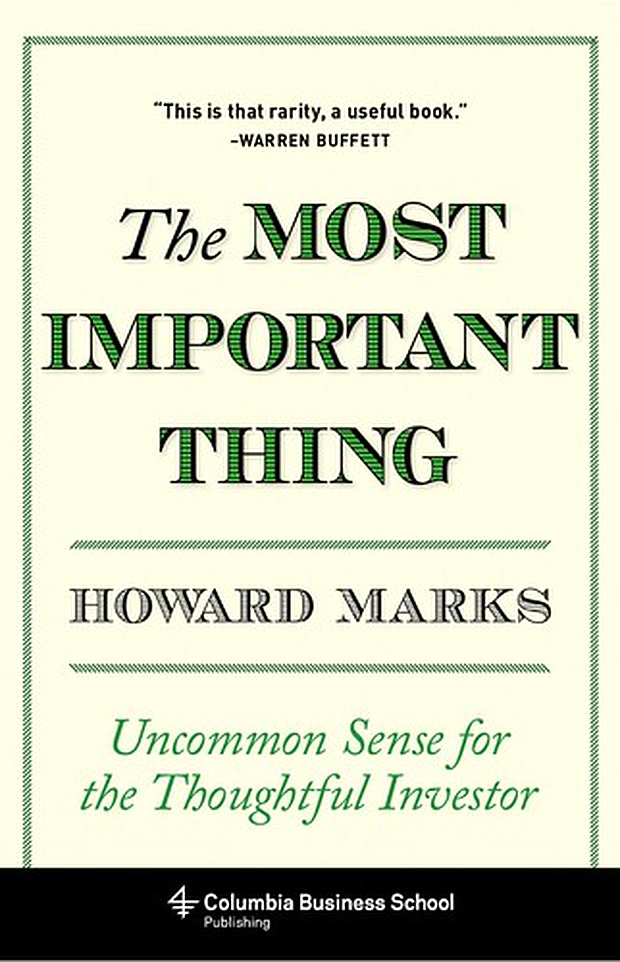
The Most Important Thing
Get on Amazon →
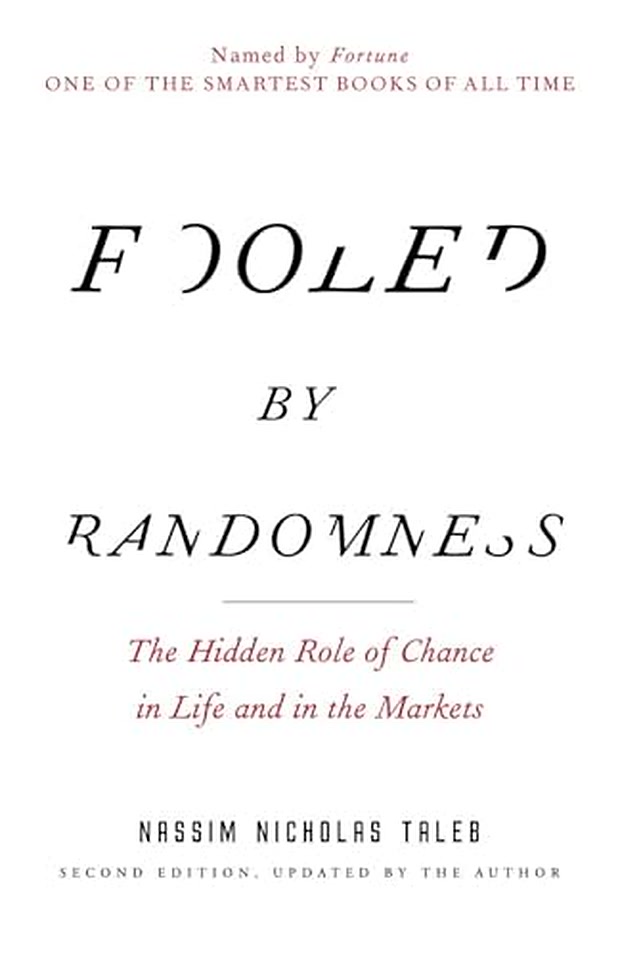
Fooled by Randomness
Get on Amazon →
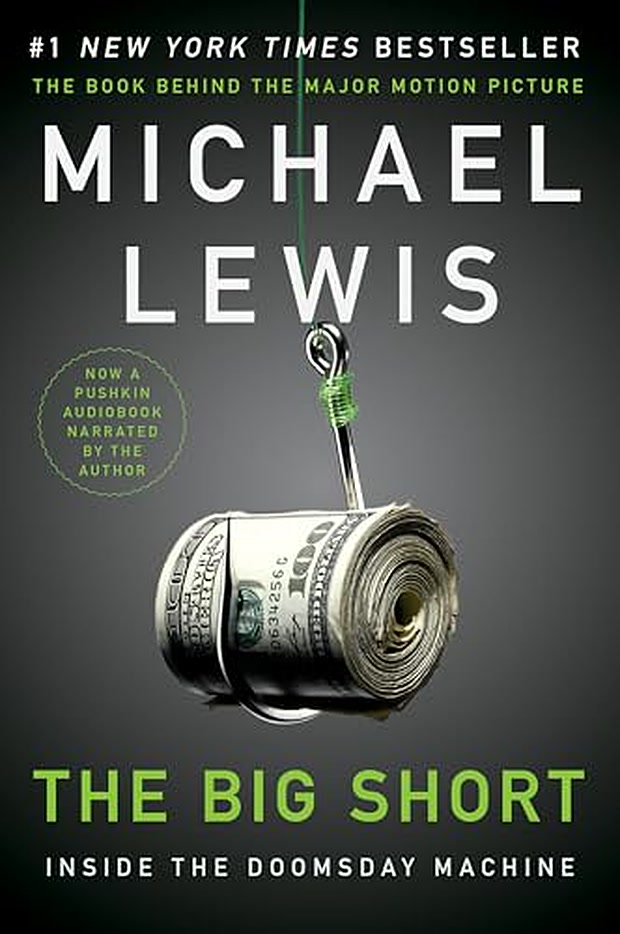
The Big Short
Get on Amazon →
As an Amazon Associate I earn from qualifying purchases.