Howard Marks
2006 03 27 It Is What It Is
© Oaktree Capital Management, L.P.
All Rights ReservedMemo to: Oaktree Clients
From: Howard Marks Re: It Is What It Is
My first exposure to the phrase that serves as the title for this memo came in 1995, a few days
before Oaktree opened its doors. My partners and I wracked our brains over whether we’d
covered every base. We asked our attorney, Peter Ostroff of Sidley & Austin, if he thought we’d missed anything. Peter’s answer was succinct an d on target as usual: “It is what it is.”
In the March 5 edition of The New York Times, William Safire devoted the Sunday Magazine’s
“On Language” column to “it is what it is.” He mentioned that the firs t use he could find had
been in 1949, and that the phrase had been adopt ed for movie and song titles in the last few
years. I was shocked when I checked Google and found 4.2 million references!
According to Safire, there is no one definitive meaning for the phrase. It can serve as the equivalent of the politician’s “no comment.” It can be used to e xpress “philosophical resignation
over a disappointment.” Or it can be “a mild put- down, as if to say, ‘That’s all you can expect.’”
Safire concluded his column w ith another possible meaning: “ que sera sera” (what will be will
be), which was the title of a hit song by Doris Day when I wa s ten. But that interpretation
suggests a fatalism and inability to affect the outcome that I don’t asso ciate with the phrase.
I took Peter’s use of the phrase in 1995 – and I’ m using it in this memo – to mean something
very different: recognition and acce ptance of today’s givens . . . but not necessarily of the end
result. What’s past is past and can’t be undone. It has led to the circumstances we now face. All
we can do is recognize our circumstances for wh at they are and make the best decisions we
can “given the givens.”
URoots in Philosophy
In the mid-’60s, Wharton students had to ha ve a non-business minor, and I satisfied the
requirement by taking five course s in Japanese studies. These surprised me by becoming the
highlight of my college career and contributing to my investment philosophy in a major way.
Among the values prized in early Japanese culture was mujo . Mujo was defined classically for
me as recognition of “the turning of the wheel of the law,” implying acceptance of the inevitability of change , of rise and fall.
This sense of accepting and “going with” the environment and the changes that take place there – rather than insisting that it st ay the same and attempting to impose our will on it – was captured
for me in a quotation from Lao-Tzu (I found it in the March letter from Rimrock Capital, which
Paul Westhead left Oaktree in 2004 to head):
© Oaktree Capital Management, L.P.
All Rights ReservedTo be strong you have to be like water: if there are no obstacles, it flows; if there
is an obstacle, it stops; if a dam is broke n, then it flows further; if a vessel is
square, then it has a square form
; if a vessel is round, then it has a round form;
because it is so soft and flexible, it is the most necessary and the strongest thing.
In other words, mujo means cycles will rise and fall, things will come and go, and our
environment will change in ways beyond our control. Thus we must recognize, accept, cope
and respond. Isn’t that the essence of investing?
UCoping With Cycles
In the world of investing, (as you’ve heard me say many times) nothing is as dependable as
cycles. Fundamentals, psychology, prices and returns will rise and fall, presenting opportunities to make mistakes or to profit from the mi stakes of others. They are the givens.
We cannot know how far a trend will go, when it will turn, what will make it turn, or how
far things will then go in the opposite direction. But I’m confident that every trend will stop
sooner or later. Nothing goes on forever. Tr ees don’t grow to the sky, and neither do many
things go to zero and stay there. Success carries within itself th e seeds of failure, and failure the
seeds of success.
So what can we do about cycles? If we can’t know in advance how and when the turns will
occur, how can we cope? On this, I am dogmatic: We may never know where we’re going, but we’d better have a good idea where we are. That is, even if we can’t predict the timing
and extent of cyclical fluctuations, it’s essentia l that we strive to asce rtain where we stand in
cyclical terms and act accordingly.
UWhat Can We Know, and How?
Even without knowing where we’re going and when, we can deduce lots of valuable information
about our investment environment. First, where do we stand in the economic cycle? Is the economy severa l years into a recovery
that may be due for a rest? Has it leveled out and begun to weaken? Or has it been weak enough
long enough that we can reasonably expect recession to give way to recovery?
Second, how have the markets been performing? Have they been weak for years, possibly
pushing prices to bargain basement levels? Or have they been so strong that we should suspect (1) the positives have been fully discounted, (2) several years of potential gains have been
accelerated into the returns to date, and (3 ) assets today are “priced for perfection”?
Finally, and often most important, how are people around us behaving? If they’re chastened
by losses and afraid of the future , there’s reason for us to be op timistic. If they’re unworried and
complacent, that’s something we should worry about. In the words of my favorite Buffettism,
© Oaktree Capital Management, L.P.
All Rights Reserved“The less prudence with which others conduct their affairs, the greater the prudence with which
we should conduct our own affairs.”
Imagine we ran into a visitor from
Mars who observed, “I see your economy and markets have
been doing well for years. Everyone’s making a t on of money. No one’s expressing worry or a
desire to avoid risk. P/E rati os, buyout prices and private equity leverage ratios are all high.
Stock buybacks and dividend recaps are adding to leverage and reducing creditworthiness.
Conferences on hedge funds and priv ate equity are sold out. Top- performing funds are closed to
newcomers and new ones start up every day, fully s ubscribed. The Greenwich Ferrari dealer has
a waiting list a year long.” Nothing in our favorite Martian’s st atements sounds like a prediction. In fact, he hasn’t said
one word about the future. But there’s a lot of helpful information there. My guess is valuable
inferences could be made about wh at’s likely to happen next. If he can see it, so should we.
And having seen it, we should take appropriately cautious action.
And the reverse can also be true (although it’s no t something I dwell on most of the time or at
what I think is today’s point in the cycle). If that Martian came down and saw nothing but weak
recent returns, widespread disillusionment, disi nterest in investing and people waiting for the
smoke to clear before they’ll comm it, we’d probably conclude it’s ti me for us to step on the gas.
0BUWhat to Do
There are few fields in which decisions as to stra tegies and tactics aren’t influenced by what we
see in the environment. Our pressure on the ga s pedal varies depending on whether the road is
empty or crowded. The golfer’s choice of cl ub depends on the wind. Our decision regarding
outerwear certainly varies with the weather. Shouldn’t our investment actions be equally
affected by the investing climate?
Most people strive to adjust their portfolios based on what they think lies ahead. At the
same time, however, most peop le would admit forward visibili ty just isn’t that great.
That’s why I make the case for responding to the current realities and their implications, as
opposed to expecting the future to be made clear.
In November 2004 I wrote a memo entitled “Risk and Return Today.” Its thesis was that in most asset classes, prospective returns were low and ri sk premiums were skinny. On that basis, I
urged investors to act accordingly, hold reasonab le expectations and – es pecially – decline to
stretch for higher returns by taki ng on more risk. The conclusi ons are just as clear today:
When high returns are not in prospect, we shouldn’t invest as if they are.
When safe investments appear unlikely to provi de the returns we need, we shouldn’t rush to
riskier investments to get them.
This is especially true when the reward for taking incremental risk is skimpy.
It’s as simple as that. We can’t expect high returns when the market doesn’t offer them.
Prices won’t fall to levels from which high returns can be expected if most investors are
© Oaktree Capital Management, L.P.
All Rights Reservedwilling to se
ttle for less. To quote Peter Bernstein, “The market’s not a very accommodating
machine; it won’t provide high retu rns just because you need them.”
My bottom line, as they might say in the self-help books: Listen to your inner Martian.
What’s going on usually isn’t that big a myster y. An overheated environment doesn’t mean the
market’s going down tomorrow, just as an excess of risk aversion doesn’t signal it’s the absolute
bottom. But the circumstances should inform our behavior. Simply observing what’s going on
around you and acting accordingly should improve your investment results.
And the distinctions needn’t be cut too fine. There can be lots of room for argument between
“undervalued” and “fairly valued,” or between “f airly valued” and “overvalued” – that’s where
most of the uncertainty lies. But it’s unlikely th at disciplined investors will find it hard to choose
between overvalued and undervalued. In my opinion, if you’re wracking your brain trying to
figure out whether something’s overvalued or fairly valued – that is, whether you should sell or
continue to hold – it’s usually pretty clear that it’s not a buy.
1BUWhat Is Going On Around Us Today?
No one I know thinks investors today are acting out of an ex cess of caution, and I agree.
Investors have forgotten the losses in stocks, corporate bonds and ventur e capital earlier this
decade and consider this a low-risk world (or at least one where risk is clearly worth taking).
Mark Cutis of Shinsei Bank sent me his memo entitled, “Market of no fear!” I think that’s an apt
description.
There’s no reason to think today’s environment implies high future retu rns. Whether it’s
high P/E ratios, high transaction multiples in buyouts, low bond yields or low capitalization
rates on real estate (and certainly all of these are interrelated), few markets appear to offer
bargains.
People are reporting big gains from private equity and real estate assets they bought cheap in the
past, levered up in accommodating capital markets and sold at very high prices (read: low prospective returns). But fewer people can claim to be buying in on the cheap today. A great deal of what’s happening is related to a glut of capital for investment in non-mainstream
asset classes. With no one interested in buying mo re high grade bonds at yiel ds near 5% or U.S.
stocks with consensus expected re turns of 5-7% or so, capital is bypassing those big markets – or
perhaps exiting them – and flocking to the sma ller alternative markets, raising prices. I
understand why people who need 8% or more are looking there for help, but that doesn’t do
much for the likelihood they’ll get what they’re after. (More on this later.)
The skinniness of today’s risk premiums can be observed most clearly in the high yield bond
market, where prospective returns can be calcula ted with precision and yield spreads are in the
vicinity of historic lows, and in certain real estate markets, where actual cash returns are
similarly low. But the difficulty of quantifying pr ospective returns in public and private equity
doesn’t mean the offerings there are any le ss paltry. And, as Alan Greenspan said, “. . . history
has not dealt kindly with the aftermath of protracted periods of low risk premiums.”
© Oaktree Capital Management, L.P.
All Rights Reserved
This is a time for caution, not aggressiveness. Fo r reaping m
ore than sowing. I said it 16 and 34
months ago, and returns in many US markets have been paltry since. Some alternative
investment returns have been quite good, but high realized returns must never be confused
with great opportunities to invest more. High past returns don’t imply high future returns;
more likely, they’ve borrowed from the future.
2BUThe Poor Man’s Guide to Market Assessment
Here’s a simple exercise: I have listed below a nu mber of market characteristics. For each pair,
check off the one you think is most descriptive of today. And if you find that most of your
checkmarks are in the left-hand colu mn, as I do, hold on to your wallet.
Economy: Vibrant Sluggish
Outlook: Positive Negative
Lenders: E a g e r R e t i c e n t
Capital markets: L o o s e T i g h t
Capital: Plentiful Scarce
Terms: E a s y R e s t r i c t i v e
Interest Rates: L o w H i g h
Spreads: Narrow Wide
Investors: Optimistic Pessimistic
Sanguine Distressed Eager to buy Uninterested in buying
Asset owners: Happy to hold Rushing for the exits
Sellers: F e w M a n y
Markets: Crowded Starved for attention
Funds: Hard to gain entry Open to anyone
New ones daily Only the best can raise money
GPs hold the cards on terms LPs have bargaining power Recent performance: Strong Weak
Asset prices: H i g h L o w Prospective returns : L o w H i g h
Risk: H i g h L o w
Popular qualities: Aggressiveness Caution and discipline Broad reach Selectivity The right qualities : Caution and discipline Aggressiveness
Selectivity Broad reach Available mistakes: Buying too much Buying too little
Paying up Walking away Taking too much risk Taking too little risk
© Oaktree Capital Management, L.P.
All Rights Reserved3BUAn Inefficient Market in Investment Advice
Bruce Karsh and I recently had an opportunity to sit down to lunch with Charlie Munger. As
usual, our conversation was most enjoyable, straying over a large num ber of topics. I think a few
of them – plus some comments from Warren Buffe tt’s latest annual report – can be woven into
something of relevance to this memo and of interest to you. Bruce started off by observing that with practic ally everyone able to start up a billion dollar
hedge fund, and with the leading private equity managers able to raise funds of $10 to $15 billion, jobs in those fields are in great demand as the way to get rich quick. It occurred to me
that if large numbers of people are convinced that a given field is sure to give them instant
wealth, something must be wrong. That’s a “bubble expectation.” Getting rich – if it can be
accomplished at all – is supposed to come from some combination of proven skill, hard work, risk bearing and luck. No one s hould be able to count on it, and es pecially not in the short run.
And given the operation of market forces , such an opportunity shouldn’t last long.
Then I remembered that for decades I’ve argued that exceptional risk-adjusted returns can only
be achieved in inefficient markets, and even then not all the time or by everyone. And by
“inefficient markets,” I’ve always meant markets where mistakes are being made. So if large
numbers of alternative investment managers and would-be managers are planning on
getting rich quick, the investment management market must be inefficient: they and/or
someone else must be making a mistake. Who else could it be? Maybe it’s their clients.
Today, as everyone knows, funds can be raised ea sily and at sizes no one imagined just three
years ago. But assets are no longer as cheap as th ey used to be, interest rates are no longer as
low, and the economic recovery isn’t as young. I recently heard a speech in which a top buyout
manager said his fund’s goal (per my memory) is to buy companies at fair prices and make them
worth more. In the past, he might’ve said they tried to buy companies cheap. On the plus side of the ledger for private equ ity, managers think more like owners than do many
public company boards; are substantially incentivi zed to see the funds’ assets appreciate; and
have the potential to improve their previously undermanaged companies. On the negative side,
however, the three of us noted th at clients are currently entrusting record amounts of money to
these managers, along with management fees bi g enough to allow the managers to get rich
without making successful investment s, as well as a share in tr ansaction fees that have the
potential to put the interests of fund ma nagers and their cl ients in conflict.
I believe the investors in these f unds feel they’ll be happy if they can earn net returns in the very
low double digits. The modest natu re of their aspirations stems fr om the juxtaposition of (a) the
perceived inadequacy (mentioned earlier) of the prospective returns on mainstream stocks and bonds, (b) the large sums some institutions have to invest, and (c) the 8% -or-better returns that
pension funds and endowments must achieve if th ey are to continue business as usual. This
combination makes it imperative that they comm it to alternative investments and hedge funds,
and thus tilts the balance of bargaining power over fees to the fund managers. This, in turn, decreases the likelihood that terms w ill be designed to maximize the clients’ interests. It also can
give the managers amounts of capital that pose a problem.
© Oaktree Capital Management, L.P.
All Rights ReservedIn his letter discussing Berk shire Hathaway’s 2005 performa nce, W
arren Buffett tells the
priceless story of the Gotrocks family, which owns all the corporations in America and earns all
the profits. Over time, individual family me mbers are approached by broker-Helpers, manager-
Helpers and consultant-Helpers, who promise to help them make money (for a fee) by buying
certain pieces of the empire from their relatives and selling them others. Eventually they also
hook up with hyper-Helpers, wearing uniforms saying “Private Equity” and “Hedge Fund,” who levy success fees on top of their other charges. It’s clear that the coll ective efforts of all the
Helpers in shuffling assets among Gotrocks family members are unlikely to increase the family’s
overall wealth (just as is true when companies are sold from one private equity fund to another).
At the same time, whether they’re successful or not, the costs involved in trying will cause a
substantial transfer of wealth from the Gotrocks to their “Helpers.” But that’s the way it is.
In April 1998 I observed in “Views on Altern ative Investments” that some good performing
managers might choose to “appropriate for themse lves a bigger portion of their funds’ superior
returns.” This is natural and happens in all businesses where the product is in strong demand.
But that doesn’t mean buyers should ignore it when it occurs. I’m not saying alternative investments and hedge f unds won’t provide the returns clients need, or
that people shouldn’t invest in them. But realistically assessin g the demand for these funds, the
amounts of money going into them, the market conditions for the underlying asset classes and
the deals the managers are able to cut for themse lves might cause would-be investors to conclude
the silver bullet still hasn’t been invented. Participate in alternative investments if you want –
in fact, Oaktree hopes you’ll keep doing so – but do it with your eyes open.
Charlie ended the lunch by urging us to create reasonable expectations among our clients and
treat them well. We promised to try.
* * *
None of us can individually influence economic or market conditions. Neither, I think, can we
accurately see what lies ahead. But it’s possible to derive in ferences from the recent past and
the present that improve our judgme nts and actions regarding the future. It’s simply
essential that we be aware of what’s going on around us. After all, who can argue with the
statement “it is what it is”? Facing up to reality is what Warre n Buffett’s doing when he says “We used to find it easy to buy
dollars for fifty cents. Today we’re trying hard to find dollars we can buy for eighty cents.” (He
also told me he has an 800 number for anyone who knows where 80-cent dollars can be found.)
Recognizing and accepting these things when th ey’re true isn’t pleasa nt, but there is no
prudent alternative.
Oaktree tries hard to take not e of prevailing market conditions, communicate what’s going on
and behave as contrarians. We try to raise bigger funds and buy more aggressively when we think others are leaving bargains on the table and do the opposite wh en they’re not. It doesn’t
always work, but it usuall y beats the alternative.
March 27, 2006
© Oaktree Capital Management, L.P.
All Rights Reserved 8Legal Information and Disclosures
This memorandum expresses the views of the author as of the date indicated and such views are subject to
change without notice. Oaktree has no duty or obligation to update the information contained herein. Further, Oaktree makes no representation, and it should not be assumed, that past investment performance is an indication of future results. More over, wherever there is th e potential for profit there
is also the possibility of loss. This memorandum is being made av ailable for educational purposes only and should not be used for any
other purpose. The information contained herein do es not constitute and should not be construed as an
offering of advisory services or an offer to sell or solicitation to buy any securities or related financial
instruments in any jurisdiction. Certain inform ation contained herein concerning economic trends and
performance is based on or derived from informatio n provided by independent third-party sources.
Oaktree Capital Management, L.P. (“Oaktree”) believes that the sources from which such information has been obtained are reliable; however, it cannot g uarantee the accuracy of su ch information and has
not independently verified the accuracy or completeness of such information or the assumptions on which
such information is based.
This memorandum, including the information cont ained herein, may not be copied, reproduced,
republished, or posted in whole or in part, in an y form without the prior written consent of Oaktree.
Recommended Reading
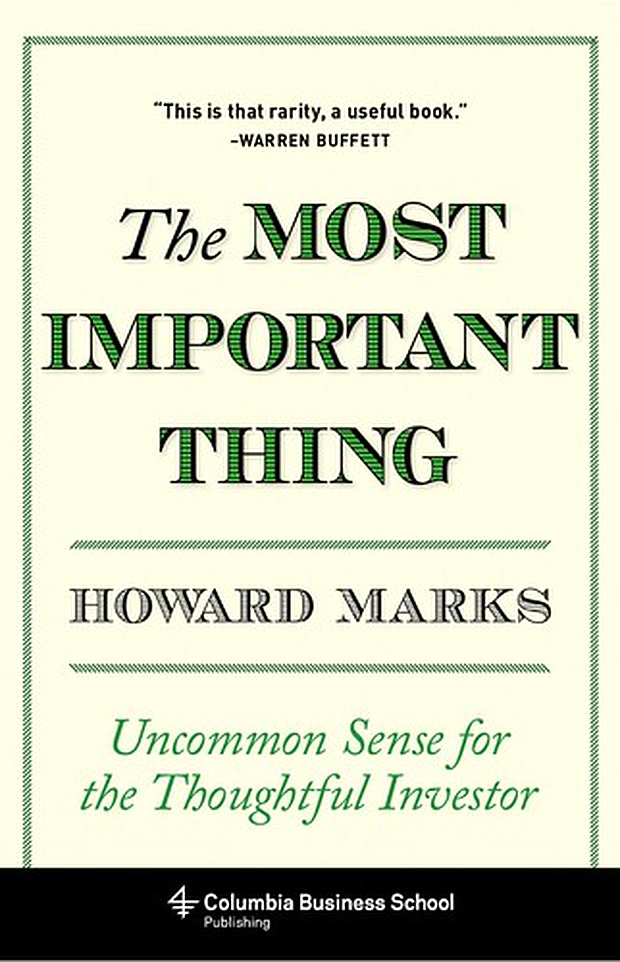
The Most Important Thing
Get on Amazon →
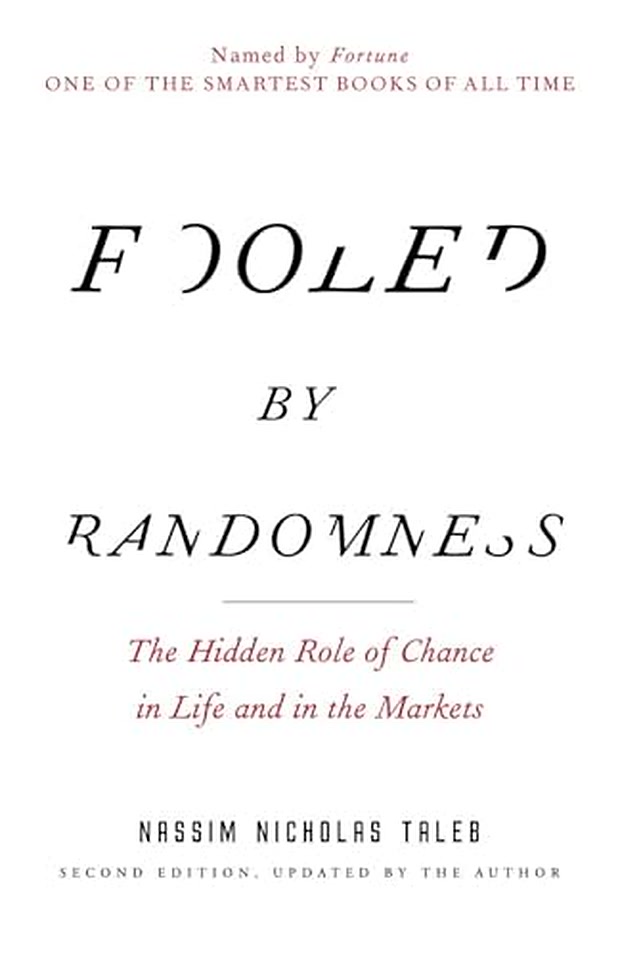
Fooled by Randomness
Get on Amazon →
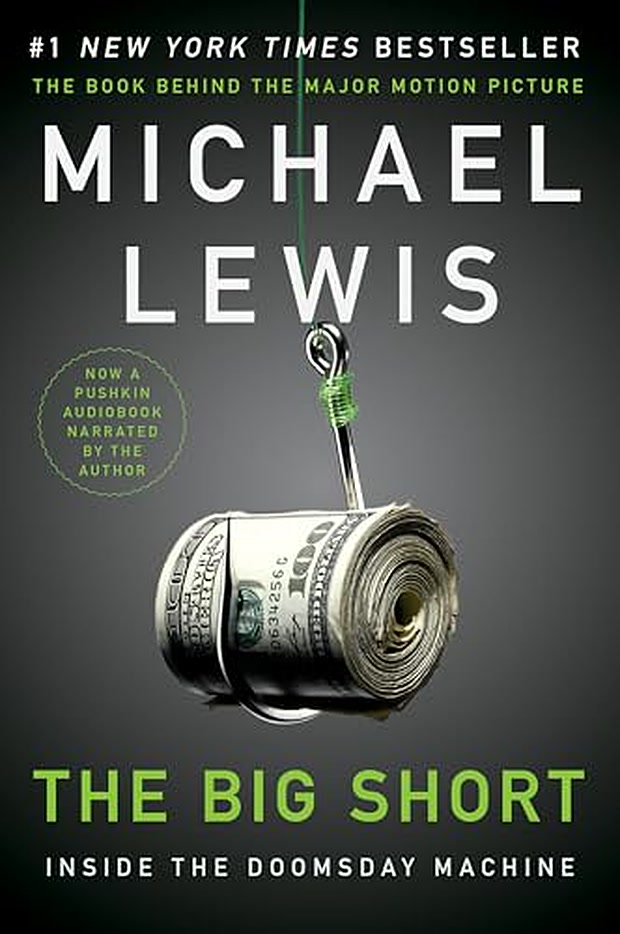
The Big Short
Get on Amazon →
As an Amazon Associate I earn from qualifying purchases.