Howard Marks
2005 10 17 Hindsight First Please Or What Where They Thinking
© Oaktree Capital Management, L.P.
All Rights ReservedMemo to: Oaktree Clients
From: Howard Marks Re: Hindsight First, Please (o r, What Were They Thinking?)
“The farther backward you can look, the farther forward you can see.”
– Winston Churchill
I often cite John Kenneth Galbraith’s observation that one of the outstanding hallmarks of the financial world is “the extreme brevity of the financial memory.” Investors lose
money over and over because they simply forget that cycles are inevitable and there’s no
such thing as a free lunch. Now I’ve f ound a great quotation from Churchill, also
reminding us that foresight comes largely from awareness of history. Along similar lines, I’m struck by the extent to which a related factor, inadequate
skepticism, also contributes to investment lo sses. Getting the most out of a book, play or
movie usually requires “willing suspension of disbelief.” We’re glad to overlook the occasional plot glitch, historical inaccuracy or physical impossibility because it increases
our enjoyment. When we watch Peter Pan, we don’t want to hear the person sitting next
to us say, “I can see the wires” (even t hough we know they’re there). While we know
boys can’t fly, we don’t care; we’re just there for fun.
But our purpose in investing is serious, not fun, and we must constantly be on the lookout
for things that can’t work in real life. In short, the process of i nvesting requires a strong
dose of disbelief. Time and time again, the post mortems of financial debacles
include two classic phrases: “It was too good to be true” and “What were they
thinking?” I’m writing to explore why thes e observations are so often invoked in
the past tense.
The combination of greed and optimism repeatedly leads people to purs ue strategies they
hope will produce high returns without high risk; pay elevated prices for securities that
are in vogue; and hold things after they have become highly priced in the hope there’s
still some appreciation left. Afterwards, hindsight shows ev eryone what went wrong: that
expectations were unrealistic and risks were ignored. It is my point that:
Investors mustn’t dwell exce ssively on recent experience.
Instead, they must look to the future.
They must consider today’s developments critically.
That assessment must take place in the light of history’s lessons.
© Oaktree Capital Management, L.P.
All Rights ReservedAll too often
, investors’ interest in the past is limited to the last few months or perhaps a
year or two. They look unskeptically, are da zzled by the high returns they see, and jump
aboard for more of the same. But they usua lly fail to consider l onger-term history, which
would show that “free lunches” never last fo rever. When the check ultimately comes in
the form of losses, there’s surprise and disappointment that could have been avoided.
Time after time when I read about trends being taken to excess – and later, when the
painful consequences become clear – I find myself asking what they could have been
thinking. The alpha that’s so much in demand tod ay is really the ability to see ahead
to things others will see only afterwards, in the rearview mirror. The people of
Oaktree spend a lot of thei r time figuring out what might be the next mistake and
preparing for it. In other words, we try to an ticipate – and avoid – pitfalls that others will
rue after the fact.
0BUCaveat Emptor
Today’s financial cause célèbre is the Bayou group of hedge funds. Results were
falsified and a lot of money has disappeared. It’s easy to make a list of those who
deserve blame in this affair, but few of the articles I see focus on the people I think should head the list: the funds’ investors. We live in an age when fingers are pointed at others all the time. Losers feel aggrieved
and sue. That’s what Bayou’s investors will do, and certainly they were defrauded. But
what was their part in the process? Where was their disbelief when they swallowed the
following:
They put their trust in a manager who claime d to have been a senior trader at Leon
Cooperman’s Omega Fund. But Leon – who deni es that claim – says he got only one
call over the years to verify it, while investors poured hundreds of millions into the
fund.
They invested in funds that executed trad es through a brokerage firm owned by the
funds’ manager. Didn’t they worry about the conflict that arises when a manager
makes more money when his fund trades more often?
They invested with managers who were the subject of complaints and lawsuits
alleging improper conduct; these things can be checked out but apparently weren’t. It
seems investors took comfort from the fact that the brokerage affiliate was licensed
by the NASD. What they missed, however, was the fact that the NASD would police
the conduct of the brokerage arm but not the fund or its management.
They went into funds whose auditors they’d never heard of. They couldn’t have
heard of them, because they’d never audite d anyone. And if they had asked, they
would’ve learned that the accounting firm’s registered principal was the hedge fund’s CFO.
© Oaktree Capital Management, L.P.
All Rights Reserved
Some
invested on the recommendation of people claiming to be hedge fund
consultants. But in many cases these “advi sers” disclosed that they were being paid
by the funds they recommended. How coul d investors have relied on what so
obviously could be biased advice?
In the case of Bayou – as in other scams befo re and others to come – it’s clear that a
drawerful of cash provides a strong incentive to steal. But if that’s so obvious today,
shouldn’t it have been obvious to people befo re they became investors? Shouldn’t that
have encouraged caution? As The Wall Stre et Journal wrote on September 30 regarding
Bayou’s founders, “Such tidbits from the duo’ s business backgrounds were easy to find
via Internet research and other inquiries.” Thus the bottom line is a simple one, and
instructive. Which of Bayou’s limited pa rtners would have invested if they had
known the above facts? And why didn’t they know them?
UStocks for the Long Run
Going from the micro to the macro, another su bject that suddenly looks a lot different in
retrospect is the likely retu rn on U.S. stocks. When I was in graduate school at the
University of Chicago in 1967-69, I learned th at its Center for Re search in Security
Prices had input the closing price for every stock every day since 1929 and computed that
the average yearly return on U.S. e quities had been a shade over 9%.
Later, a few more years of good returns ha d raised the historic figure – and thus
expectations for future return s – to the range of 10-11%. And from the late 1960s
through the late 1990s, nothing – and I mean nothing – was more universal than the
belief that stocks could be relied on for 9-11% per year. I don’t th ink I’ve ever seen
an assumption that was less questioned than this one.
The next step in cementing this expectati on was the publication of “Stocks For the Long
Run” by Wharton’s Jeremy Siegel, one of the nation’s highest-rated pr ofessors. Siegel’s
message had the effect of minimizing worry about the variability of equity returns. He
demonstrated with past data that stocks could be depended on to beat cash, bonds and
inflation over the long term. In the popular perception, this morphed into an expectation
that stocks could be depended on to beat cash, bonds and inflation . . . period.
Along with the boom in tech/media/telecom st ocks and the first-day gains of IPOs,
Siegel’s data contributed to one of the greatest equity manias of all times. Of course, it
evaporated after the TMT stocks collapsed in 2000 and was buried as the major stock
averages did the unthinkable, declining for three straight years for th e first time since the
Great Crash. So what do people expect from stocks today? Equity investors now realize that p/e ratios
are too high for multiple expansion to be counted on, and that dividend yields have
declined from 4-7% in 1925-55 and 3-4% in 195 5-95 to 1-2% in the last ten years. Thus,
© Oaktree Capital Management, L.P.
All Rights Reservedthey conclude they ma
y have to look just to profits growth for their returns, and that’s
likely to be in the mid-single digits as usual. As a result, in my view, everyone’s thinking
6-7%. No one’s talking about 9-11% anymore.
What changed? There’s nothing new about the argument contained in the paragraph just above. The cautious were making it in th e 1990s. When stocks were rolling along,
however, it had little persuasive power. With stocks high, expectations regarding
future returns were high. The S&P 500 is 20% lower today than it was in 2000, on
higher earnings, so it’s demonstrably cheaper in p/e ratio terms (eve n if not necessarily
cheap). And with stocks lower, expectations regarding future returns are lower.
Can there be a more clear-cut case of hindsi ght prevailing? I don’t think so. And by the
way, in the late ’90s, people were sure stoc ks held the key to investment performance,
and were pushing up their allocations. Some got to 80% just in time for the crash. I may
not travel in the right circles, but it’s been years since I last heard of an institutional
investor that wants to increase its allocation to domestic equities. If they’re correct
now, what were they th inking in the late ’90s?
1BUIf Not Stocks, Then What?
Since no one wants to increase allocations to U.S. stocks (or high grade bonds, for
that matter), where’s the money going? The answer is, just about anyplace else.
Everyone knows there’s too mu ch money looking for a home in buyouts, venture capital,
distressed debt, hedge funds, r eal estate, and on and on. But that isn’t keeping more from
flowing there.
I love that terrific Yogi-i sm: No one goes there anymore; it’s too crowded. But the
corollary is appropriate for th e alternative investing world of today: Because it’s so
crowded, everyone wants to go there.
Buyouts represent a great case in point today. It’s a simple business (execution aside).
You buy a company with a little equity and a lot of debt. If you buy it right, if you can
make it a better company, and if you run into an environment characterized by a strong
economy, freely available capital and rising asset prices, you’ll be able to sell it for more
than you paid for it, pay off the debt and enj oy a leveraged return. The theory is clear,
but (like everything else in the invest ment world) it doesn’t always work.
It worked very well from its inception around 1973 to roughly 1985, a period in which it was cheaper to buy a company through the stock market than start it and no one had ever
heard of Henry Kravis. Then LBOs becam e enormously popular in the late 1980s, and
companies were bought at ever-higher prices and ever-higher leverage ratios. Many of
those went bankrupt in 1990 ( causing a boom for distressed debt investors, but that’s
another story). That’s what we call a full cycle.
© Oaktree Capital Management, L.P.
All Rights ReservedThen a new cycle began,
as it always will. Because the market was depressed in the early
1990s, as were investors, companies could be bought cheap again. And with both
borrowers and lenders chastened, no one had to worry about deals becoming over-
leveraged. When a lengthy economic recovery en sued, those deals did well. (Even in the
next heyday for distressed debt investor s – 2002 – very few buyouts went bad.)
But every trend eventually is carried to exce ss, and it’s absolutely inevitable that “what
the wise man does in the beginning, the fool does in the end.” So now everyone thinks buyouts hold the answer again. Everyone’s em boldened rather than chastened. And
everyone’s enticed by the recent returns, wh ich in many cases have been eye-popping.
What’s been happening? Simply put, the stars have been perfectly aligned for buyout success. In the recession, the scandals and the stock market malaise of the early 2000s,
companies could again be bought reasonably. Lenders became motivated to put out capital, so higher leverage could be piled on at low interest rates. The economy turned strong, and business recovered. As increas ed capital flowed to buyout funds, the
competition to buy companies – even from other buyout funds – drove up prices. And most crazily, lenders became willing to extend debt capital so that equity sponsors could take out their investment in s hort order. Nothing could be better for buyout returns than
the ability to minimize your equity investment , increasing the extent to which returns are
geared up. Thus the deals made in the last year or two have produced great returns.
But that doesn’t mean the returns on deals made today and tomorrow will be similarly
high. Will the favorable trends continue, or will they reverse? Will companies be
costlier? Will interest rates rise? Will the economic environment continue to be salutary? Will leverage have the effect of magnifying gains or losses? Will the mega-
fund managers do as well with $10 billion funds in the enviro nment of tomorrow as they
did with $3-6 billion in the past, wi th the stars aligned beautifully? No one knows the
answers, but investors should be asking these questions.
I recently had a visit from the head of one of America’s largest pension funds. He agreed
with me that money is flowing to buyouts (a nd other forms of alternative investment)
mainly because no one wants more mainstream stocks and bonds. He also pointed out
that people are making these investments to capture the “illiquidity premium.” The
illiquidity premium and its cous in, the risk premium, are retu rn increments that illiquid
and risky investments should deliver to compensa te for their illiquidity and riskiness. If
return premiums couldn’t be expected, inve stors wouldn’t make those investments. But
the fact that something’s illiquid or risk y absolutely does not mean that a return
premium can be depended on to materialize – and certainly not in short-run periods
as brief as 5 or 10 years .
It seems like a long time ago that people ta lked about the equity risk premium: the
amount of return in excess of bond returns that stocks would deliver to compensate for
their riskiness. But, again, the fact that it should have been there doesn’t mean it was. In 2000-02, it certainly did not show up.
© Oaktree Capital Management, L.P.
All Rights ReservedInvestors should demand return premiums, but they shouldn’t count on them. They
should try to figure out whether they’re in prospect – and as “prospect” implies,
that’s done by looking forward, not
backwa rd. The fact that return was there in the
past doesn’t mean it’ll be th ere in the future. And, in fact, if too much return was
earned in the past, that implies no t much may be left for the future.
UThe Impact of Oil Prices
I’ll try to be brief here. If I told you th e government had just enacted a $125 billion
annual tax increase, you might think consum er purchasing would be crushed, business
strangled and stocks beaten down.
Thus I’m incredulous that, with the price of oil (of which we import 12 million
barrels a day) having risen from $33/ba rrel in January 2004 to $62 today, the stock
market is still up (albeit not much). What is a price increase on imported oil other than
an enormous tax increase, with the proceeds go ing abroad rather than to Washington?
Maybe I’m just looking for the next thing to worry about (as usual). But if the economy
slows in 2006 or 2007 and security prices de cline, and people explain it all by citing the
increased cost of oil, I hope you’ll remember to ask people what they were thinking in
2005. By the way, I don’t include this section because I want to discuss oil prices, but because
the recent developments exemplif y typical invest or behavior. When investors as a
group are feeling upbeat, the market is able to shrug off negatives as isolated and
insignificant. When they’re depressed, investors generalize individual complications
into an insurmountable web of negatives. I feel it’s very importa nt that we be aware of
whether the market is giving events their pr oper weight, versus ove rlooking or overrating
them. When things develop that should be considered, it’s a matte r of “Pay me now or
pay me later.”
UWe’re from the Government and We’re Here to Help
In 2002, at the height of the Enron/WorldCom corporate scandals, the federal government
gazed unerringly into its own rearview mirror and demonstrated its ability to solve the
last problem . . . and cause the next one. I’ve been looking for an opportunity to pop off on the subject of Sarbanes-Oxley, and here it is. There was little discussion or dissent before Congress passed – and th e president signed –
this piece of legislation designed to root out corporate corruption and hold executives
responsible for future infractions. The vote should tell you something: 423 to 3 in the
House and 99 to 0 in the Senate! Any time the Great Deliberators on both sides of the
aisle agree on something so overwhelmingly, it’s probably being done in the heat of the
moment and in response to rampant popular sentiment – and it’s probably a mistake.
© Oaktree Capital Management, L.P.
All Rights ReservedLet’s look at the law’s operation and effect s. First, it required enormous one-tim
expenditures for the scrubbing of corporat e books and the creation and assessment of
control structures designed to avoid misdeeds. Sec ond, it called for significant
incremental ongoing expenditu res along these lines.
At a conference I attended recently, a venture capitalist estimated that the average company with revenues of $50- 60 million faces increased co sts of $1-1½ million per year
associated with being public. Larger companie s are spending far more. I view this as an
enormous tax on American business in perpetuity , and the benefits as far smaller than the
cost. When the hue and cry was at its apex and this law was enacted, a widespread epidemic of
corruption was suspected. It turned out that the early reports were the worst, and few
additional cases were detected in the mandated examinations that followed. So as a result
of about $10 billion in scandals – at Enron, WorldCom, Adelphia, Tyco and a few others
– we’ve ended up with a law that will require the largely unproduc tive expenditure of
many billions every year forever (or until rectified). And it’s not as if we had no laws on fraud be fore Sarb-Ox. They were there, and they
were enforced. It’s just that in 2002, citizens, and thus politi cians, became frustrated with
the fact that the old laws di dn’t prevent all fraud or keep CEOs from saying, “I had no
idea that was going on.” Thus the government moved precipitously to enact new laws.
It’s worth noting in this connection that th e executives of Tyco, Adelphia and WorldCom
all were successfully prosecuted under the preexisting laws, while the major alleged malefactor targeted under Sarb-Ox – Ri chard Scrushy of HealthSouth – escaped
punishment altogether.
So has Sarb-Ox solved the problem? Mist akes made by generally honest managements
will be identified in some cases, as they may have in the past, and some inept fraudsters will be caught. But I doubt the serious crooks will be prevented from taking a crack at
robbing the cookie jar. And th ere is genuine risk that Sarb-Ox’s single-minded emphasis
on driving out fraud will have negative im plications for corporate decision making.
What will be the effect of all of the above on companies’ future development, and on
the free enterprise system that has done so much for America heretofore? That’s
what our government should be emphasizing – not an overblown reaction to the
scandals of the past. If the shortcomings of regulati on can be reduced to one, I think it’s
the inability to antici pate second-order consequences. My advice to Washington (not that
anyone’s asking): don’t look back at the problems of yester day, but ahead to the impact
of your “solutions.”
2BUSaving for Old Age
Henny Youngman used to tell about being st uck up at gunpoint. When asked for “Your
money or your life,” he answered, “Take my lif e; I’m saving my money for my old age.”
© Oaktree Capital Management, L.P.
All Rights ReservedWell, we rarely hear anymore about saving for old age. Th at’s part of the financial
prudence that has become
hopelessly passé. Af ter all, saving for later means consuming
less today and delaying gratification, and t hose things are entirely out of style.
But then how do people expect to live in their old age? People seem to be retiring earlier, and certainly they’re living l onger. Medical advances are prolonging life but not getting
any cheaper. With retirement lasting longer and entailing greater costs, how will people
pay their bills? Heretofore, the solution has been a stool with three legs: Social Secu rity, private pensions
and personal savings. How solidly c onstructed is the stool of today?
We’ve heard a lot about Social Security’s woes. The number of active workers supporting each retiree is declining, threatening the system with insolvency a few
decades out. After reading (and reviewing for the L.A. Times) Pete Peterson’s excellent book “Running on Empty,” I’m convinced we’ll n eed some combination of higher taxes,
delayed retirement or reduced benefits . . . but equally convinced that few politicians are
going to commit career suicide by advocating tough medicine to solve a problem that’s
decades away. Not having to worry about reelection, President Bush came out of his
2004 victory willing to spend some political capit al on his solution: the private retirement
account. But no groundswell formed behind it, an d other issues have taken center stage,
and we haven’t heard anything on this subject for months. One way or the other, I think retirees in the future will receive less from Social Security than the system promises
today. So what about private pensions? Defined Benefit plans are declining in popularity
among employers, and a not-insignificant numbe r are headed for insolvency. Defined
Contribution plans are taking their place in ma ny cases, but some of the bloom is off the
rose now that “401-k” and “Acapulco” have ceased to be synonymous. Certainly their
benefits are expected to be less lavish a nd less dependable now than was thought to be
the case while the equity bubble of 1998-99 was in full flower.
And that leaves personal savings . . . which as a percent of income just went negative in July. I am amazed when I read about the people who spend all of their income and more on lifestyle. Maybe they think old age won’t come, but that’s not a solution I’d be
eager to rely on. What about the millions – with no savings – who each year spend
thousands of dollars more on their credit card s than they earn. Ho w do they think this
movie will end? Anyway, early Baby Boomers like myself are probably well taken care of, because we
partook of the post-war economic miracle before it had to be shared broadly and heeded
the lessons of thrift taught by our Depression-e ra parents. But I worry deeply that those
who retire in the 2020s and thereafter will fi nd themselves without the resources they
need. I also worry that the government wi ll write checks to c over the shortfall.
Compassion is a good thing, but swollen defic its, higher taxes and the implications of
teaching people they don’t have to save are all very bad.
© Oaktree Capital Management, L.P.
All Rights Reserved
When 2030 rolls around, with the centennial of the Depression, there’s likely to be
widespread wonder about what the non-savers of 2005 were thinking. I’d rather people
started aski
ng the relevant questions today.
3BUYou Can Always Live in It
Of course, the solution du jour for the question of wealth build ing is real estate. People
are lining up to buy residences – especially condos – that they don’ t need, don’t intend to
occupy and can’t rent out at prices providing a reasonable re turn on their investment, all
in the expectation that they’ll be able to sell them at a profit. That prompts me to coin a
Yogi-ism of my own: My condo produ ces negative cash flow every month, but
somebody else will pay me more for it than I paid. My May memo “There They Go Again” disc ussed the residential real estate boom in
depth, and I’m not going to repeat its message. Suffice it to say that “It can only go up,” “It’s been rising for months, but it’s sure to keep going” and “If it starts to go down, I’ll
just get out” are routinely scoffed at after the fact. What I want to review here is the extent to which people are buying highly appreciated properties that they couldn’t afford if they had to pay full debt service on them on a
current basis. This is entirely analogous to the highly leveraged buyouts of the 1980s that depended on zero-coupon borrowing. This debt was a big red flag: “I’m buying
something I can’t afford, with debt I can’t service on a current basis, hoping positive
developments will bail me out.” Most of them went bankrupt in 1990 when the economy
softened and debt couldn’t be refinanced.
Now people are assuming increased financial ri sk to buy homes, often taking out interest-
only loans at artificially lo w teaser rates. The September 2005 issue of The Gloom,
Boom & Doom Report quoted Grant’s Interest Rate Observer quoting David Rosenberg
of Merrill Lynch:
An estimated 42% of first-time buyers made no down payment on their home purchase in 2004.
In the hottest price areas in the U.S.A ., ARMs [adjustable rate mortgages] now
account for over 50% of new mortgage originations.
Over 60% of new mortgage loans in Califor nia this year have been interest-only
loans or option ARMs.
People are stretching to buy the most house th ey can with the biggest mortgage payment
they can afford. But if they can barely c over today’s artificially reduced payments, what
will they do when interest kicks in and/or ra tes rise? And what if their incomes fall?
Where’s the margin for error? When I was young, the rule of thumb was that no more than one-quarter of your paycheck should go fo r shelter. Today lots of people are paying
more than half.
© Oaktree Capital Management, L.P.
All Rights Reserved
“Everyone knows” it’s better to ma
ke tax-deductible mortgage payments than to pay rent.
But the beauty of financial puzzles is that there’s no answer that’s always correct
regardless of the circumstances. I’d rather pay a low rent I’ll be able to afford even if
things get a little worse than a high and possibly rising mortgage payment, on the
continuation of which my home ownership is riding. The old goal was to have the house paid off by retirement, so you could live in it when your paycheck stopped. Now, thanks to th e magic of minimal down payments, minimal
amortization and adjustable interest rates (start ing from historically low levels), payments
may well be higher in retirement than duri ng the owners’ working years. How will
people – possibly with little or no savings – hold onto their properties when their
paychecks stop? We never hear anymore about people “saving for a rainy day” or “saving for their old
age.” If you do those things, it may be harder to get the house of your dreams . . . but
you’ll never go broke. I wonder how many of t oday’s home buyers will learn this lesson
through painful experience.
USelling Money
If a seller wants to move more of his produc t, what does he do? Well, that depends on
whether the product is capable of being different iated from its competitors. If it is, he can
try making it better, advertising it more or improving distributi on. But if it’s not
differentiable, those things won’t work. Can you imagine the success that’s likely to
come from an ad slogan like “Burn our natura l gas; it’s better”? Goods that can’t be
differentiated from their competitors are calle d commodities. If a seller of a commodity
wants to increase market share and thereby se ll more of his product, he has only one way
to go: price it below the competition. For the last two years, financial institutions have been able to make money by borrowing
at short-term rates held down for stimulative purposes and lending at higher, longer-term
rates. Thus, the institutions have battled to increase market share. But how could they do
that, given that everyone’s money is green (and leaving aside the fact that it makes no
sense for all participants to expect to increa se market share at once)? The answer’s the
same as for any other commodity: price it below the competition. In the case of
financing, that means offering more of it for a given use, at lower interest rates, with
looser terms and covenants. As The Wall Street Journal of October 7 reported,
UAL had been shopping for $2.5 billion of financing to fund its exit [from bankruptcy] before competition among four financial institutions
resulted in the larger [$3 billion] lo an package on “very competitive”
terms , the company said. . . . This is a very competitive rate in this
10
© Oaktree Capital Management, L.P.
All Rights Reservedindustry, [J.P. Morgan Vice President Jame
s] Lee said, noting that some
recent airline financings have carried much higher rates. (Emphasis
added)
When suppliers of capital are trying to pump out more money at lower rates, usually they
also apply looser credit standards and offer eas ier terms. When that’s the case, it’s time
to be a taker of capital, not a supplier. Our best investments have been made when suppliers of capital were shrinking from the market, refusing to lend or invest at any
price. That means it’s important, as in so many things, to look at the behavior occurring
around you and ask one simple question: “What kinds of times are these?” The answer
is usually clear, and thus so ar e the implications for the future.
UBut Does It Make Sense?
Ultimately, that’s all you have to ask. The same October 7 issue of the Journal carried a story describing the efforts of mutual fund companies to offer “absolute-return” funds.
The bear market was “a wake-up call” for investors who previously were
fixated on trying to earn as much or mo re as the surging stock market . . .
Now, while investors may not recognize the terminology of absolute versus relative investing, “they just know they don’t want to lose money.”
When the stock market was doing well, investor s were pursuing high returns. Now, after
some serious losses, they’re pursuing safe, de pendable returns. Even the Journal, not
particularly known for cynicism, points out th at, “the recent enthusiasm for absolute-
return funds will fall by the wayside whenever the stock market takes off and market
benchmarks rise far more than the gains at hedge-like funds.” In other words, investors
pursue safety when past results have been poor, but they lose interest in safety when past results have been good for a while. Not exactly contrarian, but the way it’s
always been. Investors have to learn that last year’s return is not an indicator of next year’s return, and thus of the appropriate strategy.
And while I’m asking investors for more insight, I see the Journal goes so far as to point
out that “it’s also possible that the absolute -return vehicles won’t achieve their stated
objectives.” There’s nothing new about investme nt managers falling short of their goals.
Further, managing a portfolio of diverse asset classes and both long a nd short positions to
produce steady returns regardless of the market environment is a particularly challenging
task. Few people are able to do it successfu lly, and someone who can is more apt to work
at a hedge fund charging “2-plus-20” than a mutual fund charging 1%. In other words, I think most investors in these “absolute-return” mutual funds will find a few years from now that they didn’t get wh at they wanted – that their returns were
disappointingly low or disappoi ntingly volatile (or both). It would be great, instead, if
they could ask
Utoday U whether it’s reasonable to expect consistent returns in the high
11
© Oaktree Capital Management, L.P.
All Rights Reservedsingle digi
ts after significant fees. Otherwise they’re likely to end up asking themselves
– once again – “What was I thinking?”
* * *
The philosopher George Santayana is fa mous for having said, “Those who cannot
remember the past are condemned to repeat it.” (Most apropos of this memo, but less
famously, he also said, “Skepticism is the chas tity of the intellect, and it is shameful to
surrender it too soon or to the first comer.”)
The value of hindsight lies in the fact that lessons learned in the past by others can
enable subsequent generations to avoid h aving to learn them anew. And yet, it
seems investors must learn those lessons over and over – and often the hard way.
The exact circumstances may not repeat, a nd the mistakes may not surround the same
asset classes, but the general lessons of investing go on having to be learned. To avoid
this, we have to improve on the brevity of me mory that Galbraith complains about; refuse
to surrender our skepticism; and learn to asse ss market behavior around us and extract the
proper inferences for applic ation to our own behavior.
Readers of my memos know I feel awaren ess and understanding of cycles is an
essential tool for investment survival. I always say about cycles, “We may never
know where we’re going, but we’d bett er have a good idea where we are.”
Hindsight is helpful in this regard, not b ecause the future will be exactly like the
past, but because by learning the time-hon ored lessons of the past we can better
cope with the uncertain future. Recognizing past patterns permits us to increase our preparedness, the payoff from which can be considerable.
Recent trends must not be counted on to continue unabated; that’s one of the main
lessons of the long-term history that matters. A better understand ing of that history
tells us that every day of the recent past – and of current experience – is just another step
toward the inevitable next cycle. A critical analysis of the future will prove far more
profitable than will unthinking adherence to th e latest trend. But it’s the latter that
always has dominated market movements, and that we have to watch out for.
So every day when you read the newspaper, watch your Bloomberg or witness investor
behavior, I encourage you to divine what those things say ab out what’s going on. That’s
one way you can change your inve sting future for the better.
October 17, 2005
12
© Oaktree Capital Management, L.P.
All Rights Reserved 13Legal Information and Disclosures
This memorandum expresses the views of the author as of the date indicated and such views are
subject to change without notice. Oaktree has no duty or obligation to update the information contained herein. Further, Oaktree makes no rep resentation, and it should not be assumed, that
past investment performance is an indication of future results. Moreover, wherever there is the
potential for profit there is also the possibility of loss. This memorandum is being made available for educational purposes only and should not be used
for any other purpose. The information contai ned herein does not constitute and should not be
construed as an offering of advisory services or an offer to sell or solicitation to buy any
securities or related financial instruments in any jurisdiction. Certain information contained herein concerning economic trends and performan ce is based on or derived from information
provided by independent third- party sources. Oaktree Capita l Management, L.P. (“Oaktree”)
believes that the sources from which such informa tion has been obtained are reliable; however, it
cannot guarantee the accuracy of such inform ation and has not independently verified the
accuracy or completeness of such information or the assumptions on which such information is
based. This memorandum, including the information cont ained herein, may not be copied, reproduced,
republished, or posted in whole or in part, in any form without the prior written consent of
Oaktree.
Recommended Reading
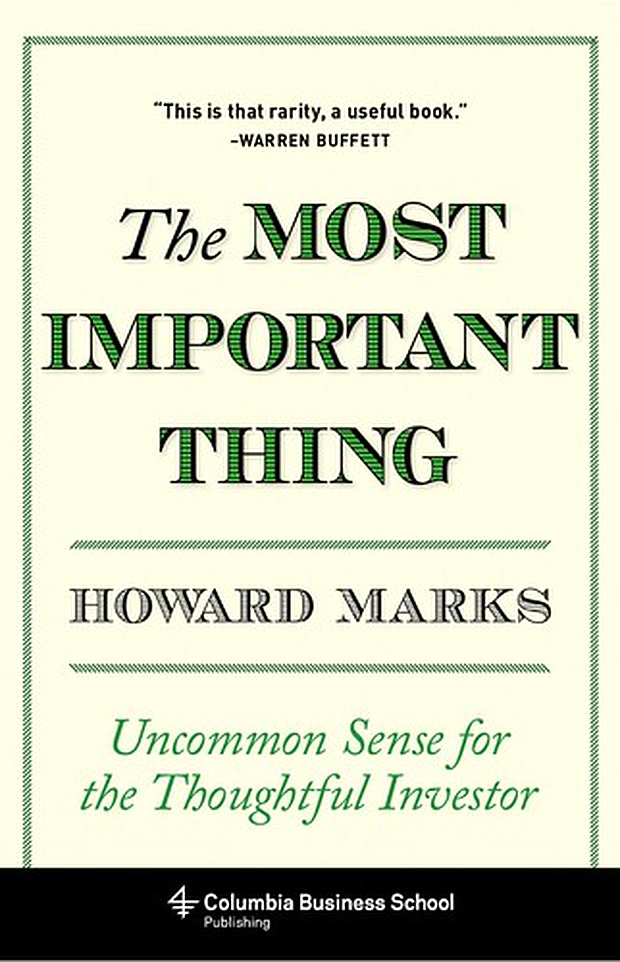
The Most Important Thing
Get on Amazon →
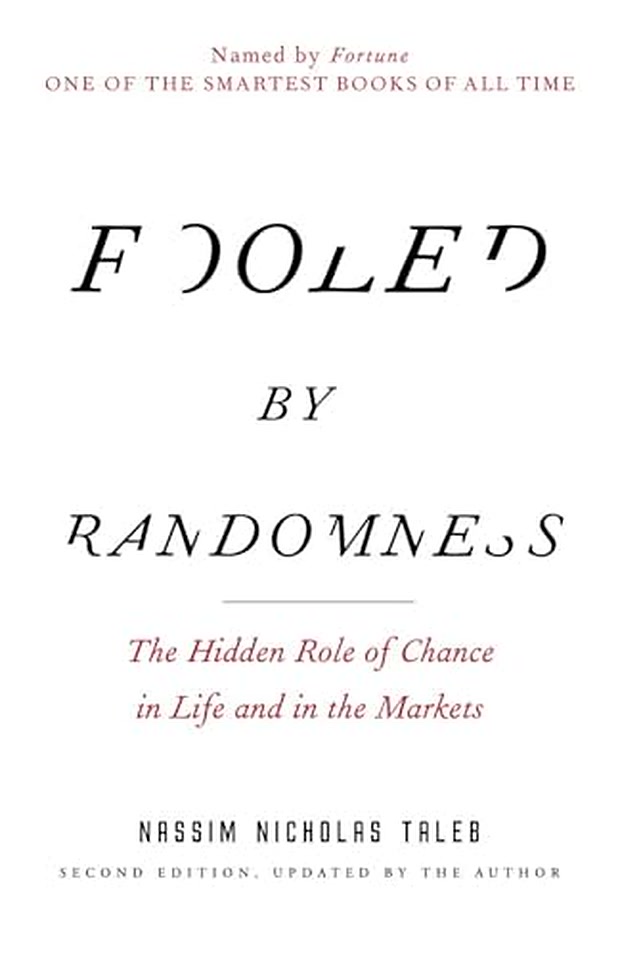
Fooled by Randomness
Get on Amazon →
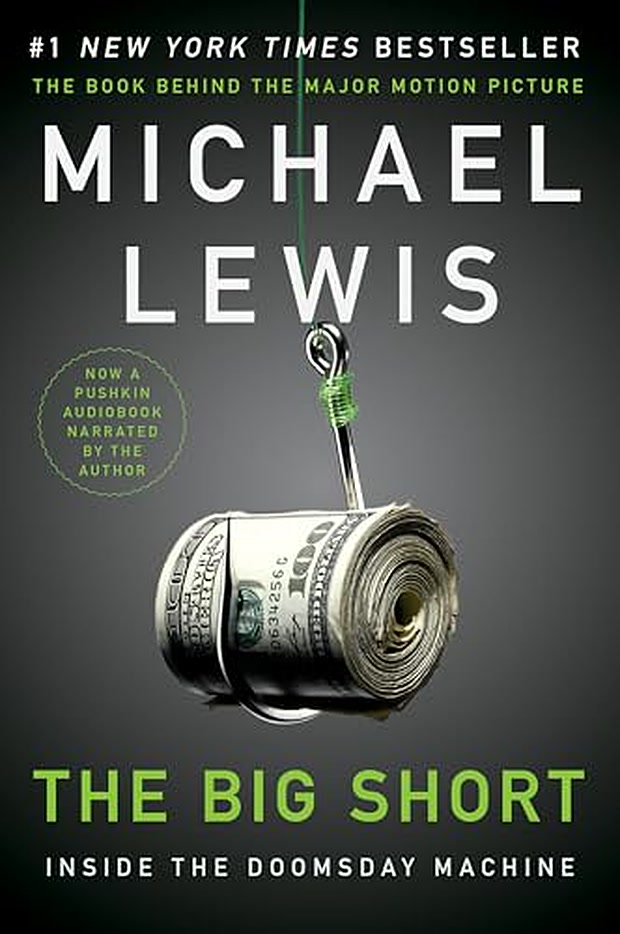
The Big Short
Get on Amazon →
As an Amazon Associate I earn from qualifying purchases.