Howard Marks
2003 05 16 Whats Going On
© Oaktree Capital Management, L.P.
All Rights ReservedMemo to: Oaktree Clients
From: Howard Marks Re: What's Going On?
In recent months, a few Oaktree clients have asked me to take part in give-and-take
sessions with their investment staffs and ot her money managers. The discussions have
revolved around changes in the investment environment and the implications for the
future. The process of thinking about thos e subjects has given rise to this memo.
UA Sweeping Change
In the last three years, ther e have been massive changes in markets, investment thinking,
expectations and behavior. Th e term "paradigm shift" certai nly is overused, but in this
case I don't think it's off target. During the 1990s and for many years prior, institutional investors su ch as pension funds
and endowments targeted returns of 8-10 %. The task of appropriately allocating assets was made easy by the universa l expectation (accompanied by sixty-plus years of
supporting data) that stocks "normally" return 9-11 % per year. When the main engine of
a portfolio's performance can be counted on for returns that exceed what's needed overall, asset allocation is a relatively easy task. Pu t a substantial majority of the portfolio in
stocks, add a few bonds in a nod to conservatism and an allocation to private equity for
spice, and the job's done. The only question was what you wanted your return to be (within the range of 8-10%),
and the solution was found in the magnitude of your equity allocation. Certainly, overall
portfolio returns in the range of 8-10% were viewed as readily attainable.
But all of a sudden, no one thinks so anymore. Goals at that level (or even a little lower) now seem quite daunting. What has changed is the equity return people feel can be
expected. History is out the window, and few people believe any l onger in 9-11% from
equities. Moderates talk about long-term returns between 4% and 8%, and the bear case
is considerably lower (or negative). With high grade bond yields also in the low to mid-
single digits, the two biggest asset categories ar e promising returns that fall short of the
overall goal. Thus it's unclear how that goal can be achieved while holding any
meaningful amount in stocks and/or high grade bonds – or whether it can be achieved at all. We all know what happened to prospectiv e bond returns: economic weakness and the
Fed's stimulative actions combined to lower prevailing interest rates, and thus promised bond returns, to 40-year lows. But what happened to the prospectiv e return on equities?
© Oaktree Capital Management, L.P.
All Rights ReservedSimply put, people began to search for the el ements that would lead to continued lofty
equity returns, and they failed to find th em. In the 1990s, few people pondered the fact
that if corporate profits grow in single digits and "normal" equity performance is 9-11 %,
two decades or so of returns almost twice that might be borrowing from the future. Now
the future is here and that realization has set in. Those single digit profit increases
(accompanied by low dividend yields) are expect ed to result in mid-single digit equity
returns if P/E ratios are unchanged, and less if multiples shrink.
So the question has switched from "How much would you like to make and spend?"
to "How much can you make safely, and what will that let you spend?"
UIs There No Opportunity in Equities?
It is clear that (a) most people's expectations for equities now are in the mid single digits,
and (b) equities are attracting as little interest as at any time in the last 25 years. There
are, however, factors supportiv e of a more positive case:
The most obvious is the fact that stock prices are off substantially since hitting
record highs in early 2000.
Another positive might be seen in the fact that the curtailing of expectations for
equity returns coincided with the incurre nce of substantial lo sses. Thus it's
tempting to think that the moderation of expectations may have stemmed from the
corrosive emotional effect of recent losses on investor psyches, not from new data
or objective analysis.
In fact, it's comforting to note a hopeful analogy. In August 1979, after a harsh correction in 1973-74 followed by several sl uggish years, the cover of Business
Week proclaimed "The Death of Equities" . . . just pr ior to the ignition of the
historic bull market that lasted throug h 1999. As in that case, with attitudes
toward equities beaten down so universally, the contrarian position today might
be to bet heavily on them. Sentiment toward equities can hardly get worse and, unimaginable as it seems, it just could get better.
At the same time, there are negatives to be dealt with:
Even though stock prices have come dow n substantially, the average P/E ratio
remains high – in the upper teens or low twenties, depending on whom you ask. In the last major cycle, which bottomed in the 1970s, P/E ratios reached levels
like today's at the
Uhigh U and fell to single digits when prices hit bottom. By that
standard, today's valuations suggest a high, not a low.
One reason today's P/E ratios are high in the absolute is that interest rates are so
low. Low interest rates justify a high va luation of future cash flows. But what
© Oaktree Capital Management, L.P.
All Rights Reserveddoes that imply for P/E ratios (and stock prices ) if interest rates were to rise from
today's historic lows?
Lastly, we have to wonder where the ener gy for a more bullish market will come
from, and specifically whether a generation of investors who've been burned is
lost from the stock market forever.
My own take is that even if the 9-11% hist oric long-term return on stocks remained
relevant with regard to the future, (and cert ainly that's the best anyone could hope
for), the above-average gains of the last two decades have borrowed from the future,
and the high resulting P/E ra tios imply an average return in single digits over the
next few years.
At the same time, I think some good indi vidual opportunities may be found among
orphaned small and mid-cap stocks. Because investment banks are no longer supposed to recommend stocks just to ge t investment banking business, their coverage lists might
contract. The financial pressures and resul ting layoffs at the big research firms are
leaving many companies without coverage. Ma ny un-researched companies will likely
emerge from financial restructurings and co rporate spin-offs. Put it all together, and
expert stock pickers probab ly will find some good opportunities in the newly less
efficient market.
UThe Market Cycle at Its Wildest
In a memo on cycles entitled "You Can't Pred ict. You Can Prepare." I discussed the
general progression of a market cycle:
Favorable developments and positive inve stor psychology cause prices to rise.
Reports of price appreciati on attract momentum player s, who shout, "We'd better
get in; who knows how far this can go." Their purchases of already-appreciated
assets move prices still higher on a trajec tory that appears capable of rising
forever.
Eventually, prices get so high that they vastly exceed intrinsic values.
A few value-conscious investors step into the crowd to sell. Prices turn down,
sagging under their own weight or perh aps because fundamental developments
begin to be less favorable.
Less-favorable developments and less- favorable psychology combine to force
prices below intrinsic values.
The pain of losses becomes so great that investors flee and prices reach giveaway
levels. This time it's, "We'd better ge t out; who knows how far this can go."
The first iron-nerved contrarians recognize that good values are available and start
to buy.
Others soon follow, and eventually th e number of new buyers exceeds the number
of sellers. Prices stop fal ling . . . and begin to rise.
© Oaktree Capital Management, L.P.
All Rights Reserved Reports of rising prices and the bargains obtained by those astu te pioneers attract
the masses to the marketplace, who shout, "W e'd better get in . . . ," and the cycle
continues.
I've always known about this cycle. I've seen it at work for decades. But I've never
seen it function – in terms of the extent and swiftness of the fluctuations – as it did
with regard to low-grade debt over the last year. Because the performance of
mainstream equities has little direct impact on Oaktree, we remain largely disinterested
observers of stock market developments. But we are vitally interested in what happens in
credit-related investments, and the change there has been mind-boggling.
UThe Pricing of Credit Risk in 2002-03
It's hard to believe, but the biggest cycle I've ever seen in distressed debt began just about
a year ago.
With investors softened up by economic sluggishness, depressing world events
and the realization of just how wrong th ey'd been in the 1990s, conditions were
ripe for a crisis of confidence. The cata lyst came in the form of an incredible
series of corporate scandals.
At first, Enron was viewed as an isolated instance of corporate venality. But then
Tyco, Adelphia and Global Crossing began to suggest a pattern. Arthur Andersen
was convicted and had to shut down. The capper was the disclosure of massive
fraud at WorldCom. Billions were lost, confidence was dashed, and investors – so certain just a year or two earlier – no longer felt they had a foundation on
which to base any confidence.
Bond fund managers who thought they had bought money-good securities found
themselves holding distressed debt. B onds they felt good about buying at prices
of 90 or 100 turned scary at 20 or 30 . High grade bond managers sold down-
graded bonds (or bonds expected to be dow ngraded) as required or to dress up
their statements, and everyone sold to reduce concentrations, raise cash to meet
withdrawals, or cut risk.
Because of this combination of events, we were able to invest more than $2 billion last summer in distressed debt pr iced very attractivel y. We put massive
amounts into the public bonds of sizeable corporations – like Tyco, Qwest,
Lucent, Nortel and Corning – that we t hought might pay interest and principal as
promised. In the past, we've always thought our distressed companies were 99%
likely to default or go bankrupt. Now we were paying death's-door prices for
bonds that we thought had a good chance of escaping that fate.
In this way, the downswing of the distressed debt market cycle gave us unusually good
investment opportunities: signif icant companies that might survive, giveaway prices,
© Oaktree Capital Management, L.P.
All Rights Reservedpotentially high prospective returns, in vast quantities. We were buying at yields well
above 20%, and total returns that we thought w ould be far higher if our credit judgments
were validated. We felt our purchases in June-September 2002 rivaled those of 1990,
which had produced our hi ghest returns to date.
But the most amazing thing is what happened next. The market turned on a dime,
and in the next six months it became as strong as it had been weak.
What caused the turn? Maybe it was the fact that scanda ls stopped erupting. Maybe it
was the first few successful sales of assets made to improve balance sheets. Maybe
investors realized that distre ssed debt offered excellent i nvestment opportunities. Maybe
distressed debt fund managers regretted ha ving missed a major opportunity to invest
during the summer. Or maybe it was Warre n Buffett's announcement that Berkshire
Hathaway had increased its holdings of lowe r-rated debt by $6 billion in 2002. Whatever
the reason, sentiment turned from negative to positive . . . with a vengeance. Based on data for the OCM Opportunities Fund IVb, the distressed debt positions we bought in 2002 returned almost 20% in November alone, and 23% in the fourth quarter of
the year. They took off again in early 2003, ri sing 15% in the firs t quarter and another
10% in April. For the six months from Nove mber through April, the total estimated gain
has been more than 55% (and more th an 41% net of fees and expenses).
This was yet another example of the sc hizophrenic swing of the investment
pendulum: Trust replaced skepticism. Gain repl aced loss. Greed replaced fear. And,
incredibly, panic buying replaced panic se lling. The cycle had swung from morosely
negative to ebulliently positive in less than a year. And thus the Tyco bonds we bought
in May 2002 at a 24% yield beca me gilt-edge securities that could be sold in January
2003 – at yields of 4%-plus.
We've seen the same cycle in high yield bonds. Last July, because investors had developed
allergies to high yield bonds, the average bond had to provid e more than 1,000 basis points
more yield than a Treasury note of comparable maturity to induce investors to buy it. But
now, investors have come to lust after high pr omised returns, and they are willing to buy
the average high yield bond at a spread of ju st 600 basis points or so. The resulting
estimated net return on our high yield bond portfolios: more than 15% for the 6 months November through April.
UBut Why?
Most observers are familiar with the return s reported above, and with the changed
attitudes toward credit risk that lie behind th em. But I think the be havior of distressed
debt and high yield bonds should be viewed in a broader context, not in isolation. There
are big-picture influen ces behind these trends.
What happens when people get ex cited about an asset class?
© Oaktree Capital Management, L.P.
All Rights Reserved
capital floods in,
prices rise,
current returns soar, and
prospective returns decline.
But don't forget the significant ramifications. Investors lose interest in other asset
classes; thus their prices fall (a t least in relative terms) and their prospective returns rise.
In other words, the popular asset becomes mo re expensive and the rest get cheaper.
A powerful cult of equity believers held sway from 1978 – when I started to manage
portfolios – through 1999, with only minor interruptions. The average return on the
S&P 500 was over 17%. There wasn't a year in which the index declined more than 5%.
Equity managers and analysts showed up on ma gazine covers and TV screens. Equities
were fawned over in books ranging from "S tocks for the Long Run" (which explained
that stocks could be counted on to beat bonds , cash and inflation in any period, providing
it was long enough) to the se lf-explanatory "Dow 36,000." The man on the street
accepted stocks as a sure thing. What both the man on the street and the i nvestment professional missed was that the
appreciation that powered stocks' record returns had borrowed from the future and made them very expensive. And the view that st ocks were all you need ed also implied that
other assets were superfluous. Thus bonds went out of favor, at least in relative terms. In
the 1990s, few of the people I met could think of a convincing reason for their fixed income allocations. Maybe that made bond yiel ds and yield spreads more generous than
they should have been. Stocks in favor and rich; bo nds out of favor and cheap.
And since the beginning of 2000? Stock prices are down. Confidence in stocks has been
dashed. Equity return expectations have co llapsed. Bonds and their contractual returns
suddenly seem more attractive. Bond prices are up. Credit spreads have narrowed. The
proof is seen in the performance described above.
UThe Power of Capital Flows
I want to discuss one last element that's been behind the powerful appreciation we've seen recently. I think the explanation's easy. In the long run, investing is about value and the expectati on that, eventually, price will
catch up. But in the short run it's about psychology, emotion and popularity. The influence of those three factors comes th rough their effect on fl ows of capital, and in the
short run it's capital flows that have the most profound impact of all.
The equity market is huge: $8.6 trillion in the U.S. alone. The high yield bond universe
is about a tenth that size, a nd distressed debt is a fraction of that tenth. When a few
© Oaktree Capital Management, L.P.
All Rights Reservedbillion dollars were withdraw n from stocks, the effect wa s moderate. But when those
same refugee dollars sought deployment in ou r niche markets, the impact was dramatic.
In the last few months, what had been a buye rs' market has become a sellers' market.
Last year, especially in distressed debt, it wa s "the more money, the better." Now it's the
opposite. In the long run the return on an investment will follow the fundamentals, and in that
sense I think of it as something approaching a fixed-sum proposition. But market fluctuations will render the receipt of that return highly uneven, as price moves above and
then below intrinsic value. Thus, everything else being equal, a higher return to date
means a lower return in the future. In this way the recent increase in bond prices
implies lower bond returns in the future, and the narrowing of yield spreads implies lower
relative returns for lower-rated bonds. A mana ger of lower-rated bonds hates to have to
make these admissions, but refusing to make the admissions wouldn't make them any less true.
UThe Cat, the Tree, the Carrot and the Stick
I hope you'll forgive an incredible mixing of metaphors, but I can't resist using one to
sum up on the subject of the current investment environment. As I think about situations
like today's, (which, by the way, is not unprec edented), I visualize a cat in a tree. A
carrot lures him out onto incr easingly higher branches, a nd a stick prods him from
behind. In my analogy, the cat is an investor, whose job it is to cope with the investment
environment, of which the tree is part. The carrot – the incentive to accept increased
risk – comes from the high returns seemin gly available from risk ier investments.
And the stick – the motivation to forsake safety – comes from the modest level of prospective return being offered on safer investments.
The carrot lures the cat to higher branches – ri skier strategies – in pursuit of his dinner
(his targeted return), and the stick prods th e cat up the tree, because he can't get dinner
while keeping his feet firmly on the ground. And that's a pretty good description of today's investment environment. Today the greatest carrots are perceived to be available in the high yield bond and
distressed debt markets. Not only do they make sense as ways to play the economic
recovery that is presumed to loom ahead, but also they have provided the best recent
results. Of course, many cat-like investors fail to realize that excellent recent results don't add to an investment's prospective return; rather, they detract from it. But
the carrot of high recent results never fails to attract new followers to a strategy. And, of course, the stick is extremely powerfu l today, because any substantial allocations
to high grade bonds (with thei r promised returns of 4- 6%) or to equities (whose
© Oaktree Capital Management, L.P.
All Rights Reservedprospective returns aren't pe rceived to be much higher) seem likely to ensure that a
portfolio with a targeted return of 8-10% will fall short.
So investors consistently climb out on the li mb of whatever strategy has performed best
lately, without noticing their in creasing distance from the ground. Risk never looks like
risk when it's generating a high return.
Today that hungry cat is looking for a free lunch (oh no, not another metaphor!) in high yield bonds and distressed debt. Those markets may offer the best way to be well-fed
today, but they should be pursued only with eyes wide open concerning the altitude
to which one is venturing.
What else is there to do? It may sound lik e heresy, but what about concluding that (a)
under what appear to be today's revised ci rcumstances, pursuing th at high-up dinner is
just too risky, and (b) investor s should content themselves with what's available, with
safety, on limbs closer to the ground? Am I being too oblique? Let me stop trying to
extend the metaphor and put it simply: invest ors may have to consider lowering their
target returns.
* * *
In recent times we've had several reminders regarding the inevitability of the market
pendulum's swing, the propensity of inve stment popularity to wax and wane, the
extremes of fluctuations, and the dramatic influence of cash flows. Some years, these transient influences will benefit us, as they have this year. Other years they're sure to
hurt.
We can try to cope by understanding where th e pendulum stands at a point in time and
striving to anticipate its future swings. Or we can put our energy into emphasizing long-
term value under the assumption that we'll be ab le to ride out the fluctuations if we're
right about the values. To help us deal with the short-run developments, we've chosen to
do some of each in the affected areas.
We're being very candid about market conditions.
We're limiting our assets under management.
And if market conditions don't take a turn for the better, our clients should expect
a reduced ability to profitably employ capital in our markets.
As to the long run, we're confident our adheren ce to value investing will continue to get
us through. May 6, 2003
© Oaktree Capital Management, L.P.
All Rights ReservedLegal Information and Disclosures
This memorandum expresses the views of the author as of the date indicated and such views are
subject to change without notice. Oaktree has no duty or obligation to update the information contained herein. Further, Oaktree makes no rep resentation, and it should not be assumed, that
past investment performance is an indication of future results. Moreover, wherever there is the
potential for profit there is also the possibility of loss. This memorandum is being made available for educational purposes only and should not be used
for any other purpose. The information contai ned herein does not constitute and should not be
construed as an offering of advisory services or an offer to sell or solicitation to buy any
securities or related financial instruments in any jurisdiction. Certain information contained herein concerning economic trends and performan ce is based on or derived from information
provided by independent third- party sources. Oaktree Capita l Management, L.P. (“Oaktree”)
believes that the sources from which such informa tion has been obtained are reliable; however, it
cannot guarantee the accuracy of such inform ation and has not independently verified the
accuracy or completeness of such information or the assumptions on which such information is
based. This memorandum, including the information cont ained herein, may not be copied, reproduced,
republished, or posted in whole or in part, in any form without the prior written consent of
Oaktree.
Recommended Reading
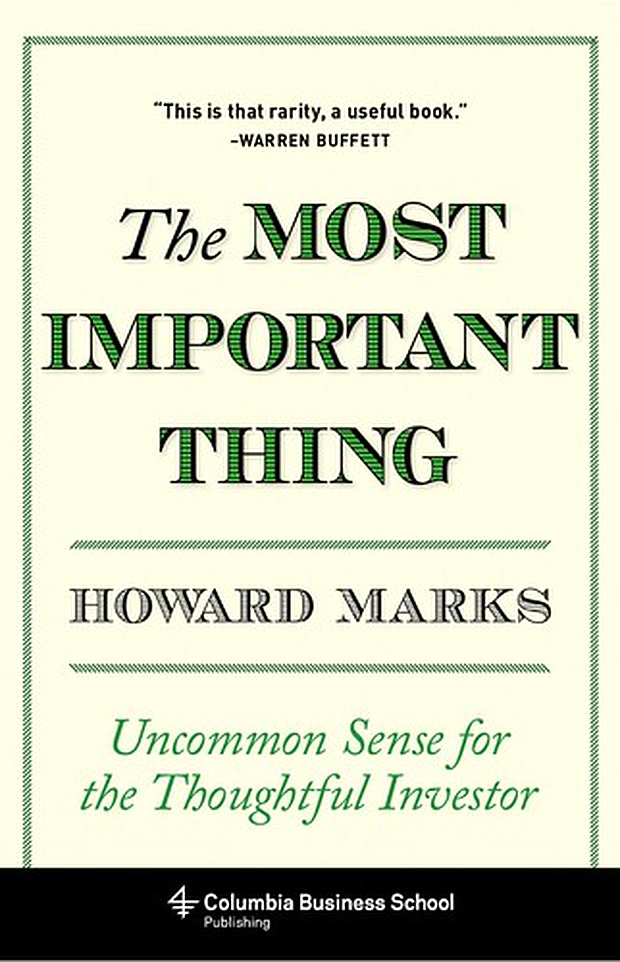
The Most Important Thing
Get on Amazon →
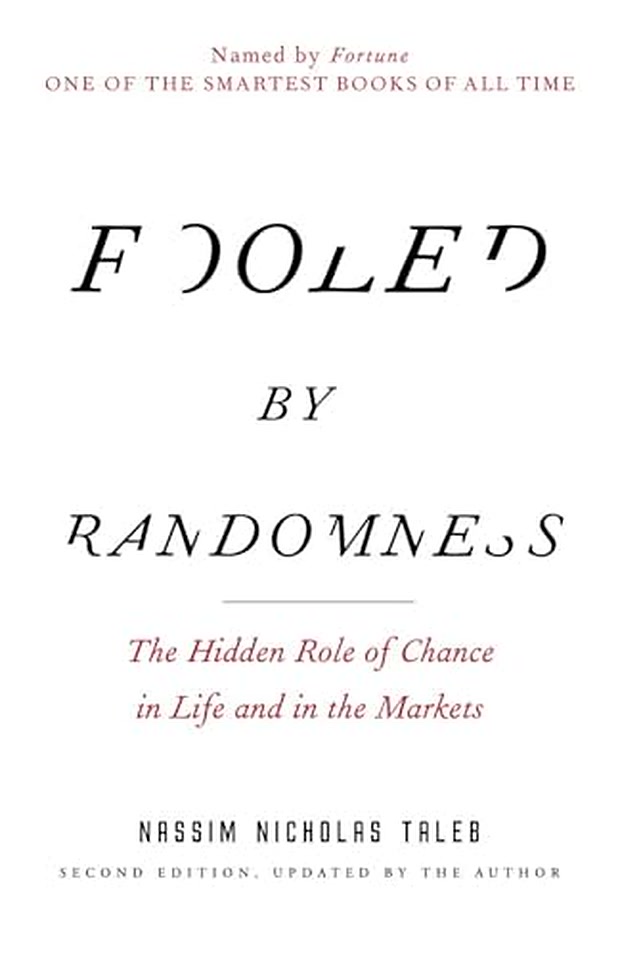
Fooled by Randomness
Get on Amazon →
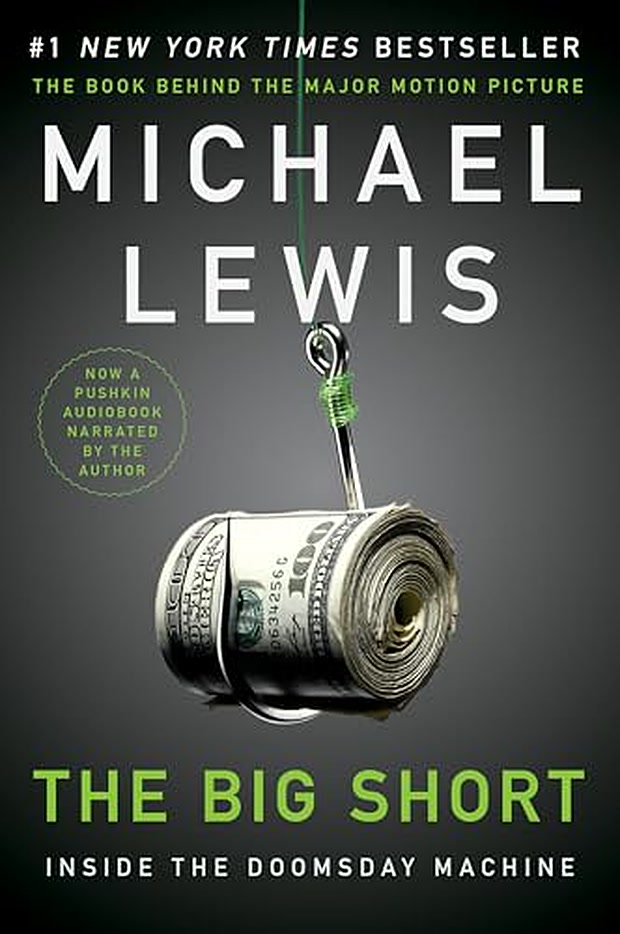
The Big Short
Get on Amazon →
As an Amazon Associate I earn from qualifying purchases.