Howard Marks
2003 03 11 Whad Ya Know
© Oaktree Capital Management, L.P.
All Rights ReservedMemo to: Oaktree Clients
From: Howard Marks
Re: Whad’Ya Know?
I always ask Nancy to read my memos before I send them out. She seems to think being my wife
gives her license to be brutally frank. “They’re all the same,” she says, “like your ties. They all talk
about the importance of a high batting average, the need to avoid losers, and how much there is that
no one can know.”
Well, I guess I do tend to go on about everything that investors would like to know but is
unknowable . . . and about all the people who claim to know it. But I’ve saved up some good stuff
for a “rant” regarding the “I know” school people who think they know but don’t. So here I go
again (with apologies for the length).
UThe “Jumbo Shrimp” of Investing
One of my favorite oxymorons is “common knowledge.” Knowledge just isn’t that common, and that which is common often contains little knowledge.
On February 4, USA Today cited a strategist as sayi ng “there might be a silver lining to the current
investor backlash, because a lot of cash is piling up on the sidelines, and the heavy selling has wrung out most of the downside.” Everyone knows the stock market can’t stop sliding and begin a
new bull phase rally until some cash has piled up on the sidelines. And thus everyone wants to see
selling exceed buying. That seems eminently reasonable.
And that’s what makes it one of my greatest pet peeves. It makes sense, it’s obvious, and people
have been saying it for decades, so it has become common knowledge. But it’s wrong! There’s no
such thing as net selling! And stock market transactions can’t cause cash to build up! Think
about it. In every stock trade there’s a buyer a nd a seller. So how can selling exceed buying? And
the buyer puts as much money into the market as the seller takes out. So how can selling create cash
on the sidelines?
As usual, there is a less simplistic explanation that’s closer to the truth:
While there can’t be more selling than buying, there can be more would-be sellers than would-
be buyers. And the sellers’ desire to sell can be stronger than the buyers’ desire to buy. These
factors are indicators of negative sentiment, and they can lead to a selling climax that creates a
market bottom, so they can presage the (eventual) end of a decline.
And clearly, uninvested cash equates to potential buying power, and thus potential fuel for a
rise. But uninvested cash can’t result from selling (which requires a buyer to put in the same amount of previously-uninvested cash as the seller takes out). Rather, a buildup of potentially
© Oaktree Capital Management, L.P.
All Rights Reservedinvestable cash m ust come from
sources that are exogenous to the market, such as household
income, savings, tax refunds, and cash contributions to pension funds or endowments.
The bottom line: there’s often no wisdom in the st uff that “everyone knows.” And nowhere is that
more true than in investing.
4BUToward Understanding Market Movements
One day in early 1995, the dollar made a big move against the yen. On my way to work, my radio
station’s Tokyo correspondent reported that the Nikkei average of Japanese stocks had been off big that day. He was glad to explain why: investors were worried about the weakness of the yen.
On my way home, the same station reported that the U.S. stock market also had declined a lot. The
explanation given: investors were concerned about the strength of the dollar.
Well that just can’t be. If one currency moves relative to another, how can companies in both
countries be worse off than they were the day before? I think this episode illustrates a few themes.
First, the general understanding of economic events and their implications is very poor. Second,
everyone wants to explain the movements of the markets, and they’ll grasp at any straw with which
to do so. Third, much of their commentary is useless. And, of course fourth, markets often do
things that defy logical explanation – but people keep explaining them anyway.
New Yorker Magazine, 1981
Every day we hear or read that “the market rose on hopes that . . .” or “. . . because investors were
cheered by the news that . . .” Or perhaps it’s “the market fell on fears that . . .” or “. . . because of
negative reaction to . . .” How do the commentators know? Where do they look to learn the reason for each day’s move? Does there have to be an explanation? Why don’t we
Uever U hear, “The
market rose today, but no one knows why”?!
© Oaktree Capital Management, L.P.
All Rights Reserved5BUSo What’s The Point?
I don’t begrudge people wanting to make money by expressing views that are beyond their ken and
of no value. I guess it’s human nature. My complaint, however, is that it’s misleading and injurious
to bystanders when people use serious platforms to state their unfounded views. They make it seem
so easy to understand economic and market developments, and thus to profit from them. Just as no one should give legal advice or medical diagnoses on TV, the media should desist from providing
economic and market analysis as well.
I think some of the greatest contributors to the 1998-99 bubble were the talking heads of the media.
For every event they provided a without-a-doubt explanation and quantified its profit implications. These “experts” were free with recommendations and exuded 100% certainty. As I’ve said before,
there are a few things they never said: “darned if I know,” “it’s hard to predict these things,” and
“but I could be wrong.”
Nobody was well served by the veneration of the “I know” school in the late 1990s: Main Streeters were lured to invest in Wall Street without an understanding of the skills required or the risks
entailed. The market and thus the economy were put through an extreme boom-bust cycle. Risk-taking investment gunslingers were anointed, and cau tious value seekers were rendered irrelevant.
And the oracles themselves eventually were brought low – they seem much less free with gratuitous wisdom and can’t-miss buy recommendations today than they were four years ago.
New York Times, March 15, 2001
© Oaktree Capital Management, L.P.
All Rights ReservedUWhere Were the Strategists?
Another group that’s no longer riding quite as tall in the saddle are the brokerage house strategists.
They attracted a lot of respect in the ‘90s, and some even attained “household name” status. But I
don’t know of any who helped their clients avoid the pain of the last three years.
I think the test is simple: Did they call the TMT bubble? It’s obvious in retrospect that many of the
tech/media/telecom companies and their strategies were somewhere between fanciful and fictitious;
the valuation multiples were ridiculous; investor behavior was nuts; and Wall Street had turned into a machine for short-term appreciation. If it’s so obvious in retrospect, lots of the strategists
(whose sole job it is to figure out what’s going on and what it means for the future) should
have had an inkling at the time.
Since this was the most extreme event of our investment lifetime thus far, and since it built up in
plain sight over a period of years (as opposed to being the result of a sudden and surprising
exogenous influence), shouldn’t the strategists have seen it? The emperor was as naked as he’s
ever been, but the brokerage strategists failed to point it out.
Abby Joseph Cohen was the most prominent of the strategists, having made a real name for herself
by correctly predicting stock price gains for a decade or more. (Or was she simply an unmitigated bull who never changed her tune regardless of the level of stock prices and looked smart in the ‘90s?) I attended a meeting with her near the top and heard the tortured rationalization that allowed
her to stay bullish, something like: “Stocks are overpriced, but not by a lot, so based on our outlook
for interest rates and other factors, they’re still a buy.” My opinion’s a little different: When an
asset’s overpriced, it can’t be a buy.
When I think about the events of the past decade, I conclude that the strategists failed to warn about
the risk in stocks because of some combination of (a) their congenital bullishness, (b) Wall Street’s
vested interest in predicting stock price appreciation, and (c) the serious limitations on knowing
what the future holds. Rarely have so many been paid so much for contributing so little.
On that note, The New York Times wrote on January 27:
When Barton Biggs announced last week that he would be leaving his job as Morgan
Stanley’s chief global strategist, it may have marked the end of a bull market phenomenon –
the transformation of market strategists into celebrity gurus. . .
Several Wall Street firms are reassessing the role of the highly paid stock strategist. Under
intense pressure to cut staff costs in the bear market, investment banks not only have been
downgrading the role of the strategist, but also have been questioning whether the position
as it exists is relevant in today’s complex market environment. . .
These concerns rarely appeared during the boom years, when Mr. Applegate [late of
Lehman Brothers] and Mr. Galvin [ex. Credit Suisse First Boston] became minicelebrities
by cultivating hip personas in print and on CNBC. . .
Lehman Brothers and Credit Suisse, which declined to comment on the strategists’
departures, have decided that, for now at least, they can make do without well-known
prognosticators.
© Oaktree Capital Management, L.P.
All Rights ReservedPerhaps the website FierceFinance summ
ed it up best that same day : “Now, Wall Street firms are
pondering whether [star strategists] have b ecome anachronisms. It reminds me of the
perennial debate in Great Britain about the need for royalty in the modern era.”
6BUHow Do They Rate?
While we’re on the subject of who knows what, we should consider the credit rating agencies.
These organizations are dedicated to assessing the quality of debt securities. They’ve been around
for scores of years and are viewed as objective. So highly are they thought of that their ratings are
accepted as regulatory standards and incorporated into law; there’s even a special SEC label for them: “nationally recognized statistical rating organizations.” But do they do any good?
I confess: I love the rating agencies! Oaktree would be lost without them. My whole career
and many of Oaktree’s activities are based on opportunities created by credit ratings.
First, a digression: In an efficient market, there’s no chance for superior returns through active
management. Active managers need markets that are inefficient. What are inefficient markets?
They’re markets where mistakes are made ; where assets sell for prices different from their fair
value and thus can be bought for less (or sold for more) than they’re worth. In order for those
mistakes to occur, there has to be ignorance, inadvertence, opacity, prejudice, emotion, or some other obstacle to objective, insightful decision making.
The ratings agencies constitute just such an obstacl e. My favorite example: literally for decades,
Moody’s has defined B-rated bonds by saying they “generally lack characteristics of the desirable investment.” How can they say that based on the risk alone, without any reference to price or promised return? Once they imply “there’s no price at which this bond could be a good buy,”
people will shun it, making it cheap. That can create an opportunity for a bargain hunter.
And the ratings agencies are wrong a lot. Not in every case, but at the margin where it counts . The
agencies are convinced they do a good job because the bonds they rate low default more often
than the bonds they rate high. But the majority of speculative grade bonds never default, and
every once in a while an investment grade bond does. Both of these phenomena have
significant financial consequences.
For example, by failing to anticipate a default and thus mistakenly maintaining an investment grade
rating, the agencies allow bonds to sell at 80 that should sell at 20. That’s an opportunity: for
investment grade bond managers to distinguish themselves by getting out before the default, and for
hedge funds to profit from selling short. And when the sense of security caused by those high
ratings is dashed, investment grade bond managers can be forced to dump these now-
nonconforming bonds, creating bargain-priced opp ortunities for buyers of distressed debt.
If the rating agencies were right every time, the bond market would be efficient; every bond’s yield
would be just right for its risk, and there would be no free lunch, no excess return. And if there
were no rating agencies, there’d be no organized process for us to game against. In either case the opportunities for Oaktree to buy cheap on behalf of its clients would be reduced. But I don’t think
there’s any risk of that. The concept of accurate ratings is dead; long live the rating agencies!
© Oaktree Capital Management, L.P.
All Rights ReservedUOften Wrong But Never In Doubt (or Hesitant to Share)
The January 6 issue of “Pensions & Investments” contained its 2003 Investment Outlook. Twenty
institutional money managers generously provided thei r views on what the coming year holds. They
ranged from cautiously bullish to outright bullish. The headlines on the more restrained forecasts included:
“‘Double-Dip’ a Possibility,” “Recovery with Headwinds,”
“International Surprises Likely,”
“Moving Sideways Toward a Bull Market,” “It Will Be a Stock-Selective Market,” and
“Blame Iraq”
The outright optimists said:
“The Worst is Behind Us,”
“Rocking and Rolling Before Long,”
“Healing Process Is Already Well Along,”
“Bullish on Credit,”
“Crisis of Confidence Is Over,” “Bullish on Equities,”
“We Are . . . in a Recovery,” and
“Extraordinarily Bullish for 2003.”
The most guarded forecaster said the market could be close to flat; nobody said “down.”
One of my greatest complaints about forecasters is th at they seem to ignore their own records. I’ve
never heard one say, “I predict such-and-such w ill happen (and 7 out of my last 10 forecasts were
off the mark)” or “I predict such-and-such will happen (and, by the way, I predicted the same thing
last year and was wrong).” However, P&I did the unusual by critically reviewing the previous
year’s forecasts. It poked a little fun at the West Coast manager who predicted the S&P 500 would
gain 15% in 2002, whereas it declined 22% instead. (He’s again predicting a 15% increase for
2003; if he keeps at it long enough, he’s bound to be right someday.) But P&I went one better by
pointing out that at the start of 2002, one of the worst years in stock market history, “not a single
one of 19 stock managers interviewed . . . predicted a negative return for the U.S. stock market.”
The amazing thing to me is that these people will go on making predictions with a straight
face, and the media will continue to carry them.
UThe Value of Predictions II
The P&I survey reminded me of a memo I wrote in 1996 under the above title. It reviewed a few of
The Wall Street Journal’s semiannual economic surveys and made several key points, not one of
which I would alter:
© Oaktree Capital Management, L.P.
All Rights ReservedThe average “ expert” added little in te
rms of predicting the future.
It’s not that the forecasters were always wr ong; when there was little change, they were
often right. It’s just that in times of major changes (when accurate forecasts would have
helped one make money or avoid a loss), the forecasters completely missed them. In the
years reviewed, the expert consensus failed to predict all of the major developments.
Where do these forecasts come from? The answer is simple: If you want to see a high
correlation, take a look at the relationship between current levels and predicted future levels.
. . In general we can say with certainty that these forecasters were much better at telling us
where things stood than where they were going.
Every six months, when the Journal reports on a new survey of forecasts, it takes the
opportunity to cite the forecaster in the previous survey who came closest . . . And the truth
is that the winner’s accuracy is often startling. . . . [However,] the important thing isn’t
getting it right once. It’s doing so consistently. . . As the Journal itself pointed out, “ . . . by giving up the comfort of the consensus, those on the fringes of the economic prediction
game often end up on the winning or losing end. . . the winners of six months and one year
ago didn’t even get the direction of interest rates right this time.”
None of this provides much encouragement for those who would invest based on guesses about the
future. But neither, apparently, does it provide enough discouragement to make them stop.
UPredicting the Events That Move Markets
I often write about how difficult it is to anticipate the things that will determine the direction of the
market. Think about it: what events in the last five years do you wish you’d seen coming?
The meltdown of Long-Term Capital Management in 1998.
The tech/media/telecom boom in the late 1990s.
The tech/media/telecom collapse in 2000.
The terrorist attacks in 2001.
The corporate scandals in 2001-02.
The interest rate decline in 2002.
Did you foresee many of these things? Did your money managers? Did anyone? I doubt it.
The market’s big moves often come in reaction to surprises like these. But most of the time, the
consensus anticipates continuation of the status quo (especially when things are going well). Surprises aren’t factored into prices ahead of time (by definition). In the movie that runs inside my
head, the members of the “I know” school sagely intone, “We’re not expecting any surprises”
(without appreciating the irony). It’s when surprises occur that big profits are there for the
taking – by anyone capable of foreseeing them. It’s just that it’s not that easy.
So, as with economic events, the outlook for profitable market forecasts is bleak:
© Oaktree Capital Management, L.P.
All Rights Reserved If y
ou make a conventional, status quo-type forecast, you’re likely to be right most of the time.
But since the status quo usually is shared widely and factored into prices, a status quo forecast
won’t help you beat the market or call its turns (even if it’s right).
The forecasts with real profit potential are the ones that correctly predict unusual events.
But idiosyncratic forecasts are wrong most of the time (and thereby unlikely to be profitable).
So if (a) conventional forecasts are easy to make correctly but generally lack profit potential, and (b)
unconventional forecasts have theoretical profit potential but are hard to make correctly, then (c) it
should be clear that forecasts are unlikely to help you know enough about the future to beat the
market.
UDoes Anyone Point Out What The Consensus Doesn’t Know?
I feel very strongly that the hundreds of economists and strategists with conventional forecasts add
little to the equation. On the other hand, Byron Wein of Morgan Stanley is one of the small group
who provide a very valuable service by consciously looking for surprises (and who knowingly
accept the risk entailed in talking about things that probably won’t happen). At the beginning of
each year Byron publishes a list of ten things that most people feel won’t happen but he thinks have
a 50% or better chance of taking place.
Here are some examples regarding 2003:
The stock market gains 25%, largely due to foreign support.
The economy shows 4% real growth, causing the 10-year Treasury yield to jump to 5.5%.
Japan gets serious about fixing its problems, and the Nikkei soars to 11,000.
Saddam steps down, Kim Jong Il negotiates, and we avoid major military action.
None of these things seems highly likely. But that’s the point : if they seemed likely, they wouldn’t
be on the list of things the consensus has dismissed. And they
Uwould U be factored into market prices.
What Byron does for us is (a) call attention to some things to watch for and (b) perhaps more importantly, remind us that the things that move the market are the surprises . . . although maybe not
these. I commend his list to your attention; it’s all about what investors (and certainly the
consensus) don’t know .
And by the way, Byron performs an additional service each year: he reprints his year-earlier list and lets us assess which ones came true. Most years, a few have materialized, but there was no way to
know in advance which ones. In retrospect, half of his calls regarding 2002 look quite impressive:
No major terrorist event occurs in the U.S.
Early strength in the U.S. economy proves short-lived.
The yield on the 10-year Treasury drops below 4%.
Japan’s recession continues.
Pension fund solvency becomes a major issue.
© Oaktree Capital Management, L.P.
All Rights ReservedOn the other hand, these d
on’t:
Iraq refuses to admit inspection teams.
People start traveling again; airlines and hotels prove rewarding investments.
Technology and telecom equipment orders improve.
Post-Enron populism sweeps the U.S.; Democrats take control of both houses of Congress.
Byron’s list shows us that (a) it is possible to pred ict some coming surprises, but (b) it isn’t possible
to do so with high reliability. Thus it’s not clear that betting on his list of potential surprises – or any such list – would be profitable.
UHere’s A Non-Consensus Forecast for You
If you’re looking for an idiosyncratic, non-consensus forecast to make some money on, see Robert
Prechter. As the February issue of “Bloomberg Markets” magazine stated:
Forget about the Dow Jones Industrial Average returning to 11,000. Try Depression-era levels of less than 1,000. And don’t flock to bonds for safety: Municipalities will default
and corporate bonds will be wracked by downgrades. Even the U.S. government’s credit status may sink low enough to make Treasury bills shaky.
You’ve heard of extreme sports; Prechter’s recen t record probably represents the norm for an
extreme forecaster. He joined the pantheon of fa mous forecasters by being right the obligatory once
in a row (but in a big way): he predicted a crash two weeks before October 19, 1987 made him right.
Then, according to Bloomberg, “he missed the almo st decade-long bull market.” And he hasn’t
changed his spots since. “I’m once again calling for events that few expect,” he says. “His work
is as relevant now as it ever was,” says Henr y Van der Erb. “A quack,” says Michael Thorson.
And that’s the point. His forecast certainly is no n-consensus, and if yo u follow him and he’s
right, you’ll make a fortune (or at least avoid losing one). But who’ll follow him? As I wrote in
“The Value of Predictions II,”
It’s difficult with regard to a non-consensus view of the future (1) to believe in it, (2) to act on it, (3) to stand by it if the early going suggests it’s wrong, and (4) to be right.
How much do idiosyncratic forecasters like Robert Prechter really know about the future? How
much can their forecasts help you to know? And how much are you willing to bet on their being
right?
UReliance on Weak Data
Investment experts love to dredge up data supporting their observations, and ever since computers
began to be applied to the stock market in the 1960s, a remarkable number of phenomena have been
discovered and documented. On December 11, the Wall Street Journal went into detail concerning “the so-called January effect – the tendency of certain stocks to rise in January after money
managers tweak their holdings for tax purposes.”
© Oaktree Capital Management, L.P.
All Rights ReservedOkay
, that makes sense. Everyone knows stocks usually do well in January. But since it’s no
secret, by now people should have learned to buy stocks ahead of the phenomenon, and that should
have negated it. As I wrote in “Etorre’s Wisdom,” if everyone moves into the fast lane, it’ll stop
being the fast lane.
But let’s say there is a January effect. My favorite part of the Journal article was where it suggested that in 2002 people should wait until the end of December to buy, rather than entering the market
sooner. The reason: while December’s usually a strong month, in 2002 a “statistical wrinkle” had
the potential to make it a weak month instead. “In more than half the 21 instances since 1897 when
the Dow Jones Industrial Average fell by 10% or more in the first 11 months of the year – it was
down 11.2% this year – December was a weak month.”
Sounds astute, right? But wait. First, the data reaches back to 1897, and I’m not sure 100-year-old
observations are relevant today. Second, this set of facts has applied only 21 times in history, and
that’s not much of a sample. Third, what’s the significance of “more than half”? If I told you a
roulette wheel had come up black in 12 or 13 out of 21 spins, would that make you bet the ranch on black? I doubt it. If I told you it was 20 out of 21, that might make you consider it. And if it had
been black 60,000 times out of 100,000 spins, you might race to the table (and find me there).
So what did happen to the January effect that “everyone knows about”? On February 3 the Wall
Street Journal reported:
. . . The Dow Jones Industrial Average finished [January] with a 3.5% drop.
That is an inauspicious beginning to the year, doubly so because it follows a 6% decline
during December. Historically, December has been the strongest month for stocks, with the industrial average rising in 72% of the Decembers since 1900.
A back-to-back December-January decline is rare; it has happened only 9 times since 1900.
In five of those nine years, the market fell after the January fizzle.
So now the bullish January effect is discarded, and the bearish December-January effect demands
our consideration. What has the Journal proved? That we can no longer count on the January effect? That it’s bad to hold stocks when both December and January show declines? Neither of
these, I think. What’s been proved is that more data doesn’t necessarily mean more
information. The Journal suggests the December-January rule as a guideline for managing money,
but I wouldn’t bet a penny on something because it ha ppened five times out of nine. (After all, if
you flip a coin nine times, it has to come up at least five times on one side or the other.)
For another example, my attention was drawn to the graphic accompanying the Journal story, titled “What Happens to Stocks When the U.S. Goes to War.” It said, “The stock market has generally
weakened while anticipating war, but rebounded strongly when fighting proceeded.” Do you really think a meaningful inference can be drawn from something that’s happened four or five times in a
century? Should people trade on it? And if not, why run the story? Who’s helped?
I think statistics are like matches – the unsoph isticated shouldn’t play with them. When
shown to the public, they tend to produce conf usion between possibility, probability and a sure
thing, and between random occurrence and cause-and-effect.
10
© Oaktree Capital Management, L.P.
All Rights ReservedUI Know a Good Thing When I See It
In “Lessons from Distressed Debt” I referred to Warren Buffett’s observation that, in the short run,
the market’s a popularity contest. And since anyone can tell a good company from a bad one, it should be easy to predict the winners of the popularity contest and rack up above average gains.
The CFA Digest is a publication of the Association for Investment Management and Research that
provides two-page summaries of scholarly articles, and one-paragraph summaries of the two-page
summaries (making it very useful for busy people). The November 2002 issue reviewed an article
from the Journal of Financial Research entitled “Are the Best Small Companies the Best
Investments?” It cited eleven annual surveys of the “best” small companies that ran in Business
Week from 1985 to 1995.
As the article shows, these surveys were of absolu tely no value – check that; negative value – in the
search for stock market profits. Whereas the stocks of the chosen companies had far outperformed a couple of stock indices in the three years prior to the surveys, they underperformed in the three years following publication.
In sum, the authors show that investing in stocks subsequent to their appearance in Business Week’s “100 Best Small Companies,” on average, provides negative excess returns relative
to the benchmarks. The authors identify mean reversion of corporate operating performance, overly optimistic growth projections, and the bidding up of the prices of
growth stocks to unrealistic levels as potential factors in this underperformance. The
authors conclude that “any attempt to find winning investments from a ‘hot growth’ listing
. . . appears futile.”
So, I ask: what do you know about which companies are the best, and what does that tell you about
your ability to profit from that knowledge?
UHelp Is On the Way (Or Is It?)
For several months now, investment forecasters have been in the news – but not in a favorable
sense. The New York Attorney General, the SEC and the NASD have been all over Wall Street
brokerage firms and their analysts for their part in the tech/media/telecom craze of the late 1990s.
As everyone now knows, there was little or no “i nformation” in many leading analysts’ profit
forecasts, target prices and buy/sell recommendations. Profit forecasts often represented little more than regurgitation of what management said. Target prices tended to be the levels analysts thought
stocks might reach (as opposed to what they thought was merited). And many of the “buy”
recommendations turned out to have been made to garner investment banking business, not to make money for brokerage clients.
The remedies that prosecutors and regulators have arrived at are (a) to further separate the firms’
research function from investment banking and (b) to require brokerage firms to buy independent
research for their retail customers. I have some serious questions about whether the latter will produce the hoped-for result:
11
© Oaktree Capital Management, L.P.
All Rights Reserved Will research boutiques with the best
information provide it to retail investors? Will the top
research shops want to communicate their information via the massive brokerages (and thereby
sacrifice its uniqueness, and their relations hips with institutional investors)?
Will retail investors (or the brokerages on their behalf) be willing to pay top dollar for the best
research? Or will it continue to go to institutiona l investors, with individuals getting the dregs?
If independent research providers earn big dollars by selling their research to the Wall Street giants, will they remain insulated from the invest ment banking considerations that affect their
new customers?
The regulators want brokers to provide independent buy-hold-sell advice. Can a blanket
recommendation be right for everyone?
What chance is there that individual investors will gain access to and read the analysis behind
the buy-sell recommendations? And make sense of it?
Can anyone really produce research capable of helping investors achieve stock market
profits?
As one observer noted in The New York Times of December 23, “What’s amazing about this
settlement is that the investor will continue to get something for nothing, which is why we had these
scandals in the first place.” In other words, investment research stopped being about investors
when commissions became unfixed and providing research became unprofitable . It was when
commissions became negotiable and payments for research dried up that the firms started thinking less about their brokerage customers and more about investment banking. What’s changed?
UHow Might the Regulators Help?
There are numerous obstacles to equipping retail investors with the tools they need to invest safely
and well. I feel most strongly that the answer do esn’t lie in giving them “independent research” that
has been blessed and thus is likely to once agai n be overly depended on and just a new source of
pain. Instead, the regulators should make sure investors are educated as to (a) the
requirements for successful investing and (b ) the severe limitations on forecasts and
recommendations. Brokerage firms are aided when investing is made to look easy and safe, but their customers certainly are not.
On December 21, The New York Times carried an article about Jack Grubman, who seems to be the
poster boy for analyst malfeasance. What caught my eye, however, was the quote from Henry Hochman, 88, who lost almost $10.7 million on WorldCom. “I’m broke. I have to start saving
pennies now. I can’t live the way I was accustomed to living. It has affected my health. Smith
Barney told me this was the best of the telecom companies. Whatever Grubman wrote sounded very
good.”
Of course, Grubman and Smith Barney are far from without fault in this matter, but Mr. Hochman
made his own mistake (although likely not unaided). From the fact that he had $10.7 million to
lose, we might guess that he had been an astute businessman. So what was he doing, in his late
eighties, investing enough in growth stocks – and in a single stock – to wreck his financial world?
If he didn’t know this was a dangerous course of action, someone should have told him so.
I’m not saying it’s the regulators’ job to provide this education. But if they’re going to get tangled
up in the investment process, I’d rather see them talk about what you can’t know than what you
12
© Oaktree Capital Management, L.P.
All Rights Reservedcan. In othe r w
ords, don’t give investors new forecasts that they’ll count on to lead them to
sure profits. Tell them there’s no such thing. That would be a public service! Most thoughtful,
unconflicted observers think the average individual investor is better served through long-term
investment in mutual funds, and index funds at that. That’s the message he or she should be given.
UHey, Get Yer Free Information!
I’ve talked about the strategists, economists, analysts and money managers whose views are
available free in brokerage house reports and in the media. The bottom line for me is that on
balance they don’t contribute much. Some are right in a big way once in a while, but not often enough to be dependable. Others are a little right a lot of the time, but they usually agree with the
consensus and extrapolate current conditions, and thus they add little value.
The statistics are clear. There just isn’t any evidence that many managers can beat the market in the
long run, or that many of the professionals who profess to know the future actually do.
But there’s another test that’s even easier: if the forecast is correct, why is it being given away?
Nothing could be more valuable than correct information about the future. Given the leveraging power of futures and options, anyone who saw the future correctly could become a billionaire in no
time. So when you see a forecast available gratis, I suggest you ask yourself, “Why is it being given
to me?” Having made that inquiry, I doubt you’ll end up doing what the pundit said to do. As
usual, Warren Buffett has put it clearly:
There’s no reason in the world you should expect some broker to tell you whether you can make money on index futures or options or some stock in two months. If he knew how to do that, he wouldn’t be talking to investors. He’d have retired long ago. (Money, Fall 1987)
Or, putting it a little more bluntly:
Wall Street is the only place that people ride to in a Rolls-Royce to get advice from those
who take the subway. (Los Angeles Times Magazine, April 7, 1991)
* * *
I guess I’ve made it obvious how little I think of the “I know” school. Its members simply do not
know all they think they do.
Most congenital bulls – who seem to be the norm among big-stock devotees – make a ton when the market soars but give it back in the bad years. The few congenital bears avoid participating fully in
down markets . . . and up markets as well. And most active managers buy and sell at a furious clip,
implying they know a lot. Yet I’m aware of few people who have beaten the market consistently by
correctly timing its ups and downs, or by picking among the stocks that everyone follows.
It might be exciting to manage money by adroitly timing exposure to the stock market, predicting
which industries will do best, and holding only the stocks that will go up the most. But my ten years
in equity research (and 25 years since as an obser ver) have taught me it’s a fool’s game. Massive
13
© Oaktree Capital Management, L.P.
All Rights Reservedamounts of brainpower an
d computer power have been devoted to the task, but there’s no evidence
it can be done. (In that connection, you might be interested to know how many profitable funds
there were in 2002 among the 100 equity funds that P&I says are most used by defined contribution
plans: none! ) It wasn’t for nothing that when I left equity research in 1978, I told Citibank “I would
do anything but spend the rest of my life choosing between Merck and Lilly.”
So I’m a card-carrying member of the “I don’ t know school.” Not because it makes life more
fun, but because it provides guidelines for working within the limitations of an intelligent,
highly competitive market.
When I was a kid, my mother often taught me through adages. One of the best went this way:
0BHe who knows not and knows not he knows not is a fool; shun him.
1BHe who knows not and knows he kno ws not is hungry; teach him.
2BHe who knows and knows not he knows is asleep; wake him.
3BBut he who knows and knows he knows is wise; follow him.
Overestimating what you’re capable of knowing or doing can be extremely dangerous – in brain
surgery, cross-ocean racing or i nvesting. As Dirty Harry said, “A man should know his limitations.”
Acknowledging the boundaries of what you can know – and working within those limits rather than venturing beyond – can give you a great advantage.
At Oaktree, we believe that because there’s so much we can’t know about the future, we should
invest only where our analysis tells us the worst case is tolerable. We try to avoid situations that entail high expected returns but also a meaningful chance of being wiped out. Peter Bernstein put it
simply but elegantly in “Economics and Portfolio Strategy,” January 1, 2003:
In making decisions under conditions of uncertainty, the consequences must dominate the probabilities. We never know the future.
Or perhaps Blondie’s take was the most profound:
circa 1973
March 11, 2003
14
© Oaktree Capital Management, L.P.
All Rights Reserved 15
Legal Information and Disclosures
This memorandum expresses the views of the author as of the date indicated and such views are subject
to change without notice. Oaktree has no duty or ob ligation to update the information contained herein.
Further, Oaktree makes no representation, and it should not be assumed, that past investment performance is an indication of future results. More over, wherever there is th e potential for profit there
is also the possibility of loss. This memorandum is being made av ailable for educational purposes only and should not be used for any
other purpose. The information contained herein do es not constitute and should not be construed as an
offering of advisory services or an offer to sell or solicitation to buy any securities or related financial
instruments in any jurisdiction. Certain inform ation contained herein concerning economic trends and
performance is based on or derived from informatio n provided by independent third-party sources.
Oaktree Capital Management, L.P. (“Oaktree”) believes that the sources from which such information has been obtained are reliable; however, it cannot g uarantee the accuracy of su ch information and has
not independently verified the accuracy or complete ness of such information or the assumptions on
which such information is based.
This memorandum, including the information cont ained herein, may not be copied, reproduced,
republished, or posted in whole or in part, in an y form without the prior written consent of Oaktree.
Recommended Reading
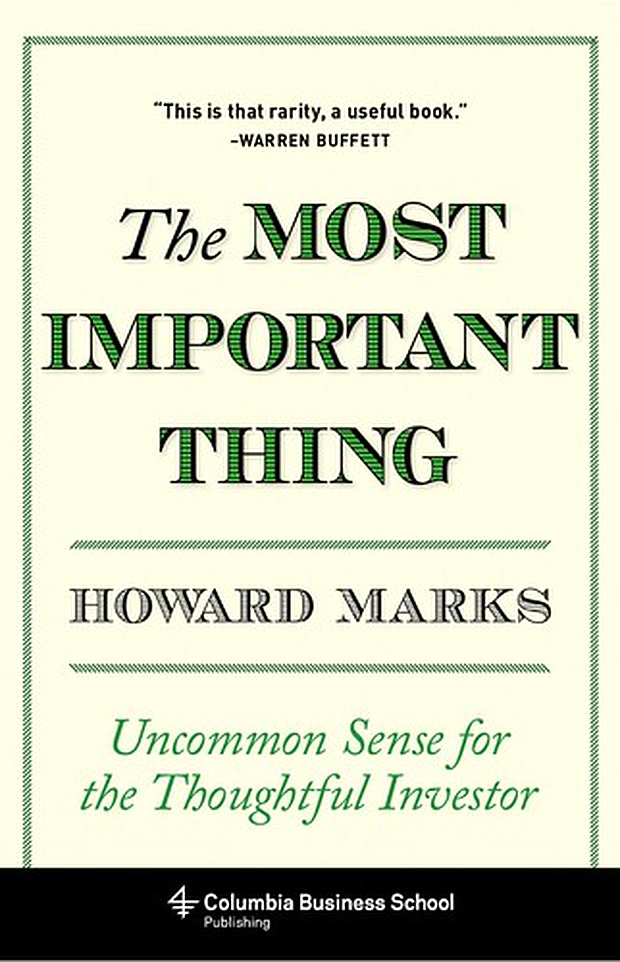
The Most Important Thing
Get on Amazon →
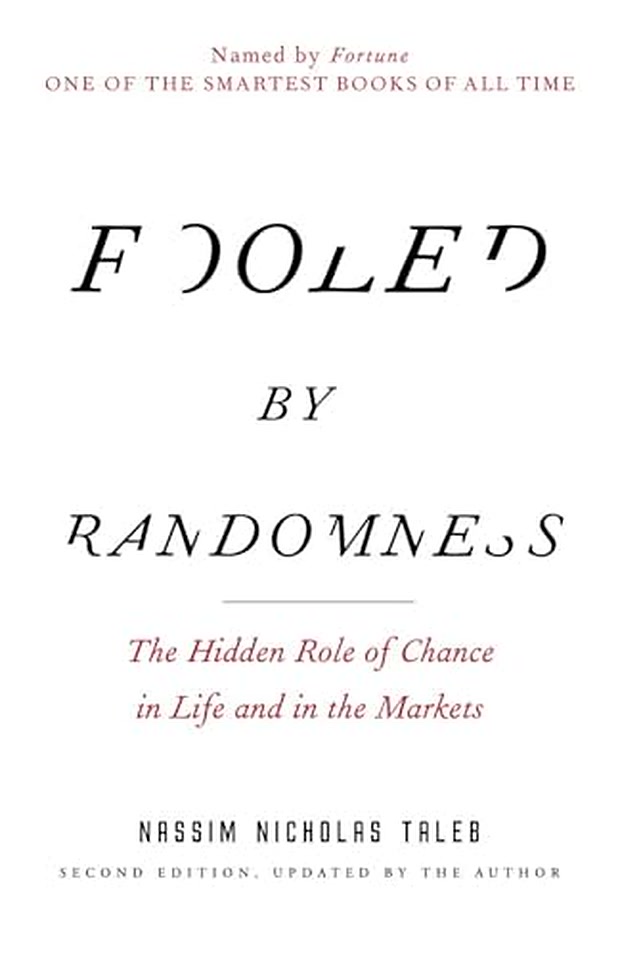
Fooled by Randomness
Get on Amazon →
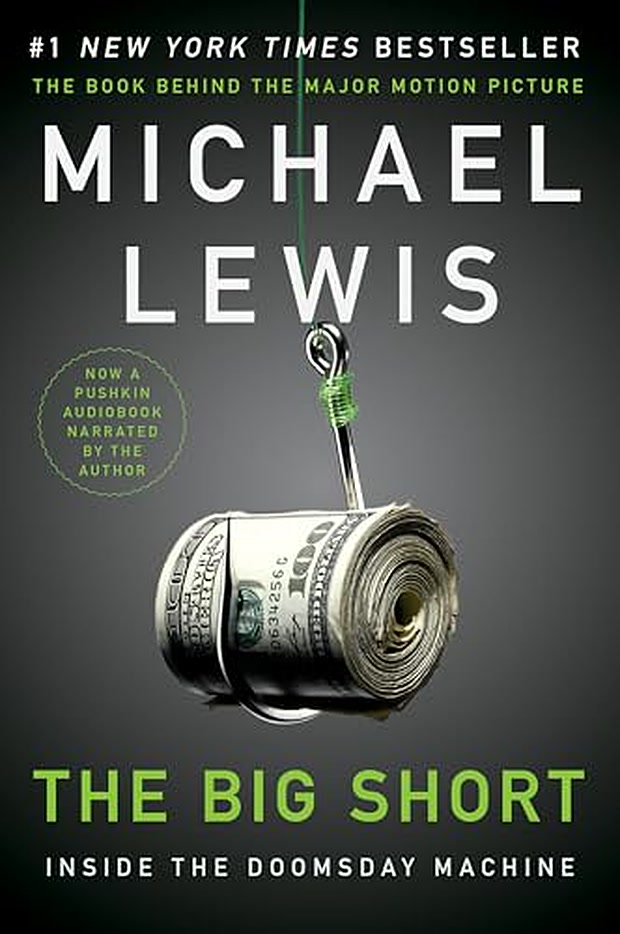
The Big Short
Get on Amazon →
As an Amazon Associate I earn from qualifying purchases.