Howard Marks
2002 05 31 The Realists Creed
© Oaktree Capital Management, L.P.
All Rights ReservedMemo to: Oaktree Clients
From: Howard Marks Re: The Realist's Creed
Early this year, I was asked to write an article for "Trusts & Estates" magazine. Here it is,
in part cobbled together from things I've writ ten in the past, and slightly changed from the
version that was published in April. The editors wanted me to recommend a course of investment action for beneficiaries and
their fiduciaries. To most people that mean s deciding how much to put into stocks and
bonds (and which ones), and whether private equ ity and hedge funds should be included.
It usually sounds easy: all you have to do is make a few simple judgments about the future. I decided to write a very different ar ticle: it's going to te ll you how hard investing
is, and how you can best equip yourself for the task.
UFirst U, I think investing must be base d on a firmly held belief system . What do you
believe in, and what do you reject? Put anothe r way, what are the principles that will
guide you? For me, the starting point consis ts of deciding which approach to take in dealing with the
future. That decision primarily revolve s around choosing between two polar opposites:
what I call the "I know" school and the "I don't know" school.
Most of the investment professionals I've met over my 33 years in the industry fall
squarely into the "I know" school. These ar e people who believe they can discern what
the future holds, and in their world investing is a simple matter:
First you decide what the economy is going to do in the period under consideration.
Then you figure out what the impact will be on interest rates.
From this you infer how the s ecurities markets will perform.
You choose the industries that will do best in that environment.
You make judgments about how the industries' companies will fare in terms of profits.
Based on all of this information, you pick stocks that are bound to appreciate.
End of story. Of course, the usefulness of this approach depends entirely on people's
ability to make these decisions correctly. What if you're wrong about the economy?
What if you're right about the economy but wrong about its impact on a company's
profits? Or what if you're ri ght about profits but the valua tion parameters contract, and
thus the price? The bottom lin e is that the members of this school think th ese things are
knowable. I know lots of people who are perpetually and constitutionally optimistic
about both the long-term future for stocks
Uand U their ability to make these judgments
correctly.
© Oaktree Capital Management, L.P.
All Rights ReservedOn the other hand, I and most of the investors with whom I feel an affinity belong to the
"I don't know" school. In short, (1) we f eel it's impossible for anyone to know much
about a vast number of things, (2) we cons ider it especially difficult to outperform by
guessing right about the directi on of the economy and the markets, (3) we spend our time
trying to know more than the next person about specific micro situati ons, and (4) we think
more about what can go wrong than about what can go right. In contrast to the "I know"
school, people in this group are more cautious and feel a strong need for downside
protection. Sticking to this approach requires some solid building blocks. One of those is contrarianism . Basically that means leaning away from the direction chosen by most
others. Sell when they're euphoric, and buy when they're afraid. Sell what they love, and
buy what they hate. In gene ral, I think you'll find few bargains among the investments
that everyone knows about, unders tands, feels comfortable wit h, is impressed by and is
eager to own. Instead, the best bargains usually lie among the things people aren't aware of, don't fully understand, or consider arcane, unseemly or risky. Closely related to contrarianism is skepticism . It's a simple concept, but it has great
potential for keeping investors out of trouble: If it sounds too good to be true, it
probably is . That phrase is always heard
Uafter U the losses have piled up – be it in
portfolio insurance, "market neutral" funds , dot-coms, or Enron. My career in money
management has been based on the convicti on that free lunches do exist, but not for
everyone, or where everyone's looking, or without hard work and superior skill. Skepticism needn't make you give up on superior risk-adjusted returns, but it should make
you ask tough questions about the ease of accessing them.
Thus I also advocate modest expectations . To shoot for top-quartile performance every
year, you have to hold an idiosyncratic portfo lio that exposes you to the risk of being
outside the pack and dead wrong. It's behavior like that that leads to managers being
carried off the field when things go poorly – an d to clients losing lots of money. It's far
more reasonable just to try for performance that's consistently a little above average.
Even that's not easy to achieve, but if accomplished for a long period it will result in an
outstanding track record. I think humility is essential, especially concerning the ability to know the future. Before
acting on a forecast, we must ask whether th ere's good reason to think we're more right
than the consensus view already embodied in prices. I think it's possible to get a
knowledge advantage with regard to under-researched companies and securities, but only
through hard work and skill. Finally, I'm a strong believer in investing defensively . That means worrying about what
one may not know, about what can go wrong, and about losing money. If you're worried, you'll tend to build in greater margin for erro r. Worriers gain less when everything goes
right, but they also lose less – and stay in the game – when th ings return to earth. All of
Oaktree' s activities are guided more by one principle than any other: if we avoid the
losers, the winners will take care of themselves . We're much more concerned about
© Oaktree Capital Management, L.P.
All Rights Reservedparticipating in a loser than we are about letting a winner get away. In my experience,
long-term investment success can be built much more reliably on the avoidance of
significant losses than it can on the quest for out sized gains. A high ba tting average, not a
swing-for-the-fences style, offers th e most dependable route to success.
USecond U, I'd advise you to approach the enti re subject of forecasts and forecasters
with extreme distrust . Reduced to the absolute minimum, investing consists of just one
thing: Making judgments about the future. And the future is inherently uncertain. Everyone
looks for help in dealing with this uncertaint y, and their usual recourse is to put faith in
forecasters. How could they not? Most fo recasters are highly articulate, represent
prestigious institutions, and exude total conf idence in their knowledge of the future.
The problem, however, is that they're not ofte n right, or at least no t consistently more
right than others. And almost never do th ey (or anyone else) r ecord and assess their
accuracy over time. Here's the way I view the forecasting game.
There are hundreds, or more likely thousands, of people out there trying to predict the
future, but no one has a record much better than anyone else. Given how valuable
superior forecasts can be, recipients should wonder why anyone who was capable
of consistently making them would distribute them gratis .
Market prices for assets already incorporate the views of the consensus of forecasters.
Thus holding a consensus view, even if it' s right, can't help you make above-average
returns.
Non-consensus views can make you a lot of money, but to do so they must be right.
Because the consensus reflects the forecasti ng efforts of a large number of intelligent
and informed people, however, it's usually th e closest we can get to right. In other
words, I doubt there's anyone out there with non-consensus views that are right
routinely.
Most of the time, the consensus forecast extr apolates current observations. Predictions
for a given parameter usually bear a strong resemblance to the level of the parameter
prevailing at the time they're made. Thus predictions are often close to right when
nothing changes radically, which is the case most of the time, but they can't be counted
on to foretell the important sea changes. And as my friend Ric Kayne says, "everything important in financial histor y has taken place outside of two standard
deviations." It's in predic ting radical change that extrao rdinary profit potential exists.
In other words, it's the
Usurprises U that have profound market impact (and thus
profound profit potential), but there's a good reason why they're called surprises:
it's hard to see them coming!
Each time a radical change occurs, there's someone who predicted it, and that person
gets to enjoy his fifteen minutes of fame. Usually, however, he wasn't right because
© Oaktree Capital Management, L.P.
All Rights Reservedof a superior ability to see the future, but rather because he regularly holds extreme
positions (or perhaps he's a dart thrower) and this time the phenomenon went his way.
Rarely if ever is that person right twice in a row.
So forecasts are unlikely to help us gain an advantage, but that doesn't make people stop putting their faith in them. It's unsettling to re alize how much in the dark we investors are
concerning future developments. But there's one thing worse: to ignore the limits of our
foresight. The late Stanford beha viorist Amos Tversky put it best: "It's frightening to
think that you might not know something, but more frightening to think that, by and
large, the world is run by people who have faith that they know exactly what's going
on."
UThird U, I think it's essential to remember th at just about everything is cyclical .
There's little I'm certain of, but these things are true: Cycles always prevail eventually.
Nothing goes in one direction forever. Trees don't grow to the sky. Few things go to zero.
And there's little that's as dangerous fo r investor health as insistence on
extrapolating today's events into the future.
The economy will not rise forever. Industrial trends won't continue indefinitely. The
companies that succeed for a while often w ill cease to do so. Company profits won't
increase without limitation. Investor psychology won't go in one dire ction forever, and
thus neither will security prices. An invest ment style that does best (or worst) in one
period is unlikely to do so again in the next.
That was really the problem with the tec hnology bubble. Investors were willing to pay
prices that assumed success forever. They ignored the economic cycle, the credit cycle
and, most importantly, the corporate life cycle. They forgot that profitability would bring
imitation and competition, which would cut into – or eliminate – profitability. They
overlooked the fact that the sa me powerful force that made their companies attractive –
technological progress – could at some point render them obs olete. And they failed to
consider that the investing fads in favor of these technologies, companies and stocks
could reverse, with dire consequences.
UFourth U, investors should bear in mind the role played by timeframe. It seems
obvious, but long-term trends need time in orde r to work out, and time can be limited. Or
as John Maynard Keynes put it, "Markets can remain irrationa l longer than you can
remain solvent." Whenever you're tempted to bet heavily on your conviction that a given
phenomenon can be depended on in the long r un, think about the six-foot tall man who
drowned crossing the stream that was five feet deep on average. One of the great delusions suffered in the 1990s was that "stocks always outperform." I
agree that stocks can be counted on to beat bonds, cash and inflation, as Wharton's Prof.
Jeremy Siegel demonstrated, but only with the qualification "in the l ong run." If you have
thirty years, it's reasonable to expect equity returns to be superior to those on bonds. For
someone with a thirty-year timeframe, the NASDAQ's decline since 2000 may turn out to
be a matter of indifference. But it hasn't fe lt that way to the people holding the stocks.
© Oaktree Capital Management, L.P.
All Rights ReservedThe need for time came into play in another way for the technology and
telecommunications entrepreneurs. Many raised the money they needed for a year or two
and proceeded to burn it up. They counted on bei ng able to raise more later, but in 2000-02
capital has been denied even to worthwhile ideas. Lots of companies never got the chance to reach profitability. They simply ran out of time.
UFifth U, you must never forget the key role played by valuation . Investment success
doesn't come primarily from "buying good things ," but rather from "buying things well"
(and the difference isn't just grammatical). It's easy for most people to tell the
difference between a good company and a bad one, but much harder for them to
understand the difference between a cheap stock and an expensive one . Some of the
biggest losses occur when peopl e buy the stocks of great comp anies at too-high prices. In
contrast, investing in terrible companies can produce huge profits if it's done at the right
price. Over time, investors may shift their fo cus from dividend yield to p/e ratio, and they
may stop looking at book value, but that doe sn't mean valuation can be considered
irrelevant. In the tech bubble, buyers didn't worry about whether a stock was priced too high because
they were sure someone else would be willi ng to pay them more for it. Unfortunately,
this "greater fool theory" only works until it doesn't. They also thought the technological
developments were so great that the compan ies' stocks could be bought regardless of
price. In the end, though, when newness b ecomes old, flaws appear and investor ardor
cools, the only thing that matters is the stoc k's price . . . and it's usually much lower.
Most shortages – whether of commodities or securities – ease when high prices inevitably cause supply to rise and satisfy the demand. And no fad lasts forever. Thus valuation
eventually comes into play, and those who are holding the bag when it does are forced to face the music.
USixth U, beware the quest for the simple solution . Two important forces drive the search
for investment options: the urge to make mone y and the desire for help in negotiating the
uncertain future. When a market, an individual or an investme nt technique produces
impressive returns for a while, it genera lly attracts excessive (and unquestioning)
devotion. I call this solution- du-jour the "s ilver bullet."
Investors are always looking for it. Call it the Holy Grail or the free lunch, but everyone
wants a ticket to ri ches without risk. Few people question whether it can exist, or why it
should be available to them. At the bottom line, hope springs eternal. Thus investors pursued Nifty-Fifty growth stock investing in the 1970s, portfolio insurance in the '80s, and
the technology boom of the '90s. They aligne d themselves with "geniuses" they thought
would make investing easy – be it Joe Gra nville, Elaine Garzar elli or Henry Blodgett.
But the silver bullet doesn't exist. No stra tegy can produce high rates of return without
risk. And nobody has all the answ ers; we're all just human. Markets are highly
dynamic and, among other things, they function over time to take away the
© Oaktree Capital Management, L.P.
All Rights Reservedopportunity for unusual profits . Unskeptical belief that the silver bullet is at hand
eventually leads to capital punishment.
USeventh U, you must be aware of what's going on around you in terms of investor
psychology. I don't believe in the ability of forecas ters to tell us where prices are going,
but an understanding of where we are in terms of investor psychology can give us a hint.
When investors are exuberant, as they were in 1999 and early 2000, it's dangerous. When
the man on the street thinks stocks are a gr eat idea and sure to produce profits, I'd watch
out. When attitudes of this sort make fo r stock prices that assume the best and
incorporate no fear, it's a formula for disaster. I find myself using one quote, from Warren Buffett, more often than any other: "The less
prudence with which others conduct their af fairs, the greater prudence with which
we should conduct our own affairs." When others are euphoric, th at puts us in danger.
When others are frightened and pull back, their behavior makes bargains plentiful. In other words, what others are thinking and doing holds substa ntial ramifications for you.
And that brings us full circle to the importance of contrarianism.
* * *
I've cataloged above the "mental arsenal" I feel is needed in the battle for investment
success. I'll proceed below to illustrate the application of some of these concepts to two key asset classes: common stocks , the grand-daddy of all active investments, and hedge
funds , a much smaller area that is in the proc ess of attracting a lot of attention (and
capital).
UCommon stocks U – Among the mantras that were re peated in the past decade, few
received as much credence as "stocks outperf orm." Wharton's Professor Jeremy Siegel
documented in his book, "Stocks for the Long Run," that equities have beaten bonds, cash
and inflation over almost all long periods of tim e. In fact, his gra ph of the movements of
the stock market since 1800 looks like a straig ht line rising from lower left to upper right.
Evidence like this allowed people to invest h eavily in the stock market while continuing
to sleep well. Little did they know that the price gains that made them feel so sanguine
about their positions were dramatically increasing their risk. I am a great believer in co mmon stock investing, but I hol d tight to a few caveats:
Return expectations must be reasonable.
The ride won't be without bumps.
It's not easy to get above-market returns.
We live in the world's most productive econom y, under a very effective capitalist system,
at a wonderful point in time. In genera l, it's great to own productive assets like
companies and their shares. But occasionally, people lose tr ack of the fact that in the
long run, shares can't do much bett er than the companies that issue them . Or to
© Oaktree Capital Management, L.P.
All Rights Reservedparaphrase Warren Buffett, when people forget that corporate profits grow at 8 or 9% per
year, they tend to get into trouble. It's never clear what base period makes for a relevant comparison, but between 1930 and 1990, annual returns from stocks averaged abou t 10% year. Periods when they did better
were followed by periods when they did wors e. The better periods were usually caused
by the expansion of p/e ratios, but valuations tended to return from the stratosphere, and
in the long run, returns roughl y paralleled profit growth.
There always will be bull markets and bear markets. The bull markets will be welcomed warmly and unskeptically, because people will be making money. These markets will be propelled to great heights, usually by the rationa lization that "it's different this time"; that
productivity, technology, globalization, lower taxation – something – has permanently
elevated the prospective return from stocks. The bear markets will come as a shock to th e unsuspecting, demonstrating that, most of
the time, the world doesn't change that muc h. For example, when you look at Siegel's
200-year straight-line stock market graph, no hiccup is visible in 1973-74. Try telling
that to the average equity inve stor, who lost half his money.
The bottom line is that risk of fluctuation alwa ys is present. Thus stocks are risky unless
your time frame truly allows you to live through the downs while awaiting the ups. Remember what Lord Keynes said about the ab ility of markets to remain irrational for
long periods of time. And remember that it's possible for you to be forced to sell at the bottom – by emotions, competitive pressure or the need for liquidity – turning temporary volatility (the theoretical definition of risk) into very real permanent loss.
In order to get more out of the ups of stocks and try to lessen the pain of the downs, most
people turn to active management via ma rket timing, group rotation, industry emphasis
and stock selection. But it's just not that easy. The American Way – earnestly applying
elbow grease – doesn't often payoff. For a model, don't think about the diligent
paperboy on his route; think about trying to profit from flipping a coin .
I say that because I believe most markets ar e relatively "efficient," and that certainly
includes the mainstream stock market. Where large numbers of investors are aware of an
asset's existence, have roughly equal access to information and are diligently working to
evaluate it, the market operates to incorporate their collective interpretation of the information into a market price. While that price is often wrong, very few investors are capable of consistently know ing when it is, and by how much, and in which direction.
The evidence is clear: most investors underperform the market. They (a) can't see the future, (b) make mistakes that keep them at a disadvantage, (c) accept high risk in their
effort to distinguish themselves, and (d) sp end money trying (in the form of market
impact and transaction costs).
© Oaktree Capital Management, L.P.
All Rights ReservedOf course, there are individuals who beat the market by substantial margins, and
they become famous. The mere fact that they attract so much attention proves how
rare they are. (That's the meaning of the adage "it's the exception that proves the rule.")
Adding to return without adding commensurately to risk requires rare understanding of
how money is made and what constitutes valu e. Far more managers promise it than
deliver. Most active managers go through times when thei r biases or their guesses lead them to do
things that beat their assigned benchmark, which they attr ibute to their skill, and times
that are the opposite, which they attribute to being blindsided by the unforeseeable (or to
some defect in the benchmark). But these are two sides of the same coin, and in the long run the average manager adds little. Usuall y, active management will not allow you to
beat the stock market, or to en joy the fruits of the market without fully bearing its risk.
How do I view the outlook for stocks? The period since I started managing money in 1978 has been incredible. There were a few bad days and quarters, but through 1999
there wasn't a single year when the S& P 500 lost 5%. From 1978 through 1999, the
return on the S&P 500 averaged 17.6% per ye ar. That rose to 20.6% for 1991-99 and
28.3% for 1995-99. I doubt there's ever been a better 22-year run; to ask for more would
be just plain piggish. But I don't think it'll be anything like that in the years just ahead,
and of course there's been a considerable correction already. The observers I most respect foresee single digit average returns for common stocks, and
I agree. Equity returns have three components: profit increase, multiple expansion and dividend yield. The last is minimal and the seco nd can't be counted on from here. So that
means we're down to the rate of increase in corporate profits, which is likely to be in
single digits. Single digit returns would be be low the historic average, but after such a
great 22-year run, a little le ss wouldn't be unreasonable.
UHedge Funds U – Perhaps because they were new to the market, many who participated in
the equity boom of the late 1990s were su rprised by the suddenness with which their
profits evaporated in the subsequent correc tion. Now they're looking for a new path to
profit without risk, and many think they've f ound it in hedge funds. Their reasons for
migrating include the good performance of hedge funds, especially amid the recent chaos, and the modest prospective returns availabl e in the mainstream stock and bond markets.
First, how about a definition. Generally speaking, a hedge fund is an unregulated, private investment partnership whose ma nager receives a percen tage of the profits. To "hedge" is
to intentionally include positions that can be depended on to move counter to each other under most circumstances, and thereby to mitigate exposure to developments in the environment. "Hedge fund" is a misnomer for many of today's funds, however, because
unlike the days when the term first arose, hedging has become far from universal. The funds I'm interested in do hedge. They're designed to systematically take advantage of market inefficiencies and to capture ma nagers' skill while limiting susceptibility to
market fluctuations. Arbitrage, long/short, hedge and market-neutral strategies fall into
© Oaktree Capital Management, L.P.
All Rights Reservedthis category. Most strive to earn returns in the teens on a consistent basis, with relative
indifference and insensitivity to the performan ce of the mainstream markets. If they can
do it, they're a great idea.
Today, hedge funds, also sometimes called "a bsolute return" funds, are being promoted
heavily by brokerage firms, mutual fund or ganizations and invest ment advisers and
popularized by the media. They are in the pr ocess of becoming the next investment fad.
And there's good reason why they should. Espe cially given the weak competition I see
coming from mainstream investment media lik e stocks, an appropriate mantra for the
coming decade might be "low double digits ai n't bad." If you can identify investment
managers who possess enough skill to consisten tly deliver such returns, you should hire
them. And there's a better-than-average chan ce they'll be found in the hedge fund arena,
where the managers get to share in the profits. However, a few caveats are in order:
Expectations still must be reasonable . Investors must realize that very few
managers are truly capable of earning before-fee returns of 12% or 15% steadily and
with low correlation to the mainstream markets. Anything approaching 20% is
Herculean.
Most returns really won't be "absolute." I have seen lots of "hedge funds" and
"market neutral funds" drop precipitously. That's because it's unusual for portfolio
returns to be entirely divorced from their environment. "Zero correlation" with the market is rarely attainable; "low correlation" may have to suffice.
Money flows will play a big role . In general, the good records have been built on
small amounts of money. And those reco rds will attract larg e amounts of money.
There are several consequences.
First, records simply may not be capable of extrapolation. To handle more money, a
manager may have to invest faster, redu ce selectivity, put more dollars into each
position, put on a larger number of po sitions, broaden the fund's range of
activities, and/or add new staff memb ers. All of these can have negative
implications for returns.
Second, many of the best managers with skill
Uand U discipline are already closed to new
money, or will reach the point when they are. Thus in the extreme, as Groucho Marx
would have put it, "I woul d never invest my money w ith anyone who'd take it."
And third, when there's too much money in an area, even funds that are closed can be
affected. Long-Term Capital Management found others emulating its trades and
eventually lost its opportunity because t oo much money had piled into its niches.
The wrong people will get money . The rush to invest in an area gives money to
managers who shouldn't get it. When the best are closed, the rest will be funded .
© Oaktree Capital Management, L.P.
All Rights ReservedSecond-string managers will split off from established groups and get money based on
their old fund's record (regardl ess of how much of it they we re responsible for). Thus,
as the amount of money in the area rises, the average quality of the managers may
fall.
Fees can eat up skill . When the demand for funds outstrips supply, fund managers
have the ability to raise fees and thereby a ppropriate for themselves a larger portion of
their funds' returns.
Disappointments will be many. Due to the factors enumerated above, the next few
years will see many investors fail to get what they hoped for . . . as usual. One of my
favorite sayings is "what the wise man does in the beginning, the fool does in the end." Over the last 20-30 years, a few tale nted hedge fund managers built successful
records with relatively small amounts of cap ital. I believe the period ahead will see
lots of people raise more than they should; thus it will have to be navigated with care.
All investment trends run a high risk of be ing carried to extremes. (For a shining
example, take a look at venture capital in 2000. ) Despite this, I think absolute return
investing deserves your atten tion. But you should commit only after a lot of investigation
and with your eyes wide open. Remember, th ere is no such thing as a silver bullet.
* * *
The main thing I've tried to indicate here is that investing isn't easy. Or better put,
Usuperior U investing isn't easy. It's easy to do aver age. In fact, there are vehicles – index
funds – that exist for the explicit purpose of delivering aver age performance at low cost,
and they are completely capable of doing so. But most people want to do be tter than the average. They want higher returns, and
achieving higher returns without assuming commensurately highe r risk is the hard part.
It's easy to make guesses about the future but ha rd to be consistently more right in those
guesses than your fellow investor, and thus hard to consistently outperform. Doing the
same thing others do exposes you to fluctuations that in part are exaggerated by their actions and your own. It's certainly undesirable to be part of the herd when it stampedes off the cliff, but it takes rare skill, insight and discipline to avoid it.
The thing I'm surest of is that the solution doesn't lie in making guesses about the big-picture future. Rather, it lies with invest ors who possess skill, insi ght and discipline.
There are times when they'll underperform – times like 1998-99, when aggressiveness
was rewarded far more than caution. But if you can find those people, you should stick
with them. For me, the laundry list of their desired characteristics is clear:
adherence to the "I don' t know" school of thought
contrarianism, skepticism, modest expectations, humility and defensiveness
eschewing of macro forecasts
© Oaktree Capital Management, L.P.
All Rights Reserved attention to the cyclical nature of things
consciousness of timeframe
concentration on valuation
disdaining the hunt for the silver bullet
awareness of prevaili ng investor psychology
You can go with opinions about the future. Ev eryone's got them, and what they call for in
terms of investment behavior usually is obvious. In other words, the "I know" school makes investing sound easy – although in my opinion it's not often right.
Or you can join me in the "I don't know" school, where you must:
face up to the uncertainty that surrounds the macro future;
concentrate on avoiding pitfalls;
invest in a few areas of specialization based on in-depth analysis, conservatively
estimated tangible values and modest purchase prices; and
be prepared for returns that trail th e risk-takers when markets are hot.
This may be the less common path, and certainly the less rosy, but it's the one I'd
much rather count on for success in the long run.
May 31, 2002
© Oaktree Capital Management, L.P.
All Rights ReservedLegal Information and Disclosures
This memorandum expresses the views of the author as of the date indicated and such views are
subject to change without notice. Oaktree has no duty or obligation to update the information contained herein. Further, Oaktree makes no rep resentation, and it should not be assumed, that
past investment performance is an indication of future results. Moreover, wherever there is the
potential for profit there is also the possibility of loss. This memorandum is being made available for educational purposes only and should not be used
for any other purpose. The information contai ned herein does not constitute and should not be
construed as an offering of advisory services or an offer to sell or solicitation to buy any
securities or related financial instruments in any jurisdiction. Certain information contained herein concerning economic trends and performan ce is based on or derived from information
provided by independent third- party sources. Oaktree Capita l Management, L.P. (“Oaktree”)
believes that the sources from which such informa tion has been obtained are reliable; however, it
cannot guarantee the accuracy of such inform ation and has not independently verified the
accuracy or completeness of such information or the assumptions on which such information is
based. This memorandum, including the information cont ained herein, may not be copied, reproduced,
republished, or posted in whole or in part, in any form without the prior written consent of
Oaktree.
Recommended Reading
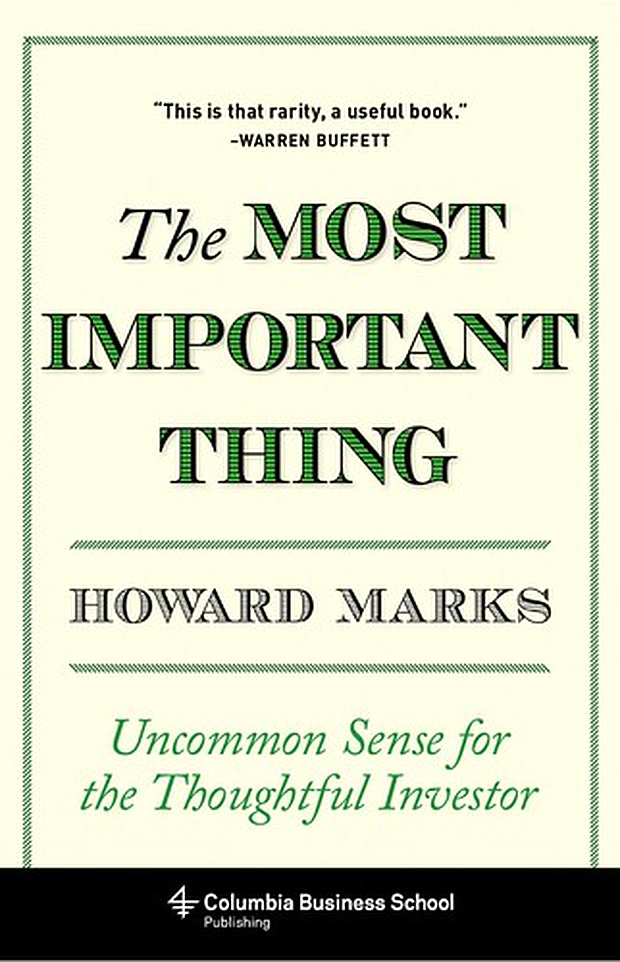
The Most Important Thing
Get on Amazon →
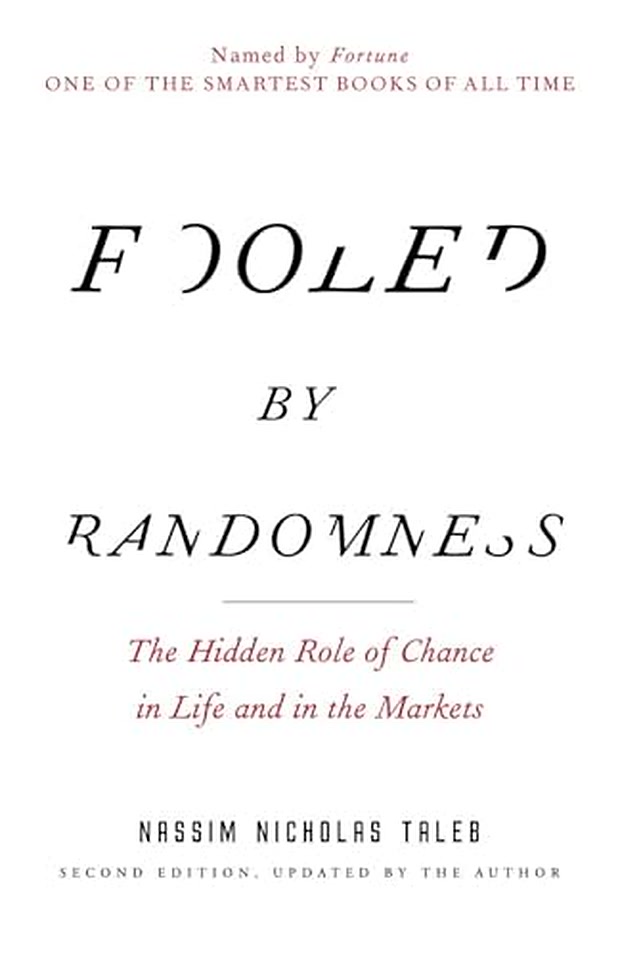
Fooled by Randomness
Get on Amazon →
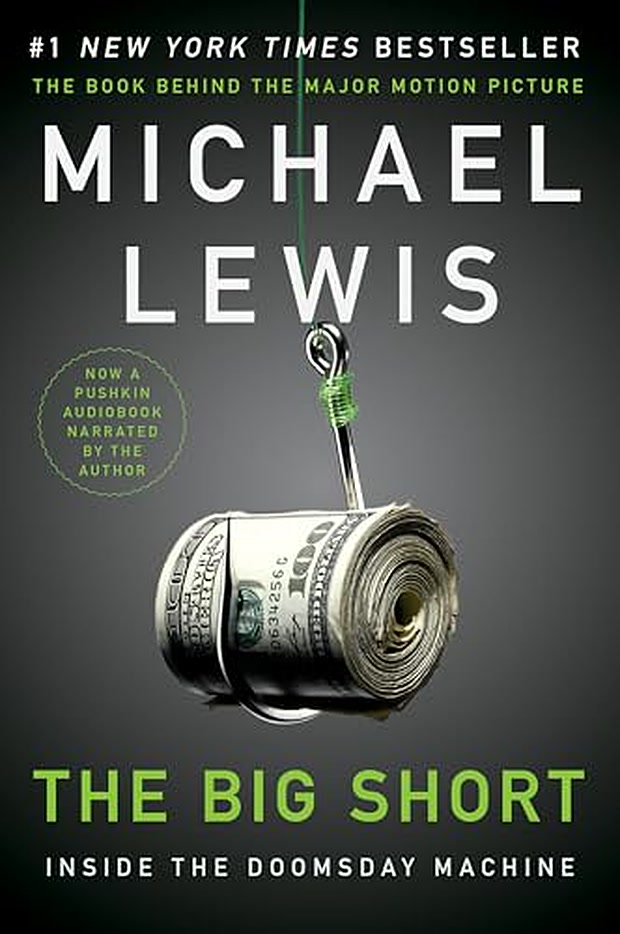
The Big Short
Get on Amazon →
As an Amazon Associate I earn from qualifying purchases.