Howard Marks
2001 07 11 Whats It All About Alpha
© Oaktree Capital Management, L.P.
All Rights ReservedMemo to: Oaktree Clients
From: Howard Marks Re: What's It All About, Alpha?
With apologies to Burt Bacharach and Dionne Warwick, whose 1966 rendition for the movie "Alfie" was much more artistic, I coul dn't resist adapting thei r title for a memo on
investment theory. What's it all about, indeed? Everyone talks about alpha . . . and beta, risk and return, and
efficiency and inefficiency. But I believe fe w people use them to mean the same thing, or
correctly. Thus the thinking I did about alpha while writing "Safety First" in April has
convinced me to set out my views on all of these subjects. In this connection, my 1967-69 attendance at th e University of Chicago Graduate School
of Business was pivotal. I had previously been at a non-theoretical Wharton, where I
learned investment practice à la Graham and Dodd but not one word on what I'm about to discuss. At Chicago I found a new theory of investments that would revolutionize the
field. My exposure to it was eye-opening and kept me from becoming an unquestioning
member of what I call the "I know" school of investing (where people think a little effort
is all it takes to know the future direction of any stock or market). The 32 years since
Chicago have given me enough time to forget a lot of the theory I learned . . . but also,
most importantly, the real-world experience needed to leaven it, leading to my own
synthesis of theory and practice.
UMarket efficiency U – A great deal of how one views the investment world depends on
one's position on the subject of market efficiency. Rather than reinvent my own wheel, I'll lift parts of my memo "Irrational Exuberance" from May 2000. (Thankfully, when
you copy from yourself it's not plagiarism.) First, I'll provide my take on the efficient ma rketeers' view. Then, I'll describe my own
version of market efficiency. I'll admit again that academicians don't share my view and theory says I'm wrong. But my approach works for me, and I'll restate it below.
While at Chicago, one of the first things I studied was the Efficient Market Hypothesis,
which states:
There are many participants in the markets, and they share roughly equal access to all
relevant information. They are intelligent, highly motivated and hard working. Their
analytical models are widely known and employed.
Because of the collective efforts of these participants, information is reflected fully
and immediately in the mark et price of each asset.
© Oaktree Capital Management, L.P.
All Rights Reserved
Thus, market prices provide accurate estimates of assets' intrinsic value, and no
participant can consistently identify and profit from in stances when they are wrong.
Assets therefore sell at prices from which they can be expected to deliver risk-
adjusted returns that are "fair" relative to other assets. Ri skier assets must offer higher
returns in order to attract buyers. The market will set prices so that appears to be the
case, but it won't provide a "free lunch." That is, there will be no incremental return that is not related to (and co mpensatory for) incremental risk.
I believe strongly that some markets are quite efficient, including those for the world's
leading stocks and bonds. Take international fixed income, for instance. Here, people try
to decide whether British, French or Ge rman government bonds are the cheapest at a
given time and establish portfolio weigh tings accordingly. The primary differences
between these bonds, it seems to me, relate to their issuing countri es' rates of economic
growth and inflation. But it's to make allo wance for those differences that there exist
differential interest rates and floating excha nge rates. And aren't those some of the
world's most closely watched phenomena, with hundreds of sophisticated financial
institutions on both sides of ev ery question? Can any one participant realistically expect
to be able to do a superior job in such a market? Stocks are less homogenous, and there's more to choose between them, but I still think the
market for popular stocks is efficient. That's the reason why, when I left equity research
in 1978, I told Citibank I would "do anything other than spend the rest of my life choosing between Merck and Lilly." I believed in efficient markets then, and I believe in
them now. But what do I mean? When I say efficient, I mean it in the sense of " speedy," not "right." I agree that because
investors work hard to evaluate every new piece of information, asset prices immediately
reflect the consensus view of the information's significance. I do not, however, believe
the consensus view is necessarily correct . In January 2000, Yahoo! sold at $237. In
April 2001 it was at $11. Anyone who argues that the market was right both times has his head in the clouds; it has to have been wrong on at least one of those occasions. But that
doesn't mean many investors were able to detect and act on the market's error.
If prices in efficient market s already reflect the consensus, then sharing the consensus
view will make you likely to earn just an average return. To beat the market you must hold an idiosyncratic, or non-consensus, view. But because the consensus view is as close to right as most people can get, a non-consensus view is unlikely to make you more
right than the market (and thus to help you beat the market). The bottom line for me is that, although the more efficient markets often misvalue
assets, its not easy for anyone person – working with the same information as
everyone else and subject to the same psycho logical influences – to consistently hold
views that are differen t from the consensus
Uand U closer to being correct . That's what
makes the mainstream markets awfully hard to beat – even if they aren't always right.
© Oaktree Capital Management, L.P.
All Rights Reserved
UInefficiency U – Although I spent a lot of time last y ear discussing efficiency, I didn't touch
on inefficiency. This is a word I've hear d misused terribly, usually as a synonym for
"cheap," as in "the oils were fully priced last year but now they're really inefficient." First
of all, inefficiency doesn't come and go in quick bursts. Markets are inefficient for
longer-term structural reasons relating primarily to shortcomings on the part of their
participants and infrastructure. Second, "inefficient" abso lutely does not mean "cheap"
(or "dear").
To me, an inefficient market is one that is marked by at least one (and probably, as a
result, by all) of the following characteristics:
UMarket prices are often wrong U. Because access to information and the analysis
thereof is highly imperfect, market prices are often far above or far below intrinsic
values.
UThe risk-adjusted return on one asset cla ss can be far out of line with others U. Because
assets are often valued at other-than-fair prices, an asset class can deliver a risk-
adjusted return that is significantly too high (a free lunch) or too low relative to other
asset classes.
USome investors can consis tently outperform others U. Because of the existence of (a)
significant misvaluations and (b) differences between participants in terms of skill,
insight and information access, it is possible for misvaluations to be identified and
profited from with regularity.
This last point is very important in te rms of what it does and does not mean. Inefficient
markets do not necessarily give their partic ipants generous returns. Rather, it's my
view that they provide the raw material – mispricings – that can allow some people
to win
Uand others to lose U on the basis of differential skill . If prices can be very wrong,
that means it's possible to find bargains or overpay. For every person who gets a good buy in an inefficient market, someone else sell s too cheap. One of the great sayings about
poker is that, "In every game there's a fish. If you've played for 45 minutes and haven't
figured out who the fish is, then it's you." The same is certainly true of inefficient market
investing. In inefficient markets, then, it's essential that a manager have superior personal skill, or
"alpha" (see below). It's act ually far more important than in efficient markets, where
prices are so well aligned that it's hard to perform far off the average. Good evidence on
this subject is found in the table on the next page, from "Pioneering Portfolio
Management" by David Swenson of Yale.
© Oaktree Capital Management, L.P.
All Rights ReservedDispersion of Active Management Returns
Identifies Areas of Opportunity
Asset Returns by Quartile, Ten Years Ending December 31, 1997
Asset Class First Quartile Median Third Quartile Range
U.S. fixed income 9.7% 9.2% 8.5% 1.2%
U.S. equity 19.5 18.3 17.0 2.5
Int'l equity 12.6 11.0 9.7 2.9
Real estate 5.9 3.9 1.2 4.7
Leveraged buyouts 23.1 16.9 10.1 13.0
Venture capital 25.1 12.4 3.9 21.2
As the table shows, the range between the 25
Pth
P percentile and the 75 Pth
P percentile of
investors in what I think are relatively ineffi cient markets (venture capital and leveraged
buyouts) is Umuch U broader than it is in more effici ent markets (mainstream stocks and
bonds). This supports the belief that in ineffi cient markets, either (a) prices diverge more
from intrinsic values, (b) there's more variation among investors in terms of skill, (c) that variation has more impact, or (d) all of the above. Any way you slice it, hiring a superior
manager is more crucial in the inefficient markets.
UReturn U – The terms alpha and beta are derived from the basic form of an algebraic
equation, which is:
y = a + bx
Thus in investments we say a portfolio's result can be predicted by the equation:
return = alpha + (beta x the market's return)
Beta is a coefficient equal to the proportion of the market's return that the portfolio can be
expected to capture. It can be st be described as "degree of responsiveness" to the market,
or "relative volatility." An S&P index fund will have a beta of 1.0 relative to the S&P 500 (that is, it will go up and down at the same rate as the S&P). An S&P index fund
leveraged two to one would have a beta of 2.0 (i.e., it will have tw ice the response). A
portfolio consisting of half S&P index fund and half cash will have a beta of .5. A defensive equity portfolio might be expected to have a beta of .7.
Turning up your beta, whether through the use of leverage or by emphasizing more
volatile holdings, is certainly one way to tr y to add to your return. Under investment
theory it's the only way, since "b eta x the market's return" is the only non-zero term in the
above equation (more on this later). The tr ouble with relying on a high beta to enhance
your return is that it's entirely symmetrical. It cuts both ways, subt racting as much when
it's wrong as it adds when it's right, which means that it does not hing to increase your
expected return unless the unde rlying decisions are right. It epitomizes the Las Vegas
© Oaktree Capital Management, L.P.
All Rights Reservedsaying that "the more you bet, the more you wi n when you win" (but also, as I like to
point out, the more you lose when you lose).
Alpha is a variable equal to the contribution resulting from the skill of the portfolio
manager. As I wrote in "Safety First," alpha is the ability to profit consistently from
things other than the movements of the market, to add to re turn without adding
proportionately to risk, and to be right more often than is called for by chance. Examples
of its ingredients include s uperiority in (a) collecting a nd analyzing information, (b)
discerning which factors are most important in determining futu re value, and (c) resisting
the market's manic-depressive fluctuations. Alpha is what's lacking when a market is effi cient. But just as I believe there are some
relatively efficient markets, I'm also sure peopl e with alpha exist, as well as less efficient
markets where it can be put to good use.
It's essential to recognize th at investment skill isn't di stributed evenly – that the
investment world isn't de mocratic or egalitarian . That's why Peter Vermilye, the
Citibank boss who steered me toward convert ibles and high yield bonds, says only the top
10% of analysts contribute anything. It's also why I think so little of investment
management firms that describe their edge in terms of head count; an army of average
analysts will do you no good. That's because, in my view, alpha is best thought of as "
Udifferential U advantage," or skill
that others don't possess. Alpha isn't knowing something, it's knowing something
others don't know . If everyone else shares a bit of knowledge, it provides no advantage.
It certainly won't help you b eat the market, given that th e market price embodies the
consensus view of investors – who on average know what you know.
Alpha is entirely personal. It's idiosyncratic, an art form. It's superior insight; some people just "get it" better than others. Some of them are mechanistic quants; others are
entirely intuitive. Hard work is a comm on thread among the best investors I know, but
hard work alone is absolutely insufficien t to explain their superior performance.
Alpha is zero for someone with no skill (i.e ., a dart thrower). Warren Buffett, on the
other hand, seems to have lots of alpha – ev en in a market most people think of as
efficient. It's possible to have negative alpha if you're wrong more often than not.
Someone who's always wrong would have lots of negative alpha, but he'd be a great guy
to know (since you could be right all the time by doing the opposite of what he says).
Everyone knows it's a cornerstone of investme nt theory that there's no such thing as
alpha . . .
Clearly this underlies the Efficient Market Hypothesis. The market is more right
than any investor. No investor is better than any other. No one is capable of
consistently outperforming. Anecdotal evidence of superior performance is
dismissed by academicians who attribute it to luck or a too-short trial period.
© Oaktree Capital Management, L.P.
All Rights Reserved
. . . but there's something of an oxymoron afoot. Even though thousands of people
expect to make a living from active in vestment management, much of traditional
investment thinking is built on the realizat ion that alpha is severely limited (even
though the practitioners don't state it that way).
Why do I say that? Most investors claim they can outperform the market – that is, can see, assess and understand better than the av erage investor – because of superior
intelligence and hard work. Doesn't everyone th ink he can beat the market? But much of
what's actually practiced, even by Oaktree, su btly acknowledges that the ability to know
more – and if you think of it, that's a lot of what alpha really is – is quite limited.
It's a common assumption that if an investor 's portfolios are highly concentrated, they're
risky. But that assumes he can't see the future. If he could, it would be perfectly safe to
have a low level of diversification. In fact, if his foresight were perf ect, then the safest
portfolio would hold only one asset, because th at's the one he would think of most highly
(and, since he could see the future, he would of course be right). Thus diversification,
which is widely practiced even in the "I know" school of investing, represents a tacit
acknowledgement that there's a lot that investors don't know.
Investors' strong preference for liquidity is another indicator that this limitation is
accepted. Even the "I know" investors, who buy on the assumption they're right, insist on liquidity – because they know there's a good chance they'll be wrong and need to beat a retreat. But the more you can see the future , the less likely you'll be wrong, and the less
risk there is that exit ing could be difficult.
In reality, then, not just investment theory, but also a great deal of everyday practice, is
built around the acknowledgement that alph a – skill and foresight – is a scarce
commodity.
URisk U – It's essential that investors consider risk . In the time since I entered the
investment field, return has in creasingly come to be evaluate d in risk-adjusted terms.
Everyone knows that if two portf olios return 8% a year for fi ve years, the two managers
didn't necessarily do an equally good job of investing. If one did it with T-bills and the other with emerging market stocks, the first manager almost certainly did a better job –
since he earned the same return with far less risk. That's real added value, just like
earning more return with the same or less risk. To know how good a job a manager
did, then, you have to have a good idea how much risk he took .
Yet I think risk may be the area where bot h theory and many aspects of practice are
furthest from right. The firs t thing you learn in investment theory, and one of the most
widely agreed-on assumptions in practice, is th at "volatility equals risk." This premise
underlies a great deal of portf olio theory, asset allocati on, portfolio optimization and
performance assessment. But what are its merits?
© Oaktree Capital Management, L.P.
All Rights ReservedI believe the academicians of the 1950s and '60s were influenced to accept volatility as
the measure of investment risk by its two out standing virtues: it is (a) absolute and (b)
quantifiable. They can tell you precisely what the standard deviation of a stock or a
portfolio's return was in the past, and thus it only takes a little extrapolation to project
what it's going to be in the future.
I will suggest some other ways to think about risk, but (a) they will vary from person to
person and from situation to situation, and/or (b) they will not be easily quantified. Thus
they won't permit you to say that one asset or portfolio would be riskier than another
(other than possibly in a given application). You won't even be able to say how risky an
asset or portfolio was in the past. What is risk? First of all, I don't think risk is synonymous with volatility. And second,
the indicia of risk vary by asset class. At Oaktree, when we think about adding an asset to a portfolio, we ask whether the risk entailed is tolerable (i.e., within our charte r from our clients) and offset by the likely
return. And by risk we mean the ch ance of losing our clients' money.
In high yield bonds we concentrate on the risk of default and how much principal would
likely be unrecoverable. In distressed debt we wonder whether the company's assets will turn out to be worth less than we think or the reorganization will go against us. In
convertibles and emerging market equities we worry about the chance a stock will decline
and the likelihood that our protective efforts will fail to insulate us.
We do not think about volatility. With our capital in either locked- up funds or long-term
relationships, we worry only about whether the ultimate result, perhaps years down the road, will be positive or negative, and by how much. We think this is what our clients
pay us to do. But we make no claim that this approach to ri sk is subject to quan tification or numerical
manipulation. Bruce Karsh probably couldn't have quantified the riskiness of Conseco bonds at the time we bought them last June. Richard Masson and Matt Barrett probably
wouldn't have agreed with him, or with each other, on the probability of loss. Any figure
they settled on probably wouldn't have been in a form that could be equated with risk.
And even today, a year later and after having sold the bonds, we still can't quantify
the risk we took . It's a concept, a notion, a worry . . . but not a number.
This might be the right way to think about risk – it's certainly how we do it – but it
wouldn't work at all for a "quant ." He'd have no way to stat e our portfolio's risk, or its
risk-adjusted return, or tell whether our performance was superior or inferior.
Will an investment lose money? Will a pensi on fund fail to earn its actuarial assumption?
Will an endowment be unable to cover its spen ding rate? Will a retiree have less than he
needs to live on? Will a manager lose an accoun t? These are the risks – the perils – that
we think matter.
© Oaktree Capital Management, L.P.
All Rights ReservedMost pension funds have a very long time horizon, and for a university endowment it's
theoretically infinite. Volatile quarterly re turns wouldn't be a meaningful source of risk
for them as they would be for a retiree scra ping by. But once you say a given portfolio is
risky for one investor but not another, ther e ceases to be a unique number that measures
its absolute riskiness. In that case, how can you talk about its ris k, or its risk-adjusted
return?
UCorrelation U – The final analytical element to be considered when assembling securities
into portfolios is their de gree of connectedness, or correlation . As discussed above, a
one-asset portfolio would be optimal for so meone who can see the future. The main
reason for holding more than one asset is di versification. But the principal virtue of
diversification, protection from catastrophic error, is wiped out if the underlying assets
will react the same to environmen tal change and move together.
Thus it's not enough to be able to estimate return and risk in isolation; we must
understand correlation. Even if we can estimate the separate potential of two assets, we
cannot know how a portfolio combining them will behave unless we know how they will move relative to each other. Two stocks in the same industry may be highly correlated, but two companies whose products compete di rectly may not (that is, whichever one
wins, the other is likely to lose). Let's say there are two assets with high prosp ective return and risk. A portfolio consisting
of the two can have high risk if they are correlated but low risk if they are not. Thus
adding an uncorrelated, high-risk asset can re duce the overall riskiness of a portfolio.
This understanding revolutionized investing by enabling risk-averse investors to hold
high-return, high-risk assets as long as they are uncorrela ted with the rest of their
portfolio. Certainly Oaktree owes much of its very existence to the understanding of how
assets behave in combination. Tracking error, which lately has been of increased in terest, refers to a specific type of
connectedness: that between a portfolio and a benchmark. More and more, clients are
asking about managers' tracking error in th e past and monitoring it after hiring them.
A client hires managers to play specific roles in its portfolio, and it wa nts to be sure they
will do so. In considering whether to include high yield bonds in its portfolio, for example, the client may model the perfor mance of the portfolio incorporating the
Salomon Cash-Pay Index as a proxy for th e high yield bond component. Then if the
client hires a manager, it wants to be sure the manager will track the Salomon Index
closely (of course while outperforming!) Thus clients have reason to wa nt low tracking error. But if you think about it, the two
principal sources of tracking e rror are (a) over- a nd under-weightings of the securities in
the index and (b) inclusion of off-index securities. So it's obviously possible for tracking
error to be too low; an index fund would have zero tracking error, but that's not what
clients hire active managers to create. Thus we have a client who monitors our tracking
error and complains when it's too low, because they want to see active bets being made.
© Oaktree Capital Management, L.P.
All Rights Reserved
* * *
This last point illustrates what I think should be the role of theory in our industry. In
short, I think, theory should Uinform U our decisions but not dominate them.
If we entirely ignore theory, we can make big mistakes . We can fool ourselves into
thinking it's possible to know more than everyone else and regularly beat heavily
populated markets. We can buy securities for their returns but ignore their risk. We can
buy fifty correlated securities a nd mistakenly think we've divers ified. When I think of the
impact of being blind to theory, I flash back to 1970 and the frighteningly simplistic
rationale behind my colleagues' expectation of 12% a year from stocks: if they could
emulate the historic 10% retu rn with ease through indexing, it should be a snap to add a
couple of percent with just a little effort.
But swallowing theory whole can make us turn the process over to a computer and
miss out on the contribution skillful individuals can make . The image here is of the
efficient-market-believing finance professor who takes a walk with a student. "Isn't that a
$10 bill lying on the ground?" asks the student . "No, it can't be a $10 bill," answers the
professor. "If it were, someone would have picked it up by now." The professor walks
away, and the student picks it up and has a beer.
So how do we balance the two? By applyi ng informed common sense. At Chicago, I
spent a wonderful semester with Professor James Lorie. Students loved his anecdote-filled course, which we nicknamed "Lorie's Stor ies," and its visits from active investors.
True-believing theorists may have sneered at it, but it was this class that inspired me to
integrate my practical Wharton foundation a nd the Chicago theory, rather than stick
exclusively to either one. A year after graduating, I had l unch with Jim Lorie and asked – off the theoretical record
– how he would manage a portfolio. His si mple advice was informed by theory but
realistic: "I would index the core and manage the hell out of the periphery."
* * *
The key turning point in my investment management career came when I concluded that
hard work and skill would pay off best in inefficient markets. Theory informed that decision and prevented me from wasting my time elsewhere, but it took an understanding
of the limits of the theory to keep me fr om completely accepting the arguments against
active management. Theory and practice have to be balanced in this way. Certainly
neither alone is enough. July 11, 2001
© Oaktree Capital Management, L.P.
All Rights ReservedLegal Information and Disclosures
This memorandum expresses the views of the author as of the date indicated and such views are
subject to change without notice. Oaktree has no duty or obligation to update the information contained herein. Further, Oaktree makes no rep resentation, and it should not be assumed, that
past investment performance is an indication of future results. Moreover, wherever there is the
potential for profit there is also the possibility of loss. This memorandum is being made available for educational purposes only and should not be used
for any other purpose. The information contai ned herein does not constitute and should not be
construed as an offering of advisory services or an offer to sell or solicitation to buy any
securities or related financial instruments in any jurisdiction. Certain information contained herein concerning economic trends and performan ce is based on or derived from information
provided by independent third- party sources. Oaktree Capita l Management, L.P. (“Oaktree”)
believes that the sources from which such informa tion has been obtained are reliable; however, it
cannot guarantee the accuracy of such inform ation and has not independently verified the
accuracy or completeness of such information or the assumptions on which such information is
based. This memorandum, including the information cont ained herein, may not be copied, reproduced,
republished, or posted in whole or in part, in any form without the prior written consent of
Oaktree.
Recommended Reading
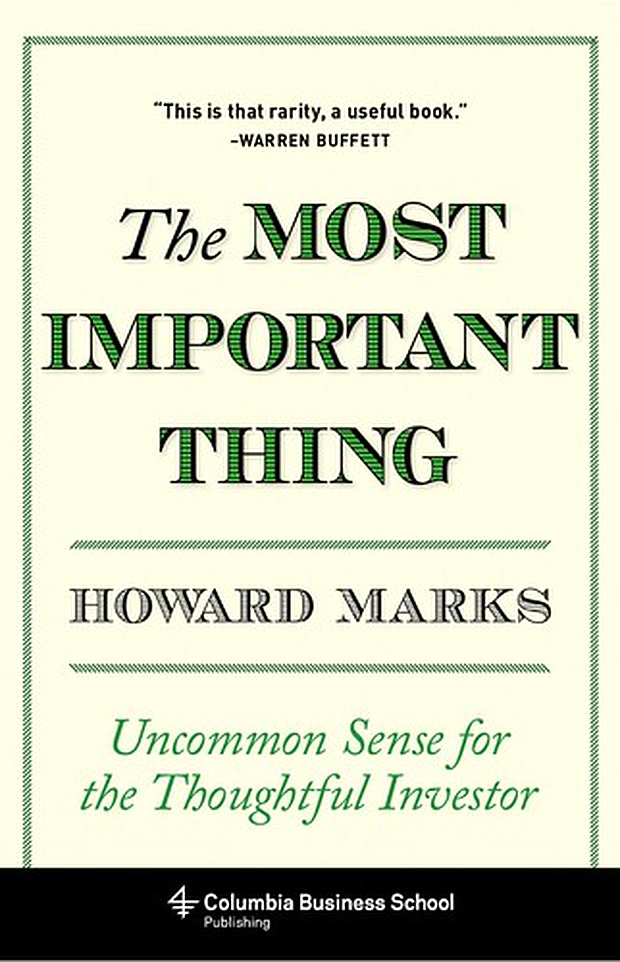
The Most Important Thing
Get on Amazon →
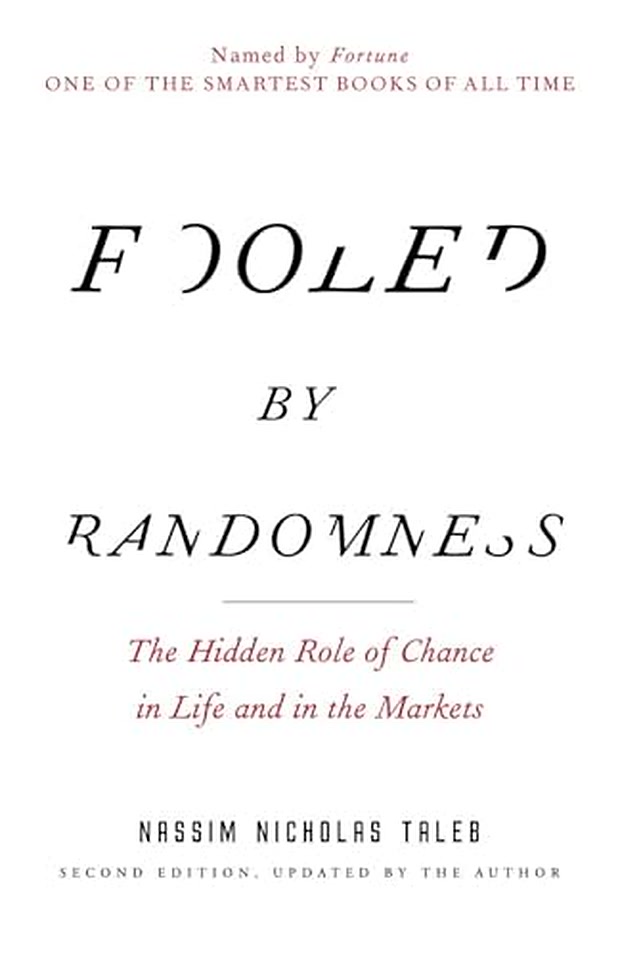
Fooled by Randomness
Get on Amazon →
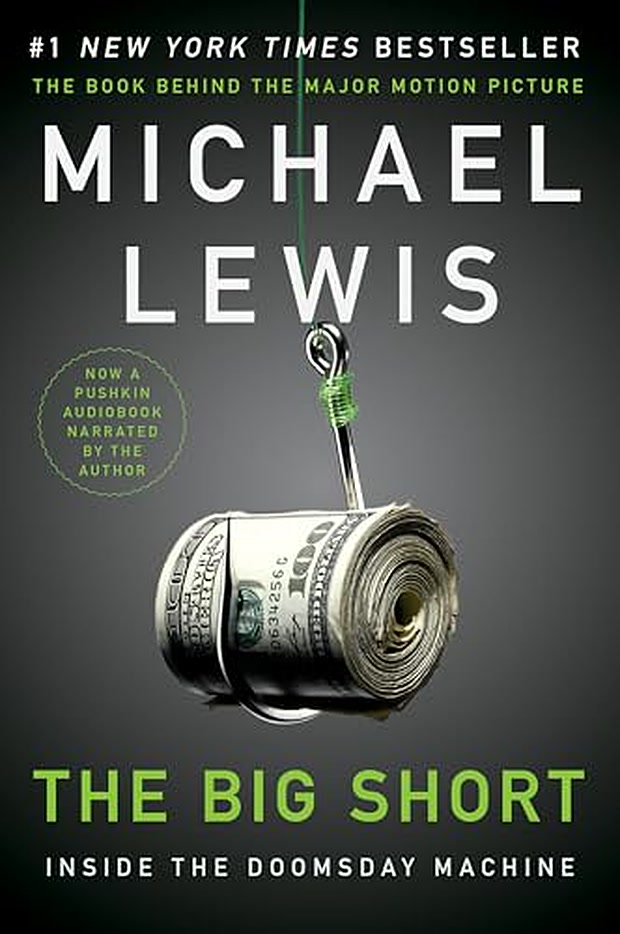
The Big Short
Get on Amazon →
As an Amazon Associate I earn from qualifying purchases.