Howard Marks
2000 11 16 Investment Miscellany
© Oaktree Capital Management, L.P.
All Rights ReservedMemo to: Oaktree Clients
From: Howard Marks
Re: Investment Miscellany
Because I've been encouraged by the respons e to my “bubble. com” and venture capital
memos, I'm going to keep writing. Over time, I collect ideas that I'm tempted to pass on
to you - nothing major, but miscellany that may be of interest. Sharing them might
become a habit; let me know if you think it should.
UCan't Get Any Respect
The behavior of IPOs and hot tech stocks in the last few years perverted everything that traditionally had held true. The episode that cr ested in March must have been the greatest
bubble of all times. Certainly money was ma de in amounts and at speeds never seen
before. Companies went from business plan to IPO in a year or two, with billions of
dollars assigned to them in market capita lizations or bestowed on their founders and
venture capital backers.
In the last twelve months, technology entrepreneurs and in vestors on both coasts bought
homes costing several tens of millions of dollars. The line of eager buyers pushed up
prices for private planes, yachts and beachfront homes. The market for art and antiques grew white hot. In short, as a friend of mine says, “money was disrespected.”
Traditional investing values were equally disrespected. Risk was viewed as the investor's friend, and caution as unnecessary and unavailing. Profits - and even profit
projections - were considered superfluous. The slow and steady ways of making money
came in last, and the riskiest schemes paid off best. Venture capital funds produced
triple-digit returns in a year, and profitless technology company IPOs did so in a day.
On the other hand, investors seemed incapab le of remembering why they had fixed
income allocations, and value stocks and absolute return strategies weren't far
behind in terms of disregard. In May of 1999, I heard John Angelo of Angelo Gordon put it br illiantly:
Twenty years ago, when I told people I could make them 15% a year, year in and year out, they said “That's impossible.” Today, when I tell people I can make them 15% a year, year in a nd year out, they say “Who cares?”
© Oaktree Capital Management, L.P.
All Rights ReservedTo illustrate, take the case of high yield bonds , whose prices have been sagging, partly
because of steady capital flows out of high yi eld mutual funds (for redeployment in
equity funds). I was asked the other da y when flows into high yield bonds would
resume. My answer: When people realize once again that 11 % is a good return.
But this disrespect for traditional investment thinking shall pass--and in fact it appears to
be in the process of doing so. In general, th e portfolios that did best last year have done
worst so far this year, and vi ce versa. Traditional investi ng values will be respected
again. I can even imagine a day when word s like “prudence” return to investors'
everyday speech.
UIt Restores Your Faith
If common sense and logic don't work, how ar e we to run our lives ? In “bubble.com” I
battologized (look that up in your Funk
& Wagnall's) regarding the dot-coms’
divergence from the old-fashioned notion that only if revenues exceed expenses is a business attractive. Instead, in 1999 busin ess models were based on giving away
products as a way to get ads in front of eyeballs, or on sel ling things for less than they
cost.
WebHouse Club is a poster child for failed giv eaways. A spin-off of Priceline.com, it let
customers name their own price for groceries and gas. There was a problem: manufacturers were unwilling to supply goods at the prices customers wanted to pay, so
WebHouse made up the difference. In “bubble. com” I related several old jokes about
the businessman who sells below cost, but I ne ver expected to see life imitate art so
precisely. Anyway, WebHouse's backers lost their enthusiasm for absorbing the losses
(the fall of their Priceline stock from $170 to $3 may have had something to do with it),
and the company ceased doing business on October 5.
I find it reassuring that entrepreneurs (and, mo re significantly, the investors expected to
fund them) are realizing that profitless “bus iness models” are untenable. Internet retail
firms are shutting down, especially those in overpopulated “spaces.” Now, I'm told, the
newest “b-to-c” among Silicon Valley employees is “back to consul ting.” Last year,
Goldman Sachs had tr ouble recruiting the MBA it needed; this year the interview rooms
are overcrowded again.
UWhat Can Reasonably Be Expected from Equities?
In a little drama that I'm sure has played out at thousands of orga nizations in the last
year, a charitable organizati on investment committee that I chair began to question its
conservative portfolio and ask whether it should have more in equities. As a result, we
commissioned some bond/stock allocation work from our cons ultants. Its conclusions
were most curious.
© Oaktree Capital Management, L.P.
All Rights ReservedTheir model called for higher equity allocations, predicting that they would lead to higher
overall returns on the portfolio Uand U lower risk. Why? Becaus e equities were projected to
return 14% and risk was defined as the proba bility of failing to average 8% over a five-
year period.
First, I said, I would never have any part in a process that equated higher equity
allocations with lower risk. I suggested that risk be define d as overall portfolio
volatility, and that took care of that.
But second, I questioned the 14% projected return from equities. Equities returned 28%
in 1995-99, I said; did someone th ink halving that made for a conservative projection?
No, I was told, the support mostly came-fro m the 13% long-run return on equities:--(I
always thought it was 10% or so, but it seems th e last five years have changed all that.)
I could only think of one way to respond: I offered to put up my money against that of
the consultant's researchers and “take the under.” I doubt st rongly that equities will
return 14% or anything like it in the next decade. Corporate earnings have traditionally
grown at single-digit rates, and I don't feel that's about to ch ange substantially. With p/e
ratios unlikely to rise further and dividends immaterial, single-digit earnings growth
should translate into single-digit average equ ity performance at best for the foreseeable
future.
In the end, I feel there has b een unreasonable reliance on the av erage historic return from
equities, be it 10% for 1929-92 or 13% for 1940-99. What's been lost tr ack of is the fact
that p/e ratios were much lower when these pe riods began and since then have risen
substantially. I just don't believe that further p/e expansion can be counted on. How do I
view the issue? I ask the bulls one question: What's been the average performance of
stocks bought at p/e ratios in the twenties? I don't think the return has been in double
digits. I'm not even sure it's been positive.
UA Framework for Understanding Market Crisis
I want to call your attention to an excellent paper with the above title written by Richard
Bookstaber, head of risk management for Moore Capital Management. It was published
in the proceedings of an AIMR seminar on “Risk Management: Principles and
Practices” (August, 1999). What smart people do is put into logical words the thoughts we may have had but never formulated or expressed. In his ar ticle, Bookstaber has
done a great job of explaining the forces behind market crisis.
I'll try to summarize his anal ysis, borrowing extensively from his words but adding my
own interpretation and emphasis, there'll be some slow going, but I think you'll find it
worthwhile.
Most people think security price movement s result primarily from the market's
discounting of information about corporate, economic or geopolitical events - so-
called “fundamentals.” If you sit with a trader, however, it's easy to observe that
prices are always moving in response to th ings other than fundamental information.
© Oaktree Capital Management, L.P.
All Rights Reserved Bookstaber says “the principal reason fo r intraday price movement is the demand
for liquidity .... In place of the conventional academic persp ective of the role of the
market, in which the market is efficient and exists solely for informational purposes,
this view is that the role of the mark et is to provide immediacy for liquidity
demanders.....By accepting the notion that ma rkets exist to satisfy liquidity
demand and liquidity supply, the framework is in place for understanding what causes market crises, which are the ti mes when liquidity and immediacy matter
most.”
“Liquidity demanders are demanders of immediacy.” I would describe them as holders of assets in due c ourse, such as investors a nd hedgers, who from time to
time have a strong need to adjust thei r positions: When there's urgency, “the
defining characteristic is that time is more important than price .... they need to get
the trade done immediately and are willing to pay to do so.”
“Liquidity suppliers meet the liquidity demand.” They may be block traders, hedge fund managers or speculators with ready cash and a strong view of an asset's value
who “wait for an opportunity when the liquidity demander's need for liquidity creates a divergence in price [from the asset' s true value]. Liquidity suppliers then
provide the liquidity at that price.” What they offer is liquidity; providing liquidity
entails risk to them (which increases as the market's volatility increases and as its liquidity decreases); and the profit they e xpect to make is their price for accepting
this risk. “To liquidity suppliers, pr ice matters much more than time.”
Usually when the price of something falls, fewer people want to sell it and more
want to buy it. But in a crisis, “marke t prices become countereconomic,” and the
reverse becomes true. “A falling price, instead of deterring people from selling,
triggers a growing flood of selling, and instead of attracting buyers, a falling price drives potential buyers from the market (or, even worse, turns potential buyers into
sellers.)” This phenomenon can occur for reasons ranging from transactional (they
receive margin calls) to emotional (they get scared). The number of liquidity
demanders increases, and they become more highly motivated. “Liquidity
demanders use price to attract liquidity suppliers, which sometimes works and
sometimes does not. In a high-risk or cr isis market, the drop in prices actually
reduces supply [of liquidity] and increases demand.”
In times of crisis, liquidity suppliers beco me scarce. Maybe they spent their capital
in the first 10% decline and are out of powder. Maybe the market's increased volatility and decreased liquid ity have reduced the price th ey're willing to pay. And
maybe they're scared, too. Bookstaber recal ls the Crash of 1987. After the first leg
down, liquidity suppliers “had already ‘made their move,’ risking their capital at
much lower levels of volatility, and now were stopped out of their positions by
management or, worse still, had lost their j obs. Even those who still had their jobs
kept their capital on the sidelines. Enteri ng the market in the face of widespread
destruction was considered imprudent ... Information did not cause the dramatic
price volatility. It was caused by the cris is-induced demand for liquidity at a time
that liquidity suppliers were shrinking from the market.”
© Oaktree Capital Management, L.P.
All Rights Reserved “One of the most troubling aspects of a market crisis is that diversification strategies
fail. Assets that are uncorrelated su ddenly become highly correlated, and all
positions go down together. The reason for the lack of diversification is that in a
[volatile] market, all assets in fact are the same. The factors that differentiate them
in normal times are no longer relevant. What matters is no longer the economic or financial relationship between assets but the degree to which they share habitat.
What matters is who holds the assets.” In recent years, the “habitat” in which most
investors feel comfortable has expanded. Barriers to entry have fallen, access to
information has increased and, perhaps most importantly, most investors' forays abroad have been rewarded. Thus “mar ket participants become more like one
another, which means that liquidity dema nders all [hold] pretty much the same
assets and grab whatever sources of liquidity are available.” If they are held by the
same-traders, “two types of unrelated-assets will become highly correlated
because a loss in the one asset will force the traders to liquidate the other.”
That's not a bad explanation for the fact that when Long-Term Capital and the
emerging markets crashed in September 1998, high yield bonds and other unrelated
asset classes fell with them.
I hope you'll recognize in the above some of the elements behind the Oaktree
approach, as exemplified by our work with distressed debt.
We look for Bookstaber's “liquidity demanders,” with their exogenous
motivations. We call them forced sellers, and they provide our best bargains.
We take advantage when “noneconomic” ma rket conditions increase the pressure
to sell even as asset prices move lower.
And we rarely approach holde rs to buy, preferring to wa it until they call us. In
that way we are “liquidity suppliers” rath er than eager buyers. Take it from me,
the latter pay more.
Many of us may have had thoughts like Bookstaber's, and in my 30+ years in money
management I've had plenty of chances to watch liquidity demand soar, liquidity supply
dry up, prices collapse and diversification fail. But I respect someone who can put into a
rigorous framework that which “everybody knows.” Speaking of panics, we all recognize the carnag e that occurs when the desire to sell far
exceeds the willingness to buy. But I think Books taber's analysis applies equally to the
opposite - times when the desire to buy outstri ps the willingness to sell. It's called a
buying panic and represents no less of a cr isis, even though - because the immediate
result is profit rather than loss - it is disc ussed in different term s. Certainly 1999 was
just as much of an irrational, liquidity -driven crisis as 1987. While some of the
ramifications have been seen thus far th is year, I think there's more to come.
© Oaktree Capital Management, L.P.
All Rights ReservedUKnowledge Versus Information
If Bookstaber's article made brilliant sense of a market phenomenon, what's the
opposite? For an example, I would look to “Stock Hoax Should Affirm Faith in
Markets” by James K. Glassman (Wall Street Journal, August 30). Glassman's name may be familiar to you, because my memo of May 1, 2000 took issue with “Dow
36,000,” a book he co-authored. Now it's a pleas ure to take issue with him again.
Glassman's book said the Dow should be at 36,000 because stocks' multiples should be
much higher than they are. Multiples should be higher because there's so little risk in
stocks, and thus investors needn't incorporate a risk premium. I didn't think that argument
made any sense, and I don't think the recen t article makes any, either. This time,
Glassman argues that one of the things great ly reducing the riskine ss of stocks is the
technology being employed in the markets, most notably the Internet. Because
information is disseminated so rapidly a nd thoroughly, investing entails less risk, so
stocks are a better place to be. As he puts it, “The Internet - simply as a tool to get
financial information out speedily - has had th e effect of raising stock prices, perhaps
permanently. In that way, the new technology has added hundreds of billions of dollars
to the wealth of U.S. investors.”
Paradoxically, Glassman finds proof of this in the Emulex incident. On August 25, 2000,
a false press release was picked up on the Internet, taking Emulex stock from $103 to
$45
within twenty minutes. After a few-hour trad ing halt, corrected information took it back
above $100. Glassman's term for the mark ets: “dazzling in their efficiency.”
He finds comfort in the fact that both the falsified data and the correction were
disseminated so quickly. I feel the rapid and universal distribution of information -
often at speeds and in amounts that make it impossible to verify, distill and understand -
does nothing to make the markets safer per se. For proof, look at th e trend in volatility.
It seems inescapable that media hype and other short-term oriented developments have made the markets more treacherous.
Looking at today' s mass market and the a ssociated flood of information, my partner
Sheldon Stone sees investors as passenge rs on a boat, running back and forth en masse
-to one side in response to new information, and then back to the other. That makes
for a rocky crossing.
Where does Glassman go wrong? To me, his er ror is obvious in the following sentence:
Markets know so much more about companies, and know it so quickly,
that their assessments of worth have an up-to-the-minute efficiency and
accuracy.
© Oaktree Capital Management, L.P.
All Rights ReservedThe bottom line for me: Efficiency and accuracy are two very different things. As I
wrote in my May memo, investors rapidly incorporate new information into their
estimates of security values, and the market rapidly reflects the consensus view of
values,...but that doesn't mean the consensus is right. Information isn't knowledge. The
mere fact that investors have data doesn't mean they unde rstand its significance. If
investors' knowledge was really growing, st ock volatility wouldn't be increasing as
dramatically as it is. As the adage says of the fool, “he knows the price of everything and
the value of nothing.”
November 16, 2000
© Oaktree Capital Management, L.P.
All Rights ReservedLegal Information and Disclosures
This memorandum expresses the views of the author as of the date indicated and such views are
subject to change without notice. Oaktree has no duty or obligation to update the information contained herein. Further, Oaktree makes no rep resentation, and it should not be assumed, that
past investment performance is an indication of future results. Moreover, wherever there is the
potential for profit there is also the possibility of loss. This memorandum is being made available for educational purposes only and should not be used
for any other purpose. The information contai ned herein does not constitute and should not be
construed as an offering of advisory services or an offer to sell or solicitation to buy any
securities or related financial instruments in any jurisdiction. Certain information contained herein concerning economic trends and performan ce is based on or derived from information
provided by independent third- party sources. Oaktree Capita l Management, L.P. (“Oaktree”)
believes that the sources from which such informa tion has been obtained are reliable; however, it
cannot guarantee the accuracy of such inform ation and has not independently verified the
accuracy or completeness of such information or the assumptions on which such information is
based. This memorandum, including the information cont ained herein, may not be copied, reproduced,
republished, or posted in whole or in part, in any form without the prior written consent of
Oaktree.
Recommended Reading
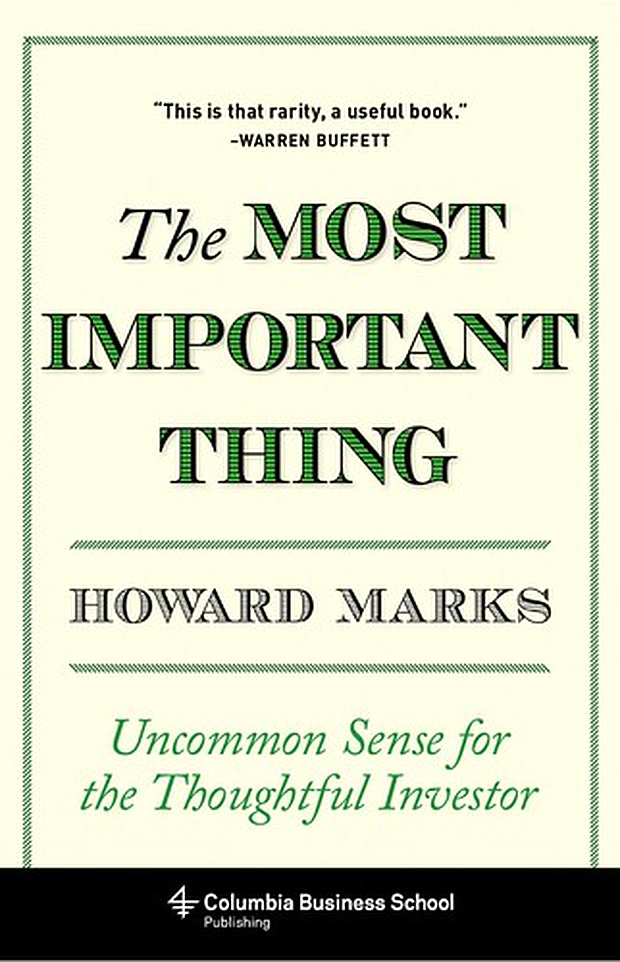
The Most Important Thing
Get on Amazon →
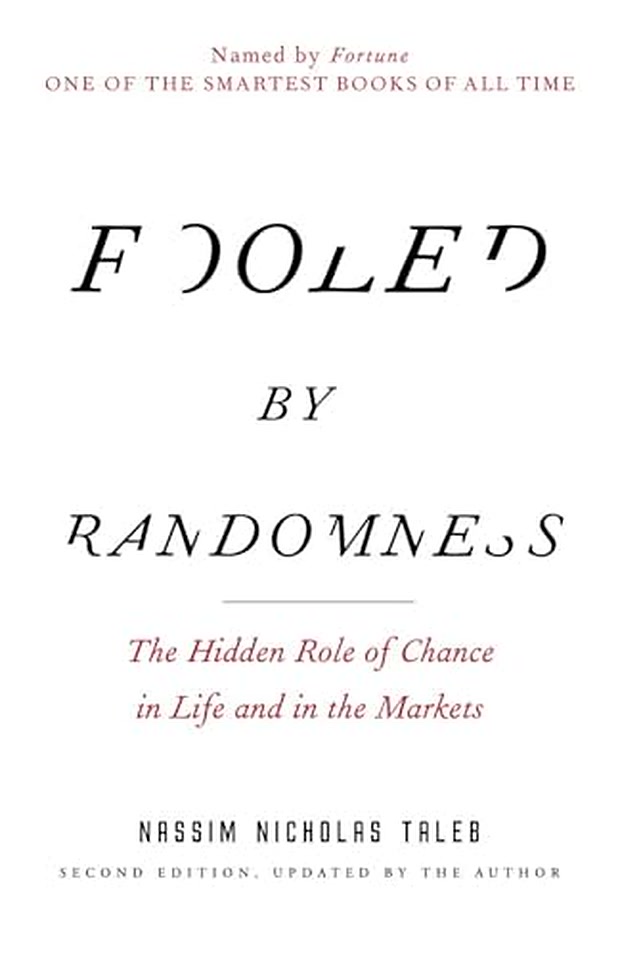
Fooled by Randomness
Get on Amazon →
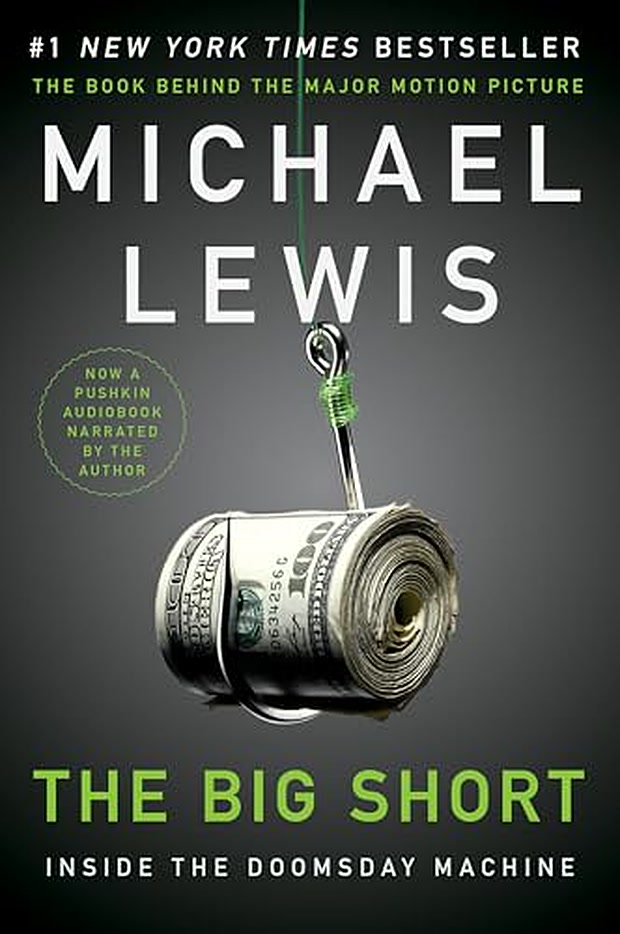
The Big Short
Get on Amazon →
As an Amazon Associate I earn from qualifying purchases.