What if Warren Buffett's billions came not from one brilliant trade, but from rolling a snowball the same way for eighty years?
This is The Snowball by Alice Schroeder, the definitive biography of Warren Buffett. It traces how one quiet, numbers-obsessed boy from Omaha built the greatest fortune in modern history.
The Metaphor

The book's central image is a snowball. Buffett describes life and wealth as a ball of snow rolling down a very long hill. To grow enormous, it needs two things, wet snow and a long slope. The wet snow is the money you save and the returns it earns.
The long slope is time, and starting early matters more than anything else. Because returns compound on top of returns, the greatest growth always happens near the very end. Small, steady beginnings and immense patience can build results that look impossible from the starting line.
His First Small Snowballs

That instinct appeared almost at birth. Growing up in Omaha during the Great Depression, the young Buffett was obsessed with numbers and with small businesses. He sold packs of gum and bottles of soda door to door, organized paper routes that essentially ran themselves, resold lost golf balls, and placed pinball machines in barbershops.
He kept meticulous records of every dollar and watched his small sums grow. These were not games to him. They were early lessons in capital, customers, and the quiet thrill of money working while he slept.
Graham and Munger

As a young man he studied under Benjamin Graham at Columbia, who taught him to buy stocks as pieces of real businesses and to demand a margin of safety. Graham's famous character, Mr. Market, taught him to treat the market's mood swings as opportunities rather than orders. Later, his partner Charlie Munger pushed him beyond Graham's habit of buying cheap but mediocre companies.
Munger argued that it was far better to pay a fair price for a wonderful business than a wonderful price for a fair one. Together, those two teachers set the course for everything that followed.
The Engine

The vehicle that supercharged his snowball was insurance. After Buffett bought the struggling textile firm Berkshire Hathaway and then a series of insurance companies, he gained access to float. This is the money customers pay in premiums long before any claims are ever paid out.
Berkshire could invest that money and keep the profits while it waited. The float acted like a vast, low-cost loan that grew decade after decade, funding his purchases of entire businesses and stocks. Understanding this engine explains how a small textile company became one of the largest companies on earth.
Whose Standards Do You Live By?
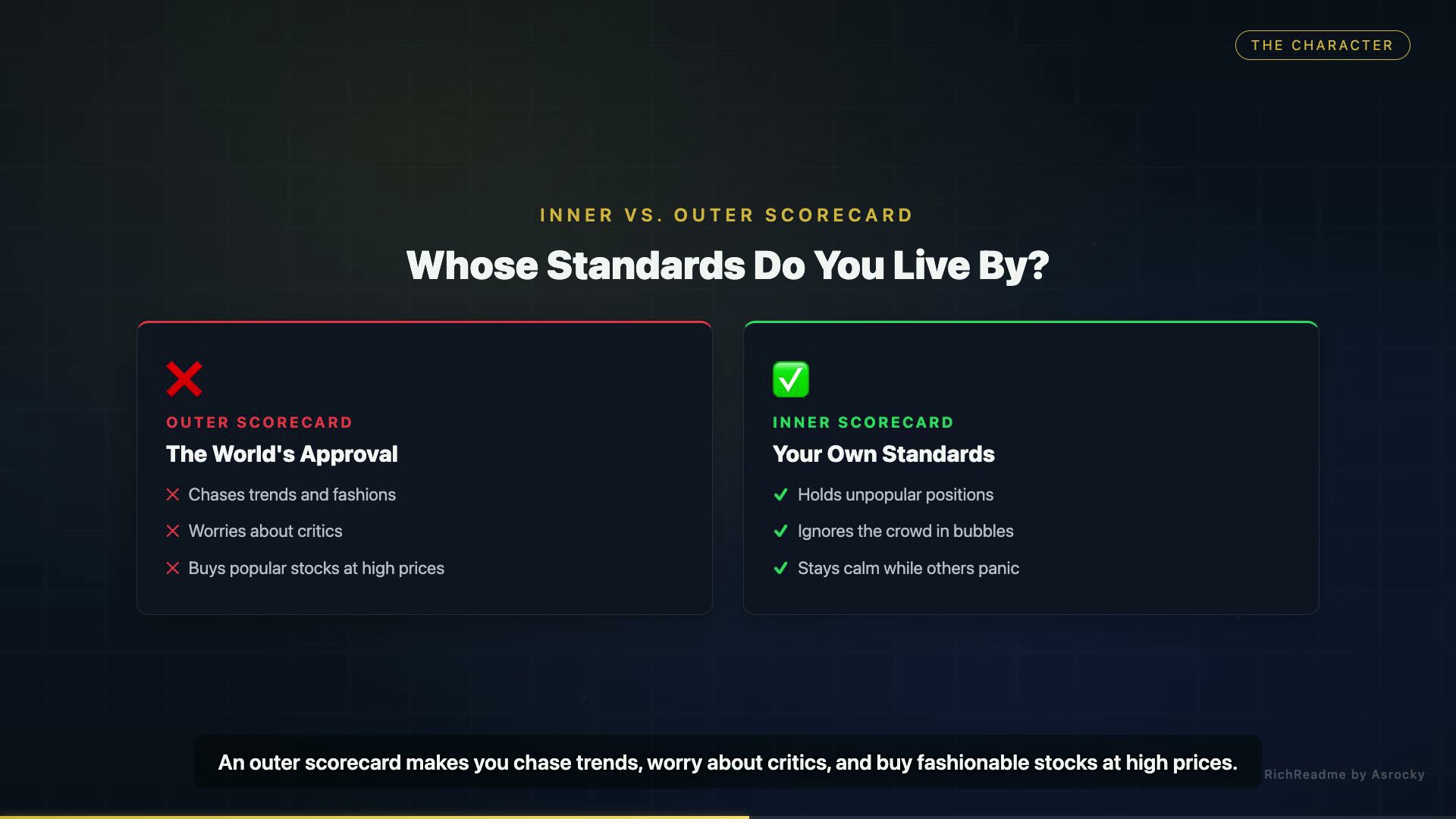
Perhaps his most personal principle is the inner scorecard. Buffett says people live by either an inner scorecard, judging themselves by their own standards, or an outer scorecard, judging themselves by what the world thinks of them. An outer scorecard makes you chase trends, worry about critics, and buy fashionable stocks at high prices.
An inner scorecard lets him hold unpopular positions, ignore the crowd during bubbles, and stay calm when everyone else panics. The question is simple. Would you rather be truly good and have everyone think you are poor at it, or be poor at it and have everyone think you are great?
Temperament
Buffett believes temperament matters far more than intelligence. You do not need a genius level IQ to invest well. You need the emotional discipline to stay rational when others are greedy or terrified, and the patience to hold a good business for decades.
He treats reputation as his most precious asset, noting that it takes twenty years to build and only five minutes to ruin. He still lives simply in the same Omaha house he bought in his twenties, driven not by luxury but by the game itself and by the compounding he finds endlessly fascinating.
Three Rules That Never Changed
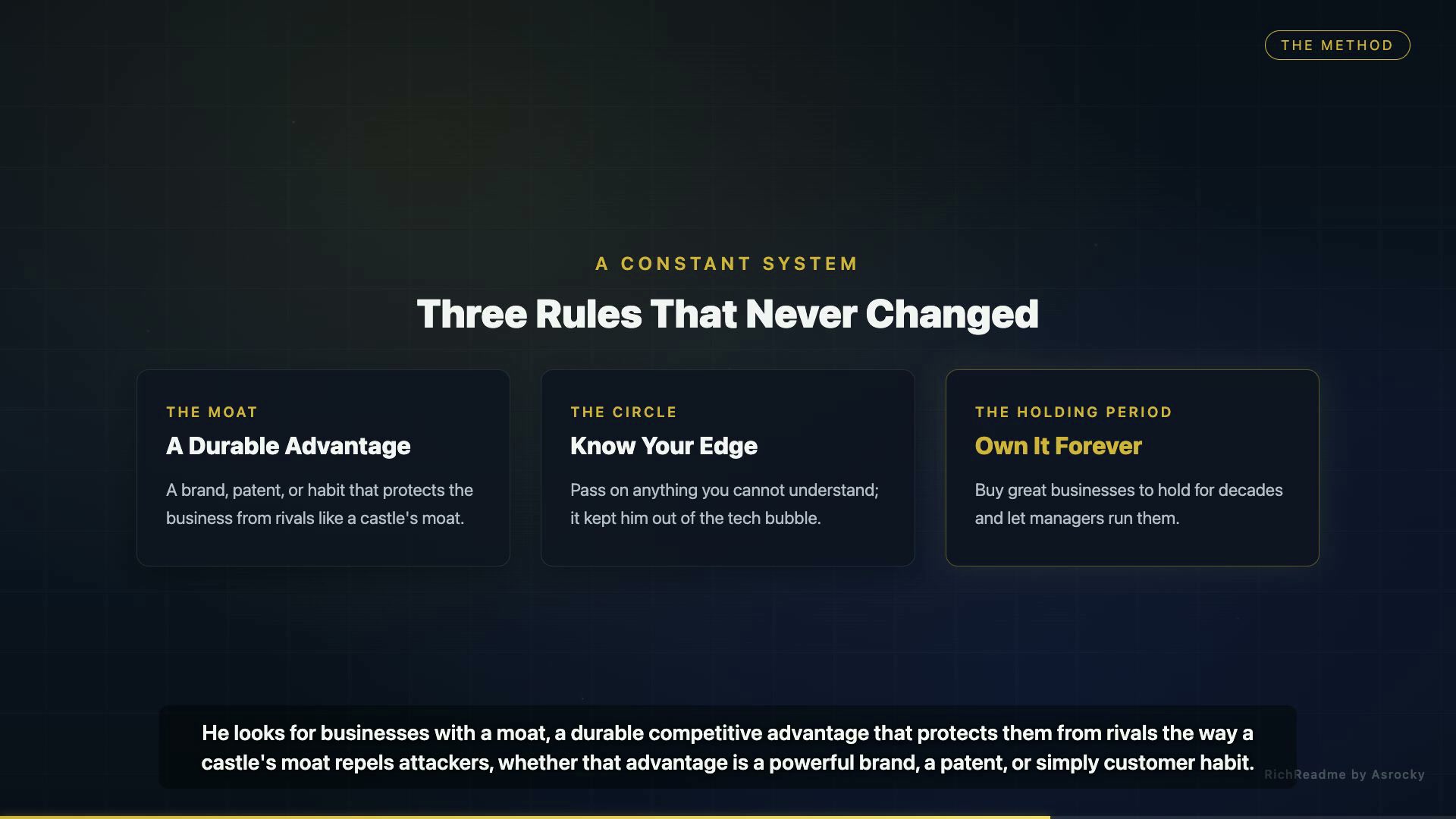
His investment method stayed remarkably constant. He looks for businesses with a moat, a durable competitive advantage that protects them from rivals the way a castle's moat repels attackers, whether that advantage is a powerful brand, a patent, or simply customer habit. He stays strictly inside his circle of competence, passing on anything he cannot understand, which famously kept him out of the entire technology boom and bust. He buys to own for years, often forever, and lets excellent managers run their companies without interference.
From Accumulator to Giver

Late in life, the man who spent decades accumulating wealth turned to giving it away. He pledged the vast majority of his fortune to the Gates Foundation and other charities, arguing that once his children had enough to do anything they wanted, giving them billions more would do them no good. For him, the snowball was never simply about luxury.
It was a scorecard for a life of discipline and rationality, and its final purpose was to flow back into the world. Wealth, in his view, is a tool to be deployed wisely, not a trophy to be hoarded.
Three Habits to Borrow

You can borrow three habits from his life. Start your own snowball now by saving and investing early, because the time you add matters more than the amount you add. Define your circle of competence and write down why you own each investment, questioning anything you cannot explain. And build an inner scorecard, making financial decisions from your own written plan rather than from headlines and friends.
You will never build Berkshire, but the same wet snow and long hill are available to anyone who begins. If this made compounding and patience feel more powerful than chasing the next hot stock, hit like and subscribe. The full book is linked below. Congratulations on finishing this book!
📖 Want the full book?
Get The Snowball on AmazonDisclosure: This post contains affiliate links. If you buy through them, I earn a small commission at no extra cost to you.