A tulip bulb once cost a whole farm. A month later, it was worthless. This is the madness of crowds.
The Classic
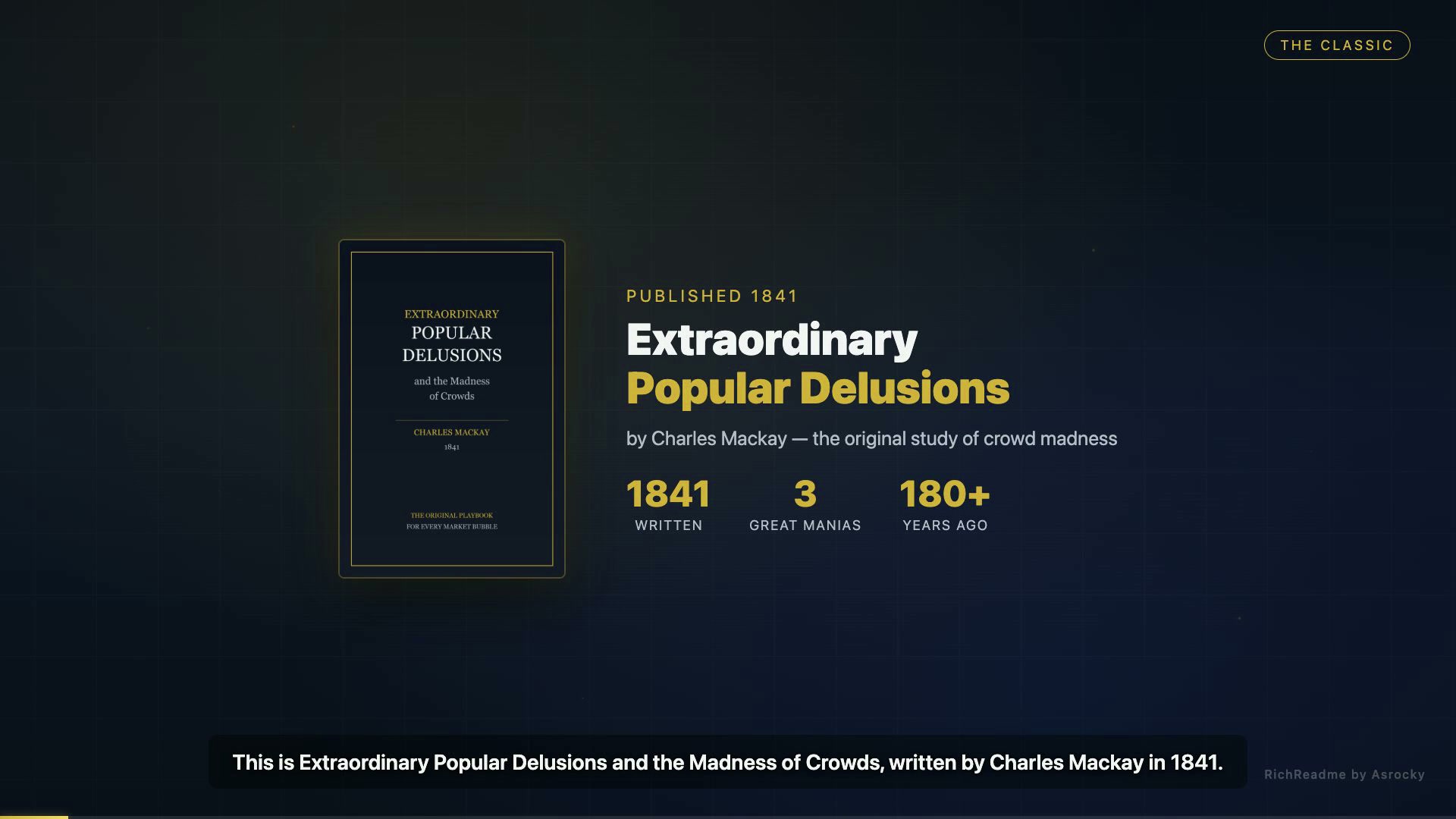
This is Extraordinary Popular Delusions and the Madness of Crowds, written by Charles Mackay in 1841. Today I will show you the manias that broke the world, and why they still happen today.
Tulip Mania
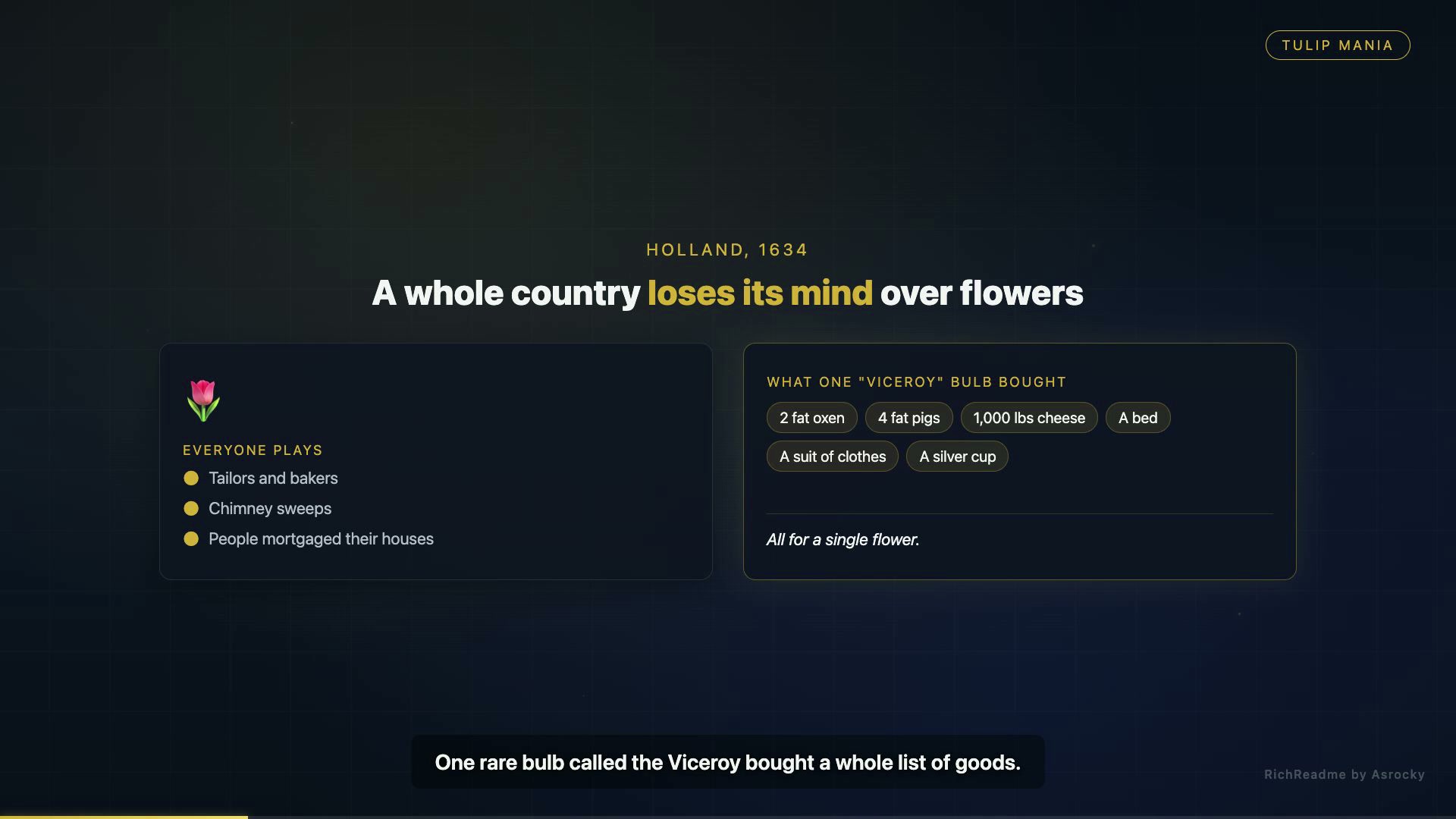
Let us start with the tulips. The flower came to Europe from Turkey around 1550. At first, rich people just liked the way it looked. Then something snapped. By 1634, the whole country of Holland was obsessed. Tailors, bakers, chimney sweeps, everyone was trading tulip bulbs. People mortgaged their houses to buy a single root. The prices sound insane. One rare bulb called the Viceroy bought a whole list of goods. Two fat oxen. Four fat pigs.
A thousand pounds of cheese. A bed. A suit of clothes. All for one flower. The most famous bulb, the Semper Augustus, was priced at six thousand florins. That was more money than a craftsman earned in his entire lifetime. Here is the best story. A sailor walked into a merchant's shop, saw a bulb that looked like an onion, and ate it for breakfast with his herring. He had just eaten a fortune. The merchant nearly fainted. Then it ended.
Peak & Crash

One day in 1637, buyers simply vanished. Nobody wanted tulips anymore. A bulb that cost six thousand florins could be sold for fifty.
People who bet everything were wiped out overnight. Holland was not alone.
South Sea Bubble
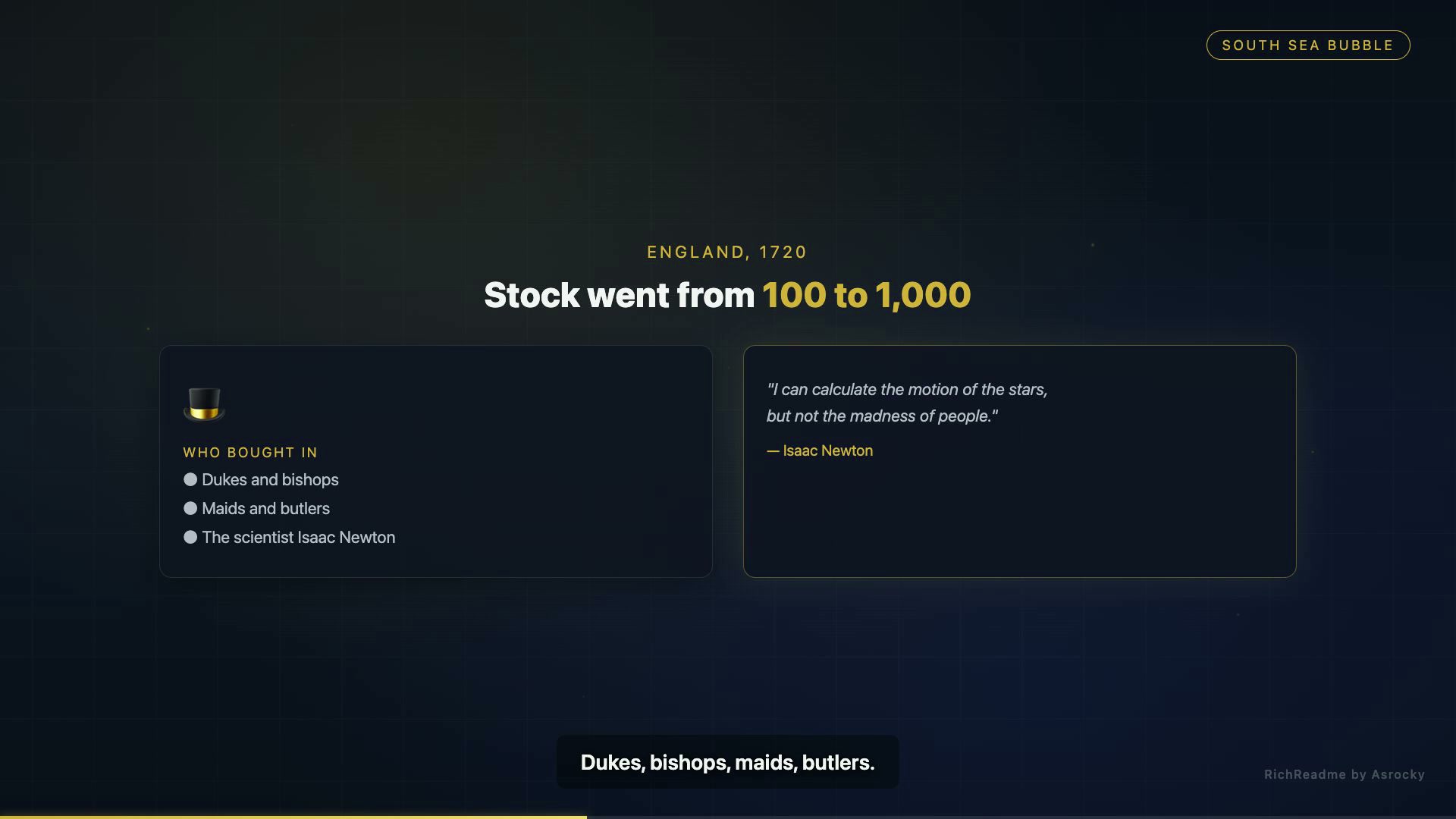
In 1720, England went crazy over the South Sea Company. It promised riches from the gold mines of South America. Stock went from one hundred pounds to over a thousand. Everyone got in. Dukes, bishops, maids, butlers. The scientist Isaac Newton bought in.
He later said he could calculate the motion of the stars, but not the madness of people. The craziness got ridiculous. Dozens of fake companies popped up. One promised an undertaking of great advantage, but nobody to know what it is. People invested anyway. Then the bubble burst.
The Burst

South Sea stock crashed back down. Newton lost twenty thousand pounds, a fortune in today's money. He spent the rest of his life refusing to hear the word.
Mississippi Scheme
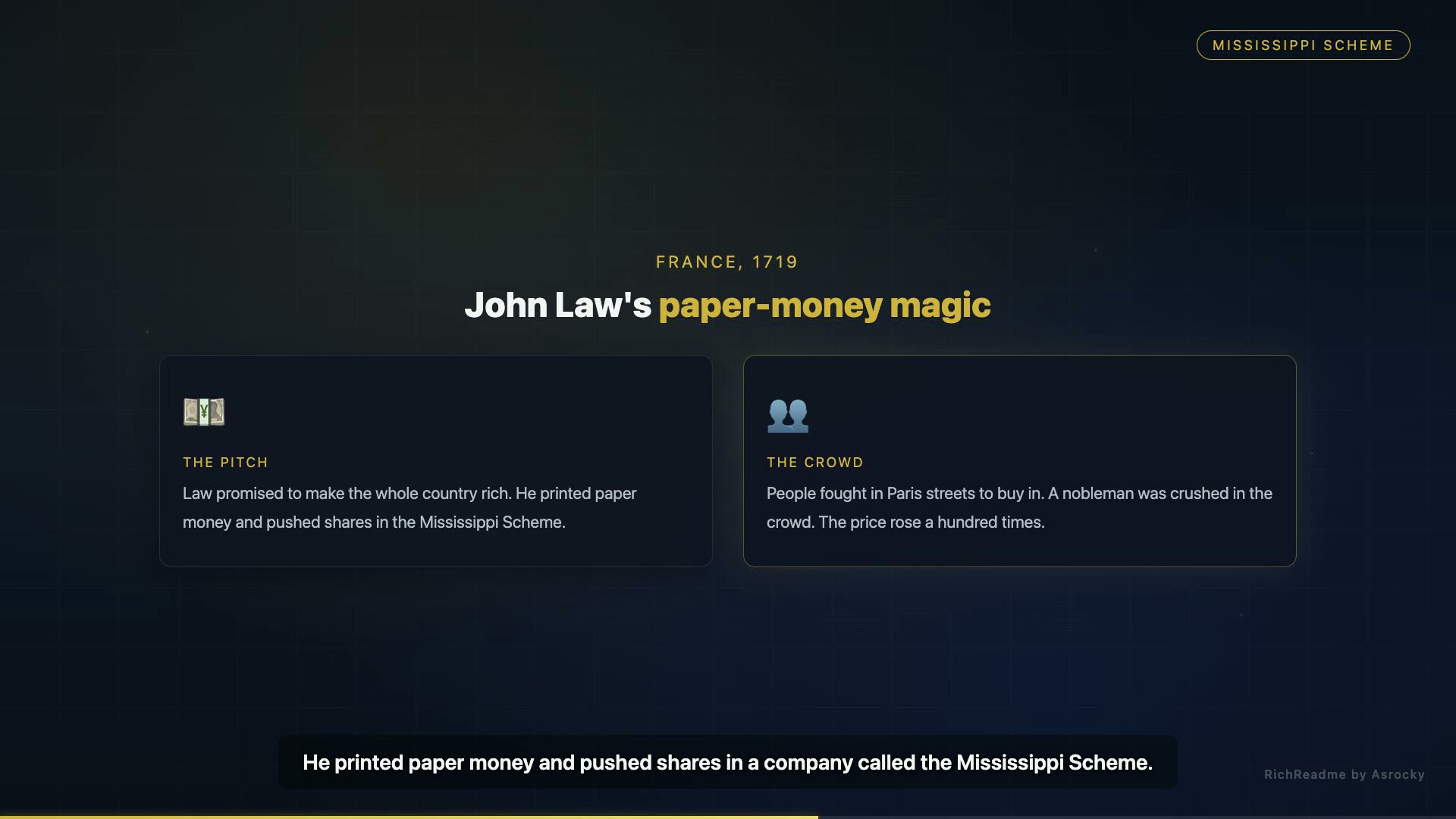
And across the channel, France did it even bigger. A man named John Law promised to make the whole country rich. He printed paper money and pushed shares in a company called the Mississippi Scheme. Paper shares rose faster than anyone had ever seen.
In Paris, people fought in the streets to buy a piece of Law's magic. A nobleman was crushed to death in the crowd. The price went up a hundred times. But the paper had no real gold behind it.
The Crash

When people finally tried to cash out, the whole thing collapsed. The money became worthless. France was left broke and angry.
The Pattern

So what actually happened in all three? Here is the pattern. A story grabs people. Prices start rising. Then people stop asking what actually worth. They buy only because the price went up yesterday.
They figure someone else will pay more tomorrow. Economists call this the greater fool theory. You do not need value. You just need a bigger fool behind you. Mackay said it best. People think in herds.
Mackay's Law

They go mad in herds. And they only wake up slowly, one person at a time, after the crash. The book's most famous line is worth repeating.

Men think in herds. It will be seen that they go mad in herds, while they only recover their senses slowly, and one by one. So how do you avoid being the fool?
Protect Yourself

First, ask the boring question. What is this thing actually worth, on its own? Not what someone paid last week.
Second, be suspicious when a rising price becomes the whole story. If your only reason to buy is that it is going up, you are playing the greater fool game. Third, watch the room.
The Signal

When taxi drivers and bakers give you stock tips, the smart money is already walking out the door. Mackay's book is almost two hundred years old, but nothing has changed.
The Lesson

Dot-coms. Crypto. Every new mania is just tulips in a new costume. The lesson is simple.
Prices can stay crazy longer than you can stay solvent. Do not confuse a rising price with a smart idea.
📖 Want the full book?
Get Extraordinary Popular Delusions and the Madness of Crowds on AmazonDisclosure: This post contains affiliate links. If you buy through them, I earn a small commission at no extra cost to you.